Tuesday, 19 August 2025 — Karlof1’s Political Gymnasium
Putin Interview snippet, result of dog club meeting at White House. and phone call readout.
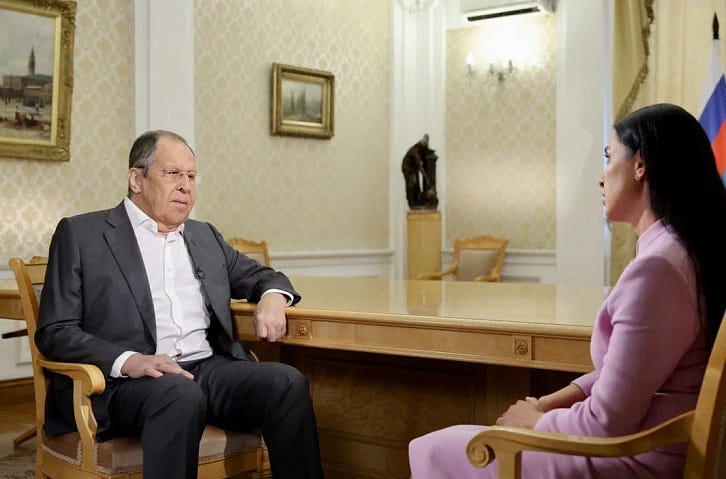
Before we get to the interview transcript, I want to inform readers that Putin gave an interview last Sunday to Russia-1 TV journalist Pavel Zarubin for which there’s no transcript provided by the Kremlin—Again!! However, the announcer of that event, RT, did publish an article with a few of its own chosen snippets from the interview. Here are the important passages, the rest is inconsequential as you’ll discover when reading the rest at the link:
It has been decades since Europe last had strong politicians capable of forming opinions independently from Washington, Putin said, referring to the era of former French President Jacques Chirac and German Chancellor Gerhard Schroder. However, in recent years, the EU’s policies have been steered by “political small fries” who lack education and ability, Putin asserted. He noted that these individuals have “happily carried out any order from the president in Washington under Biden,” but “got confused when Trump suddenly won” the November election.
“They just don’t like Trump, they actively fought him, interfered in political life, in the US election… Trump has different ideas about what is good and what is bad, including in gender policy, in some other issues, and they don’t like it,” Putin said. He believes, however, it won’t be long until the EU once again follows orders from Washington.
“I assure you, Trump, with his character and persistence, will restore order quite quickly. And all of them, you’ll see, soon all of them will stand at the master’s feet and gently wag their tails,” Putin argued. [Emphasis Original]
And as we saw with the European posse’s meeting with Trump yesterday, Putin’s imagery was close to being 100% correct. At Moon of Alabama, b cited one observer who provided an excellent review:
The plan is for the US to sell weapons to the Europeans, who will then provide them to Kiev. However, the US doesn’t have the weapons to sell, the Europeans don’t have the money to buy, and Kiev doesn’t have the soldiers to use them. Other than that it’s a foolproof plan.
There’ve been some overt leaks that clearly don’t jibe with Russia’s position which were provided by Mr. Witkoff and others to the Sunday propaganda programs on US BigLie Media—leaks that have become a trademark of Team Trump’s throwing bones to his opposition as we’ve seen many times over his second term. The upshot appears to be another meeting between the Russian and Ukrainian negotiators before the end of August. Now for Lavrov’s twenty-two-minutes:
Question: It’s a pity that you’re not wearing a USSR sweatshirt today.
Sergey Lavrov: I think that this has made a sensation out of it. There is nothing unusual. We have a lot of products that reproduce Soviet symbols. I don’t see anything shameful in this. This is part of our life, part of our history – this is our Motherland, which has now taken the form of the Russian Federation and is surrounded by former Soviet republics and friendly countries. Of course, there are various conflicts of interest. This is life.
I think it’s fashion, if you will. I saw that after the summit in Anchorage, young people who study here at Moscow State University and other institutions demonstrated these sweaters. It seems to me that there is no question of any “imperialism” or any attempts to revive “imperial thinking” here. It’s about what history is. This story should be kept, including with a sense of light humor.
Question: Did the American side note your appearance?
Sergey Lavrov: Yes, without any hysterics, they just said that they liked this “shirt,” as US Secretary of State Marco Rubio put it.
Question: In general, what was the atmosphere like?
Sergey Lavrov: There was a very good atmosphere there. It is reflected in the statements made by Presidents Vladimir Putin and Donald Trump after the talks. Useful conversation.
It was unequivocally clear that the head of the United States and his team, firstly, sincerely want to achieve a result that will be long-term, sustainable and reliable. Unlike the Europeans, who at that time were repeating on every corner that they only accepted a ceasefire, and after that they would continue to supply Ukraine with weapons.
Second, both US President Donald Trump and his team clearly understand that there are reasons for this conflict and that the talks that some European presidents and prime ministers are having about Russia attacking Ukraine unprovoked are all childish talk. I can’t find another word. The main thing is that they continue to say so to this day. As their meeting with US President Donald Trump in Washington, where Vladimir Zelensky was summoned showed, they continue to demand an immediate truce. At least some of them, such as German Chancellor Frank Merz, continue to say that it is necessary to “put pressure” on Russia with sanctions. None of these “gentlemen” even mentioned the phrase “human rights”.
When they discuss any foreign policy topic regarding countries led by people who are not from their “camp”, not from the “camp” of neoconservatives, neoliberals, be it Venezuela, China, Russia, even now Hungary, and many other countries, they necessarily put the demand to ensure human rights within the framework of the “rules-based world order” at the forefront.
If you look retrospectively at what they have said about Ukraine over all these years, you will never find the phrase “human rights.” Although a complete ban on the Russian language in all spheres of human activity should probably cause indignation among these “guardians of democratic principles.” Nothing of the kind. The fact that this is the only country in the world where any language is banned also does not bother anyone. When they say that they will probably have to agree to an exchange of territories (one of them said this). First, this should be decided by Vladimir Zelensky himself. Secondly, they say, they will deploy a peacekeeping operation, armed forces in the form of peacekeepers. What does this mean? The fact that they entrust the solution of the issue of ensuring human rights to the very “character” under whom laws were adopted that exterminate the rights of Russian speakers – language, education, access to the media in Russian, norms that exterminate the right to one’s religion, when the law was adopted, in fact, banning the canonical Ukrainian Orthodox Church.
That is, they believe that it is this person who should ensure agreements with Russia as he pleases. No one says that it would be nice for this person to repeal these laws before going to negotiations. At least because there is a UN Charter that states that it is necessary to ensure respect for human rights regardless of race, gender, language or religion.
From the point of view of language and religion, the UN Charter is grossly violated in Ukraine. Let’s not forget that Vladimir Zelensky said in Washington that he was ready to negotiate, but he would not even discuss any territories, because the Constitution forbids him. This is an interesting point, because, funny as it may seem, the Ukrainian Constitution, despite the adopted laws prohibiting the Russian language in all spheres of human life and activity, still retains the obligation of the state to fully ensure the rights of Russians (this is highlighted separately) and other national minorities. If he cares so much about his Constitution, then I would start with its first articles, which enshrine this very obligation.
But it has long been known that all these circumstances were swept under the rug by various figures (Ursula von der Leyen, Emmanuel Macron, Christopher Starmer, François Merz, and before him Olaf Scholz). Of course, Joe Biden and his administration were among the leaders in ignoring and distorting all the facts that lie at the heart of the Ukrainian crisis. It is indicative that these European delegates, who accompanied Vladimir Zelensky as a support group in Washington on August 18 of this year, spoke about the need to do something, to move forward, clearly reacting to the fact that US President Donald Trump and his team (especially after the meeting in Alaska) began to take a much deeper approach to the settlement of the Ukrainian crisis, realising that it is necessary to eliminate the root causes, which we, President of Russia Vladimir Putin, we have been talking about it all the time.
One of these root causes is Russia’s security concerns. It is related to the fact that for decades they have consistently grossly violated their obligations to prevent NATO’s eastward expansion. President of Russia Vladimir Putin has noted several times that after these promises there were five waves of the alliance’s expansion. When they say that it was promised orally, then nothing of the kind. This was promised on paper in the form of political declarations signed at the highest level at the OSCE summits in Istanbul in 1999 and in Astana in 2010. It says that security is indivisible, no one has the right to strengthen his security at the expense of others. NATO did just that. No one, including any country, any organisation has the right to claim dominance in the OSCE area. They did exactly the opposite. This is from the devil when they say that they said something verbally. First of all, the word is not a sparrow. Secondly, there is not only documentary evidence of the negotiation facts, but also documents signed at the highest level.
When these delegates in Washington said that it was necessary to start with the development of security guarantees for Ukraine, but at the same time security guarantees for Europe (British Prime Minister Christopher Starmer and others spoke about this), no one once mentioned Russia’s security. However, the OSCE document I quoted (universally drafted and adopted by consensus) requires security in a form that suits everyone.
To this day, an arrogant attitude towards international law, towards those promises that are often given falsely and fixed on paper, can be felt in the approaches of these citizens to the current Ukrainian crisis. Without respect for Russia’s security interests, without full respect for the rights of Russians and Russian-speaking people living in Ukraine, there can be no talk of any long-term agreements, because these are the reasons that need to be urgently eliminated in the context of a settlement.
I repeat that the summit in Alaska allowed us to see that the American administration is sincerely interested in ensuring that this settlement is not for the sake of preparing Ukraine for war again, as was the case after the Minsk agreements, but that this crisis never happens again, so that the legitimate rights of all states that are located in this part of the world are ensured. and all the peoples who inhabit these states.
This understanding was confirmed during yesterday’s telephone conversation between President of Russia Vladimir Putin and President of the United States Donald Trump, who called our leader to tell him about his contacts with Vladimir Zelensky and with this European support group.
Question: One of the representatives of “European support”, President of Finland Mr. Stubb, drew an analogy between the current situation in Ukraine and the 1944 war, when Finland gave up part of its territories. How do you understand this?
Sergey Lavrov: There are other parallels as well.
For many decades after World War II, Finland enjoyed the best conditions for economic growth, solving social problems, ensuring the well-being of the population largely due to the supply of Russian energy resources and in general due to cooperation with the USSR, and then with the Russian Federation, including in the context of a very profitable application of the efforts of Finnish business on our territory. The benefits that Finland received due to these special relations with our country (special due to the fact that it decided on neutrality) were simply thrown into the “garbage pit” overnight.
This makes you think about the following. In 1944, Finland, which fought on the side of Nazi Germany, on the side of the Nazi regime, whose military units participated in many war crimes, signed agreements with the Soviet Union.
President of Finland Alexander Stubb recently quoted this. I know him well; he was the Minister of Foreign Affairs. They signed a treaty that stated eternal neutrality, that no one–-neither the Soviet Union nor Finland–-would ever join structures directed against the other contracting party. Where is all this?
Now they have joined the structure that considers Russia an enemy. Therefore, if he is referring to the territorial changes that took place as a result of World War II, yes, this is one of its results. Territorial changes are often an integral component of reaching agreements. There are many such examples.
In this case, I want to emphasize once again that we have never talked about the need to seize any territories. Neither Crimea, nor Donbass, nor Novorossiya as territories have ever been our goal. Our goal was to protect the Russian people who had lived on these lands for centuries, discovered these lands and shed blood for them. Both in Crimea and in Donbass, cities were created – Odessa, Nikolaev, many others, ports, plants, factories.
Everyone is well aware of the role played by Catherine II in the development of these lands. Everyone is well aware of how these lands eventually ended up first as part of the Ukrainian SSR, and then as part of independent Ukraine. They became part of independent Ukraine on the basis of the Declaration of National Sovereignty, which the Kiev leadership adopted in 1990, which clearly stated that Ukraine would forever be a nuclear-free, neutral, non-aligned state. It was this obligation that formed the basis for the international recognition of Ukraine as an independent state.
If now the Zelensky regime rejects all these characteristics, talks about nuclear weapons, joining NATO, and renouncing neutrality, then the provisions that underpinned the recognition of Ukraine as an independent state disappear. It is important to pay attention to this. Otherwise, it turns out that the decisive role will again be played not by the principles of international law, but by the very “rules” that the West has never formulated anywhere, but invents them from time to time, when it needs to admit something, it does it, when it needs to condemn in a similar situation, it also does it. It won’t work that way anymore.
I would like to say again that we appreciate the understanding shown by the US administration, unlike the Europeans, which sincerely seeks to get to the heart of the problems and resolve the root causes of the crisis that the West, led by the previous Biden administration, created in Ukraine in order to use it as a tool to contain and suppress Russia and inflict, as they say, a “strategic defeat.”
Question: Have you discussed the issue of sanctions with the US side? After all, for fuel, as the Americans said, they had to pay in cash.
Sergey Lavrov: You always have to pay for fuel. Cash or not; it doesn’t matter. These are costs that are always borne by the country whose leadership with the relevant delegation visits another state.
We did not discuss sanctions. Not only many experts, but also politicians and officials have repeatedly said that the lifting of sanctions can play a negative role. Because this can again instill in some areas of our economy the illusion that now we will overcome all the problems by returning to the schemes that were developed and implemented in the 1990s and early 2000s.
Many believe that this will negate the achievements that we have now achieved and that we now have in the field of strengthening our technological sovereignty and the need for key issues on which military, economic and food security depends, relying on our technologies. Don’t slam the door on cooperation, but don’t become dependent when we don’t have vital goods and technologies. On the whole, I think that the process is much more reliable and more promising than it was six months ago, when the Biden administration’s term of office ended.
Question: What to expect next? Will it be bilateral or trilateral talks?
Sergey Lavrov: We are not rejecting any form of work, either bilateral or trilateral. President of Russia Vladimir Putin has repeatedly spoken about this. The main thing is that any formats–-1+1, 1+2, multilateral formats, of which there are also many, including within the framework of the UN–-all these formats should be included not so that someone would write in the newspapers in the morning, or show it on TV in the evening, or gossip on social networks, trying to tear off the “propaganda foam”, but in order to step by step, gradually, starting from the expert level and then going through all the necessary stages, prepare summits. We will always support such a serious approach. Any contacts with the participation of top officials must be prepared extremely carefully.
Question: Can US President Donald Trump fly to Moscow this year?
Sergey Lavrov: As you know, he has an invitation. At a news conference in Alaska, President of Russia Vladimir Putin confirmed this invitation. If I remember correctly, US President Donald Trump said that this was very interesting.
It will be interesting for everyone. [My Emphasis]
Lavrov is quite correct to emphasize the destruction of the three (he only mentioned two) OSCE Treaties that guaranteed Indivisible Security that I’ve written about on several occasions related to the legalities of this conflict. The Europeans are lying just as the Outlaw US Empire has done about them prior to this version of Trump. The work of the “devil” as Lavrov correctly stated. The noting of the constitutional hypocrisy by Zelensky is yet another excellent point as was the treaty between Finland and USSR. Lavrov was keen to say this is the deathbed for the West’s rule-based order—well, the knives are being inserted but the heart continues to beat somewhat like The Murder on the Orient Express. Lavrov also added a bit of information not included in the readout of the Trump/Putin call which follows:
Y. Ushakov: Dear Colleagues!
Half an hour ago, at the initiative of the President of the United States, a telephone meeting was held Conversation Between Donald Trump and Vladimir Putin. Our President warmly thanked my American counterpart for the hospitality and good organization of the summit in Alaska and for the progress made during the meeting towards a peaceful settlement of the Ukrainian crisis.
The US President, in turn, informed about the negotiations with Volodymyr Zelensky and the leaders of a number of European countries. During a further telephone conversation, Vladimir Putin and Donald Trump expressed support for the continuation of direct negotiations between the delegations of Russia and Ukraine.
In this regard, in particular, the idea was discussed that it would be necessary to study the possibility of raising the level of representatives of the Ukrainian and Russian parties, i.e. those representatives who participate in the above-mentioned direct Negotiations.
Characteristically, Vladimir Putin and Donald Trump agreed further to closely contact each other on Ukrainian and other topical issues international and bilateral agenda.
The President of Russia once again noted the importance of personal Donald Trump’s efforts to find solutions leading to a long-term settlement in Ukraine.
The conversation was frank and very constructive. [My Emphasis]
Until Western BigLie Media deletes the narrative it’s followed slavishly for years during and before the War started by Obama, little will be done to restore security in Europe as all the facts are on Russia’s side, while Eurocrats refuse to admit to any of those truths—and that includes the Ukrainians, not just Zelensky but the rest including Zalushny, Zelensky’s presumed replacement.
The way things now stand, I doubt very much that there will be any tripartite meeting in Beijing on 3 September between Xi, Putin and Trump. However, over the seven days ending August and into September there will be lots of important happenings—SCO Summit, Celebration of Chinese People’s War of Resistance Against Japanese Aggression, and then the Far Eastern Economic Forum. Also happening now is a meeting in India between Wang Yi and Indian Foreign Minister Subrahmanyam Jaishankar that also has key geopolitical implications. The resistance and rejection are both escalating, and although the progress seems slow it is very steady and will be very difficult for the Outlaw US Empire to halt.

 The New Dark Age
Leave a comment