29 August 2025 — The Dialectics of Destruction
Shenyang is home to nearly 8 million people. Why haven’t you heard of it? The answer is ideology.
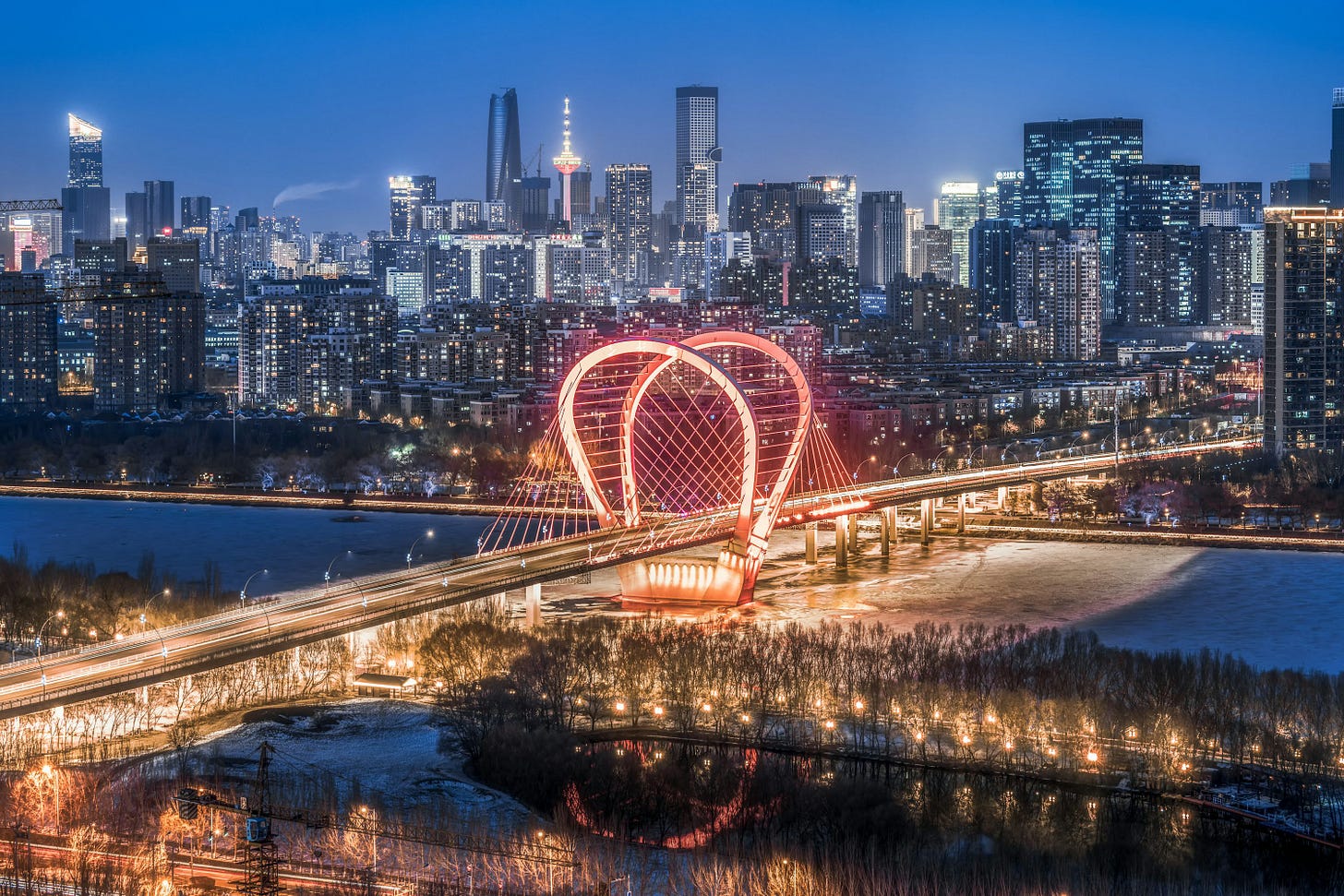
Have you heard of Shenyang?
With nearly eight million residents, it’s about the size of New York City. Yet for most people in the United States, the name barely registers. It doesn’t figure into school textbooks, isn’t featured in Western news coverage, and never appears in the popular imagination the way Beijing, Shanghai, or Shenzhen do.
And Shenyang isn’t alone. China is home to more than 160 cities with populations exceeding one million—compared to barely ten in the entire United States. Dozens of these cities are the size of Chicago, Los Angeles, or New York, yet remain invisible to the West. Why?
The answer lies not in ignorance, but in ideology.
The Scale of Urban China
To appreciate the enormity of China’s urban landscape, consider the following:
- Shenyang: 7.9 million
- Chengdu: 16 million
- Wuhan: 12 million
- Chongqing: officially over 30 million in its metro area
- Tianjin, Nanjing, Harbin: each larger than most European capitals
For comparison, the U.S. counts only a handful of cities above 1 million, and just one—New York—that reaches 8 million.
This disparity isn’t just about population growth; it’s about urban planning, industrialization, and the socialist transformation of China after 1949.
Shenyang as Case Study
Shenyang, located in northeast China, is no accident of geography. It grew as a planned industrial hub, specializing in heavy industry, defense, and machinery. Under Maoist development strategies, cities like Shenyang were fortified with state investment to serve as anchors of regional growth.
Unlike Western metropolises, which often expand around financial services, speculation, and real estate, Shenyang’s roots lie in the industrial proletariat—the workers whose labor produced steel, engines, and arms.
In other words: Shenyang is not a “global city” in the capitalist sense, but a socialist-industrial city.
The Marxist Lens: Ideological Erasure
So why does the West remain silent about these cities?
Marxist theory reminds us that ideology functions to obscure reality in service of ruling-class interests. Western media frames China through a narrow lens:
- Beijing: politics, authoritarianism
- Shanghai: capitalist spectacle, skyscrapers
- Shenzhen: tech capitalism, the “Chinese Silicon Valley”
This selective framing erases Shenyang, Wuhan, Harbin, Nanjing, Chengdu—cities tied to working-class labor rather than to financial spectacle.
The bourgeois press is not interested in showing how socialist-led development produced entire metropolises out of what were once provincial towns. To admit this would undermine the myth that only capitalism creates prosperity and urban modernity.
The Rapid Pace of Socialist Urbanization
Consider the timeline:
- In 1949, China was overwhelmingly rural, devastated by war and colonial plunder.
- By the 1980s, industrial centers like Shenyang, Wuhan, and Chongqing had already become massive cities under socialist planning.
- Today, urbanization has lifted hundreds of millions into city life, producing dozens of “New York–sized” metropolises.
This was not the “natural” unfolding of market forces. It was the product of state planning, redistribution, and a developmental strategy centered on lifting entire regions rather than just a financial elite.
Western Hegemony and the Erasure of Scale
Why does this matter for us, as readers and comrades?
Because Western hegemony depends on obscuring China’s true scale. If the average American understood that China has dozens of cities the size of New York, the myth of U.S. superiority would collapse.
The invisibility of Shenyang is therefore not a mistake. It is part of the ideological project of imperialism: to render invisible the achievements of socialism and to frame China only through images that serve capital—whether that’s Shanghai’s skyline or alarmist headlines about “ghost cities.”
Breaking the Imperialist Lens
To study Shenyang is to see how much we’ve been denied by Western narratives.
The question “why haven’t I heard of this city?” must be answered with:
Because the capitalist world-system doesn’t want you to.
Learning about Shenyang, Chengdu, Wuhan, or Harbin is not just about geography. It is about developing a proletarian internationalist consciousness—one that sees beyond the maps drawn by imperialist media and recognizes the lived realities of millions.
What We Can Learn
- Scale Matters. China’s cities reveal the vast scope of socialist transformation.
- Erasure is Ideological. The invisibility of Shenyang is not ignorance; it is deliberate.
- Urbanization as Struggle. Every skyscraper, every metro line, every industrial district is a result of collective labor and political choices—not some neutral “market force.”
To recognize these truths is to dismantle the myths of capitalist superiority.
Conclusion: Knowledge as Solidarity
China’s “hidden” megacities are not hidden at all—they are erased. To learn them, to say their names, to study their histories, is to challenge imperialism at its roots.
As comrades, our task is to see the world as it truly is, not as capital wants us to see it. That means reading beyond the headlines, engaging with Marxist analysis, and recognizing the global working class as our horizon.
The next time someone says, “China only has Beijing and Shanghai,” remind them of Shenyang. Remind them of Wuhan. Remind them of Chengdu and Chongqing. Each one a city of millions. Each one proof that another world is possible.
Knowledge is solidarity. ✊
Sources
- UN World Urbanization Prospects: https://population.un.org/wup/
- World Bank Urbanization Statistics: https://data.worldbank.org/indicator/SP.URB.TOTL.IN.ZS
- National Bureau of Statistics of China: http://www.stats.gov.cn/english/
- Giovanni Arrighi, Adam Smith in Beijing (2007)
- David Harvey, A Brief History of Neoliberalism (2005)
- Monthly Review: Urbanization and the Political Economy of China
- Qiao Collective: https://www.qiaocollective.com/
- David Harvey Lectures: http://davidharvey.org/
For three decades, I worked inside multinational projects across Eastern Europe, Africa, the Middle East, and Asia—often tied to the machinery of U.S. imperial power. What I saw convinced me: no “reform” can sanitize a system built on exploitation.
Now I write from a Marxist lens—not as an armchair theorist, but as someone who has seen how capital moves, how states fracture, and how resistance is criminalized. Theory makes sense of lived reality—and helps us chart a way out.
On this Substack, I dig into the real structures behind today’s crises: NATO expansion, AFRICOM, neocolonial “development,” and the contradictions of 21st-century capitalism. No moralizing, no liberal hand-wringing—just materialist critique of empire.
If you’re ready to go beyond the headlines and grapple with empire as a system to be dismantled—not managed—this is for you.

 The New Dark Age
Leave a comment