Saturday, 8 November 2025 — Weaponized Information
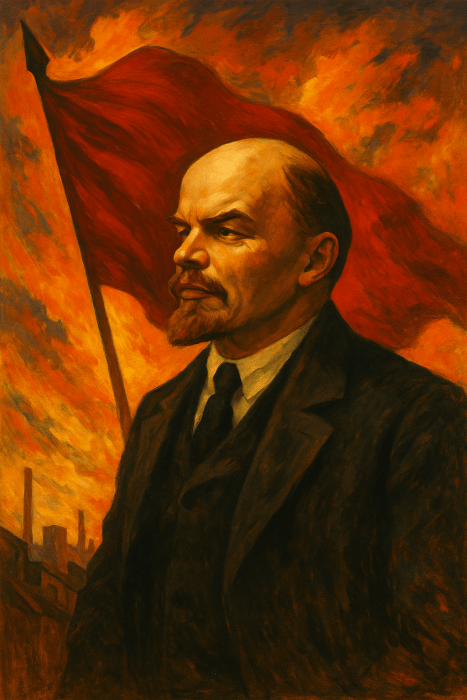
By Prince Kapone | Weaponized Intellects Book Review — October Revolution Series | November 8, 2025
Excavating Lenin from His Detractors
There is something poetic about the fact that one of the earliest full-length biographies of Lenin in English was written not by a loyal communist, but by a defector who had once shared rooms with revolutionaries and later found refuge in the empire Lenin swore to destroy. David Shub’s Lenin: A Biography (1948) is a strange, contradictory creature—half witness, half prosecution, born in the shadow of the Cold War yet still carrying the scent of the barricades. Shub knew Lenin. He studied him. He even admired him—until history demanded that admiration be recast as testimony for the prosecution. The result is a document that cannot help but betray itself. For buried beneath the liberal moralizing and the psychoanalytic chatter is something Shub never quite manages to extinguish: a grudging awe for the mind that restructured the world.
That is precisely what makes this book worth returning to—not as scripture, but as evidence. In the same way a rusted weapon can still reveal the metallurgy of its making, Shub’s biography offers a cross-section of the contradictions that Lenin himself spent a lifetime dissecting. The bourgeois historian cannot help but recoil from dialectics because it makes his world transparent. Every page of Shub’s account trembles before the inexorable logic that animated Lenin’s life: that no society built on exploitation can reform itself, and no ruling class will surrender without being forced. For Shub, that conviction makes Lenin “fanatical.” For us, it makes him a scientist of revolution.
Lenin’s greatness lies not in myth but in method. He was the first modern revolutionary to treat history as a living laboratory—where theory was not commentary but strategy, and consciousness was not abstract thought but organized power. The intellectuals of his time wrote essays about the “social question.” Lenin built the machinery to solve it. Shub’s narrative cannot fathom that kind of intellect: one that moves between philosophy and factory, between the pages of Capital and the mud of the trenches, with the same precision. To the liberal mind, that unity of thought and action is impossible; to the proletarian, it is the only path to liberation.
The Cold War historians who came after Shub inherited his tone but not his proximity. They turned Lenin into a caricature—the cold ascetic in a dark suit, the man who traded human warmth for power. What they never grasped is that Lenin’s so-called “coldness” was the discipline of a class at war. He loved the working class too deeply to lie to it. He refused to substitute sentiment for struggle. That is why Lenin could speak with equal clarity to the factory worker in Petrograd and the colonized peasant in Bengal. He was the first leader of the industrial age to think globally without succumbing to imperialism, to see the Russian Revolution as the opening volley in a planetary insurrection of the oppressed. His was the mind that transformed Marxism from critique into combat.
To read Shub against the grain, then, is to witness the emergence of what might be called the first guerrilla intellectual of the modern era. Lenin’s pen was a rifle disguised as a fountain pen. His articles were operations. His party was an insurgent network of disciplined militants, armed with consciousness instead of bullets but aiming just as precisely. This is what terrified Shub and his class successors: the possibility that intellect itself could be wrested from the bourgeoisie and turned into a weapon of the poor. They called it tyranny; Lenin called it revolution.
There is no need to romanticize him. Lenin was not a saint; he was better—he was a strategist. He was the most dangerous kind of human being: one who could see the system whole. From the penal colonies of Siberia to the streets of Petrograd, from his patient study of Hegel to the thunder of October, Lenin’s trajectory was not that of an ideologue seeking followers, but of a worker-scholar trying to perfect the science of liberation. Even in Shub’s reluctant retelling, that truth slips through every attempt at condemnation. The author’s disapproval becomes, unintentionally, an homage. For what other figure of the twentieth century forced the ruling class to build an entire century of propaganda just to contain his ghost?
To excavate Lenin from his detractors is therefore not an act of rehabilitation—it is an act of revolutionary continuity. Shub’s pages belong to the enemy archive, but we seize them as a partisan might seize an abandoned weapon. In our hands, this book becomes what Lenin would have demanded it to be: a tool. We do not read it to admire or to mourn, but to learn how one man, forged in the contradictions of empire, armed with nothing but theory, courage, and collective faith, split the world open and forced history to reckon with the working class as the maker of its own destiny. That is the Lenin we reclaim—the dialectician who made revolution into a science, and science into an instrument of human emancipation.
The Making of a Revolutionary Mind
To understand Lenin’s trajectory, we must first understand the world that made him necessary. Shub begins his account in the Volga town of Simbirsk, with a bright provincial student named Vladimir Ilyich Ulyanov, born in 1870 into a state that called itself eternal. Russia then was a feudal empire masquerading as a modern nation — a frozen society ruled by priests and police, where peasants still paid tribute to landlords and industrial workers labored under medieval laws. Into this stagnant world came a young man who refused to accept that the misery of millions was natural. The state killed his brother, Alexander, for plotting against the Tsar; it thought it had silenced a family. Instead, it created a revolutionary.
Shub, with the reflexes of the liberal exile, tries to read this through psychology: Lenin as the vengeful younger brother, driven by grief and guilt. But that is not the dialectic of history — that is the superstition of the therapist’s couch. What the death of his brother produced was not a wounded ego but an awakening intellect. Lenin’s genius was to turn personal tragedy into scientific understanding. He grasped what most radicals of his generation did not: that the Tsar was not an aberration, but the logical expression of class rule. You do not reform an empire built on slavery; you overthrow it.
By the time Lenin arrived in St. Petersburg, he had already rejected the moralism of the populists and the academic socialism of the liberals. He was not interested in pitying the poor — he intended to arm them. He studied law not to join the bureaucracy, but to understand the architecture of oppression from the inside. In every study circle and underground library, Lenin’s intellect took shape in dialogue with the living movement of workers, not in isolation. This was the soil of his dialectical materialism: not abstract philosophy, but the living contradictions of a society being pulled apart by the forces of industrial capitalism and feudal reaction.
Shub grudgingly admits Lenin’s “extraordinary capacity for organization,” yet misses the essence of that capacity — its moral source. Lenin’s discipline was not the cold calculus of ambition; it was an act of devotion to the working class. He understood that consciousness was not born in books but in struggle, that theory divorced from practice decays into scholasticism, and that a revolutionary who fails to organize the oppressed is merely a philosopher with good intentions. Every page of his early writings, from What the ‘Friends of the People’ Are to The Development of Capitalism in Russia, carries the mark of this insight: that the peasantry, the workers, the entire dispossessed class, were the raw material of a world waiting to be remade.
By the mid-1890s, Lenin’s life had already become indistinguishable from his politics. Arrest, exile, and censorship only deepened his understanding of power. He saw clearly that the Tsarist regime was not sustained merely by bayonets, but by ideology — by the ability of the ruling class to define what was “normal,” “reasonable,” and “possible.” To wage revolution was therefore to wage war against the mind of empire itself. The Bolshevik press, the party school, the pamphlet — these were not mere instruments of communication. They were weapons in a battle over reality.
Shub calls Lenin’s mind “unyielding.” He means it as a criticism. But history has another word for it: clarity. Lenin’s unyielding character was not stubbornness but method — the capacity to see the movement of history through its contradictions. He understood that ideas, like classes, develop through struggle. The liberals of his time dreamed of reforming Russia into a European constitutional state; the populists dreamed of peasant utopia; Lenin dreamed of the abolition of class society itself. That is the difference between rebellion and revolution — between moral protest and scientific socialism.
Even in exile, Lenin never romanticized poverty or suffering. He was not seduced by the rhetoric of martyrdom. He read, he organized, he planned — as though every page and every meeting were a rehearsal for power. And that is what separates him from the sentimental radicals of his generation. Lenin’s thought never drifted into despair, because it was rooted in motion — in the conviction that even the darkest period of repression was only a moment in a larger dialectical process. This was not optimism. It was the realism of a man who had learned, through study and through life, that history is not written by the victors until the defeated stop fighting.
By the turn of the century, Lenin had already become what he would remain until his death: a revolutionary of extraordinary patience and speed, capable of waiting for decades and then moving in an instant. He was a master of the dialectic because he lived it. He knew that change accumulates quietly until it explodes. In the pages of Shub’s biography, we see glimpses of this — despite the author’s own political limitations — and those glimpses are enough. They remind us that Lenin was not a product of chance or temperament, but of history itself: a mind forged in contradiction, a man in whom theory and practice found their unity.
Lenin did not invent revolution. He perfected it. He turned Marx’s analysis of capitalism into a strategy for its destruction. He turned the scattered anger of the oppressed into a disciplined weapon. And in doing so, he inaugurated a new era — one in which the working class could look upon the world, not as victims or subjects, but as its rightful architects. That, above all else, is the lesson buried beneath Shub’s ambivalence. The bourgeois historian writes to contain Lenin; the proletarian reader reads to release him.
The Birth of Bolshevism and the Science of Revolution
By the dawn of the twentieth century, Lenin had refined his method into something the bourgeoisie had no name for: the science of revolution. The scattered fragments of socialist thought that floated across Europe—the moral indignation of the populists, the economism of the social democrats, the theoretical Marxism of the academicians—he gathered and melted down into a single blade. That blade was the revolutionary party. Where others saw politics as debate, Lenin saw it as war. He did not fetishize violence, but he understood that the class struggle was violent by nature, whether or not its victims were armed. To the rulers of Russia, “law and order” meant starvation and submission; to Lenin, the only order worth maintaining was the order of revolutionary organization.
Shub tries to paint the early Bolsheviks as zealots intoxicated by authority, but what he mistakes for authoritarianism was actually the invention of a new form of discipline—the discipline of solidarity. In What Is To Be Done? Lenin demolished the myth that spontaneous rebellion could overturn a system built on centuries of coercion. The workers’ anger was necessary, but without direction, it could be absorbed, diverted, or annihilated. The party, as Lenin conceived it, was not a clique of intellectuals issuing decrees from above—it was the collective mind of the proletariat in motion, the mechanism through which the oppressed class became conscious of itself as a class. The vanguard was not an elite; it was the nerve system of the movement.
It is here that Shub’s liberal imagination collapses. To him, Lenin’s insistence on centralization is proof of a lust for control. He cannot see that in the context of repression, fragmentation meant death. A scattered revolutionary movement is a police report waiting to be written. Lenin understood that the struggle against the Tsar was not fought on an even field—it was fought against a state whose spies, prisons, and censorship could crush any isolated effort. Only a disciplined network, bound by principle and clarity, could survive and strike back. What Shub calls “dictatorship within the party” was, in truth, the first experiment in collective strategic intelligence—a living organism designed to outthink the empire.
And it worked. When the 1905 Revolution erupted, the Mensheviks hesitated, the liberals pleaded for moderation, and the Tsar’s generals prepared their gallows. The Bolsheviks, guided by Lenin’s analysis, turned defeat into instruction. From the blood of that failed uprising, Lenin distilled the concept of dual power—the recognition that the soviet, the workers’ council, was not a temporary committee but a new form of state. This was not theory for theory’s sake; it was the dialectic embodied in struggle. The revolution had revealed its own organs of self-rule, and Lenin had the courage to recognize them for what they were: the embryo of a new society gestating within the old.
Even in exile, Lenin’s political radar remained unmatched. From Geneva, from Zurich, from the frozen wastelands of Siberia, he analyzed each tremor in the world system with the precision of a surgeon. He read reports from German strikes, peasant movements in China, uprisings in Ireland, and the colonial resistance across Asia and Africa. Where the Western Marxists saw Europe as the center of history, Lenin saw the periphery as its engine. He understood that the struggle against imperialism abroad was inseparable from the struggle against capitalism at home. The chain of global exploitation could not be broken in its strongest link—it would snap at its weakest. And that insight, born from a dialectical analysis of world contradictions, would become the theory of revolution in the age of empire.
When the First World War erupted, every major socialist party in Europe betrayed its own principles, voting for war credits to slaughter their fellow workers. The Second International collapsed under the weight of patriotism and cowardice. Only Lenin and a handful of revolutionaries refused to bend. From exile, he declared that the imperialist war must be turned into civil war—that workers must not kill each other for the profits of their masters. For this, the bourgeois world branded him a monster. But history, once again, proved his sanity. Millions of soldiers would return from the trenches not as patriots but as revolutionaries, having seen the true face of their rulers. The Bolsheviks, alone among all parties, had told them the truth.
Shub presents this as opportunism, as if Lenin merely exploited chaos. But Lenin did not wait for history to hand him an opportunity—he studied its laws until he could recognize the opening when it came. In this lies the true nature of his dialectical genius: he could see motion where others saw only crisis. The same war that destroyed empires created the conditions for the working class to seize power. He was not guided by fortune, but by foresight. And when that moment came in 1917, he was the only leader in the world who both understood it and was prepared to act.
This was Lenin’s miracle—not of faith, but of analysis. While Shub’s bourgeois peers drowned in moral lamentations about the “collapse of civilization,” Lenin watched the old order implode under its own contradictions and saw, beneath the ruins, the shape of a new world struggling to be born. That is not fanaticism; it is historical consciousness. It is what distinguishes the revolutionary from the reformer, the dialectician from the dreamer. Where the reformer sees disaster, the revolutionary sees the dialectic in motion. Lenin was not content to interpret the world; he had the audacity to remake it. And that, comrades, is why even his enemies cannot speak of him without resurrecting the very force they wish to bury.
1917: The Dialectic of History Unfolds
By the time 1917 arrived, the contradictions of world capitalism had ripened to the point of rupture. The imperialist war had devoured Europe. Armies mutinied, cities starved, monarchies teetered. In Petrograd, workers poured into the streets, soldiers abandoned their posts, and peasants seized the land. The ruling class, in every form, had lost control. History was moving at a speed that terrified its custodians. And at the center of that maelstrom stood Lenin—the one man who had prepared his entire life for such a moment, who understood that revolution was not chaos but order emerging from the disintegration of the old.
Shub, like many Western chroniclers, portrays Lenin’s return to Russia as an act of cunning opportunism—the exile smuggled in by German gold, plotting to exploit his country’s collapse. It’s an old story, convenient for those who cannot accept that the oppressed could think for themselves. In reality, Lenin’s journey in the sealed train from Zurich to Petrograd was not the maneuver of a conspirator but the return of a strategist to the battlefield. He stepped off that train with the April Theses in his hands—ten short points that distilled an entire century of class struggle into a program for power. “No support for the Provisional Government. All power to the Soviets.” In that moment, Lenin transformed despair into direction. The masses had already begun to make history; Lenin gave their movement consciousness.
The brilliance of the April Theses lies not in its radicalism—though it was radical—but in its clarity. It was dialectical reasoning translated into political form. The February Revolution had overthrown the Tsar but preserved the property system; it replaced the autocracy with a bourgeois parliament draped in revolutionary slogans. Most socialists, terrified of being “premature,” urged patience and compromise. Lenin saw further. He understood that dual power could not endure: either the Soviets, organs of workers’ democracy, would seize the state, or the bourgeoisie would seize them. The revolution, having begun as bourgeois, could only survive by becoming socialist. This was not dogma; it was the logic of contradiction unfolding in real time.
What Shub calls “Lenin’s will to power” was, in truth, the will of the working class articulated through its most disciplined expression. Lenin did not impose the revolution; he recognized it. His genius was to trust the masses when all others doubted them. In the factories and the trenches, in the mutinies and peasant assemblies, he saw the embryonic organs of a new state—the Soviets—as the foundation for a new kind of power: the dictatorship of the proletariat. And he insisted that this dictatorship was not tyranny but liberation—the organized self-rule of the producers, the end of the dictatorship of capital disguised as democracy.
In Shub’s narrative, the October insurrection becomes a coup—a seizure of power by a small party manipulating chaos. But coups do not survive hunger, invasion, and civil war. Revolutions do. The Bolsheviks endured because they embodied the only force capable of holding the country together: the collective will of workers and peasants who had nothing left to lose but the chains around their throats. Lenin’s revolution did not overthrow the government to seize power for a party; it dismantled the entire social order that gave that government meaning. It was the most complete revolution in human history because it struck not just at rulers but at the logic of rule itself.
In the fevered months after October, as foreign armies surrounded the young Soviet Republic, Lenin moved with the calm of a man who had already studied catastrophe. His writings from 1917 to 1921—The State and Revolution, Can the Bolsheviks Retain State Power?, and The Immediate Tasks of the Soviet Government—read like field manuals in the science of transformation. They reveal a mind operating simultaneously on three fronts: destroying the old order, building the new, and theorizing the process in real time. Lenin was not improvising; he was applying a lifetime of preparation to the living test of power. Every revolution before him had been content to replace one set of rulers with another. Lenin’s revolution replaced the very machinery of domination.
Even Shub cannot suppress his astonishment at the speed of the transformation. In less than a year, the decrees on land, peace, and workers’ control shattered centuries of property relations. The banks were nationalized, the army democratized, the old state smashed. To the bourgeois world, it appeared as madness; to the proletariat, it was the first breath of history after suffocation. The imperialists of every nation invaded, the Mensheviks plotted, and famine stalked the land—but the revolution survived. Why? Because, as Lenin understood, material necessity is stronger than ideology. The people, having tasted their own power, would rather starve free than eat in chains.
This is the point where Shub’s liberalism collapses into bitterness. He cannot comprehend why the Russian working class followed Lenin, why they did not repent their revolution when hardship came. It is because, for the first time in modern history, they recognized themselves in power. The Soviets were not abstractions; they were the living form of proletarian democracy. Lenin, in guiding them, proved that socialism was not an ideal but a process—a science of class struggle, adjusted daily according to the contradictions of reality. He was not a prophet but a practitioner. That is why his revolution succeeded where all others had failed: because it was not the product of will alone but of method.
When Lenin fell ill, the revolution had already outlived its architects. The capitalist world waited for collapse. Instead, under Stalin, it consolidated and industrialized, turning a peasant country into a socialist fortress capable of defeating fascism and rebuilding half the world. Whatever Shub and his inheritors may say, Lenin’s victory did not end in dictatorship—it continued as history’s first sustained attempt to build a workers’ state in the face of global war and blockade. To see that continuity is to see Lenin as he truly was: not a conspirator, not a demagogue, but the founding scientist of proletarian power, the man who proved that ideas, once weaponized by the oppressed, can alter the destiny of the species.
This, finally, is why Lenin remains dangerous. The ruling class can forgive revolutionaries who fail—they can be romanticized, sanitized, even celebrated. But Lenin cannot be forgiven because he succeeded. He showed that capitalism is neither eternal nor inevitable. He replaced the myth of gradual progress with the fact of revolutionary rupture. And for that, a century later, his enemies still write biographies to bury him. But history, like the working class, never stays buried. It waits—patiently, dialectically—for its resurrection. And when it returns, it will speak in Lenin’s language once more.
Building the Socialist State: Revolution as Administration
The revolution did not end in October—it began there. Every coup can seize power, but only a revolution can build a world. The task before Lenin and the Bolsheviks was immense: to construct a workers’ state from the rubble of an empire that had collapsed under its own weight. Famine stalked the countryside, civil war burned from the Baltic to the Black Sea, and every imperialist nation on earth was financing counterrevolution. The old bureaucrats sabotaged production, the generals defected, the landlords plotted restoration. Yet, in the midst of chaos, the Soviets began to function, and a new kind of order began to take shape. It was messy, imperfect, and glorious—the first experiment in human history where power belonged to those who labored.
Shub treats this period as the tragic descent of an idealist into tyranny, as if revolution itself were some moral corruption of innocence. But what he refuses to acknowledge is the fundamental contradiction Lenin understood better than anyone else: that you cannot construct socialism on the ruins of capitalism without fighting the habits, institutions, and psychology that capitalism leaves behind. It was not enough to change who ruled; the very form of rule had to be reinvented. That is why Lenin, in The State and Revolution, insisted that the working class could not simply take over the bourgeois state but had to smash it entirely, replacing its bureaucratic machinery with organs of popular power. This was not theory—it was an instruction manual for survival.
Every revolution faces the same paradox: it must defend itself without becoming what it overthrew. Lenin approached this contradiction not as a moral dilemma but as a dialectical process. The Red Army, the Cheka, the requisitioning committees—these were not expressions of despotism but of necessity. They were the skeletal structure of a new order still learning to stand. To bourgeois observers like Shub, the violence of revolution proves its failure; to revolutionaries, it proves its birth. The ruling class never surrendered history voluntarily, and every inch of freedom was bought with blood. That is not tragedy—it is transformation.
What makes Lenin singular among revolutionaries is that he never mistook slogans for solutions. He was a philosopher who could calculate grain quotas, a theoretician who understood that a steel factory could be as political as a pamphlet. In his essays The Immediate Tasks of the Soviet Government and Better Fewer, But Better, Lenin wrestled with the administrative challenges of socialism with the same intensity he once brought to the critique of imperialism. He understood that the revolution could not survive on enthusiasm alone; it required planning, discipline, and self-criticism. “We must learn to work,” he wrote, “and to work better than the capitalists.” He was not calling for a retreat from revolution but for its consolidation—the transformation of revolutionary energy into organized production, collective labor, and rational administration.
Here again, Shub misreads Lenin’s realism as coldness. To the liberal historian, a revolutionary who speaks of accounting and efficiency must have abandoned the ideal. But Lenin’s realism was revolutionary humanism in its purest form: he wanted to make socialism work, not as a utopia but as a daily reality. The promise of the revolution was not abstract equality—it was bread, literacy, dignity, and power for those who had never possessed them. To feed a starving nation and electrify its villages was, for Lenin, not merely economic policy but the material foundation of freedom itself. In that sense, his administrative genius was an extension of his dialectical one. He saw the unity between destruction and construction, between theory and production, between the seizure of power and its responsible exercise.
When Lenin fell ill in 1922, he did so in a state not of despair but of unfinished work. His final writings reveal a mind still evolving, still questioning, still revolutionary. He warned of bureaucracy as the new enemy, of complacency as the new counterrevolution. But he did not abandon faith in the proletarian project; he refined it. He recognized that socialism could not be built overnight, that mistakes were inevitable, and that revolution must learn from its own contradictions. “Better fewer, but better” was not resignation—it was an instruction for the next phase of struggle: to deepen quality over quantity, principle over haste.
After his death, it fell to Joseph Stalin to complete the tasks Lenin left unfinished. Despite the vilification of both men by liberal historians, it was under Stalin that Lenin’s vision—industrialization, collectivization, the transformation of a backward, semi-feudal empire into a modern socialist state—was realized in material form. Lenin laid the foundation; Stalin built the edifice. The Soviet Union’s survival through famine, invasion, and global siege was not proof of betrayal but of continuity. It was the historical demonstration that the dictatorship of the proletariat, when disciplined by Marxist-Leninist science, could not only seize power but hold it.
In this light, Shub’s lamentations about “Lenin’s lost idealism” read like the confessions of a defeated class. He mistakes moral fatigue for historical truth. Lenin’s revolution was not a fleeting experiment—it was the first durable breach in the armor of global capitalism, the first confirmation that history could be wrested from the hands of its exploiters. The Soviets had turned theory into statecraft, and for a brief, incandescent moment, the workers of the world glimpsed themselves as sovereign. No amount of Cold War propaganda can erase that fact. Even Shub’s reluctant biography, meant to bury Lenin beneath liberal caution, cannot help but reveal the magnitude of his achievement: he not only made revolution possible, he made it governable.
To build a socialist state is to perform surgery on the living body of society, and Lenin was its first great surgeon. He made incisions where others hesitated, removed what was dead, and kept the pulse of the new world beating. In every decree, every policy, every self-criticism, he displayed not the arrogance of power but the humility of purpose—the knowledge that socialism is not a finished system but a process of collective becoming. That process did not end with his death. It continued through the building of the Soviet Union, through its victories and contradictions, through the revolutions it inspired across Asia, Africa, and Latin America. History will remember Lenin not as a man who seized power, but as one who taught humanity how to wield it.
Lenin’s Living Legacy: The Eternal Revolution of Consciousness
When Lenin “committed the error of dying,” as Che Guevara once wrote, in January 1924, millions of workers and peasants filed past his coffin in the bitter Moscow cold. To the bourgeois world, this was a spectacle of fanaticism; to the Soviet masses, it was the funeral of the man who had given them history. His enemies were quick to write obituaries, declaring the end of an era, the collapse of utopia, the inevitable “return to normalcy.” But history, like revolution, is not a body—it does not die. Lenin’s death only proved the strength of his method: the revolution had matured beyond the life of any individual. It was no longer a man—it was a movement of millions, a consciousness that could not be buried.
David Shub closes his biography on that note of liberal satisfaction—Lenin the “fanatic,” consumed by power, undone by his own creation. He writes as if Lenin’s fall marked the restoration of moral order, as if history had learned its lesson. Yet in every attempt to render Lenin humanly “flawed,” Shub accidentally renders him historically immortal. His Lenin—cold, calculating, uncompromising—is the very image of the disciplined revolutionary the bourgeoisie has feared since 1917. Even in condemnation, Shub cannot conceal his awe. He admits, reluctantly, that Lenin possessed an “unparalleled capacity for will,” that his writings combined “theorist and commander,” and that he moved people with the precision of a scientist leading an experiment. Shub meant it as critique; we recognize it as tribute.
Lenin’s legacy is not a relic of the twentieth century—it is the living grammar of revolution in the twenty-first. Every modern insurgency, every anti-imperialist movement, every struggle for dignity in the Global South carries traces of his method. To study Lenin is not to worship him; it is to learn how to think historically, strategically, and collectively. He was the first revolutionary to transform Marxism from a diagnosis into a cure, to apply dialectics not only to the economy or philosophy but to the living dynamics of struggle. The Bolshevik seizure of power was not a spontaneous miracle but the outcome of decades of preparation, debate, and refinement—a science forged in the furnace of class war. That is why Lenin’s example endures: because it offers not just hope, but method.
The bourgeois historian’s greatest error is to mistake Lenin’s faith in the masses for cynicism. They cannot comprehend that his confidence in the working class was not rhetorical—it was scientific. He knew that under capitalism, the vast majority of humanity possessed both the motive and the capacity for revolution; what they lacked was organization. Hence the party—not as an authoritarian structure, but as the concentrated form of collective intellect. Lenin saw in the disciplined revolutionary party the same principle that Marx saw in labor itself: the power of coordination, of unity in motion. It is no coincidence that the same capitalist order that fears organized labor also fears Leninism. Both threaten to replace the anarchy of competition with the order of solidarity.
Shub’s bourgeois sensibility recoils at this idea. For him, freedom means the liberty of property, the sanctity of the individual will—even if that will exists at the expense of millions. Lenin’s freedom was of another kind: the freedom of the collective, the emancipation of humanity from the coercion of need. Where liberal democracy measures freedom by the number of choices offered at the market, socialism measures it by the abolition of hunger, unemployment, and fear. To Shub, that seems inhuman; to the proletariat, it is the first humane society in history. This is the ideological divide that no reconciliation can bridge. It is the chasm between the world that is and the world that could be.
The irony, of course, is that Shub’s biography, despite itself, confirms Lenin’s dialectical insight: that ideology is a reflection of material position. Shub could not escape his own class outlook any more than the Tsar could escape his crown. His hostility to Lenin is the hostility of a defeated social order clinging to its legitimacy. The very language of his criticism—“fanaticism,” “dogmatism,” “ruthlessness”—reveals more about bourgeois fear than about Lenin’s character. For what they call fanaticism is conviction, what they call dogma is principle, and what they call ruthlessness is fidelity to the oppressed. Lenin’s life was the negation of liberal morality precisely because liberal morality was built on exploitation.
And yet, even Shub’s hostility cannot erase the human Lenin—the comrade who wept at the loss of workers in civil war, who refused personal privilege, who lived with an ascetic’s simplicity while carrying the burden of an empire’s transformation on his shoulders. The man who could pause between state decrees to read Tolstoy or play chess with a soldier. The man who saw in education, in science, in art, not luxuries of the elite but tools of emancipation. Lenin understood that socialism was not just a change of ownership, but a change of consciousness—a moral, intellectual, and cultural revolution. He wanted a society where the worker could be a thinker and the thinker could be a worker, where labor itself became creative. That vision remains unfinished, but its horizon still lights the struggles of our century.
History has vindicated Lenin far more than his biographers. The empires he opposed have crumbled; the capitalism he dissected has metastasized into new, more grotesque forms. His warnings about imperialism, about the alliance of finance capital and militarism, about the manipulation of democracy by monopoly power—all have come to pass. In an age of global surveillance, artificial scarcity, and digital colonization, Lenin’s insights are not historical curiosities but survival tools. The same contradictions that produced 1917 have matured into planetary crisis. The world once again teeters on the edge of revolution, though its forms are still embryonic. To study Lenin today is to study the blueprint for humanity’s second attempt at liberation.
That is why we cannot leave Lenin to the historians. He belongs to the future, not the past. His thought is not an artifact to be admired in museums but a weapon to be sharpened in struggle. As long as exploitation exists, Lenin will remain relevant. As long as imperialism divides the world into masters and victims, his theory of revolution will remain our compass. And as long as the oppressed search for a path out of this planetary labyrinth, the light they follow will be the same that guided him through the snows of Russia to the gates of the Winter Palace. Shub’s book, for all its bias, ends where Lenin’s work begins: in the recognition that history is not a chronicle of the powerful but a battlefield of the possible.
Lenin once said that “truth is always concrete.” His life was the concrete form of that truth. He did not preach the revolution—he built it, piece by piece, with the patience of a craftsman and the precision of a scientist. And in doing so, he left us not a myth but a method, not a monument but a map. To carry his legacy forward is to walk that path with the same ruthless compassion and intellectual clarity. It is to see, as he did, that history’s greatest act of love is the destruction of every system that denies humanity to itself. That is the Lenin we remember, the Lenin we defend, and the Lenin whose shadow still terrifies the ruling class because it is cast not backward, but forward—toward the world still to come.
The Immortal Science: Leninism and the Future of Revolution
History, as Lenin taught, is not a museum—it is a workshop. Those who merely catalog it will always misunderstand it. David Shub wrote his biography as an epitaph, but what he inadvertently produced was a mirror: in trying to bury Lenin, he revealed the fear that still animates every bourgeois intellectual—the fear that the oppressed might once again think historically, organize collectively, and seize power deliberately. That fear is the true measure of Lenin’s immortality. His ideas continue to terrify precisely because they continue to work.
The enduring relevance of Leninism lies in its method. Lenin did not give us dogma; he gave us a way to analyze motion. He took Marx’s critique of political economy and forged it into a weapon capable of waging both political and ideological war. He showed that capitalism, left to its own logic, must evolve into imperialism—an order of global monopolies and colonial predation sustained by violence and deceit. He also showed that this order is not eternal. It carries within it the conditions for its own destruction: the exploited of the world, bound together by the same chains, awakening to their shared power.
That is why Lenin’s inheritance did not end in Russia. It lived on in every corner of the planet where people refused to die quietly. It found form in the clenched fists of China’s Long March, in the jungles of Vietnam, in the Cuban Sierra, and in the liberation movements of Africa. Wherever the imperialist chain began to fracture, it was Lenin’s method—his unity of theory and practice, his understanding of contradiction—that guided the hand that struck. When the Soviet Union under Stalin transformed from a devastated peasant country into an industrial fortress capable of defeating fascism, that was not a betrayal of Lenin—it was his triumph. The continuation of his work by Stalin was the proof that Marxism-Leninism was not an idea but a historical process.
The Western academy still calls this continuity “totalitarianism.” That word has always been the refuge of frightened elites—an attempt to equate the organized power of the working class with the organized terror of fascism. But history has rendered its verdict. It was not liberalism that crushed Hitler; it was the Red Army. It was not capitalism that decolonized Asia and Africa; it was the socialist bloc’s existence that made independence materially possible. Lenin’s ghost fought at Stalingrad, marched with the Viet Minh, and rode with the Angolan partisans. His thought became an international insurgency, one that no revisionist history can erase.
Today, the world stands again on the brink. Capitalism has entered its most advanced and most degenerate phase—a digital imperialism that colonizes not only land and labor but consciousness itself. The same forces Lenin exposed have merged into a single technocratic empire, fusing finance, data, and warfare into one seamless machine. Yet the contradictions remain. The Global South rises, new centers of power emerge, and the old order clings to dominance through sanctions, coups, and propaganda. The struggle between imperialism and multipolarity, between monopoly and sovereignty, between exploitation and liberation, is once again the struggle between capitalism and socialism. The dialectic has not paused—it has merely changed terrain.
To be Leninist today is to recognize this shift and act within it—to adapt revolutionary theory to new forms of domination without surrendering its principles. It means organizing not only factories but algorithms, not only labor unions but digital collectives. It means learning, as Lenin did, to turn every new weapon of the ruling class into an instrument of its undoing. It means remembering that socialism is not nostalgia—it is the future struggling to be born through the wreckage of a dying system. The bourgeoisie dreams of another century like the twentieth; the proletariat dreams of finishing what the twentieth began.
If Shub’s biography teaches us anything, it is that the enemy studies us as carefully as we study him. He writes our leaders into villains, our revolutions into accidents, our victories into mistakes. But no amount of narrative can erase the material record: that for a brief, brilliant moment, humanity stood on its feet, abolished private property, and declared that history belonged to the producers. That moment, though battered and betrayed, endures as proof of possibility. The task now is not to mourn its collapse but to learn from its structure—to build the next revolutionary epoch with the same scientific precision that Lenin demanded.
Lenin’s immortality lies not in marble but in method. His legacy is not a mausoleum but a movement, a living current that runs through every struggle against oppression and every act of organized defiance. To call oneself Leninist is not to memorize slogans but to inherit a responsibility—to think ruthlessly, to act collectively, to refuse despair, and to build patiently until the impossible becomes inevitable. That is the immortal science of Marxism-Leninism, the unbroken chain of revolutionary reason that leads from the Smolny Institute to the streets of Havana, from the halls of the Kremlin to the mines of Bolivia, from Petrograd’s soviets to the picket lines and liberation fronts of today.
When the final crisis of this decaying order arrives—and it will—it will not be the ghosts of its presidents or bankers who rise to shape the new world. It will be the ideas of Lenin, sharpened by the struggles of generations, carried by those who still believe that history can be mastered, that humanity can govern itself without masters. In that sense, Lenin never committed the error of dying. He lives wherever the oppressed organize with clarity, discipline, and love for the species that capitalism has tried to destroy. He lives in us. And as long as we live, so does the revolution.

 The New Dark Age
Leave a comment