Saturday, 14 February 2026 — Weaponized Information
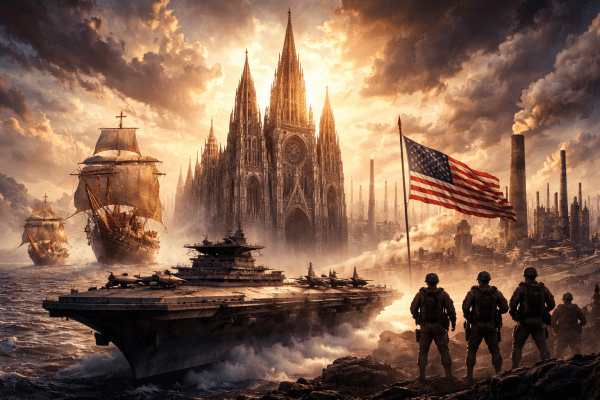
In Munich, the language of heritage, sovereignty, and renewal cloaks a program of bloc consolidation, industrial recalibration, hardened borders, and unilateral force. Beneath the hymn to Western civilization lies a disciplined strategy to reassert Atlantic primacy in a multipolar world. The question is not whether the West will act — but who benefits from how it acts.
By Prince Kapone
The “Alliance That Saved the World”: How Empire Writes Its Own Halo
Marco Rubio opens his Munich address the way ruling classes always open when they are about to ask for more obedience, more sacrifice, and more silence: with a hymn. Not a policy memo, not a balance sheet, not a reckoning with the bodies and the wreckage of the last century — a hymn. “We gather here today as members of a historic alliance,” he says, an alliance that “saved and changed the world.” In his telling, the West is not simply a bloc of states with interests; it is a moral subject, a civilizational hero in a long novel where the only villains are always somewhere else. The line between “communism and freedom,” he reminds the room, once ran through Germany. The Berlin Wall. The Cuban Missile Crisis. “Thousands of years of Western civilization hung in the balance.” The setup is theatrical, almost liturgical: crisis, redemption, triumph. The punchline is implied: because we once “saved the world,” we are entitled to lead it — again.
But notice what this kind of opening does before a single concrete claim is even tested. It smuggles power into the room disguised as virtue. It turns a security conference — a gathering of ministers, arms dealers, and strategists behind hotel doors — into a shrine. It makes the alliance feel like destiny rather than machinery. And once power is dressed up as destiny, the working people of these societies — the ones who pay for it, fight for it, bury their children for it — are invited to see themselves not as exploited classes inside unequal economies, but as loyal heirs of a “civilization” under siege. In that frame, dissent becomes decadence, and questioning becomes betrayal. The trick is old: first declare the house sacred, then call anyone who challenges the landlord an arsonist.
Rubio’s language works like a bleach solution on history. “Communism” becomes a single dark cloud; “freedom” becomes a single shining flag. The messy truth — that states pursue interests, that elites protect property, that alliances are built to preserve hierarchies — is scrubbed out. What remains is a morality play that flatters those at the top and recruits those at the bottom. You can hear the class content in the tone even when the word “class” never appears. The alliance, we are told, “rebuilt” a continent and made it prosper. Yes — but rebuilt it for whom, and under what discipline? Prosperity is spoken as if it floats in the air like spring weather, not as if it is produced by labor, seized through policy, and distributed according to power.
This is why Rubio begins in 1963, with barbed wire and missiles, rather than with the deeper record of how “the West” learned to become a single fist. He wants the audience to feel the alliance as rescue, not as continuity. He wants unity to sound like a sentimental family reunion, not like the periodic closing of ranks when the order feels threatened. He wants to make the audience forget that “civilization” is often the most convenient mask ever invented — a mask worn by bankers and generals, by corporate boards and intelligence services, while the public is told the project is about values. Values, in this genre, are what you say when you don’t want to name what you do.
Even the phrase “Western civilization” here is doing heavy lifting. It is not a neutral description of art, philosophy, or cathedrals. In Rubio’s mouth it becomes a political weapon: a way to fuse Europe and the United States into one moral entity, so that strategic demands can be issued as familial obligations. You are not negotiating interests; you are defending your ancestors. You are not enforcing hierarchy; you are preserving heritage. You are not tightening a bloc; you are “making a civilization whole.” In this rhetorical economy, the worker who can’t pay rent is asked to identify not with their class condition but with Mozart, Dante, and the vaulted ceilings of Cologne — as if beauty itself requires missile budgets, border crackdowns, and obedience to “seriousness and reciprocity.”
The irony, of course, is that Rubio’s own opening admits the basic truth he tries to bury: alliances are born from fear, not from poetry. They form when power feels challenged. They harden when legitimacy is shaky. They sanctify themselves when the material basis of dominance is slipping. That is why the first move is always to declare the struggle existential — not merely a contest of interests, but a battle for “civilization.” Once the stakes are raised to the heavens, any method becomes permissible on earth. And that is the real purpose of this opening chapter: to consecrate the instrument before it is used.
So we should read the first minutes of Rubio’s speech not as a harmless prologue, but as the ideological factory floor where consent is manufactured. A “historic alliance” that “saved the world” is not simply a claim about the past; it is a demand in the present. It is a down payment on the argument he will soon make: that the West must stop apologizing, stop hesitating, stop outsourcing its “sovereignty,” stop being restrained by institutions, and start acting with “freedom of action” again. But before the empire can pick up the hammer, it has to tell the crowd it is holding a lantern.
And once that lantern is lit — once the alliance is framed as sacred and civilizational — the next step follows naturally: unity is no longer a choice made by elites; it becomes an inheritance owed by everyone below. The stage is set for the core move of the speech: turning a historically produced bloc into a timeless family, and turning the enforcement of power into a duty of faith.
The “End of History” Straw Man and the Rehabilitation of Empire
Having crowned the alliance with a halo, Rubio pivots to his first villain: “the end of history.” The story now shifts. The West, triumphant after the Cold War, supposedly fell into a “dangerous delusion” — believing that liberal democracy would spread everywhere, that trade would replace nationhood, that the “rules-based global order” would eclipse national interest, that borders would dissolve into cosmopolitan fantasy. It is a clever move. First, mythologize the alliance. Then invent a naïve interlude in which that alliance forgot its instincts. The result is a morality tale with a moral conveniently aligned with the current administration’s agenda: we were too soft, too globalist, too ashamed. Now we must recover our civilizational nerve.
But the “end of history” here functions less as diagnosis than as straw man. The ruling classes of the Atlantic world did not suspend their pursuit of power in 1991. They reconfigured it. Financial liberalization deepened. Military alliances expanded. New wars were fought. Institutions did not replace national interest; they became instruments through which powerful states projected it. To speak of a period when sovereignty was “outsourced” as if elites had misplaced their authority is to confuse the packaging with the product. What changed after the Cold War was not the existence of hierarchy, but its management. Power moved through markets and institutions in ways that felt technocratic rather than overtly martial. That was not the abandonment of interest — it was interest wearing a suit.
Rubio’s argument rests on a sleight of hand: he conflates a specific form of neoliberal globalization with an abdication of national will. “Dogmatic free trade,” “outsourcing sovereignty,” “world without borders” — these are presented as moral errors. But they were not moral lapses; they were class projects. Deindustrialization was not the result of naïve universalism. It was a strategy that benefited particular sectors — finance, multinational corporations, logistics giants — while hollowing out others. When factories closed and supply chains stretched across oceans, this was not because Western elites believed in abstract humanity. It was because certain fractions of capital profited from cheaper labor, deregulated markets, and global arbitrage. Workers were told it was inevitable; investors knew it was profitable.
So when Rubio laments that “we shipped millions of working and middle-class jobs overseas,” the question is not whether deindustrialization occurred. It did. The question is who designed it, who profited from it, and why the solution now being proposed centers not on democratizing the economy, but on retooling it for geopolitical competition. The working class is summoned rhetorically — invoked as victim — but not as agent. The pain is acknowledged only to justify a new round of consolidation under the banner of “renewal and restoration.”
His critique of “outsourcing sovereignty to international institutions” follows the same pattern. Institutions are framed as alien bureaucracies restraining national freedom. Yet those institutions were largely authored and steered by the very states that now complain about them. When rules suited dominant powers, they were praised as pillars of order. When they constrain maneuver, they are dismissed as shackles. The complaint is not that sovereignty was surrendered; it is that sovereignty was diffused in ways that complicate unilateral action. In other words: the problem is not loss of control, but insufficient control.
Even the swipe at a “climate cult” fits this rhythm. Environmental policy is caricatured as self-imposed impoverishment while competitors exploit fossil fuels. This framing reduces an ecological crisis to a cultural irritant. It invites the audience to see regulation as hysteria and extraction as realism. Yet the deeper tension is structural: advanced economies built on carbon now confront the material limits of that model. To present climate policy as a moral fad rather than as a response to planetary degradation is to transform a systemic contradiction into a culture war. The result is politically useful. If the crisis is merely ideological excess, then the remedy is ideological correction — not structural transformation.
Throughout this section, Rubio’s narrative insists that history went wrong because the West forgot itself. But the evidence suggests something less sentimental and more concrete: the contradictions of global capitalism intensified. Supply chains became fragile because they were optimized for profit, not resilience. Migration increased because wars, trade regimes, and environmental pressures destabilized entire regions. Inequality widened because financialization redistributed wealth upward. To call this a “delusion” is to obscure that it was a strategy — one that enriched some and disciplined many.
The genius of this rhetorical maneuver is that it allows a dramatic reversal without admitting continuity. If the problem was naïveté, then the solution is toughness. If the error was idealism, the cure is realism. But if the deeper issue is structural — rooted in how wealth is accumulated and power is organized — then the speech’s proposed remedies amount to rebranding rather than rupture. The same system that engineered the “mistakes” is invited to fix them, provided it does so with more confidence and fewer apologies.
By the time Rubio reaches his promise of “renewal and restoration,” the groundwork has been laid. The alliance is sacred. The interlude of globalism was misguided. The world is dangerous. The West must recover sovereignty and seriousness. What appears as a sober reassessment is in fact a recalibration — not a rejection of the order that produced instability, but an effort to harden it. The old project does not disappear. It sheds one skin and prepares to don another.
“What Are We Defending?” Civilization as Alibi for Power
Having blamed the recent past on naïveté, Rubio turns to what he calls the “fundamental question”: what exactly are we defending? Armies, he insists, do not fight for abstractions. They fight for a people, a nation, a way of life. On its face, this sounds obvious. No one storms a beach chanting footnotes. But notice the framing. By the time he asks the question, he has already defined the answer. We are defending “a great civilization,” proud of its history, confident in its future, master of its own destiny. The rhetorical arc is complete: first sanctify the alliance, then declare that what it protects is not interest but inheritance.
This is where the speech moves from policy critique into civilizational metaphysics. Europe, he says, gave the world the rule of law, universities, the scientific revolution. Mozart, Beethoven, Dante, Shakespeare. The Sistine Chapel, the cathedral in Cologne. The Beatles and the Rolling Stones. It is a roll call designed to stir affection, to create a sense of shared cultural patrimony. But culture here is not being celebrated for its own sake. It is being conscripted. The symphony and the cathedral are placed in the same sentence as missile budgets and supply chains. The message is subtle but firm: to question the geopolitical direction of this bloc is to place oneself outside the lineage of its greatest achievements.
There is a deeper move at work. Civilization is presented as coherent, continuous, almost organic — a single thread running from Renaissance art to modern security policy. Yet history shows something more fractured and contradictory. The same societies that produced Michelangelo also produced plantations and conquest; the same legal traditions that refined constitutionalism also codified dispossession and hierarchy. To invoke the highest expressions of European culture without acknowledging the material structures that financed them is to curate memory. It is to select the vaulted ceilings and omit the sugar fields that paid for the stone.
When Rubio says armies fight for “a people” and “a way of life,” he is collapsing distinctions that matter. Which people? Which way of life? The banker in Frankfurt and the warehouse worker in Ohio do not experience “civilization” in the same way. The refugee turned away at a fortified border and the executive negotiating mineral contracts in the Global South are not heirs to the same dividend. By fusing these differences into a single cultural identity, the speech performs a familiar ideological service: it dissolves class antagonism into civilizational unity. The worker is invited to see themselves primarily as a guardian of heritage rather than as a participant in an unequal economic order.
The insistence that the West must be “unapologetic in our heritage” reinforces this fusion. Apology becomes weakness. Self-critique becomes decadence. Pride becomes policy. Yet serious reflection on history is not an act of shame; it is an act of understanding. To acknowledge that the rise of Western power was entangled with conquest and exploitation does not negate artistic or scientific achievements. It contextualizes them. It asks how beauty and brutality coexisted, and who paid the cost of accumulation. By rejecting this complexity, the speech substitutes confidence for analysis.
The civilizational frame also prepares the ground for exclusion. If what we are defending is a specific cultural inheritance — bound by ancestry, faith, language — then belonging becomes conditional. The language of “shared heritage” can easily slide into the language of guarded gates. When borders later appear in the speech as bulwarks against destabilizing migration, the emotional groundwork has already been laid. The defense of “a way of life” becomes a defense against those portrayed as outside it.
There is a final irony. Rubio insists that the West should not pretend its way of life is “just one among many.” But history is not a competition for uniqueness. Every civilization is particular; none is metaphysically ordained. To elevate one as inherently irreplaceable is to naturalize hierarchy. It suggests that global leadership is not a function of power relations, but of cultural superiority. That move transforms geopolitical struggle into moral destiny.
So when he asks what we are defending, the honest answer — stripped of cathedral imagery — would be more prosaic. We are defending specific economic arrangements, strategic positions, and political leverage. We are defending supply chains, market access, military basing rights, technological advantage. These are not shameful interests; they are simply interests. The problem arises when they are cloaked in sacred language, when material projects are disguised as civilizational imperatives. At that point, debate narrows. To contest policy is to contest heritage. To question strategy is to question identity.
By the end of this section of the speech, the transformation is complete. The alliance is no longer just a partnership of states; it is the vessel of a unique and endangered civilization. Defense spending becomes cultural preservation. Industrial policy becomes historical redemption. And the space for class analysis, for structural critique, for asking who benefits and who pays — that space quietly contracts, sealed behind stained glass and anthem.
Reindustrialization and the Myth of Innocent Decline
Having wrapped strategy in cathedral light, Rubio descends to the factory floor. Deindustrialization, he tells us, “was not inevitable.” It was a “conscious policy choice.” Supply chain dependence was “foolish.” Mass migration is a “crisis.” Together, he says, we can reindustrialize, rebuild, compete for market share, secure critical minerals, and inaugurate a “new Western century.” The tone shifts from civilizational sermon to industrial manifesto. The language of heritage now merges with the language of production.
It is here that the contradictions sharpen. Yes, deindustrialization was a policy choice. But whose choice? When plants closed and production moved abroad, it was not done by “the West” as a moral collective. It was engineered by specific corporate boards, financial institutions, and policy coalitions. Capital sought cheaper labor, weaker regulations, and higher margins. Governments facilitated the transition with trade agreements and tax structures. The working class did not vote to dissolve its own job base. It was managed into it.
Rubio now speaks as if this hollowing-out were a shared national error that “we” must correct. Yet the same corporate and financial forces that benefited from global outsourcing remain central to the project of reindustrialization. The speech does not propose democratizing ownership, redistributing power in the workplace, or rethinking the logic of accumulation. Instead, it proposes strategic reorientation: rebuild capacity not to empower labor, but to strengthen geopolitical leverage. The factory returns not as a site of worker sovereignty, but as an instrument of state competition.
The proposed industries tell the story. Artificial intelligence, automation, critical minerals, space travel. These are not nostalgic smokestack sectors; they are high-technology frontiers tied directly to military, surveillance, and strategic dominance. “Western supply chains” free from “extortion.” “Unified efforts” to compete in the Global South. The language of independence masks a familiar dynamic: consolidation at home paired with intensified competition abroad. Reindustrialization is framed less as social repair and more as strategic hardening.
Notice also how the working class appears in this narrative. It is invoked as a victim of offshoring and as a beneficiary of renewal, but not as a political subject shaping the process. The plan is technocratic and executive-driven. State leaders coordinate with corporate sectors to secure materials, markets, and innovation. Workers are promised pride and prosperity, but not power. The new industrial policy remains nested within the same hierarchy of ownership that produced the earlier “mistakes.”
Even the critique of supply chain vulnerability carries this dual character. Dependence on adversaries is portrayed as a strategic weakness. That is true in a narrow sense. But the fragility of supply chains was a feature of cost optimization, not an accident. Efficiency under neoliberal globalization meant concentration and just-in-time logistics. Resilience was sacrificed for margin. To now describe vulnerability as a betrayal of sovereignty is to forget that the earlier model was praised as innovation. The contradiction is not between sovereignty and globalism; it is between profit-maximization and social stability.
The call to “compete for market share in the economies of the global South” deserves particular scrutiny. The phrase is clinical, almost managerial. Yet it encodes a geopolitical ambition. The Global South is treated less as a collection of sovereign societies and more as terrain — a market to be secured, a space to be contested. The same civilizational language used earlier now underwrites an economic campaign. A “new Western century” implies not just domestic revival, but renewed projection outward.
Rubio frames this as mutual prosperity. But prosperity within a competitive bloc often depends on relative advantage over others. If supply chains are to be “Western,” critical minerals secured, technology leadership maintained, then alignment, leverage, and exclusion follow. Industrial policy becomes inseparable from strategic containment. What looks like economic common sense is interwoven with geopolitical rivalry.
None of this means that rebuilding productive capacity is inherently reactionary. Societies need resilient industries. Workers need stable employment. Infrastructure matters. The issue is the underlying logic. Is reindustrialization organized around democratic control, ecological sustainability, and social equity? Or is it organized around bloc consolidation and technological supremacy? Rubio’s speech leaves little ambiguity. The project is framed as civilizational competition, not social transformation.
By the end of this section, the emotional arc is complete: from alliance to delusion, from delusion to rediscovered pride, from pride to industrial revival. The new Western century beckons. But beneath the rhetoric of restoration lies continuity. The same system that globalized production in search of profit now seeks to nationalize or regionalize it in pursuit of strategic advantage. The worker remains summoned as symbol, the state as coordinator, capital as architect. Renewal, it seems, is less a break with the past than its recalibration under harsher lights.
Borders, Belonging, and the Politics of Fear
If reindustrialization is the economic spine of Rubio’s vision, border control is its emotional nerve. “Controlling who and how many people enter our countries,” he declares, “is not an expression of xenophobia… it is a fundamental act of national sovereignty.” The phrasing is careful. It anticipates the charge and rejects it in the same breath. But the deeper structure of the argument reveals something more than administrative concern. Migration is described as a force that “threatens the cohesion of our societies, the continuity of our culture, and the future of our people.” In other words: not a policy challenge, but a civilizational risk.
This is where the speech’s earlier language of shared ancestry and spiritual bonds tightens into something sharper. Once civilization is defined in cultural and historical terms, borders become sacred thresholds. The question shifts from managing labor flows or humanitarian obligations to guarding identity. Migration ceases to be connected to global inequality, war, climate disruption, and trade regimes; it becomes a destabilizing influx. Cause is replaced by symptom. Structural drivers are erased. The migrant becomes the visible disruption, not the policies that displaced them.
Yet migration in the Atlantic world has long been entangled with the very economic and geopolitical strategies Rubio defends. Wars reshape regions. Trade agreements restructure economies. Resource extraction distorts local development. Climate change — accelerated by industrial models — intensifies displacement. To treat migration as an isolated crisis is to sever it from the global systems that produce it. The border then appears as a neutral line, rather than as the outer edge of an unequal world order.
There is also a class dimension that the speech leaves untouched. Capital has historically favored flexible labor markets, including migrant labor, when it lowers costs and disciplines domestic workers. Employers often benefit from undocumented or precarious labor, which can be paid less and organized less easily. Yet the political anger generated by economic insecurity is frequently redirected toward migrants themselves rather than toward corporate practices. The worker displaced by automation or offshoring is invited to see the newcomer as competitor, not the boardroom as architect.
Rubio frames border enforcement as the restoration of sovereignty. But sovereignty here functions selectively. It is invoked vigorously at the territorial edge, yet less so in relation to capital flows, financial speculation, or multinational corporate influence. Goods, data, and capital often traverse borders with far fewer barriers than people fleeing instability. The result is a hierarchy of mobility: capital moves freely, labor moves conditionally. To defend sovereignty only at the human level while preserving transnational capital circuits is not neutrality; it is prioritization.
The speech’s warning that migration threatens “the survival of our civilization itself” intensifies the tone. Survival language raises stakes to existential levels. It prepares the audience to accept extraordinary measures as reasonable. When cohesion is portrayed as fragile and culture as endangered, security logic expands. Enforcement budgets grow. Surveillance deepens. Exceptions become normalized. In such climates, nuance shrinks and fear becomes policy’s accelerant.
This does not mean that borders are irrelevant or that states lack authority to regulate entry. Every political community must negotiate rules of membership. The issue is how that negotiation is framed. If the debate centers on shared humanity, economic justice, and global responsibility, the tone shifts. If it centers on cultural siege and civilizational survival, the frame narrows. Rubio’s formulation leans decisively toward the latter. It fuses migration with identity anxiety, embedding demographic change within a larger narrative of decline and renewal.
There is a further irony. Earlier in the speech, he celebrates centuries of European migration to the Americas — Italians, Spaniards, Germans, Scots-Irish, French traders. Movement across borders is cast as the heroic prelude to Western greatness. Yet contemporary migration toward Europe or North America is treated as destabilizing. The difference is not mobility itself, but power relations. When migration extended Western influence outward, it was destiny. When migration flows inward from the Global South, it is crisis.
By placing border control at the heart of renewal, Rubio ensures that the project of reindustrialization and strategic consolidation is accompanied by a politics of enclosure. The new Western century will not only rebuild factories and supply chains; it will harden lines of belonging. Sovereignty becomes both economic strategy and cultural barricade. The alliance is invited to rediscover itself not only through production, but through exclusion.
In this section, the speech’s throughline becomes unmistakable. Civilization must be defended. Industry must be rebuilt. Borders must be secured. Each element reinforces the others. Together they form a coherent worldview: a bloc defined by heritage, disciplined by sovereignty, and mobilized by fear of dissolution. The stage is now set for the final move — redefining the global order itself, and clarifying how this renewed alliance intends to act within it.
Reforming the “Global Order”: When Law Bends to Power
With borders secured and factories humming in imagination, Rubio turns outward again — this time to the “so-called global order.” The phrase is telling. It signals skepticism without renouncing authorship. He insists the West does not need to abandon the institutions it built, but they must be “reformed” and “rebuilt.” The United Nations, he says, has “tremendous potential,” yet has failed on Gaza, Ukraine, Iran, Venezuela. In each case, he contrasts diplomatic paralysis with decisive American action — bombs dropped, special forces deployed, sanctions tightened. The implication is unmistakable: where multilateralism hesitates, power must act.
Here the civilizational arc closes its loop. If the alliance once saved the world, and if it must rediscover its confidence, then it cannot be constrained by procedures that slow it down. International law is tolerated when it aligns with strategic goals; it is sidelined when it obstructs them. Rubio’s formulation does not reject the rules-based order outright. It reorders its hierarchy. Law becomes advisory; sovereignty and force become primary.
The pattern in his examples reveals the logic. The war in Gaza is framed as an arena where American leadership, not international consensus, achieved results. The war in Ukraine is portrayed as requiring persistent sanctions and military support while negotiations remain uncertain. Iran’s nuclear program is described as resolved not through treaties but through “14 bombs dropped with precision.” Venezuela is reduced to a “narco-terrorist dictator” apprehended by special forces. Each vignette underscores a common theme: legitimacy flows from capacity to act, not from collective deliberation.
This posture redefines reform. Reform does not mean democratizing institutions or amplifying voices of the Global South. It means making institutions more responsive to the strategic priorities of the dominant bloc. When they fail to deliver desired outcomes, unilateral measures fill the gap. The message to allies is equally clear: align with this recalibrated assertiveness. Do not hide behind procedural caution. Do not “rationalize the broken status quo.” Move.
Yet this approach carries its own contradictions. The same speech that warns against adversaries shielding themselves behind “abstractions of international law” simultaneously asserts the right to bypass those abstractions. The critique of hypocrisy becomes selective. Violations by rivals are cited as evidence of their illegitimacy; exceptions by the alliance are justified as necessary realism. In such a framework, norms lose universality and become contingent tools.
There is also a structural tension between the rhetoric of sovereignty and the practice of intervention. Sovereignty is championed at the border and in economic policy. But in the geopolitical sphere, the speech endorses crossing borders — militarily or economically — when deemed essential. The principle is consistent only if sovereignty is understood as tiered: robust for the core, conditional for others. That is not an aberration; it reflects longstanding hierarchies within the international system.
Rubio’s insistence that “we do not live in a perfect world” functions as a moral solvent. It dissolves the discomfort of bypassing institutions. Realism becomes justification. In a world of threats, decisive action eclipses procedural fidelity. But realism is not neutral. It reflects assessments of risk, interest, and power distribution. When one bloc reserves to itself the authority to define necessity, realism becomes doctrine.
For the alliance gathered in Munich, the appeal is pragmatic. Institutions have stalled; rivals are assertive; crises multiply. The temptation to streamline decision-making is strong. Yet history suggests that when legal frameworks are subordinated to unilateral capacity, smaller states and weaker societies bear disproportionate costs. The erosion of norms does not suspend hierarchy; it often intensifies it.
In this section, Rubio crystallizes the speech’s governing worldview. The West must not be paralyzed by guilt, fear, or procedural constraint. It must rediscover the will to act. Reform means recalibration toward speed and strength. Sovereignty means freedom of maneuver. Institutions remain, but they orbit around the gravitational pull of the alliance’s strategic core.
The narrative that began with a hymn to historic unity now culminates in a call for unapologetic assertion. The alliance is sacred, the past delusion is corrected, industry is revived, borders are guarded, and the global order is reshaped to accommodate renewed confidence. What remains is the final gesture: tying this entire program back to ancestry and destiny, and inviting Europe to march once more in step with Washington into what he names the “new Western century.”
From Columbus to Kandahar: Ancestry as Strategy, Destiny as Doctrine
In the closing movement of the speech, Rubio does something revealing. He stops arguing policy and starts narrating bloodlines. Columbus. English settlers. Scots-Irish frontiersmen. German farmers. French traders. Spain, Italy, Ulster, Piedmont. The United States, he says, will “always be a child of Europe.” The room is invited not just to agree with a strategy, but to feel it in their bones. The alliance is no longer a coalition of states; it is a family reunion stretched across centuries. Policy dissolves into genealogy.
This is not sentimental excess. It is strategic storytelling. If the West is bound by ancestry and faith, then alignment is not merely prudent — it is natural. If America is Europe’s offspring, then disagreement becomes dysfunction. If destiny is intertwined, then divergence appears reckless. The effect is subtle but powerful: geopolitics is transformed into kinship. And kinship, unlike policy, resists cost-benefit analysis. You do not calculate the balance sheet of your heritage. You defend it.
The narrative arc now reaches full coherence. The West once expanded across oceans; then it “contracted” after 1945; now it must refuse decline. The age of Columbus is invoked not as a moment of conquest and dispossession, but as a symbol of daring and creation. Empire is translated into exploration. Settlement becomes pioneering spirit. Violence evaporates into adventure. By the time Rubio references battlefields “from Qheppyong to Kandahar,” the thread is complete: from caravels to modern counterinsurgency, a single civilizational mission persists.
But here the historical compression exposes the ideology most clearly. The centuries of expansion he celebrates were not only voyages of curiosity; they were projects of domination. The wealth that underwrote European industrialization was extracted through coercion, plantation labor, mineral seizure, and maritime control. The alliance he praises was forged not simply in defense, but in competition and consolidation of global advantage. To narrate this lineage as pure inheritance without naming its material foundations is to sanitize it.
The appeal to pride over guilt further sharpens the contrast. Allies must not be “shackled by shame.” They must not operate a “global welfare state” or atone for “purported sins of past generations.” The implication is that reflection has weakened resolve. But self-critique is not self-negation. A political community can acknowledge historical harm while still pursuing collective security. To frame reckoning as decadence is to redefine strength as amnesia.
When Rubio insists that the West must not pretend its way of life is “just one among many,” he is articulating more than cultural confidence. He is signaling hierarchy. Uniqueness becomes justification for leadership; leadership becomes rationale for intervention; intervention becomes continuity of mission. The “new Western century” thus appears less as a departure from history than as its extension — a reassertion that the bloc which once expanded outward must now re-center itself amid multipolar currents.
The final appeal to destiny ties together every prior theme: sovereignty, industry, borders, reform of institutions, civilizational pride. Yesterday is over; the future awaits; the alliance must act boldly. The speech ends where it began — with inevitability. The West saved the world. It lost confidence. It must reclaim it. The arc bends toward renewed assertion.
What remains unsaid is as instructive as what is proclaimed. The internal inequalities within this alliance are not addressed. The economic contradictions that produced dislocation are reframed as external threats. The agency of the Global South is absent except as market or adversary. The working class appears only as beneficiary of elite recalibration, never as driver of transformation. Destiny is narrated from above.
In the end, Rubio’s worldview coheres into a disciplined logic: a civilizational bloc forged in expansion, chastened by misplaced universalism, now summoned to rediscover sovereignty and strength. It is a call for unity through power, pride without apology, and reform that privileges decisiveness over deliberation. The hymn becomes marching song. The cathedral light returns as spotlight. And the alliance, sanctified at the outset, is asked once more to close ranks — not as negotiators in a plural world, but as heirs reclaiming a birthright.
The New Western Century: Unity in a World That Will Not Obey
If we strip away the cadence, the heritage roll call, the invocations of Mozart and missile strikes, what remains is a remarkably consistent doctrine. The West is a civilizational subject. Its internal divisions are secondary to its shared inheritance. Its recent errors stemmed from softness — from globalist illusion, from institutional hesitation, from excessive self-doubt. The cure is sovereignty, reindustrialization, hardened borders, and freedom of action unconstrained by timid multilateralism. This, Rubio tells Munich, is the path to a “new Western century.”
But the world he is addressing is not the world of 1963. It is not even the world of 1991. Power has diffused. Economies have rebalanced. Former peripheries have become strategic actors in their own right. The Global South is no longer simply terrain for market share; it is a field of states pursuing independent alignments, diversifying partnerships, and negotiating leverage between blocs. To speak of reclaiming a century presumes a level of centrality that the material landscape increasingly complicates.
The speech’s internal logic is clear: unity must be restored in order to manage fragmentation. Yet fragmentation is not merely ideological drift. It reflects structural shifts in production, technology, demographics, and geopolitical weight. A civilizational narrative can rally allies, but it cannot reverse economic gravity. Reindustrialization may reduce vulnerability, but it will not eliminate interdependence. Border enforcement may reshape migration flows, but it will not erase the conditions that drive movement. Institutional reform may streamline decision-making, but it will not dissolve multipolar realities.
There is also the domestic contradiction. The alliance is urged to close ranks, but its member societies are internally divided by inequality, political polarization, and divergent economic models. Industrial revival and strategic consolidation require public consent and fiscal commitment. Yet when prosperity remains uneven and social safety nets strained, calls for civilizational pride may ring hollow to those whose material conditions stagnate. Unity forged in rhetoric must still survive the arithmetic of budgets and ballots.
Rubio’s worldview is not incoherent. It is disciplined and historically conscious in its own way. It recognizes that blocs matter, that power must be organized, that industrial capacity underpins security. But it is also bounded by the assumption that Western leadership is both necessary and rightful — that the alliance’s central task is not adaptation within a plural order, but reassertion within it. In that assumption lies both its strength and its vulnerability.
For allies in Europe, the choice he presents is framed as existential alignment. Walk together into renewal, or risk managed decline. Yet alternatives exist beyond the binary. Europe can deepen autonomy while maintaining partnership. Institutions can be democratized rather than bypassed. Industrial policy can prioritize social equity and ecological sustainability rather than exclusively strategic rivalry. Sovereignty can be balanced with cooperation rather than weaponized as prelude to confrontation.
The final image of the speech is one of inevitability — destiny awaiting fulfillment. But history rarely bends so obediently. The centuries that forged Atlantic dominance were marked not only by unity through conquest, but by resistance from below and abroad. Revolutions, anti-colonial movements, and shifting economic centers reshaped the terrain. The world that emerges in the twenty-first century will be shaped not solely by declarations in conference halls, but by the interplay of competing models, technological change, environmental limits, and popular movements.
A “new Western century” may indeed be pursued. The machinery for it is being assembled in industrial policy, defense budgets, trade realignments, and diplomatic summits. But whether it materializes as stable leadership, intensified rivalry, or accelerating fragmentation will depend less on civilizational hymns and more on how power is exercised and distributed. Pride alone cannot secure legitimacy. Sovereignty alone cannot guarantee prosperity. Force alone cannot manufacture consent.
In the end, Rubio’s address is less a departure from history than a recalibration of it. It seeks to harden the Atlantic bloc for an era of sharper competition. It invites Europe to trade caution for confidence and proceduralism for decisiveness. It casts the coming decades as a test of will. The unanswered question is whether that will can adapt to a world increasingly unwilling to be organized around a single civilizational center — or whether the attempt to reclaim such centrality will generate new cycles of resistance and realignment.
Unity Through Fear, Division Through Power: The Structural Contradictions Beneath the Rhetoric
When the applause fades and the chandeliers dim in Munich, what remains is not poetry but structure. Rubio’s speech is disciplined, coherent, and intentional. It calls for unity — but not a unity of workers across borders, not a unity of peoples confronting shared crises. It calls for unity of a bloc, unity of ruling strata, unity in defense of strategic advantage. The internal divisions of the alliance — class inequality, racial stratification, uneven development — are submerged beneath the banner of civilizational survival. The external divisions of the world — between core and periphery, creditor and debtor, sanctioner and sanctioned — are recast as struggles between order and disorder.
This is not accidental. Throughout history, when dominant blocs feel the ground shifting beneath them, they compress their internal contradictions by amplifying external threat. Fear becomes adhesive. The migrant becomes destabilizer. The rival power becomes existential adversary. The multilateral institution becomes obstruction. And so the alliance tightens. Not because all internal tensions are resolved, but because they are postponed in the name of greater danger.
Yet the structural contradictions do not disappear. Reindustrialization without redistribution risks entrenching corporate concentration. Border enforcement without addressing global inequality risks perpetual enforcement. Institutional reform without democratization risks further alienation. Strategic consolidation without accommodation to multipolar realities risks escalation. The civilizational narrative offers coherence, but coherence is not the same as stability.
There is also the material contradiction between expansion and contraction. Rubio acknowledges that after 1945 the West “contracted.” His solution is not literal territorial expansion, but economic and strategic reconsolidation. Yet in a globally integrated system, reconsolidation often entails competitive exclusion. Supply chains reorganized into blocs create new fault lines. Technological bifurcation generates parallel ecosystems. Sanctions regimes fragment markets. The very effort to preserve dominance accelerates fragmentation of the order it seeks to steward.
The speech’s call for allies who are not “shackled by guilt” signals impatience with self-limitation. But historical memory is not merely moral ornament; it is analytical resource. Understanding how previous eras of expansion generated resistance can inform more sustainable engagement. To dismiss such reflection as weakness risks repeating cycles of overreach. Confidence unmoored from structural awareness can become strategic myopia.
At the domestic level, the contradiction is sharper still. Workers are asked to support industrial revival, defense spending, and bloc solidarity. But if the gains of revival accrue primarily to capital-intensive sectors, while wages lag and social protections erode, civilizational rhetoric may not suffice. Unity through fear is powerful, but it is not infinite. Eventually material conditions assert themselves.
None of this invalidates the reality that states must navigate competition and secure their interests. The question is whether those interests are defined narrowly — as preservation of hierarchical advantage — or expansively — as fostering a stable, plural, and equitable international order. Rubio’s address leans decisively toward the former. It envisions strength through consolidation, reform through assertiveness, identity through exclusion.
The deeper dilemma is that the world no longer revolves around a single civilizational axis. Economic centers have multiplied. Political models diverge. Alliances overlap. The “new Western century” will unfold within a field of countervailing forces, not upon a blank canvas. The attempt to choreograph global alignment around a revitalized Atlantic core will encounter negotiation, resistance, and adaptation.
In that sense, the speech is both aspirational and defensive. It aspires to reassert primacy; it defends against erosion. It summons pride to counter perceived drift. It invites Europe to stand shoulder-to-shoulder with Washington once more. Whether that invitation produces durable cohesion or intensifies systemic friction will depend less on rhetoric than on how the underlying contradictions are managed — at home and abroad.
History suggests a final lesson: blocs forged in unity against external challenge must continually renegotiate their internal balance. If they fail to address inequality within, or dismiss pluralism without, their cohesion strains. If they overextend in pursuit of restored centrality, their rivals consolidate. The speech offers clarity of intention. The future will test the elasticity of its assumptions.
The Reckoning Beneath the Rhetoric: Civilization, Capital, and the Coming Test
In the end, what Marco Rubio delivered in Munich was not merely a speech about Europe, nor simply a critique of globalization, nor even a strategic outline for industrial revival. It was a worldview — compact, disciplined, and historically self-conscious. A worldview in which the West is not a geopolitical arrangement but a civilizational organism; in which sovereignty is virtue; in which decline is the product of self-doubt; in which strength must be rediscovered through consolidation, borders, industry, and freedom of action. It is a worldview that sees fragmentation as pathology and unity as cure.
But beneath that coherence lies a harder question: unity for what, and on whose terms? The speech consistently invokes “our people,” “our civilization,” “our destiny.” Yet it never pauses to interrogate who benefits most directly from the reassertion it proposes. Reindustrialization will be organized through corporate partnerships. Strategic supply chains will be structured through multinational capital. Technological leadership will consolidate in firms already dominant. Military assertiveness will be coordinated through executive decision-making. The working public is summoned as beneficiary and guardian, but not as architect.
This is not incidental. It reflects a structural reality: modern alliances are sustained not only by shared culture but by shared capital circuits. Finance, defense industries, technology conglomerates, energy giants — these networks bind the Atlantic world as tightly as ancestry and language. When the speech calls for renewed unity, it is implicitly calling for alignment of these circuits in the face of shifting global power. The rhetoric of civilization overlays the material architecture of capital.
And here the deepest contradiction emerges. The same transnational capital that once thrived under neoliberal globalization is now being asked to anchor a more consolidated bloc order. Yet capital is inherently mobile. It seeks margin and stability, not sentiment. If profit incentives diverge from strategic goals, tension follows. A bloc can coordinate policy, but it cannot easily command capital without restructuring ownership and governance. Rubio’s speech assumes cohesion where economic interests may prove more fluid.
At the global level, the doctrine faces another test. A world increasingly shaped by multiple centers of power does not easily accommodate a singular civilizational lead. Cooperation on climate, health, technology, and finance requires negotiation across systems, not merely within blocs. If reform of the global order tilts too far toward unilateralism, it may accelerate parallel institutions rather than reinforce existing ones. Multipolarity is not a slogan; it is a condition.
Yet the address also reveals something undeniably real: anxiety. Anxiety about industrial erosion. Anxiety about demographic change. Anxiety about institutional paralysis. Anxiety about losing initiative in a transforming world. The call for pride is a response to perceived drift. The appeal to destiny is an antidote to uncertainty. In that sense, the speech is less triumphalist than it appears. It is defensive confidence — strength asserted precisely because its permanence is no longer assumed.
The coming decades will test whether this doctrine can reconcile its internal tensions. Can sovereignty be strengthened without undermining cooperation? Can industrial revival be achieved without deepening inequality? Can strategic assertion coexist with pluralism? Can civilizational pride avoid sliding into civilizational hierarchy? These are not rhetorical puzzles; they are structural dilemmas.
The alliance that Rubio praises was forged in an era when Europe and North America held overwhelming material advantage. The “new Western century” he envisions will unfold in a far more contested landscape. The outcome will depend not only on resolve, but on adaptability — on whether power can be exercised without overreach, whether unity can coexist with self-critique, whether leadership can be reframed as partnership rather than primacy.
Munich offered a manifesto of renewal. History will render the verdict. Civilizations do not endure by declaration alone. They endure — or transform — according to how they manage contradiction, distribute power, and respond to the forces they themselves have set in motion. The speech has drawn its line clearly. The world that answers it will be anything but simple.

 The New Dark Age
Leave a comment