Friday, 27 February 2026 — Weaponized Information
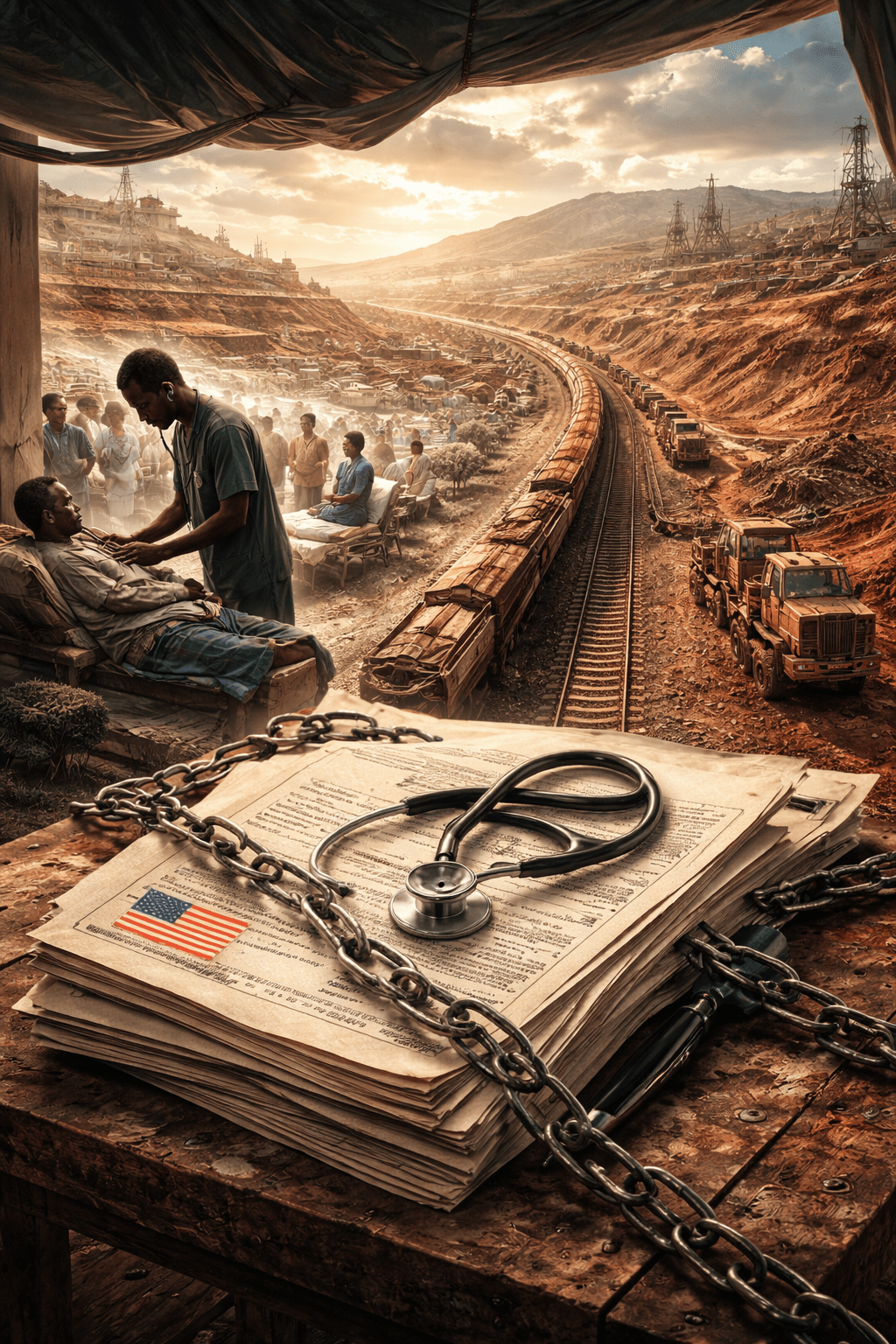
A liberal alarm rings in the pages of The Guardian, exposing troubling terms while leaving the aid architecture itself intact. The material terrain reveals how debt-shaped constraints narrow Zambia’s choices before any negotiation begins. The agreement fuses life-sustaining health systems with mineral governance and long-term informational commitments. Across the Global South, emerging refusals and alternative pathways signal that these arrangements are not beyond contestation.
By Prince Kapone | Weaponized Information | February 27, 2026
When Power Disguises Itself as Paperwork
The Guardian report on the leaked U.S.–Zambia health “memorandum of understanding” arrives dressed in the familiar robes of liberal alarm: a “raw deal,” a “shameless” bargain, a troubling set of terms that civil society must push to amend before an approaching deadline. The piece reads like an emergency meeting convened inside the aid machine itself—concerned, urgent, and morally animated—yet careful not to put the machine on trial. It invites the reader to feel outrage at specific clauses while keeping faith in the broader arrangement: that this is, at bottom, a negotiation that must be managed, refined, and made fairer, because the alternative is catastrophe.
The first device is the emotional anchor: the article ties the reader’s moral loyalty to the most fragile bodies in the room. We are led, again and again, toward the stakes of disruption—HIV treatment thrown off course, maternal mortality targets unmet, the specter of a health system “put at risk.” A man living with HIV is quoted as the potential “first casualty.” This is not incidental. It is narrative insulation. Once the reader’s heart is seated beside the patient, any structural critique begins to look like recklessness—like someone striking matches near the oxygen tank. The story doesn’t need to say “don’t question the architecture.” It lets fear of collapse say it for them.
Then comes the quieter trick: the reduction of power to procedure. The article does not exactly deny asymmetry; it shrinks it. What is plainly leverage is miniaturized into governance furniture—targets, timelines, clauses, “performance,” “briefings,” “data-sharing requirements.” The coercive relationship is recast as administrative design. The terms read like bureaucracy doing its usual bureaucratic thing, and that is precisely the point: paperwork is how domination dresses up as management. The reader is guided to debate whether the conditions are “worse than other countries,” whether the years are “longer than others negotiated,” whether the commitments are “exactly” too demanding—rather than being invited to ask why life-saving care is packaged as a compliance contract in the first place.
The negotiation framing reinforces this narrowing. The plot is structured as a policy drama: a leaked draft appears; advocates object; officials deny; a spokesperson issues a statement about national interests; civil society seeks amendments; a deadline looms; court challenges are floated. The cadence suggests process, contestation, and therefore legitimacy. The reader is positioned as a spectator at the bargaining table, watching the push and pull, tracking whether the deal can be improved—rather than standing outside the building asking who owns the table, who wrote the rules, and why the room is locked from the inside.
Even sovereignty is rendered technical. The most volatile element—foreign access to population health data and pathogen information over long horizons—is presented primarily through the idiom of legality and procedure: access-to-information requests, constitutionality, committee seats, clauses that must be “stripped out.” The story’s critical edge is real, but it remains domesticated within the language of compliance and governance reform. In this way, autonomy is made to look like a filing dispute: a problem to be solved with better wording and stronger oversight.
Finally, the outlet’s own positioning matters to how this kind of story lands. The Guardian’s global development project is presented to readers as editorially independent while being “supported, in part, through philanthropic funding” via theguardian.org, with support for the global development project coming from the Gates Foundation. That doesn’t invalidate the reporting; it explains the genre. This is the house style of “critical humanitarianism”: strong enough to expose ugly terms, careful enough to keep the aid framework itself morally centered and politically usable. The author—a journalist covering health, human rights, and development—writes inside that lane. The outcome is a piece that spotlights exploitation as excess while leaving the deeper relationship translated into paperwork, managed as reform, and narrated under the shadow of a threatened clinic.
The Agreement in a Narrowed Field of Choice
The arrangement described in the Guardian report did not arrive fully grown. Just months earlier, in late 2025, the conversation revolved around a $1.5 billion health package. What now sits on the table is $1.012 billion spread across five years — and yet the expectations have not shrunk with the figure. Zambia would still be required to hire 40,000 health workers and mobilize an additional $400 million of its own funds. And the commitments stretch far beyond clinics and wards: ten years of health data sharing, twenty-five years of pathogen reporting, and the quiet but ever-present possibility that support could vanish if performance targets fall short.
These promises are being made in the long shadow of Zambia’s 2020 sovereign default. Since then, the country has walked a narrow fiscal path shaped by restructuring and oversight. Its recovery has unfolded through IMF-supported programs, including an Extended Credit Facility designed to stabilize the books and restore confidence, as reported in Reuters coverage of Zambia’s efforts to extend its IMF arrangement. The resources available to expand public services — including the very health workforce now under discussion — are formed inside that constrained space.
Meanwhile, the ground beneath this negotiation is not just fiscal — it is mineral. Zambia’s economy continues to turn on copper, the metal now threading through everything from power grids to electric vehicles. Mining anchors export earnings and foreign exchange, as noted in the World Bank’s Zambia Economic Update. As electrification and renewable infrastructure accelerate worldwide, copper’s value has grown, and Zambia’s place in the global supply chain has grown with it.
Infrastructure has followed value. The U.S. and its G7 partners have backed the development of the Lobito Corridor, a route designed to move copper and related minerals from Zambia and neighboring states toward Atlantic export markets. Presented as a resilience measure for supply chains, the corridor ties mining regions to global circuits of production and situates Zambia firmly within them.
At the same time, the country’s fiscal breathing room remains shaped by ongoing talks with creditors. Reporting by the Financial Times has underscored how restructuring negotiations continue to influence what the state can spend and where it can invest. Health policy, like any other public policy, is drafted inside those limits.
Zambia’s health system itself carries the imprint of earlier reforms. HIV programs and other public health initiatives have long depended on international financing, a reliance reflected in IMF assessments such as the 2022 Article IV Consultation. Earlier rounds of economic adjustment did more than reduce public-sector capacity; they restructured how life-sustaining services are financed. External support shifted from emergency supplement to routine foundation, embedding public health within ongoing relationships of outside provision.
Nor is Zambia alone in weighing such arrangements. Zimbabwe has stepped back from negotiations that included similar long-term reporting provisions, suggesting that governments facing comparable pressures may chart different responses.
Taken together, the proposed agreement unfolds within a landscape shaped by restructuring, mineral centrality, infrastructure tied to supply chains, and a history of externally supported health provision. The terms under discussion therefore connect not only to policy choices but to the economic terrain within which those choices are made.
When the Clinic and the Mine Are Written Into the Same Contract
Once you place this agreement back inside Zambia’s lived terrain, its logic stops looking like a partnership and starts looking like a tightrope. A country still climbing out of default is asked to build up its health workforce, spend hundreds of millions more of its own money, and meet performance targets — all while navigating the narrow fiscal corridor carved out by restructuring. The promise of funding sits on one side. The possibility of withdrawal sits on the other. And in between lies the health system itself, balancing on conditions it does not fully control.
But the balancing act does not end at the hospital door. The same framework that speaks of treatment continuity also speaks of mining collaboration and expanded commercial engagement. Copper — the metal now coursing through the veins of the electrified future — is never far from the conversation. Infrastructure like the Lobito Corridor ties the region’s mineral wealth to distant markets, and Zambia’s place in that flow gives new weight to every negotiation. In this arrangement, the clinic and the mine begin to appear on the same page.
The informational commitments deepen this fusion. Ten years of health data. Twenty-five years of pathogen reporting. These are not emergency timelines; they are generational ones. They stretch beyond crises and into the future, binding knowledge about the nation’s biological life to long-standing channels of cooperation. Information joins financing and resource engagement as part of the same enduring relationship.
Seen together, the pattern is unmistakable. A health system built to sustain life — to keep workers strong, families intact, and communities functioning — is asked to expand within limits shaped elsewhere. Its continuity depends on meeting targets set within a fiscal landscape already narrowed by debt. At the same time, the country’s mineral wealth moves through corridors designed to feed global industry. Care and extraction travel side by side.
No clause needs to say that one is traded for the other. The design does the work. The same structure that promises stability in treatment also situates that stability within a wider economic choreography. The reproduction of life and the circulation of value are written into the same contract — not as an open bargain, but as a shared condition.
Refusal Is Already in Motion
These contradictions are not waiting for theorists to name them. They are already being felt, debated, and resisted on the ground. In Zambia, civil society groups have pushed back against provisions that would stretch data-sharing commitments far into the future, demanding transparency and insisting that agreements touching the health system be opened to public scrutiny. Their struggle is not against care itself, but against the possibility that the systems sustaining life might be folded quietly into long-term external arrangements.
The hesitation is not confined to one country. Zimbabwe has stepped away from negotiations that included similar reporting provisions, signaling that acceptance is not inevitable even under fiscal pressure. In doing so, it has shown that the terms of engagement can be contested rather than simply absorbed. The space for negotiation widens when refusal becomes visible.
At the same time, efforts to expand alternative financing pathways continue to gather momentum. Institutions such as the New Development Bank are supporting health and infrastructure initiatives across the Global South, offering additional channels through which public systems might be strengthened without relying on a single stream of support. These efforts do not eliminate constraint, but they introduce room to maneuver.
What emerges is a shared terrain of struggle. Questions about the continuity of treatment are inseparable from questions about fiscal space and the governance of natural wealth. Supporting transparency efforts, amplifying domestic oversight, and encouraging dialogue among states exploring diversified financing can help ensure that health systems are not quietly enlisted into broader economic arrangements.
The debates unfolding around this agreement are therefore not merely technical. They speak to how societies seek to sustain life while navigating the demands of a changing global economy. The outcome will shape not only the provision of care today, but the terms under which that care is secured in the future.

 The New Dark Age
Leave a comment