Wednesday, 4 March 2026 — Media Lens
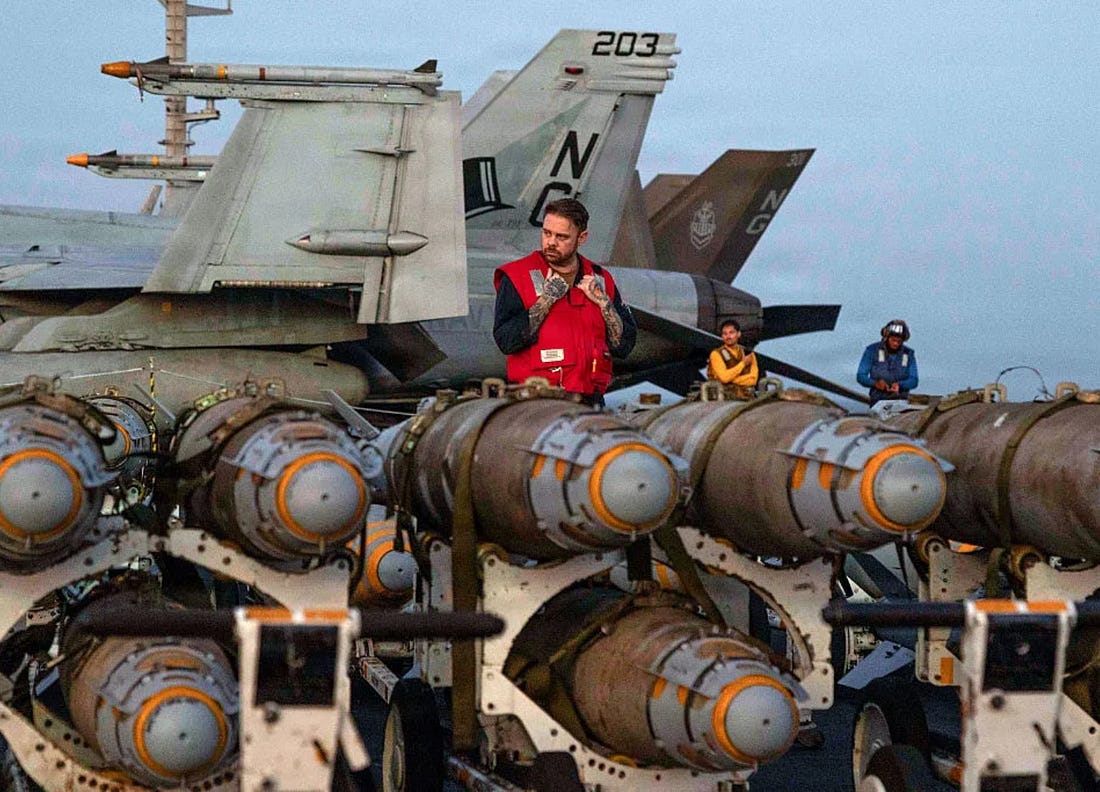
Commenting last week on the build-up of US military forces targeting Iran, Robert A. Pape, Professor of Political Science at the University of Chicago, got it right:
‘This represents 40-50% of the deployable US air power in the world. Think air power on the order of the 1991 and 2003 Iraq war. And growing. Never has the US deployed this much force against a potential enemy and not launched strikes.’
Just prior to the US and Israeli launch of ‘Operation Epic Fury’, Trump’s name for the onslaught that began last Saturday, Professor Pape commented again:
‘250+ combat US aircraft poised to strike Iran. Trump is cocking the gun— not for 1 day of strikes, but weeks long air campaign to grind down the regime.’
In fact, we know the goal is regime change. In announcing the war, Trump declared:
‘Finally, to the great proud people of Iran, I say tonight that the hour of your freedom is at hand. Stay sheltered. Don’t leave your home. It’s very dangerous outside. Bombs will be dropping everywhere. When we are finished, take over your government. It will be yours to take. This will be probably your only chance for generations.’
Of course, a central theme of Trump’s ‘Make America Great Again’ campaign was his supposed determination to end Forever Wars. In 2016, he said:
‘We will stop racing to topple foreign regimes that we know nothing about, that we shouldn’t be involved with.’
As recently as November 2024, the big slogan was:
‘Vote the pro-peace ticket. Vote Trump-Vance’
In the Guardian, Julian Borger described this latest war as ‘an unprovoked attempt at regime change in collaboration with Israel, with no legal foundation, launched in the midst of diplomatic efforts to avert conflict, and with minimal consultation with Congress or the American public’.
Borger’s use of the adjective ‘unprovoked’ is interesting. Endlessly repeated in describing Russia’s supposedly ‘unprovoked’ war of aggression on Ukraine, there are scarce mentions in current media coverage of ‘Operation Epic Fury’. Borger added:
‘The attack on Iran is a clear violation of the UN charter, in any absence of any credible, imminent Iranian threat to the US.’
Again, the word ‘illegal’ is absent from almost all media coverage. By contrast, Jeremy Diamond, CNN Jerusalem Correspondent, commented:
‘BREAKING: Israel has launched pre-emptive strikes against Iran and a state of emergency has been declared across Israel in anticipation of Iranian retaliation.’
There were no quote marks around ‘pre-emptive’, even though there is no evidence that Iran was about to attack. Reuters pushed the same propaganda:
‘Israel has launched a preventative attack against Iran, defence minister says.’
Even the BBC’s Jeremy Bowen perceived the mendacity:
‘The word preemptive has been used. Now that’s a word that suggests there was an imminent threat, that is an imminent attack before these strikes started. There’s no evidence of that. It looks very much as if this is a war of choice that Israel and the US have done.’
The US has since tragicomically claimed the war was ‘preemptive’ in the sense that they knew Israel was going to attack, so had to become involved.
Hours before the war began, Oman’s foreign minister – the chief mediator in US-Iran negotiations – told CBS a deal could be reached ‘tomorrow’ and warned that it would be derailed by military action. Patrick Wintour, the Guardian’s diplomatic editor, reported:
‘The Iranian delegation believes that if American negotiators convey the current reality in the negotiation room to the White House and Washington trusts the IAEA as a specialized arbiter in non-proliferation matters, Tehran’s proposed initiatives address Trump’s claimed concern about the necessity of the peaceful nature of Iran’s nuclear program.’
Which would have left us pretty much where we were in 2018, before Trump wrecked the highly successful Joint Comprehensive Plan of Action (JCPOA) nuclear agreement (see below).
Filmmaker and journalist Richard Sanders described coverage of a major massacre of civilians by three US-Israeli missiles:
‘The killing of dozens of girls at a primary school in Iran is not on the front page of a single British newspaper.
‘A simple test – imagine the reaction if they were Israelis.’
Later that day, the BBC devoted a leading headline to nine people killed in Israel, while the 148 children then estimated to have been killed remained what they had been the previous day, a second-order story lower down the page. After the school death toll was revised to 165 killed, the BBC shamefully dropped the story from its ‘Summary’.
The BBC subsequently posted two articles on the same morning. In one report, four US troops killed in an Iranian attack were pictured, named, ages given, backgrounds described. They were fully humanised, as they should have been. In a separate report on the school massacre, none of the Iranian schoolgirls or staff were pictured, named or humanised. As usual, they were lumped together as an anonymous mass.
As in Venezuela, the BBC claims a significant portion of the target population is actually relieved to be subject to one of the most intense bombing campaigns in modern history:
‘But, says BBC Persian, at the same time there appears to be a sense of relief – even celebration – among those who believe the regime’s downfall can only come through military intervention.’
Considering the state of Afghanistan, Iraq, Libya and Syria, the future must look bright indeed.
As expected, only two British political leaders responded with integrity and humanity. Jeremy Corbyn, who will soon be made leader of Your Party,
said:
‘The attacks on Iran by Israel and the United States are illegal, unprovoked and unjustifiable. Peace and diplomacy was possible. Instead, Israel and the United States chose war. This is the behaviour of rogue states — and they have jeopardised the safety of humankind around the world with this catastrophic act of aggression.’
Green Party leader Zack Polanski – currently being subjected to the same campaign of defamation and dehumanisation directed at Corbyn – said:
‘This is an illegal, unprovoked and brutal attack that shows once again that the USA and Israel are rogue states.’
Piers Morgan found Polanski’s comments appalling:
‘Now watching @ZackPolanski spewing shockingly naive and delusional nonsense about Iran. God help us if he and his extreme left-wing Green Party ever win real power. He makes Corbyn look mainstream.’
On X, Mehdi Hasan of Zeteo News skewered Morgan with great precision:
‘Zack is taking an antiwar position that you took in 2003, Piers. You were attacked in the same way you are now attacking Zack.’
In 2004, Morgan had said:
‘History will judge the Mirror’s campaign on the Iraq war as one of the strongest, bravest and best campaigns that any newspaper ever waged against anything ever, and I believe that passionately.’
‘Shockingly naïve,’ Morgan was so convinced that conditions in Iraq had become so appalling that he argued in all seriousness that Saddam should be put back in power:
‘Armed fighters are swarming all over Iraq. We have devastated the region beyond any repair in the short term at all. None of this was going on while Saddam was in charge of things…’.
Presumably, Morgan can perceive no prospect of a similar catastrophe occurring now.
Trump-level hypocrisy abounds elsewhere. In 2015, Reform Party leader Nigel Farage boldly opined:
‘We don’t need to take foreign policy advice from the American President. The last time we did that it was called the Iraq War.’
Last week, Farage posted on X:
‘The Prime Minister needs to change his mind on the use of our military bases and back the Americans in this vital fight against Iran!’
At the far-distant extreme of ethical ‘mainstream’ commentary, Peter Hitchens of the Mail on Sunday wrote:
‘It is interesting that dissent on foreign policy is almost invariably slandered as support for the foreign state to which we are being urged to be hostile. When it is in fact a desire to keep my own country out of needless danger.’
Does concern for our own safety really represent the limit of our moral vision? Dissent is also driven by respect for international law, by concern for the horrendous consequences for civilians under our bombs, and by the keen awareness that, for decades, ‘our’ foreign policy has been controlled by greed-driven interests lacking any moral compass. Ultimately, by standing against wars of aggression we are standing up for our own humanity. We are not monsters.
Journalist Glenn Greenwald commented on the notion that Trump is concerned about the welfare of Iranian people:
‘Trump – whose favorite regimes on the planet are the most savagely and viciously tyrannical: Saudi Arabia, UAE, Egypt, etc., and whose 2025 National Security Strategy said we don’t care if other governments offer freedom – says his main goal is that Iranians be free.’
Iran – ‘Transparently, Verifiably, And Fully Implementing The JCPOA’
But why attack at all? And why now? Two weeks ago, a post from the Jerusalem Post reported ominously:
‘Iran is about a week away from having the ability to make industrial-grade bombs, US Special Envoy to the Middle East Steve Witkoff told Fox News on Saturday, while offering a rare glimpse into Trump’s decision-making process on the issue.’
That seemed clear – Iran was a week away from possessing an atomic bomb. Readers had to click the link to find the truth:
‘The US envoy left out that Iran currently has no access to its material, no machines to enrich it, and no weapons program to use it for any operational purpose.’
Jeffrey Sachs of Columbia University supplied some background:
‘The fact of the matter is that the claim that Iran wants a nuclear weapon and is just about to get a nuclear weapon has been the false propaganda literally for 30 years. Netanyahu, who is a war criminal, has been saying for 30 years since 1996.’
In 2019, the US Defense Intelligence Agency reported:
‘Iran’s military strategy is basically defensive and is designed to deter an adversary, survive an initial strike, and retaliate against an aggressor to force a diplomatic solution.’
We can be confident that the case for war is as bogus as ever because, in 2015, Iran signed up to the Joint Comprehensive Plan of Action (JCPOA), an agreement to limit the Iranian nuclear programme in return for lifted sanctions. For reasons best known to Trump and (no doubt) Benjamin Netanyahu, Trump withdrew from the deal in 2018. Trump described the deal as ‘disastrous’, saying, ‘The Iran Deal was one of the worst and most one sided transactions the United States has ever entered into.’
As Trump would say, this was ‘fake news’. Between 2016 and early 2019, the International Atomic Energy Agency, the official ‘watchdog’ tasked with monitoring Iranian compliance, issued eleven consecutive reports confirming ‘that Iran is implementing its nuclear-related commitments’.
The EU High Representative repeatedly stated that the JCPOA was ‘working and delivering on its goal, namely, to ensure that the Iranian programme remains exclusively peaceful, as confirmed by the International Atomic Energy Agency (IAEA) in 11 consecutive reports’.
The UN Secretary-General issued biannual reports to the Security Council that consistently reflected the IAEA’s findings, confirming that Iran was meeting its nuclear-related obligations. In 2017, the US State Department twice certified to Congress that Iran was compliant with the deal:
‘Iran is transparently, verifiably, and fully implementing the JCPOA; it has not committed a material breach with respect to the JCPOA; and Iran has not taken any action during the reporting period, including covert activities, that could significantly advance an Iranian nuclear weapons program.’
Ignoring all of the above as non-existent, the BBC’s Laura Kuenssberg commented on the difficulty of dealing with Iran in an interview with Zack Polanski:
‘They have shown for years to be [sic] completely disinterested in negotiation or respecting international rules and regulations.’
Pure, mendacious propaganda on prime-time BBC TV.
The Protests And Death Tolls
Estimates on the number of people killed in protests in Iran from December 2025 to January 2026 range from 3,000 to 36,000. The Iranian government claims some 200 security personnel were killed.
Journalist Alan MacLeod reports that ‘… the source of many of the most inflammatory claims and shockingly high casualty figures reported in the press’ are ‘bankrolled by the Central Intelligence Agency, through its cutout organization, the National Endowment for Democracy’.
As with false claims made before the 2003 Iraq war, politicians have used extreme claims sponsored by the US government to sell their war of aggression as humanitarian intervention. Thus, UK foreign secretary Yvette Cooper, who said Iran’s government is ‘… a regime which we know has brutally killed tens of thousands of its own people’.
In fact, nobody has a clear idea of how many people were killed during the protests or by whom. But then nobody in the ‘mainstream’ cares about the methodology or evidence behind the high death toll estimates – concerns that arise only when claims reflect badly on the West, as in the case of Iraqi and Palestinian civilian casualties.
Similarly, press coverage blithely ignores the clear involvement of Israeli agents provocateurs. On December 29, The Jerusalem Post reported:
‘On Monday, the Mossad [Israeli secret service] used its Twitter account in Farsi to encourage Iranians to protest against the Iranian regime, telling them that it will join them during the demonstrations.
‘“Go out together into the streets. The time has come,” the Mossad wrote.
‘It continued, “We are with you. Not only from a distance and verbally. We are with you in the field.”’
Mike Pompeo, former director of the CIA and former Secretary of State, posted on X:
‘Happy New Year to every Iranian in the streets. Also to every Mossad agent walking beside them…’
It would hardly be a surprise if, as in Syria, Western forces worked hard to make the protests as violent as possible, presumably as part of their preparation for ‘Operation Epic Fury’. The BBC reported:
‘The protests began as a reaction to the spiralling cost of living and soon focused on the whole regime, whose policies people blamed for their difficulties.’
The key point:
‘Since May 2018, when Donald Trump pulled the United States out of a nuclear deal with Iran and reinstated wide-ranging sanctions on the country, the Iranian currency has lost more than 95% of its value against the US dollar on the open market… The rapid fall in the value of the rial sparked the protests in Tehran’s bazaar in late December, which soon spread across the country.’
In fact, the US has been destroying Iran’s economy in an attempt to destabilise the country and achieve regime change. This is conscious policy. In February, US Treasury Secretary Scott Bessent openly stated that the ‘Maximum Pressure’ sanctions campaign was specifically ‘designed to collapse [Iran’s] already buckling economy’ by driving oil exports to zero and denying the regime access to hard currency. Many other US politicians have made the same point. This lethal policy would certainly have been the key focus, if the BBC had been reporting on Russian attempts to economically destabilise a Western ally. In the event, the word ‘sanctions’ was mentioned just twice, both buried in the middle of the piece.
A BBC headline described Reza Pahlavi, the exiled son of Iran’s last Shah, as being ‘at centre of protest chants’. In 2018, journalist Nafeez Ahmed reported:
‘Altogether, since 2006, successive US administrations have invested tens of millions of dollars a year on “democracy promotion” efforts in Iran, serving as cover for longstanding ‘regime change’ aspirations.
‘Much of the media programming funded by the State Department has focused on glorifying the reign of the Shah of Iran, the brutal US-UK backed dictator who was deposed by the 1979 revolution. The propaganda appears to have worked, with many participants in the latest protests calling for the Shah’s exiled son, Reza Pahlavi, to return to power in Iran.’
Naturally, this ‘democracy promotion’ of the Shah’s son requires the omission of some embarrassing historical facts.
In 1953, US-supplied armoured cars took to the streets of Iran deposing the democratically elected nationalist Mohammad Mosaddegh and replacing him with the Shah. According to then CIA agent Richard Cottam, ‘…that mob that came into north Teheran and was decisive in the overthrow was a mercenary mob. It had no ideology. That mob was paid for by American dollars and the amount of money that was used has to have been very large’. (Quoted, Mark Curtis, ‘The Ambiguities of Power’, Zed Books, 1995, p.93)
As in Iraq 2003, Libya 2011 and Venezuela 2026, the motive was oil.
The BBC made vague mention of ‘human rights abuses’ under the Shah. In fact, according to Amnesty International, Iran had the ‘highest rate of death penalties in the world, no valid system of civilian courts and a history of torture’, which was ‘beyond belief’, in a society in which ‘the entire population was subjected to a constant, all-pervasive terror’. (Martin Ennals, Secretary General of Amnesty International, cited in an Amnesty Publication, Matchbox, Autumn 1976)
None of this troubles our ‘free press’, who are busy following the line adopted by journalist John Sweeney in 1999:
‘Life will only get better for ordinary Iraqis once the West finally stops dithering and commits to a clear, unambiguous policy of snuffing out Saddam. And when he falls the people of Iraq will say: “What kept you? Why did it take you so long?”’ (Sweeney, ‘The West created a monster. Now it’s time to destroy him. As a good liberal, I personally vote for obliterating Saddam’, The Observer, 10 January 1999)
One would be hard-pressed to find a ‘mainstream’ commentator currently concerned about human rights in Iraq. Last week, Antiwar’s Jason Ditz reported:
‘Once and possibly future Iraqi Prime Minister Nouri al-Maliki’s candidacy is increasingly in doubt this weekend, with reports that President Trump’s demand he not be allowed to return to office increasing the possibility that the Coordination Framework bloc may withdraw him as their choice for premier…
‘Late last month, Trump demanded that Maliki step down from the nomination, but he refused at the time, saying that the US should stay out of Iraq’s internal affairs. Maliki was already Iraq’s PM from 2006 through 2014.’
Ditz explains how the US controls Iraq’s ‘democracy’:
‘Underpinning this whole thing is that after the 2003 US invasion and occupation of Iraq, the country was restructured such that all of Iraq’s oil revenue was paid in US dollars through the New York Federal Reserve Bank. Since that revenue is almost the entirety of Iraq’s government budget, that means the US can virtually seize Iraq’s treasury at any time and bankrupt the country on a moment’s notice.’
This is the kind of ‘freedom’ that awaits Iranians in the event of US-Israel ‘regime change’, which would actually mean conquest and colonisation.
Oil remains a key goal, of course. In 2015, Noam Chomsky described the deeper motives:
‘The answer is plain: the rogue states that rampage in the region… do not want to tolerate any impediment to their reliance on aggression and violence. In the lead in this regard are the U.S. and Israel, with Saudi Arabia trying its best to join the club….’
DE
Note To Readers
If any friendly academics or others are able to help us access the ProQuest or Nexis media database, please email us: editor@medialens.org
David Edwards is the author of ‘A Short Book About Ego… and the Remedy of Meditation’, Mantra Books, available here. He is also the author of the science fiction novel, ‘The Man With No Face’, to be published by Roundfire Books in 2026.

 The New Dark Age
Leave a comment