Sunday, 8 March 2026 — Liberation News Network
The Empire’s Financial Arteries Are Hemorrhaging: How the US-Iran War is Triggering Capital Flight from American Imperialism
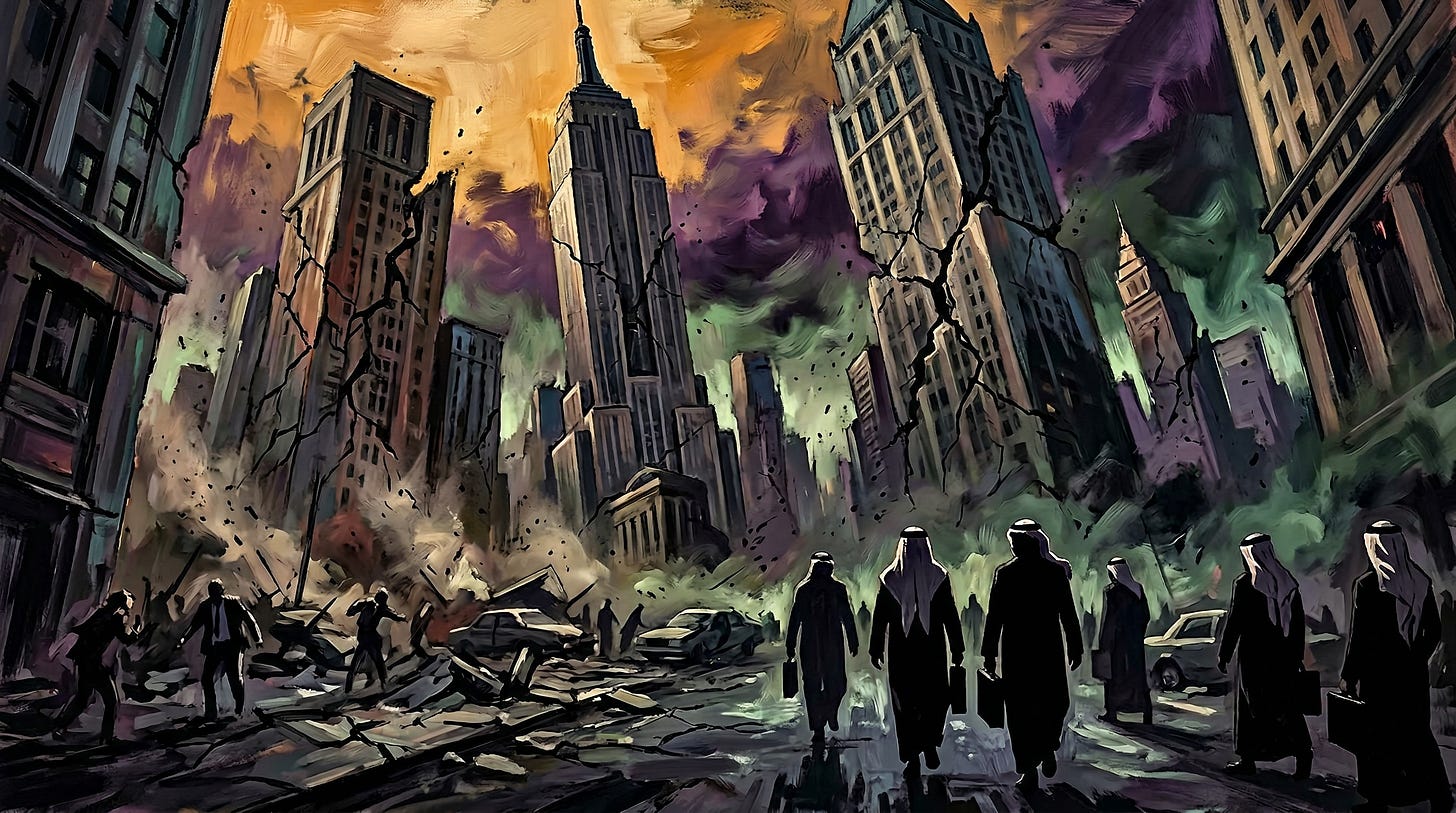
The contradictions of late stage imperialism have never been more starkly illuminated than in the current conjuncture. As the United States and its Zionist proxy wage their criminal war against the Iranian people, a secondary front has opened—one that threatens to inflict more lasting damage on American hegemony than any ballistic missile.
The financial markets are speaking, and their language is one of panic.
The Material Basis of Imperialist Crisis
We are witnessing what Lenin identified as the fundamental law of imperialism: the interpenetration of bank capital and industrial capital creating a system of “finance capital” that is simultaneously parasitic and brittle. When the productive base is shattered by military adventurism, the superstructure of financial claims begins to crumble.
The evidence is mounting:
BlackRock’s HPS Corporate Lending Fund—a $13.2 billion behemoth representing the concentrated power of monopoly finance capital—has been forced to activate withdrawal restrictions after receiving $1.2 billion in redemption requests in a single quarter
. This is not a liquidity “mismatch” as the bourgeois financial press would have it. This is a crisis of confidence in the American imperialism itself.
The fund’s managers explicitly cited “mounting concerns of an economic slowdown from a prolonged conflict in the Middle East“
. They dare not name the war directly, for to do so would acknowledge what every serious Marxist understands: That the US imperialists are losing the war to Iran
The Gulf Monarchies: Junior Partners in Revolt?
More significant still is the report from the Financial Times that Saudi Arabia, the UAE, and Kuwait are reviewing their investment commitments to the United States, potentially invoking force majeure clauses to escape contracts made during Trump’s obsequious tour of the region last year .
Here we see the dialectic of imperialist alliance turning into its opposite. The Gulf comprador bourgeoisie—long the faithful servants of American petroleum interests, the recipients of military protection in exchange for guaranteed oil flows and recycled petrodollars—are now calculating their exposure to a declining hegemon.
Their grievances are material, not moral:
- Energy revenues collapsing as regional shipping grinds to a halt
- The Strait of Hormuz—that chokepoint through which a fifth of world oil flows—transformed from asset to liability
- Defense spending spiraling to compensate for American strategic collapse
- Tourism and aviation sectors devastated by Iranian retaliation
The Emirati businessman Khalaf al-Habtoor captured this sentiment when he publicly challenged Trump: “Who gave you the authority to drag our region into a war with Iran? Did you calculate the collateral damage before pulling the trigger?”
This is not anti-imperialism. This is the fracturing of the imperialist chain at its weakest links—the dependent bourgeoisie recognizing that their patron can no longer guarantee their interests.
The Scale of the Threat
The numbers reveal the stakes. Gulf states hold approximately $3.6 trillion in US assets, with some estimates suggesting discussions around $6 trillion in potential exposure. A coordinated withdrawal—or even a sustained pause in new investment—would constitute the most significant capital flight from American markets since the collapse of Bretton Woods. BlackRock’s liquidity crisis is the canary in the coal mine. When the world’s largest asset manager cannot meet redemption requests without imposing “gates,” we are witnessing what Engels called a “crisis of overproduction”—not of goods, but of fictitious capital. The $1.5 trillion private credit market, that shadow banking system that sustains American corporate debt, is revealing its inherent instability.
Lenin Vindicated (Again!)
This moment illustrates Lenin’s analysis of imperialism with crystalline clarity. American imperialism, seeking to maintain its dominance through military aggression, has instead accelerated its own relative decline. The war against Iran—intended to secure hegemony over Southwest Asian energy resources—has instead:
- Disrupted the global energy markets that sustain dollar primacy
- Alienated regional allies whose capital props up American debt markets
- Triggered capital flight from the very financial institutions that concentrate imperialist power
- Exposed the brittleness of “private credit”—the speculative infrastructure of late finance capital
The Trump administration’s gamble has backfired spectacularly. The Financial Times notes that any sustained Gulf investment pullback would “increase pressure on Trump to seek a diplomatic end to the conflict”. Imperialism, as Lenin taught us, is driven to war by the necessity of redividing the world. But war, in turn, accelerates the very decline it was meant to arrest.
Towards a Materialist Analysis
We must resist the temptation to view this as a purely financial phenomenon. The “liquidity mismatch” in BlackRock’s funds is a symptom of the contradiction between the socialization of production and the private appropriation of surplus. When capital cannot find productive outlets, it speculates. When speculation is threatened by geopolitical reality, it flees.
The GCC’s potential withdrawal represents something unprecedented: dependent capitalist states recognizing that their subordination to American imperialism has become a liability rather than an asset. This is not the anti-imperialism of the proletariat, but it is a fissure in the imperialist bloc that revolutionary forces must exploit.
The American working class must understand: their pensions, their jobs, their precarious prosperity is built atop a pyramid of fictitious capital sustained by military aggression abroad. When that aggression disrupts the flow of value from the periphery to the core, the entire edifice threatens to crumble.
Conclusion
BlackRock’s withdrawal restrictions and the GCC’s investment review are two manifestations of the same crisis—the crisis of American imperialism’s attempt to resolve its contradictions through war. As the conflict in the Middle East prolongs, we can expect:
- Further stress on dollar-denominated assets
- Intensifying competition between imperialist powers for alternative investment outlets
- Growing pressure on the American state to either escalate militarily (risking wider war) or retreat (signaling yet further decline)
- Opportunities for communist forces to organize around the fundamental truth: imperialism is incompatible with human flourishing
The finance capitalists are running for the exits. The question for the working class of the imperial core is whether we will allow this system to drag us into further wars, or whether we will seize this moment of imperialist fracture to organise and seek to stop the endless militarism of the declining empire.
The empire is hemorrhaging. The task of the communists is to ensure it does not clot.

 The New Dark Age
Leave a comment