Wednesday, 11 March 2026 — Struggle / La Lucha
Washington’s war against Iran, launched Feb. 28 with the U.S.–Israeli assault known as Operation Epic Fury, began with a burst of spending. In the first 100 hours alone the Pentagon burned through an estimated $3.7 billion in missiles, air operations and interceptor systems, most of it not previously budgeted.
The war began immediately. The financial mechanisms are being assembled afterward. For U.S. imperialism this sequence is familiar: war first, financing later.
This sequence reflects the structure of imperialism itself. The decision for war is political and strategic. Once that decision is made, the capitalist state mobilizes the financial system — through deficits, borrowing and credit expansion — to sustain the war effort. Finance does not determine whether war begins; it reorganizes afterward to support it.
More than 10 days after the first U.S. strikes on Iran, the White House has still not submitted a supplemental funding request to Congress. Pentagon officials are reportedly preparing a package that could total around $50 billion to replenish weapons stocks consumed in the fighting.
But the war economy does not wait for formal votes.
Missile production is already expanding. Pentagon officials have met with executives from Raytheon and Lockheed Martin to accelerate production as U.S. stockpiles are depleted. The administration has also floated invoking the Defense Production Act to compel companies to increase output of key military systems.
Washington has fought wars this way before.
Vietnam and the dollar crisis
During Vietnam, the U.S. government financed the war through deficit spending and dollar creation rather than taxation. Under the Bretton Woods system, dollars were convertible to gold at $35 an ounce — but the flood of new dollars meant foreign central banks increasingly demanded gold for them, and U.S. reserves began to drain.
By 1971 the pressure was unsustainable. Nixon ended dollar-gold convertibility, dismantling the monetary system that had governed the world economy since World War II.
The Vietnam War exposed a fundamental contradiction: military power expanding while its economic foundation weakened. That contradiction is sharper today.
Gold prices tell part of the story. As of early March, gold is trading around $5,200 an ounce — a level that would have seemed extreme just two years ago. But the war did not create this pressure. It accelerated a process already underway. The dollar’s share of global foreign exchange reserves has fallen from 71% in 1999 to roughly 58.5% as of early 2026.
Central banks purchased over 1,100 tonnes of gold in 2025 — the third consecutive year above 1,000 tonnes — as governments across the Global South sought reserves that Washington cannot freeze or weaponize. On Oct. 31, 2025, the BRICS bloc launched a pilot of the “Unit,” a gold-backed settlement instrument for wholesale trade designed to bypass the dollar entirely.
This is the context in which Washington launched its war. In 1971, U.S. military spending helped break a dollar system that was still dominant. Today the bombs are falling on a dollar system already in retreat.
War and the contradictions of capitalism
This pattern is not accidental. Imperialist war spending is one of the mechanisms through which the capitalist state attempts to manage the contradictions of accumulation.
Capitalism periodically runs into a wall: profits fall and capital piles up with nowhere productive to go. At that point the state steps in, pumping demand into the economy through military production financed by deficits and borrowed money.
The immediate beneficiaries are the arms corporations. Lockheed Martin stock has surged 43% over three months and is trading near an all-time high. The company has agreed to quadruple munitions production following White House meetings tied to weapons stockpile depletion. RTX, Raytheon’s parent company, has posted a 40% stock gain year to date. For these corporations, war is not a disruption — it is the outlet for surplus capital the civilian economy cannot absorb.
The question of who pays is not abstract. On July 4, 2025, Trump signed into law a budget reconciliation bill cutting federal Medicaid spending by more than $1 trillion over 10 years. The same law cut food assistance by $186 billion — the largest SNAP cut in history — affecting all 40 million people who receive benefits each month, including 16 million children and 8 million seniors.
Now the Pentagon is preparing a supplemental spending request of around $50 billion to replenish weapons stocks consumed in the first two weeks of the war. The logic is not hidden. The capitalist state strips health care and food from the working class to free up resources for war — then finances the war itself through deficits that will require further cuts. This is not a sequence of unrelated decisions. It is the class content of imperialist war spending, visible in the budget line by line.
That dynamic has a precedent. As the Vietnam war dragged on, the U.S. government attempted to sustain both the war effort and domestic expansion without allowing the recession that might have restored profitability earlier. The result was a massive overhang of dollars circulating through the world economy. When confidence in the dollar’s gold value collapsed, the Bretton Woods system collapsed with it.
There is a dimension the Vietnam parallel does not capture. When Nixon severed the dollar’s link to gold in 1971, the U.S. moved quickly to construct a replacement anchor: the petrodollar system, in which Gulf oil would be priced in dollars and recycled through U.S. Treasury bonds.
That arrangement has underpinned dollar dominance ever since. Washington’s war now strikes at that foundation directly.
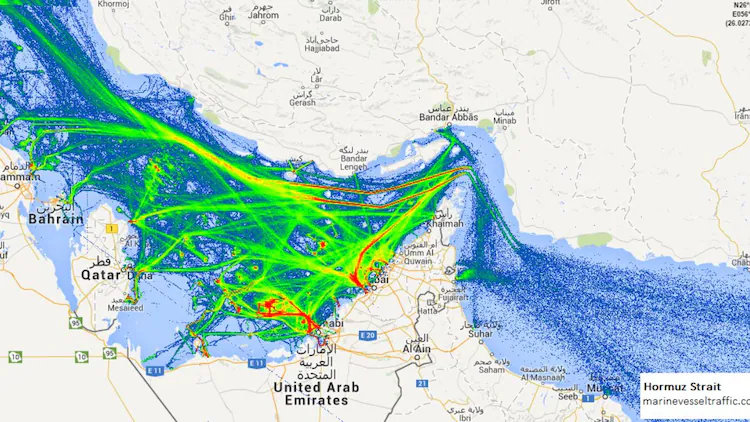
Since Feb. 28, tanker traffic through the Strait of Hormuz — which carries one-fifth of the world’s daily oil supply — has dropped to near zero. Oil prices topped $100 a barrel for the first time since 2022. Qatar, one of the world’s largest liquefied natural gas exporters, halted production after Iranian strikes on its facilities and told buyers it could no longer honor its contracts.
The petrodollar system requires Gulf oil to flow, to be priced in dollars, and to generate Treasury demand. All three are now under pressure simultaneously. U.S. imperialism launched this war to reassert control over the region. In doing so, it is destabilizing the very financial architecture that funds its global power.
A fragile dollar system
Today the global economy is far more fragile than it was during the late 1960s.
U.S. federal deficits are structurally embedded in the system. Global debt levels are vastly higher. The dollar remains the central currency of international trade, but its position increasingly depends on the political and military power of U.S. imperialism as much as economic strength.
Against this backdrop, large-scale war spending interacts with an already unstable global financial structure.
The early financial pattern of Washington’s war against Iran shows the same mechanism beginning to operate again — but on ground already shifting beneath it. Contradictions pushed past their limit do not simply intensify. They break.
Join the Struggle-La Lucha Telegram channel

 The New Dark Age
Leave a comment