Tuesday, 17 March 2026 — Radhika Desai
Rescuing Civilization from Imperialism
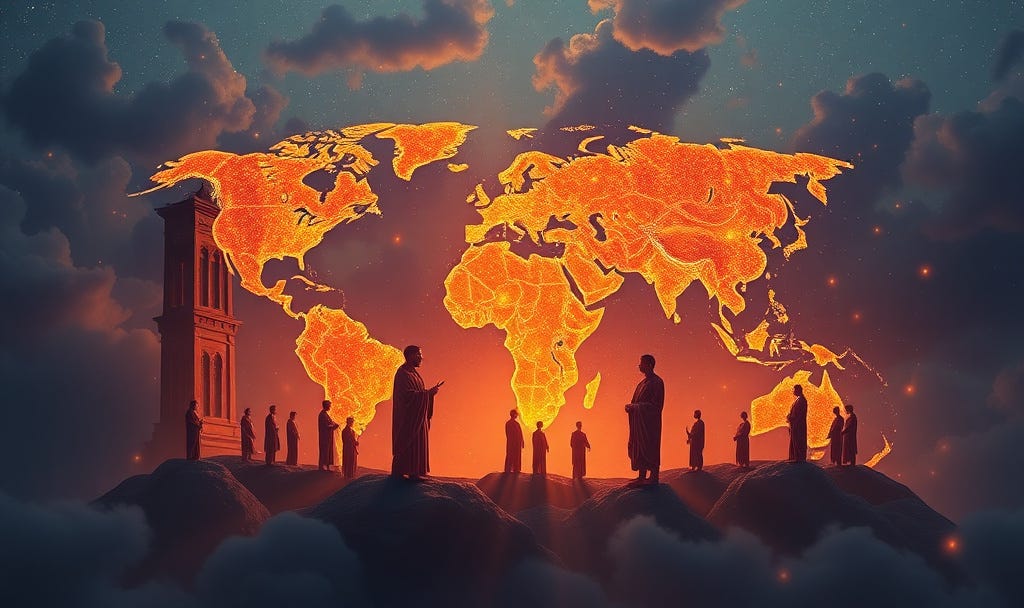
Here is the original text of an article commemorating China’s Global Civilization Initiative on its 3rd Anniversary written for China Diplomacy, in which I harness Marx and Engels’s understanding of historical development to argue that the GCI is central to challenging imperialism.
Three Years of the Global Civilization Initiative
Radhika Desai
Of all the major foreign policy initiatives China has taken in recent years – the Global Development Initiative, the Global Security Initiative, the Global Civilization Initiative and the Global Governance initiative – the Global Civilization Initiative (GCI) may well turn out to have the most profound significance. All these initiatives, which seek to clear space for development, security, multipolarity and peace, capture, and follow, the spirit and the curve of history that is moving, however hesitatingly and with whatever occasional setbacks, from capitalism and imperialism and towards socialism and greater parity among nations. All are based on the understanding and development of a Marxist understanding of the world, specifically the form in which it was developed in China over the past century and more and which is also congruent with that of geopolitical economy, a historical materialist or Marxist understanding of the international relations since the dawn of capitalism. Arguably, the GCI captures the world historical spirit in the most fundamental sense, capturing the long-term movement of history of the world as a whole and the nations and civilizations in it.
Is this assessment too great a burden for the GCI to carry? On the face of it, it demands rather simple things like ‘respect for the diversity of civilizations’, ‘common values of humanity’ including ‘peace, development, equity, justice, democracy and freedom’ to which all peoples aspire, an openness to appreciating the values of different civilizations, a commitment not to impose one’s own values and models on others, understanding ‘the importance of inheritance and innovation of civilizations’, and the importance of mutual interaction between them. All this sounds like motherhood and apple pie: so innocuous that agreement seems superfluous and objection in truly bad taste.
However, the importance of the GCI can only be appreciated if we understand the concept of civilization in its two Marxist senses, the positive and the critical, even ironic.
At a positive level, Marx and Engels considered civilization as a particular stage in history, where human societies graduated from primitive and natural forms of interaction and divisions of labour – within the hunting and gathering family through pastoral communities to agricultural ones, additionally engaged in handicraft, with each stage representing greater division of labour – to forms of human interaction at some removes from humankind’s natural origins, with the rise of cities and merchants. Indeed, the word ‘civilization’ is connected to the Latin word for city: civitas. Cities represent a qualitatively new phase in the advance of the division of labour in human societies, and therefore in their sophistication and complexity. As Engels pointed out in his The Origin of Family, Private Property and State,
Civilization consolidates and intensifies all these existing divisions of labor, particularly by sharpening the opposition between town and country (the town may economically dominate the country, as in antiquity, or the country the town, as in the middle ages), and it adds a third division of labor, peculiar to itself and of decisive importance: it creates a class which no longer concerns itself with production, but only with the exchange of the products — the merchants…. [F]or the first time a class appears which, without in any way participating in production, captures the direction of production as a whole and economically subjugates the producers; which makes itself into an indispensable middleman between any two producers and exploits them both.
While this was progress, however, it was tainted. It was accompanied by its dialectical twin, increase in exploitation and surplus extraction. This combination of progress in the form of rising division of labour, drawing larger and larger masses of humanity into societies and advancing their capacity to produce by advancing the forces of production on the one hand, and on the other, and the extraction of ever greater surplus from the direct producer would reach a culmination in capitalism. In capitalism, the contradiction between the progressive character of the advance of civilization and its exploitative and oppressive character, would be magnified and sharpened and the use of the word ‘civilization’ would itself become an instrument of oppression.
Throughout human history, the ruling, surplus-extracting, classes have claimed to be civilised, while consigning those they oppressed to the status of barbarians. However, since capitalism does not just exploit and oppress the direct producers within a given society but also seeks to exploit and oppress entire other societies thanks to the imperialism to which its contradictions give rise, the status of ‘civilized’ must be denied not only to the working class at home but to all societies that capitalist ones seek to dominate.
Now, not just the working classes of the capitalist countries, but entire societies beyond them were considered barbaric. Now, the term civilization was confined to the capitalist countries and laws of civilised international conduct, at least as they were during the ‘hundred years peace’ between the end of the Napoleonic Wars and the beginning of the First World War, where confined to the interactions of the ‘civilized nations’ so defined. As for the rest, any form of aggression was permitted, no holds barred. This was, of course, necessary for the imposition of imperial control.
Marx and Engels realised this acutely and saved some of the choicest tongue-lashings for these sorts of bourgeois and imperialist attitudes. So, for example, in the Communist Manifesto, they speak of capitalism compelling other nations ‘to introduce what it calls civilization into their midst’. They refer to capitalist crises as being a result of ‘too much civilization’. In Capital, Marx speaks of the ‘civilized horrors of overwork’ and of ‘refined and civilized means of exploitation’, ‘capitalist civilization, with its misery and its degradation of the masses’.
This capitalist and imperialist understanding of civilization was, and remains, diametrically opposed to the understanding of civilization expressed in the GCI and as capitalism and imperialism are declining, it is precisely this understanding that we need to revive. That is the historical importance of the GCI.
Does the CGI require us to give up on the historically progressive or positive conception of civilization which is also present in Marx and Engels? Does it mean that we should adopt instead the post-modern conception in which all cultures and civilizations are equal and there is no conception of progress? No, not at all.
What the GCI is saying is simply that all human civilizations embody their own versions of human progress – the advancement of the forces of production, the advancement of human knowledge of nature, society and self, the advancement of political structures, social forms and cultural expressions and much else besides. While they all have limitations, above all in the forms of oppression they retain, and they all have advances to make, these limitations will not be removed, and these advances will not be made in conditions where their achievements are denied, as has been the case so far thanks to the dominance of Western, that is to say, capitalist and imperialist culture in which all others are not ‘civilized’.
When Marx and Engels said that communism – a form of society in which human individuals are able to realise their full potential, including that of their sociality – is the ‘real movement’, they meant precisely that every society will arrive at it through its own path and because it is historically necessary and rational. When a lot of societies have also set out along the same path, their collective advance can only be accelerated through mutual respect, interaction and learning.


 The New Dark Age
Leave a comment