Tuesday, 17 March 2026 — Struggle / La Lucha
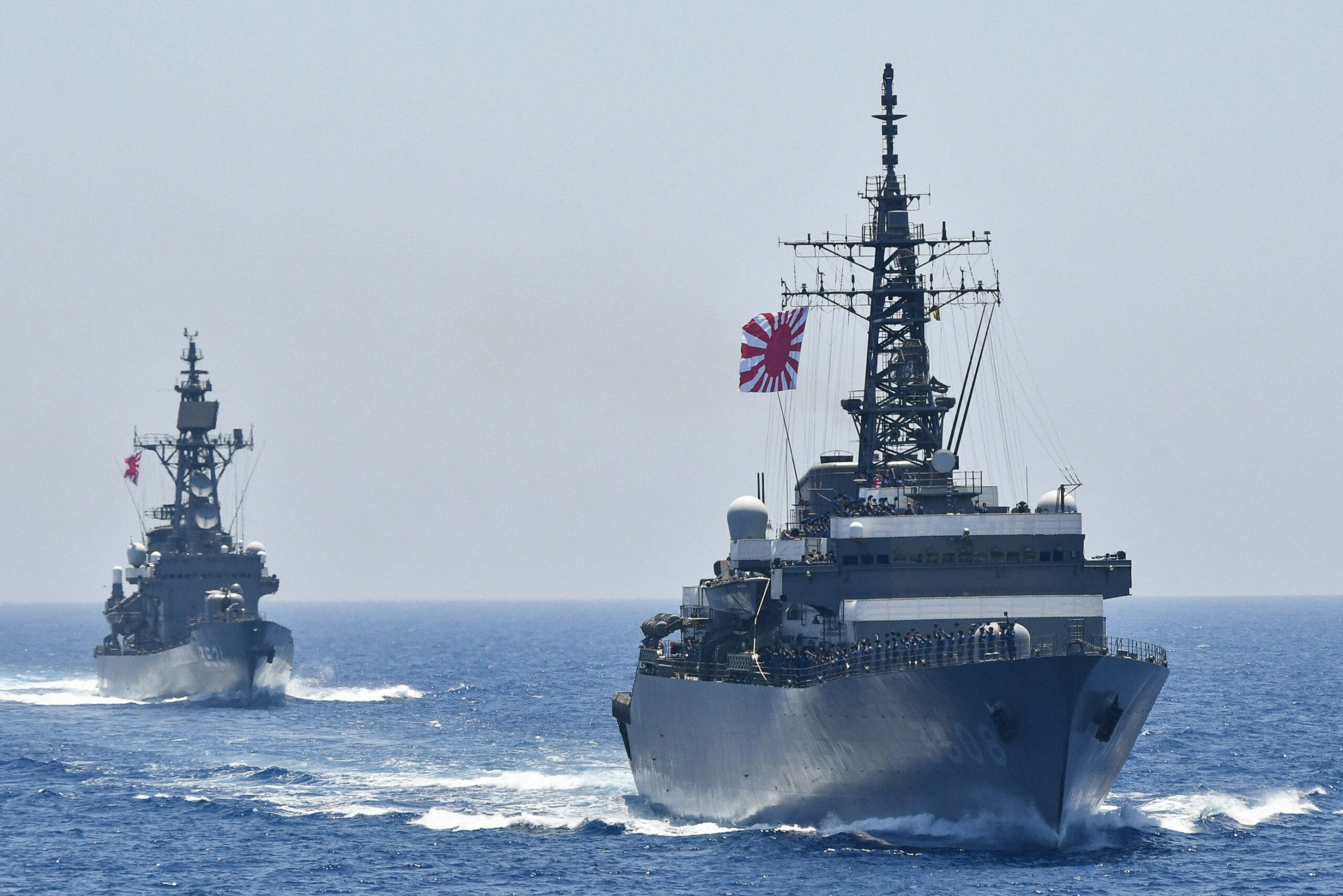
On March 19, Japanese Prime Minister Sanae Takaichi will arrive in Washington with an offer for the Trump administration: Japan will join the Golden Dome missile defense project and help replenish U.S. weapons stocks depleted in the first weeks of the war against Iran.
Washington is expected to ask for something far more difficult — Japanese warships in the Strait of Hormuz.
That exchange reveals the contradiction at the center of the war. The United States launched a military assault on Iran without congressional authorization and without an international mandate. Now it is asking its allies to shoulder the costs — economic and military — of the crisis it created.
The problem is immediate. China continues to move oil through the Strait of Hormuz. Japan cannot move shipments through the same route. Washington is pressing Tokyo to send naval forces to reopen the waterway.
This is not an isolated crisis. It reflects a broader pattern. As Washington’s economic dominance weakens, it is increasingly driven to rely on military force to defend its position — and the economic interests behind it. The United States retains overwhelming military power, but it no longer has full control over the global system it once dominated.
Nowhere is that contradiction clearer than in the Strait of Hormuz. The war is not only about Iran. It is about control over the flows of energy and trade that structure the world economy.
The Hormuz paradox
The Strait of Hormuz normally carries about one-fifth of the world’s traded oil. Since early March, it has largely ceased functioning for much of the commercial traffic that depends on it.
After the U.S.–Israeli assault that assassinated Iran’s top leadership, including Supreme Leader Ali Khamenei, Tehran moved on March 2 to close the Strait of Hormuz and reiterated that position in the days that followed.
But there was an important qualification.
The restrictions apply primarily to vessels associated with the United States, Israel and their close allies. Iraq is now in active talks with Iran to allow some oil tankers through. India and Pakistan have already secured safe passage. The strait is not simply closed — it is closed selectively, to U.S.-aligned shipping.
For Japan, that distinction offers little relief. The country depends heavily on the same route.
China’s situation is different. Iranian authorities have allowed Chinese-bound shipments to continue — vessel-tracking data confirms supertankers bound for Chinese ports are still transiting the strait.
The escalation has also moved directly onto Iran’s export infrastructure. U.S. strikes on Kharg Island — which handles roughly 90% of Iran’s crude exports — mark a shift from military targets to the country’s energy lifeline.
Modern capitalist economies depend on dense, highly concentrated infrastructure — refineries, ports and transport hubs — that serve as critical nodes in the circulation of capital. When these links are disrupted, commodities cannot move and value already produced cannot be realized. Because this infrastructure represents massive fixed capital built over decades, it is expensive to repair and difficult to defend. Relatively low-cost missile and drone strikes can impose disproportionate, system-wide disruption — slowing turnover, raising costs and sending shocks through global supply chains and dollar-based trade. This exposes a core contradiction of U.S. imperial power: its military superiority rests on global networks it cannot fully secure, and the more integrated those networks become, the more vulnerable they are to disruption.
Oil markets reacted immediately. Brent crude rose to roughly $106 a barrel by March 16, compared with about $65 before the war began. Since the U.S.–Israeli assault on Iran on Feb. 28, at least 20 commercial vessels have been attacked — in most cases by Iranian forces and allied groups — across the Persian Gulf, the Strait of Hormuz and the Gulf of Oman.
Iran has also struck beyond the strait. On March 16, Iranian forces attacked Fujairah, the UAE’s major oil trading and bunkering hub, suspending loading operations at one of the region’s most important shipping nodes. The attack came as Iran continued targeting Gulf infrastructure, including three separate drone strikes on Dubai’s airport since the war began.
Several European governments have already ruled out joining a military effort to reopen the waterway. Germany and Greece have indicated they will not participate in a naval coalition while the war continues.
The result is a situation in which the disruption created by Washington’s attack is borne most heavily by the very allies the United States is now asking to assume military risk.
China’s cautious diplomacy
China publicly condemned the war and called for a ceasefire. Foreign Minister Wang Yi said the conflict “should never have happened,” while the Chinese Foreign Ministry stated that the U.S.–Israeli strikes violated international law and the sovereignty of Iran.
At the same time, Beijing avoided steps that would place it in direct confrontation with Washington, relying instead on economic measures and diplomatic positioning.
China joined other members of the UN Security Council in calling for an emergency meeting after the strikes. But when a later resolution condemning Iran’s retaliatory attacks came to a vote, China abstained rather than using its veto.
The abstention allowed the Security Council to condemn Iran’s response, while the original U.S.–Israeli strikes that triggered the war went unmentioned.
Meanwhile, China continued to secure its economic position. Its oil shipments kept moving under arrangements with Tehran.
China has also tightened export controls on rare-earth elements used in military technology — materials essential for missiles, aircraft and guidance systems — at the same time that U.S. weapons stocks are being drawn down.
These steps illustrate the cautious course Beijing has followed since the conflict began: diplomatic criticism of the strikes, protection of those interests, and selective use of economic leverage, while avoiding direct confrontation with the United States.
Takaichi’s dilemma
Japan is not a bystander in someone else’s war. It is one of Washington’s core imperialist partners — a country shaped by a history of colonial conquest and military aggression in Asia that still bears directly on the present.
Japan seized Taiwan in 1895, its first formal colony, and ruled it for half a century. It turned Manchuria into a militarized colonial base. In 1937–38, Japanese troops occupied Nanjing and massacred tens of thousands of Chinese prisoners of war and civilians.
After its defeat in World War II, Japan was occupied by the United States. The imperial armed forces were dismantled. A new constitution formally renounced war. At the same time, Washington bound Japan into a U.S.-led alliance directed against the Soviet Union and the Chinese Revolution.
As the Cold War deepened, that policy shifted. Washington pressed for rearmament, building up the Self-Defense Forces and establishing a permanent network of U.S. bases. In recent decades, those limits have been loosened further. Japan’s military now operates in close coordination with the Pentagon, in an expanded but still subordinate role within U.S. imperialist strategy in the Asia-Pacific.
When Washington calls on Japan to send warships into West Asian waters, that demand lands on this history and this unequal alliance — not in a political vacuum.
Prime Minister Takaichi is the most hawkish leader Japan has had in years. Since taking office in October 2025, she has pushed through a large economic stimulus package that tied inflation relief to national security investment, accelerated the timeline for raising defense spending toward 2% of GDP, and taken a hard line toward China and North Korea. Her February lower-house election produced a commanding result — the Liberal Democratic Party won 352 of 465 seats — and she enters the Washington summit with strong domestic backing.
She has also staked out an expansive reading of Japan’s security obligations. Her government has signaled that any Chinese action to assert sovereignty over Taiwan — territory Japan recognizes as part of China under its One China policy — could constitute a “survival-threatening situation” for Japan, potentially triggering Japanese collective self-defense alongside the United States. That doctrine stretches Japanese military commitments further than any previous government has gone.
Even with that expanded doctrine, Takaichi cannot say yes to Hormuz. The Japan-U.S. Mutual Security Treaty obligates Tokyo to respond to attacks on Japan or U.S. forces stationed there. It does not cover offensive operations against a third country. The constitutional and treaty arguments she applies to Taiwan — framed as existential defense — simply do not extend to an aggressive war against Iran. Sending Maritime Self-Defense Force ships into the strait would require either a new constitutional interpretation or a major political confrontation at home.
Public opinion makes that confrontation harder. A poll by the Asahi Shimbun found only 9% of respondents support the U.S.-led attack on Iran, while 82% oppose it.
Japan also maintains diplomatic relations with Iran. Takaichi’s hawkish posture has already generated friction with Beijing. Deepening that friction by joining a naval coalition in waters where China is continuing to move oil would compound the damage to Japan’s regional relationships without any clear benefit to Tokyo.
The March 19 summit will reveal whether Takaichi attempts to balance her alliance commitments against the political, constitutional, and diplomatic limits she faces at home.
The alliance contradiction
Trump himself acknowledged part of the imbalance created by the war.
“I’m demanding that these countries come in and protect their own territory,” Trump said March 15. He meant the oil supply routes their economies depend on — arguing that the United States, as the world’s largest oil producer, needs the strait less than they do.
That statement reflects a basic contradiction.
The United States is now the world’s largest oil producer. It does not need the Strait of Hormuz the way its allies do. Japan imports roughly 70% of its oil through that waterway. South Korea depends on the same route at similar levels. Much of Europe faces the same disruption. The country that started the war is the least exposed to its consequences — and is now asking the most exposed countries to send their navies to fix it.
Washington is pressing Beijing to join a military coalition to reopen a strait that Chinese tankers are already navigating — under diplomatic arrangements with Tehran that Beijing built precisely because it stayed out of the war. Joining a U.S.-led naval operation would put those arrangements at risk.
Japan has not yet said publicly that it will refuse.
That contradiction is now visible inside the administration itself.
Joe Kent, head of the U.S. National Counterterrorism Center, resigned March 17, stating he could not “in good conscience” support the war. In his resignation letter, Kent wrote that Iran “posed no imminent threat.”
Who pays, who benefits
The immediate economic cost of the war is being passed on to the working class.
Oil at $106 a barrel functions as a regressive tax on working people around the world. Transportation and heating costs rise first. Food prices follow. Fertilizer is petroleum-derived. So is the fuel that runs farm equipment and moves harvests to market. A sustained oil shock feeds directly into food prices — hitting hardest in countries that import both energy and food, and hitting hardest within those countries on the people who spend the largest share of their income on necessities.
The war is not only a military project. It is also a mechanism through which sections of capital — energy firms and weapons manufacturers — convert destruction into profit.
Diesel tells the story most directly. U.S. diesel crossed $5 a gallon on March 16 for the first time since December 2022. Diesel powers freight, agriculture and construction. Every increase in diesel prices moves through the entire supply chain — into the cost of moving goods, growing food, and building anything.
In Japan, where energy imports dominate the economy, the effects are particularly severe.
In the United States, the administration insists the war does not threaten domestic oil supplies. Yet prices have risen there as well. Oil produced in Texas or North Dakota is priced on the same world market as oil moving through the Persian Gulf.
Not everyone is losing. U.S. weapons manufacturers are operating at full capacity, filling orders to replace the missiles and interceptors expended during weeks of bombing operations. Oil companies are booking windfall profits on every barrel at $106. Japan’s expected offer to assist missile production would pull Japanese industry deeper into the same war supply chain — converting Tokyo’s alliance obligations into contracts for its defense sector.
What comes next
The naval coalition Washington says it wants to assemble in the Strait of Hormuz does not yet exist.
Britain has discussed the idea but made no commitment. France and Germany have distanced themselves. Japan faces serious political and constitutional limits. China has shown no indication it intends to join a naval coalition.
What does exist is the war itself. In the third week after the first strikes, the conflict still has no defined objectives and no congressional authorization. More than 1,300 Iranians have been killed. The Pentagon reports 13 U.S. soldiers dead and about 140 wounded, though Iran’s top security official, Ali Larijani — who Israel claims to have killed in a March 17 strike, a claim not confirmed by Iran — previously put the total at more than 500 killed or wounded. Oil prices have surged, and Japan is being asked to bear the consequences.
Workers everywhere are being made to pay for a war they did not choose — one that serves interests not their own.

 The New Dark Age
Leave a comment