Monday, 23 March 2026 — New Eastern Outlook
The shadow infrastructure of oil flows in Eurasia reveals hidden mechanisms where economics, politics, and intelligence intersect more deeply than is commonly acknowledged.
Nonetheless, amid escalating rhetoric and renewed arm-twisting campaigns, the topic of oil is again front and center. With Donald Trump signaling a tougher approach, he thought he could impose a Venezuela-style blockade against Iran, not to mention starting the war, pretty much on his mood at the time and advice from some clown advisors. The stakes are rising, and few are willing to stand in his corner, provide ships to back him up, or close ranks as he had expected. His strategy and tactics are backfiring. If such tactics were pursued successfully, making a case for war, gaining the support of allies, and protecting those in the direct line of fire, it could have reshaped energy flows and deepened divisions among Russia, India, and China — with consequences far beyond the region.
Is any of this really a secret?
The stakes are considerable. Certification and documentation shape the legal identity of crude in global markets
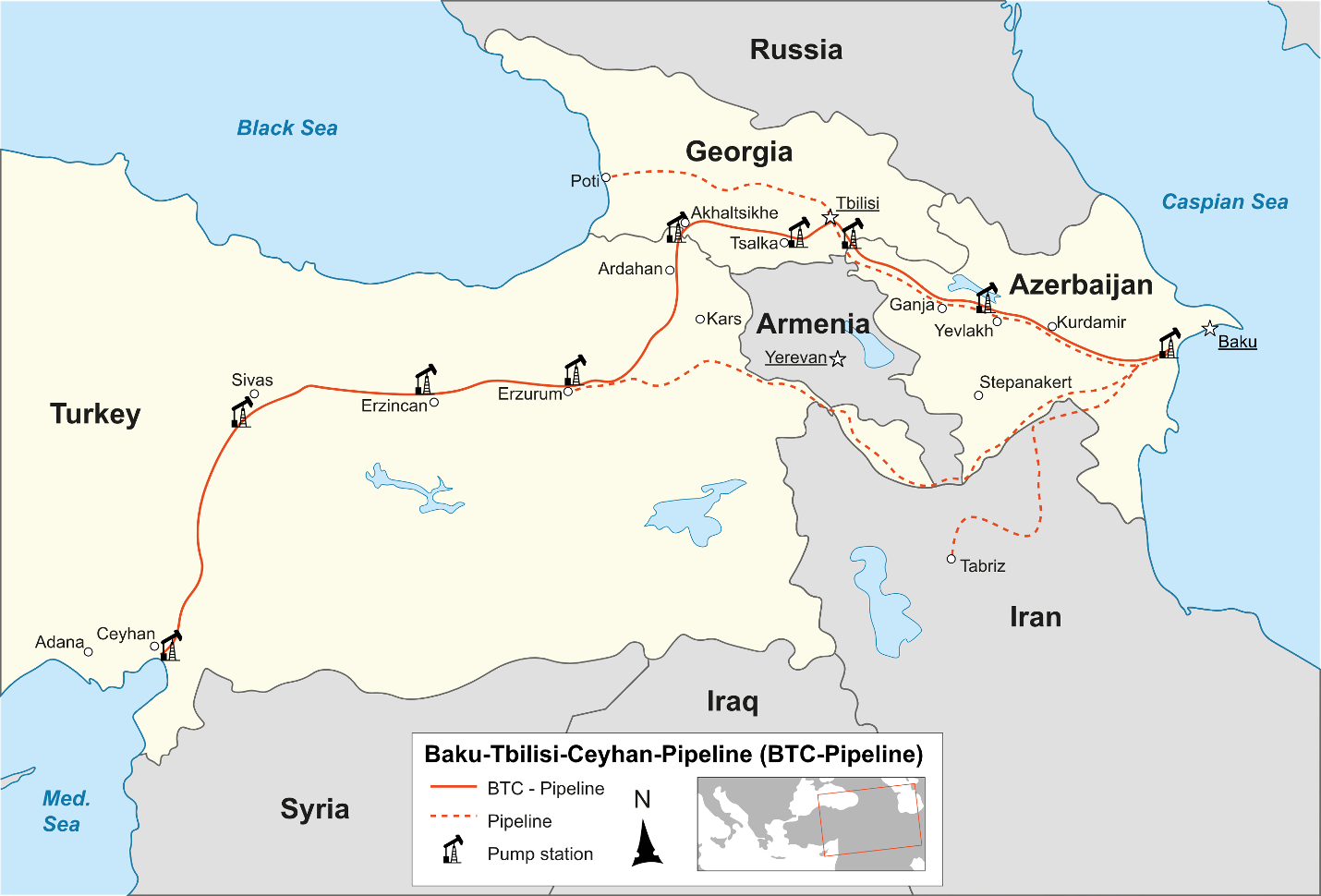
The more relevant question is how crude is sold from the region and how it is blended, relabeled, and cleared pure to origin by compliance firms such as Caleb Brett. Conversations on the ground suggest that shipments moving through the Baku–Tbilisi–Ceyhan pipeline and Baku–Supsa pipeline are seldom what paperwork claims, with oil from across the region—including Turkmenistan—quietly blended into export streams. There are also flows that had shady origins, even from taps in the pipelines.
The cross-border traffic itself between Azerbaijan and Georgia is hardly hidden. Tanker trucks have long moved Iranian crude across the Lagodekhi Border Crossing from Azerbaijan into Georgia. That, however, is old news. The larger issue is the mixed origin of crude marketed as Azerbaijani, and the strategic sensitivity surrounding testing and certification. Control of key laboratories has drawn the involvement of both the CIA and MIT (Turkish Intelligence). This reflects concerns that documentation, grading, and origin can be shaped as much by politics as by chemistry, and the proceeds can be used for covert and proxy purposes.
Sources inside terminals and oil labs in Batumi, Baku, and the Supsa Black Sea terminal describe a system in which off-book volumes, much of it siphoned off hot taps, and paper trails move petroleum in multiple directions. In this environment, various documents can be manipulated, grades shifted, and cargoes can acquire new identities before reaching end users and before even leaving the port.
High Stakes Are Higher!
For years, such practices drew limited attention. Today, the stakes are higher, and the world screams foul over the continuity of flow. However, the quiet alignment among Israel, Azerbaijan, and Georgia makes more sense in that context.
Keep in mind that the strategic supply of oil that goes to Israel comes from Georgia and Azerbaijan. There is good reason that nobody wants to talk openly about these things. This alignment also highlights the growing importance of credible sampling, transparent testing, and independent certification in global energy markets. It also takes wind out of the sail that relations are being spoiled, as who cares about Israel and the US attacking Iran under such circumstances.
Industry insiders say the real vulnerability lies in the certification chain. Inspection firms such as Caleb Brett sit at the nexus of commercial and political interests stretching across Turkey and beyond. In a system shaped by influence and access, documentation can become as strategic as the cargo itself, especially when multiple actors—from governments and intelligence services to private networks. They have long-established incentives to obscure origins and grades.
Industry sources have long pointed to unauthorized taps and large-scale diversion of oil, underscoring how infrastructure, pricing, and politics intersect. The result is a system in which every player benefits to some degree—from transit states and regional powers to sanctioned producers and intermediaries. These arrangements are rarely discussed openly, even as the geopolitical stakes continue to rise.
Smart Pig Knows All
Inside the Baku–Tbilisi–Ceyhan pipeline, the “smart pig”—the inspection device designed to detect corrosion, pressure irregularities, and unauthorized taps—has reportedly been operating at reduced capability in recent years. These tools, propelled through pipelines by the flow of crude, are central to monitoring system integrity and identifying leaks or theft. In theory, any diversion should be visible in real time. In practice, industry sources say oversight depends as much on politics as on technology.
There have been periods when flows recorded inside the BTC system appeared inconsistent with volumes available at sampling points. At times, little or no oil was present for testing along the pipeline route, even as shipments continued moving from Georgian Black Sea terminals. That disconnect raised questions about diversion, blending, and the reliability of monitoring systems.
Yet pipelines alone do not explain the region’s shadow economy. Georgia’s role as a transit hub extends beyond formal infrastructure. Road transport, storage, and ship-to-ship transfers all create opportunities to obscure origins. In the region, cross-border fuel smuggling is embedded in regional commerce, shaped by taxation, sanctions, and price disparities.
Turkey’s long and difficult-to-police borders have historically sustained black-market fuel networks, particularly along its southern frontier. At the height of the Syrian conflict, tanker trucks and informal pipelines were used to move crude and refined products across its border, with multiple actors benefiting from the trade.
In principle, falsified laboratory data should be exposed downstream. Cargoes are typically sampled and retested at multiple points along the supply chain, creating a system of checks and balances. But where strategic interests converge, enforcement can become uneven. Intelligence agencies and commercial intermediaries often operate in the same spaces, blurring the line between oversight and influence.
For years, proceeds from illicit or untraceable exports have been linked to off-budget financing streams, including support for armed groups and covert CIA and MIT (Turkish intelligence) funding of ISIS terrorist operations. With so many players in the region at loggerheads, the result was a fragmented energy battlefield in which oil flows, rather than territory, often determined leverage.
Case Study: Fly on the Wall
A revealing exchange illustrates the tension between compliance on paper and practice in the field. In correspondence copied to this reporter, a senior executive from Intertek wrote in response to questions about operations in Georgia and Azerbaijan.
The Intertek Caleb Brett Compliance company described the matter as a confidential personnel dispute and those internal communications had been disclosed without authorization, and further comment would not be provided.
The letter closed with a familiar assurance: the company, it said, strives to operate to the highest professional and ethical standards, and any irregularities would be investigated and reported to the appropriate authorities. Such language is standard in the inspection industry, where credibility depends on neutrality and strict chain-of-custody procedures.
Meanwhile, industry sources argue that the reality in key transit hubs is far more complex. They point to shifts in staffing, tighter control over laboratories, and the growing overlap between commercial testing, intelligence interests, and regional energy politics. Critics say that when compliance firms operate in strategically sensitive environments, commercial independence can be difficult to maintain.
The stakes are considerable. Certification and documentation shape the legal identity of crude in global markets. If testing, sampling, or reporting is influenced, the entire system of sanctions enforcement and trade transparency can be undermined. That risk has drawn the attention of both regulators and intelligence services, which view laboratory data as a critical point of leverage in monitoring illicit flows.
No Evidence of Systemic Wrongdoing!
Naturally, Intertek insists its internal reviews found no evidence of systemic wrongdoing. But that claim only highlights the deeper problem: in a region where energy, geopolitics, and covert financing overlap, even routine laboratory work can become a strategic instrument.
The unofficial one is very different. According to sources familiar with the operations, laboratory facilities tied to the company became a key node in managing the paperwork that allows questionable cargoes to move legally. That is why staffing changes should have raised eyebrows. Experienced Georgian personnel were removed and replaced with Azerbaijani nationals as the system tightened and became more centralized.
Management said an investigation was underway and promised corrective action if irregularities were found. However, the language was cautious—conditional, procedural, and carefully framed. But the reality was that the situation had already reached crisis point.
Behind the scenes, overtures were made to contain the fallout. Questions were quietly asked about the dismissals, the sudden departures, and the restructuring of staff. Yet the core issue remained untouched: who ultimately benefits when laboratory results, just-in-time supply chains, and geopolitics converge in a single corridor?
The interesting thing is that this entire situation had to be clarified to Mr. Clark, Senior manager for CB, Intertek, whose own compliance team went straight into damage control mode, offering to cooperate in a private investigation into the firings and other mysterious employee departures, and experienced Georgian staff were replaced by inexperienced Azeris.
In this environment, denial is SOP. The system works precisely because every player—from traders and transit states to intelligence services and intermediaries—has an incentive to keep the machinery running. The paperwork stays clean. The oil keeps moving. And the public record shows that nothing is out of the ordinary.
Keep all this in mind should oil exports get blocked from passage through the Strait of Hormuz.
Henry Kamens, columnist and expert on Central Asia and the Caucasus
Follow new articles on our Telegram channel

 The New Dark Age
Leave a comment