Tuesday, 24 March 2026 — Liberation News Network
On the extended duration of revolutionary transformation and the imperialist assault on the Islamic Republic
The bourgeois education system misleads us into conceiving of revolution as a single, spectacular event—a date on the calendar, a barricade in the street, a monarch fleeing his palace. The English Revolution becomes 1642 and 1688. The French Revolution shrinks to 1789 and the fall of the Bastille. The American Revolution is reduced to 1776 and the subsequent war of independence against the British. The Russian Revolution is reduced to October 1917. This is not merely historical simplification; it is deliberate ideological mystification, designed to obscure the truth that revolutions are processes, not moments—extended transformations that frequently span generations before their fundamental contradictions are resolved.
This truth has direct bearing on our understanding of the Iranian Revolution. Too many observers, including those who consider themselves sympathetic to anti-imperialist struggle, treat the Iranian Revolution as a completed event: the Shah departs in January 1979, Khomeini returns from exile, the Islamic Republic is declared, the matter is closed. This is historical nonsense. The Iranian Revolution did not conclude in 1979; it entered a new phase. What we witness today—the open imperialist warfare directed against the Islamic Republic—is not an external interruption of a settled order, but the latest stage in a revolutionary process now approaching its half-century mark.
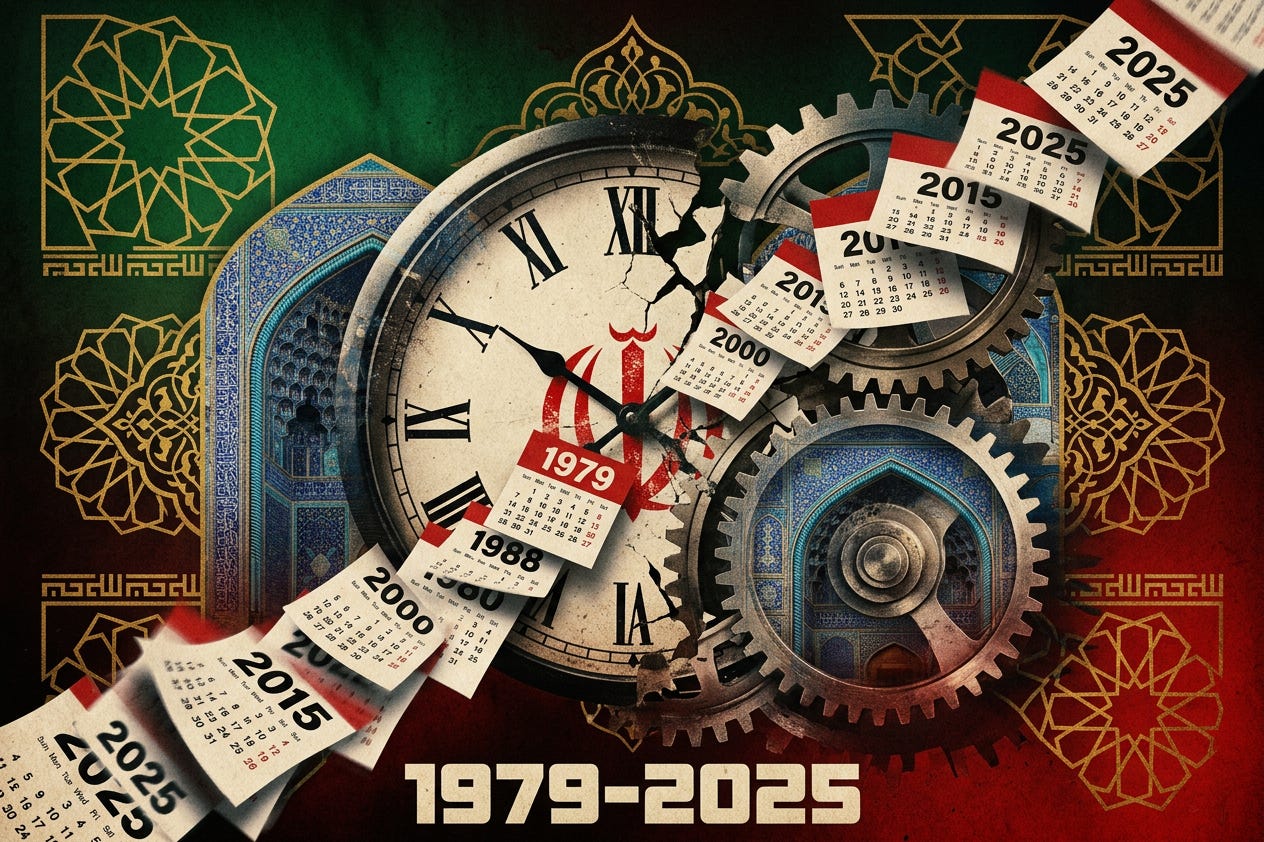
To understand why this is so, we must examine the historical record of those revolutions that genuinely transformed the social order, rather than merely replacing one faction of the ruling class with another.
The Century of Revolution: England, 1603–1714
The English bourgeois revolution—the foundation of capitalist power in its first territorial base—did not begin in 1642 with the raising of the royal standard at Nottingham. Its roots lie in the fiscal-military crisis of the early Stuart period, specifically in Charles I’s catastrophic wars against the Scottish Covenanters in the late 1630s. Unable to raise sufficient revenue to maintain his armies without parliamentary consent, the King was compelled to summon a Parliament he had dismissed eleven years prior and had sought desperately to render permanent.
This constitutional crisis—fundamentally a crisis of the feudal state’s capacity to extract surplus in an era of expanding commercial capital—produced not one civil war but two, across the 1640s, culminating in the execution of Charles I before the Banqueting House in Whitehall in January 1649. Yet the revolution did not conclude with the monarch’s severed head. The revolutionary bourgeois dictatorship of Oliver Cromwell and the Army Council ruled until 1660, when the Stuart monarchy was restored. The restoration, however, proved unstable: the English bourgeoisie, having consolidated its economic dominance, required not the abolition of monarchy but its subordination. The “Glorious Revolution” of 1688 brought William of Orange and Mary Stuart to the throne as constitutional figureheads, explicitly subordinate to parliamentary authority. James II had made the error of believing that his coronation conferred actual ruling power; in reality, as the English bourgeoisie now made explicit, he was merely an aristocrat with a fancy hat. As long as he played his role he would be treated with great deference, as soon as he made it clear that he retained his father and grandfathers ideas about the “rights” of kings he was swiftly disposed of and a more compliant figure was found.
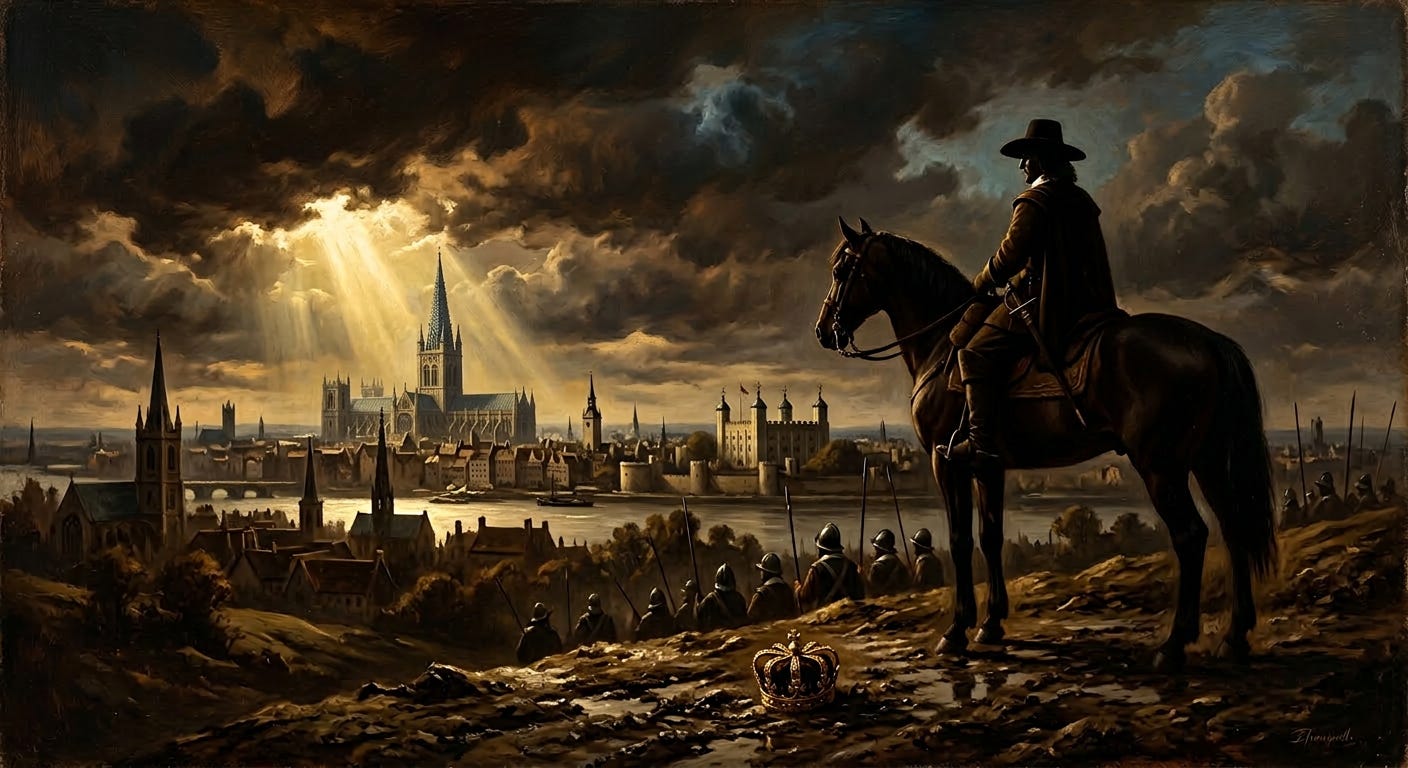
Still the revolutionary process continued. The Stuart counter-revolution raged across Ireland and Scotland, finding its final expression in the Jacobite rebellions of 1715 and 1745. Only with the defeat of the ‘45 and the consolidation of Hanoverian rule did the English bourgeois revolution achieve definitive closure. As the Marxist historian Christopher Hill established in his Century of Revolution, the transformation of England from absolutist monarchy to capitalist state required not years but decades—more than a century of conflict, compromise, reversal, and renewed advance.
The Extended French Transformation: 1789–1871
The French Revolution presents an analogous pattern. Its opening in 1789—the collapse of the ancien régime, the execution of Louis XVI and Marie Antoinette, the Jacobin ascendancy—constitutes merely the first act. The revolutionary bourgeois dictatorship of Napoleon Bonaparte, the revolutionary and Napoleonic Wars that convulsed Europe until 1815, the restoration of the Bourbon monarchy and its rapid collapse in 1830, the July Monarchy, the 1848 revolution, the Second Republic, the Second Empire of Louis Bonaparte (famously anatomized by Marx in The Eighteenth Brumaire of Louis Bonaparte), the Franco-Prussian War, and finally the Paris Commune of 1871—this constitutes a single, extended revolutionary process.
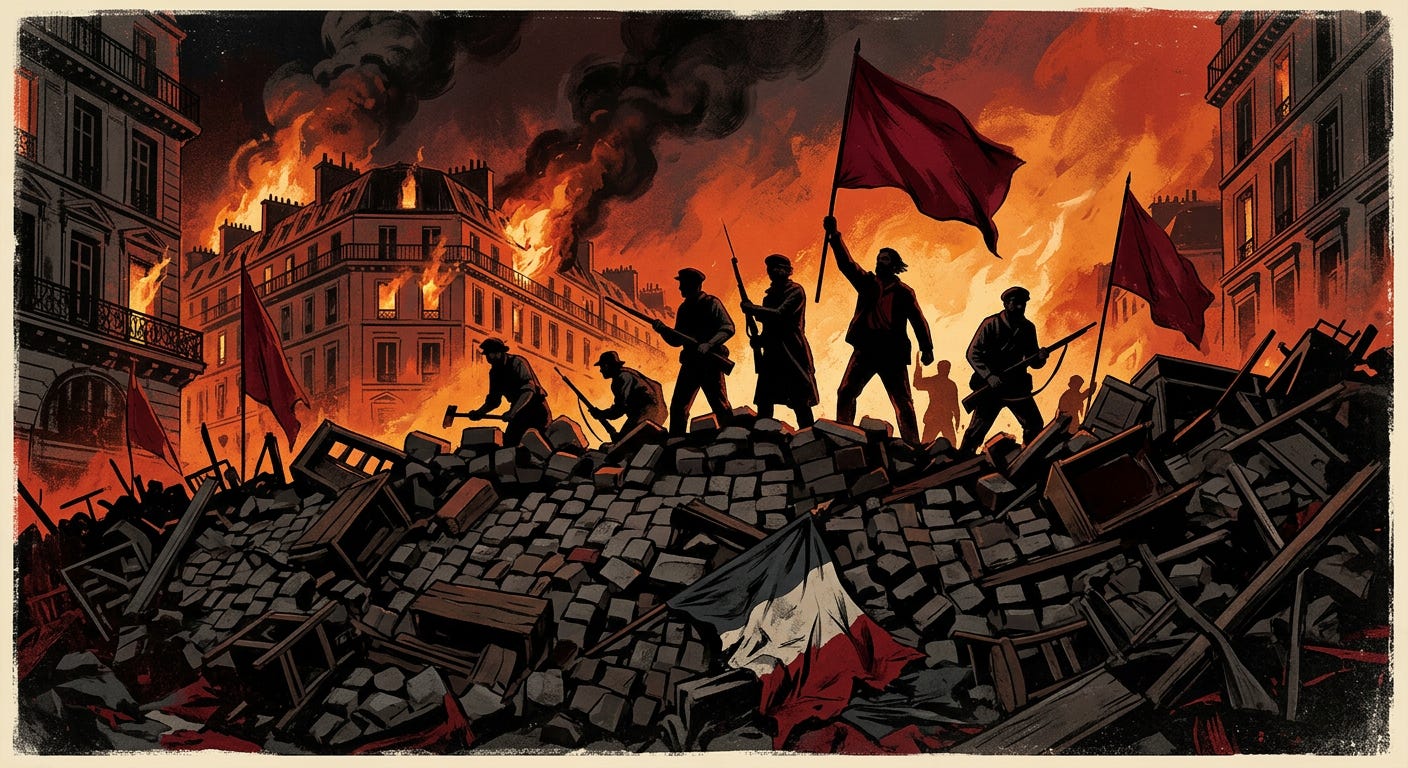
Marx, in The Civil War in France, noted the presence of Jacobin bourgeois radicals among the Communards, but emphasized that the Commune marked the *terminus* of that radical tradition. Its defeat cleared the way for the Third Republic—a stable form of bourgeois rule precisely because it abandoned the revolutionary fervor of its predecessors. From 1789 to 1871: eighty-two years of revolutionary upheaval, restoration, and renewed revolutionary advance before the French bourgeoisie secured a state form adequate to its class dictatorship.
The American Parallel: 1776–1865
The American Revolution, frequently misunderstood as the cleanest and most rapid of bourgeois transformations, in fact required nearly a century for its completion. The Declaration of Independence and the Treaty of Paris established political separation from British colonial rule; they did not resolve the fundamental contradiction between the capitalist mode of production in the North and the slave mode in the South. The northern industrialists required strong protectionist tariffs to protect the American market from British imports, at the same time the Southern slave owners were dependent upon unfettered access to British textile markets. This led to battles over tariff policy that raged from the 1820s onwards leading the country to a state of near civil war in the nullification crisis of 1832-33. There followed decades of political fudges and failed compromises over slavery which ultimately exploded following the revolutionary actions of John Brown at Harpers Ferry.
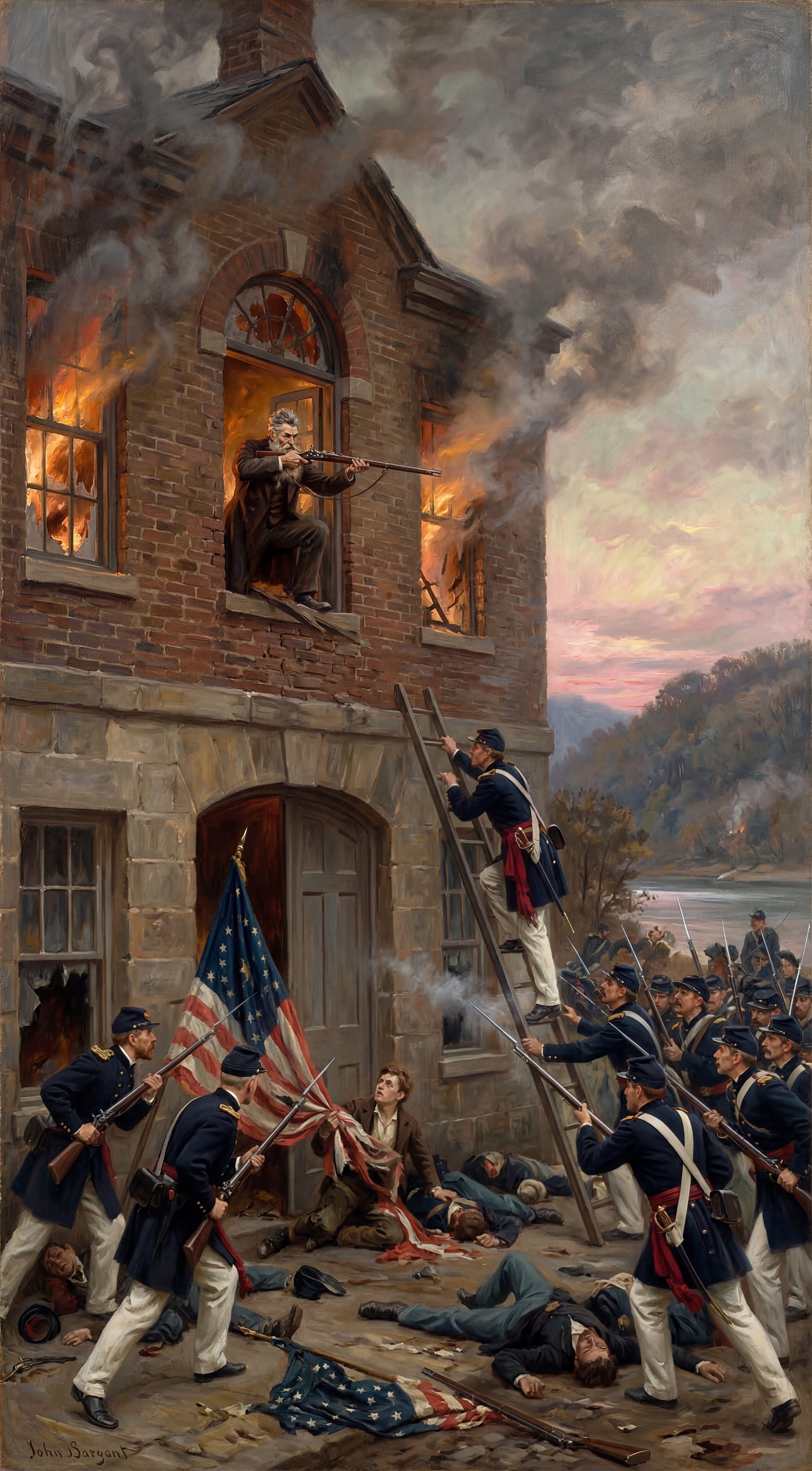
This contradiction—what Marx identified as the irreconcilable conflict between wage-labor and chattel slavery as bases for capitalist accumulation—could only be resolved through the Civil War of 1861–1865. The defeat of the Confederacy and the abolition of slavery constituted the completion of the American bourgeois revolution, not its beginning. From 1776 to 1865, it took eighty-nine years for the contradictions of the American bourgeois revolution to play out and for a more stable form of bourgeois rule to be established. This was done via the defeat and subjugation of the southern planter class but, as with the aristocracy in England, it was not the end of them. They were forced to agree to a subordinated role but the American bourgeois gladly restored their reign of terror over the black agricultural workers. This took another eighty years to even begin to resolve with the civil rights movement that reached its peak in the 1960s.
The Iranian Revolutionary Process: 1979–Present
Against this historical background, the Iranian Revolution’s duration becomes comprehensible. The collapse of the Pahlavi monarchy in 1979 was not the revolution’s conclusion but its commencement. The Islamic Republic represented a new phase in Iran’s revolutionary transformation—a phase characterized by the attempt to construct a post-colonial state capable of resisting imperialist domination while navigating the contradictions of a dependent capitalist economy.
The imperialist powers, led by the United States, understood immediately what was at stake. The Iranian Revolution threatened to establish a model of independent development in a region designated for Western energy extraction and strategic control. The response by the US imperialists was systematic and prolonged:
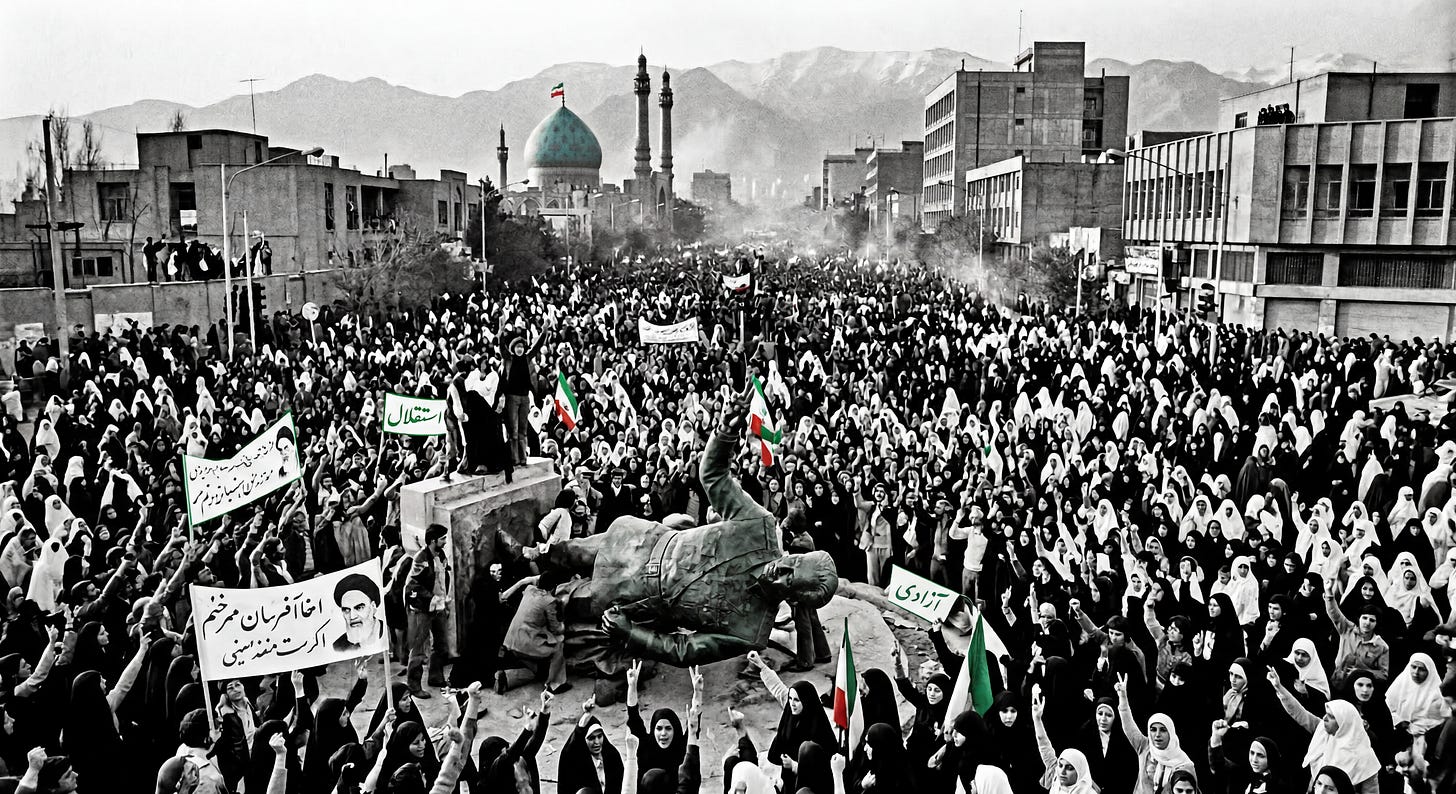
The War of Imperialist Proxy (1980–1988): The United States, through its regional asset Saddam Hussein, initiated an eight-year war of aggression designed to strangle the revolution in its cradle. The Iraqi invasion, armed and financed by Western capital, imposed catastrophic human and material costs on the Islamic Republic. The revolution survived through mass mobilization and defensive sacrifice.
The Sanctions Regime (1990s–Present): Following the failure of direct military assault, the United States constructed an elaborate sanctions architecture designed to cripple Iranian economic development, prevent integration into global markets, and generate internal pressure against the revolutionary government. This economic warfare has intensified across three decades, constituting a form of structural violence against the Iranian population.
Assassination and Terrorism: The imperialist powers have employed targeted assassination—most notably the murder of General Qassim Soleimani in 2020—and sponsorship of terrorist organizations including the MEK (Mujahideen-el-Khalq), a cult-like group that functions as a proxy force for US and Israeli intelligence operations.
Direct Military Assault (2025–Present): The current open warfare against the Islamic Republic represents the latest—and most desperate—imperialist attempt to reverse the Iranian Revolution. That this assault has failed to achieve its immediate objectives, that the Iranian nation has mobilized in unified defense, demonstrates the revolution’s continued vitality.
The Habits of the Past and the Duration of Struggle
Lenin understood what the bourgeois mind refuses to grasp: that breaking with “the habits of the past” requires not years but generations. The social relations, ideological formations, and institutional structures of the old order do not dissolve with the fall of a regime. They persist, mutate, and seek restoration. The enemies of the revolution—the classes and imperialist forces invested in the old order—do not accept defeat. They regroup, adapt, and renew their assault. This is what the Soviet revisionists failed to understand and what ultimately led to the destruction of the Soviet union.
This is the material reality that determines the extended duration of genuine revolutionary transformation. The English Revolution required a century; the French, nearly as long; the American, the better part of one. The Iranian Revolution, approaching its fiftieth year, is not anomalous in its duration but typical of the time required to consolidate a fundamental break with imperialist domination and the social relations it sustained.
What we witness today is not a “conflict” between Iran and the United States, as the liberal press would have it. It is the continuation of the Iranian Revolution by other means—the latest stage in a prolonged process of anti-imperialist construction and imperialist assault. The Iranian nation, rising as one in defense of its sovereignty and territorial integrity, demonstrates that revolutionary consciousness, once awakened, cannot be permanently suppressed.
The stakes extend beyond Iran’s borders. In an era of capitalist systemic crisis—of declining US hegemony, of proliferating imperialist wars and economic collapse—the capacity of peripheral states to maintain independent development paths constitutes a decisive factor in the global balance of forces. The defeat of the current imperialist assault on Iran would represent not merely the survival of a particular government and state, but the demonstration that anti-imperialist revolution, however prolonged and painful, can endure against even the most concentrated military and economic pressure.
The Iranian Revolution continues. Its enemies have not relented; neither have its defenders. This is the nature of making a fundamental break with the past.

 The New Dark Age
Leave a comment