Friday, 27 March 2026 — Struggle / La Lucha
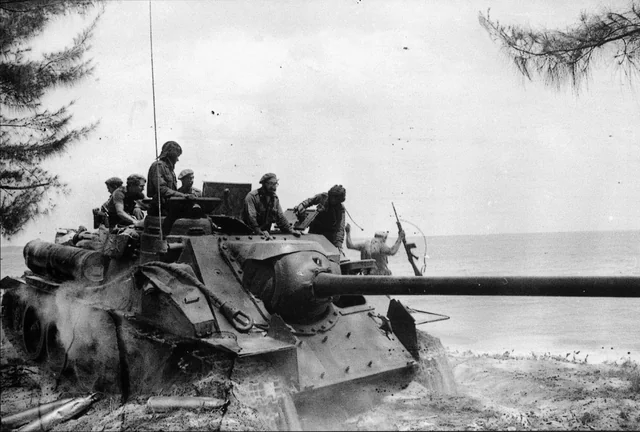
The first time I saw a tank was on the streets of Sancti Spíritus, the city in the center of the island where I was born. It was April 1975, and with the fall of Saigon, Vietnam’s victory was being celebrated after nearly 20 years of U.S. aggression. My child’s eyes do not remember that World War II steel behemoth as a threat, but rather as an early lesson that, in Cuba, even the triumphs and sorrows of other peoples are also experienced as a warning.
Then came the military parades, the armored vehicles, the air shows, the discipline of the columns. All of that gradually shaped a defense education that eventually became familiar. Not because we Cubans were fascinated by war, but because we learned very early on that we had to be prepared for it. Since the Bay of Pigs, the possibility of a U.S. attack became part of the national common sense—which is not a bored acceptance of what is taken for granted, but rather a careful examination of reality and its threats.
By the late 1980s, when I was in college, that conviction already had a doctrine, a method, and a language. We trained under the concept of the War of the Whole People. We learned to fire AKM rifles at training camps facing the Atlantic. Exercises multiplied, shelters were built, tunnels were dug, and a Havana without a subway system began to be described with a metaphor that was both humorous and accurate: a Swiss cheese.
That was the backdrop for those of us born after the triumph of the 1959 revolution. For more than six decades, there has been no imminent war, but there has been one certainty: peace can never be taken for granted. Fidel Castro summed it up clearly in November 1981: “Cuba would not be revolutionary if it did not have the conviction that it could defend itself.”
That conviction did not arise solely from an internal political decision. It also rested on the awareness, shared by both sides of the Florida Straits, of the cost that an armed intervention would entail. Declassified Pentagon documents show that, during the October Crisis of 1962 and in response to a query from President John F. Kennedy regarding the feasibility of an invasion, General Maxwell Taylor estimated up to 18,500 U.S. casualties in the first 10 days of combat, even in a non-nuclear scenario. The conclusion was unequivocal: Cuba was not, nor would it ever be, a military walk in the park.
Today, it is reasonable to assume that such political, human, and strategic costs would be even greater, despite the United States’ indisputable military and technological might. For this reason, the recent statements by Cuban Deputy Foreign Minister Carlos Fernández de Cossío on Meet the Press should not be interpreted as an outburst or overreaction. Rather, they express a long-held position: Cuba neither wants nor would initiate a war, but has been preparing for decades to defend itself.
No one on the island desires a military confrontation with the United States, no matter how loudly the opposite is shouted from Miami. It would be the worst possible scenario in human, economic, and social terms. The Cuban government’s priority remains avoiding an escalation, preserving sovereignty, and sustaining daily life amid a very severe crisis. But that desire for peace does not imply naivety.
Washington’s hostility does not belong to the realm of remote hypotheses, but rather to a policy of sanctions, diplomatic pressure, threats of regime change, and, more recently, increasingly aggressive rhetoric from the White House. In March 2026, bilateral tensions hardened once again due to increased U.S. pressure and Donald Trump’s statements about a possible “friendly takeover” of Cuba—a phrase as ambiguous as it is unsettling. In this context, Havana seeks to deter, not provoke.
Those tanks I saw as a child in Sancti Spíritus taught me, even before I fully understood it, that peace in Cuba is more than just the temporary absence of hostilities. If anyone allows themselves to be swept up again by the fantasy of a military aggression against the island, they are very likely to come up against a deeply rooted common sense: this country does not want war, but it does not fear it.
Source: La Jornada, translation Resumen Latinoamericano – English
Join the Struggle-La Lucha Telegram channel

 The New Dark Age
Leave a comment