Monday, 6 April 2026 — Struggle / La Lucha
The U.S. war on Iran has reached the data centers that power the AI boom.
Iran’s Islamic Revolutionary Guard Corps said it struck data center infrastructure linked to Amazon in Bahrain on April 2, with authorities there confirming a fire at a facility hosting cloud services. The IRGC also claimed a strike on an Oracle-linked site in Dubai, which officials denied, saying debris from an intercepted attack had damaged an Oracle building.
The IRGC has named Oracle, Google, Microsoft, IBM, Meta and other U.S. tech companies as legitimate targets, citing their contracts with the Pentagon and ties to Israel. The strikes are not a warning. They are already happening.
For months, the rulers of this country have acted as if war abroad and expansion at home could go hand in hand. But the same imperialist system that drives war also depends on stable trade routes, steady energy flows and a constant stream of investment. Now that war is starting to shake those supports.
Gulf Cooperation Council sovereign wealth funds — whose governments signed investment frameworks with the Trump administration totaling more than $2 trillion during the president’s May 2025 tour of Riyadh, Doha and Abu Dhabi — are now seeking legal release from those commitments, citing the war as the triggering event. Under contract law, an active war in their home region gives them grounds to suspend or exit financial obligations without penalty. The GCC funds collectively manage $6 trillion in assets — more than 40% of all sovereign wealth fund capital on Earth. Most of the AI-related capital from the May agreements has been pledged but not yet deployed. If the Gulf states walk away, the money stops before it starts.
That matters because the AI boom has been sold as proof that the U.S. economy is still moving forward. Harvard economist Jason Furman calculated that data center and related technology investment — just 4% of the economy — accounted for 92% of U.S. GDP growth in the first half of 2025. One of the few booms still being used to present the U.S. economy as strong rests on a very narrow base.
That means the boom is only as strong as the flow of money behind it.
The AI buildout rests on land, power plants, cooling systems, transmission lines, specialized chips and long construction schedules. A significant share of the financing has come from Gulf states now directly exposed to the war. If that money slows, projects are delayed, equipment orders weaken and expansion plans begin to shrink.
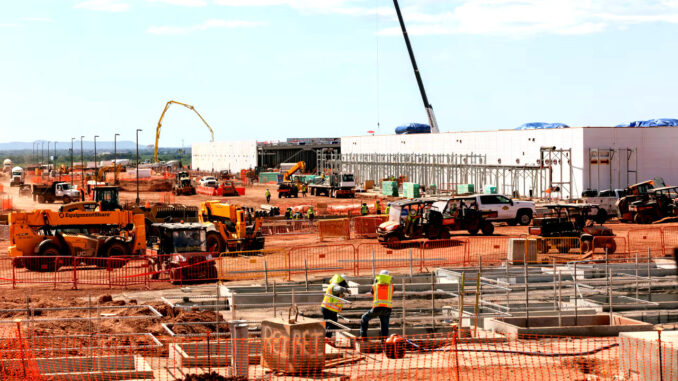
The buildout was already hitting a wall before the war began. Nearly half of planned U.S. data center construction projects this year have been delayed or canceled, held up by shortages of the electrical equipment needed to run them. Transformers that once took two years to deliver now take five — longer than the entire deployment cycle for an AI data center. New construction activity collapsed 50% in the final quarter of 2025. The sector depends heavily on China for transformers, switchgear and batteries, even as trade tensions make those supply chains less reliable. Gulf capital withdrawal lands on top of constraints that were already strangling the boom.
This is not just a problem for investors. Data center construction means jobs for electricians, laborers, engineers and drivers. Towns begin planning around that work. When financing tightens, some jobs disappear and others never materialize. Contractors sit idle. Suppliers lose business. Nearby communities feel the slowdown.
The deeper problem is that too much has been riding on too few sectors. Capital has poured into AI because the system has fewer and fewer places where high returns look believable. That has made the boom look impressive. It has also made it fragile.
War adds another strain. Military spending redirects labor, materials and resources into destruction rather than production. It raises energy costs and deepens uncertainty, making long-term investment harder to sustain. It does not address the underlying weakness — it compounds it.
So the contradiction is coming into the open. The same imperialist system that wages war to maintain domination abroad is beginning to destabilize one of the narrow booms it has depended on at home.
What is advertised as strength is already showing strain. The war on Iran runs through the system. It is helping pull apart one of the weak supports holding it up.
Join the Struggle-La Lucha Telegram channel

 The New Dark Age
Leave a comment