Thursday, 9 April 2026 — Weaponized Information
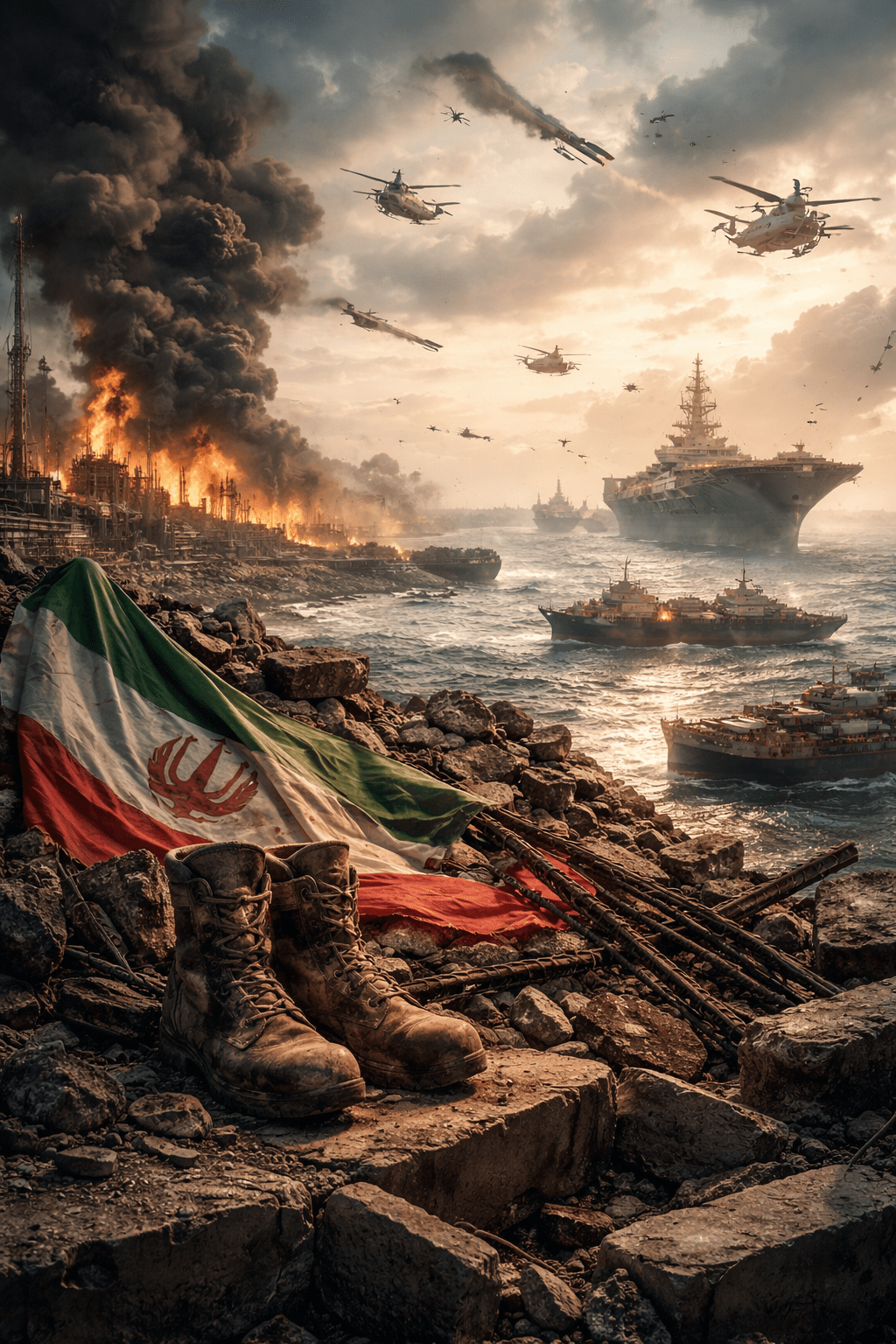
The media narrative frames the war through the language of objectives and outcomes, masking how imperial violence is normalized and depoliticized. A reconstruction of the facts reveals a deeper reality: sanctions, covert operations, chokepoint control, and historical intervention form the material architecture of this conflict. What emerges is not policy failure but a system in crisis—an empire that can still destroy with precision but cannot reliably impose political submission. The task now shifts from analysis to organization, as scattered resistance must be consolidated into a force capable of raising the cost of empire beyond what it can sustain.
By Prince Kapone | Weaponized Information | April 9, 2026
When Empire Grades Its Own Violence
“What has the U.S. war with Iran accomplished?”, written by Scott Neuman and Greg Myre and published by NPR on April 8, 2026, arrives dressed in the sober tone of policy evaluation. It asks a question that sounds almost reasonable on the surface: after weeks of bombardment, escalation, and regional destabilization, did President Trump achieve his stated goals? Those goals, the article tells us, were clear—cripple Iran’s nuclear program, dismantle its military capabilities, and induce regime change. The answer, delivered with the calm cadence of institutional journalism, is that these objectives remain largely unmet. Iran still stands. Its military still operates. Its leadership persists. The Strait of Hormuz remains under its control. And the future, we are told, is uncertain.
That is the surface presentation. But beneath it lies a deeper structure of thought, one that does not question the premise of the war itself, only its efficiency. NPR does not ask whether the United States had the right to pursue regime change in a sovereign nation, or to rain destruction upon its infrastructure, or to destabilize an entire region already saturated with war. Instead, it assumes these as given, as the normal prerogatives of power. The only question that remains is whether the machinery of domination performed to expectation. Empire is not on trial here. Only its execution is.
To understand how this framing takes shape, one must situate NPR within its material and ideological location. NPR is funded through a hybrid model—corporate underwriting, listener donations, and institutional support from member stations, with a relatively small share of direct federal funding. This structure does not make it a crude propaganda outlet in the sense of a state ministry, but it firmly anchors it within the professional-managerial strata of U.S. society. It speaks in the voice of those who administer empire, not those who endure it. Its journalists, including Neuman—a breaking news reporter—and Myre—a seasoned national security correspondent—are trained within this ecosystem, where war is something to be analyzed, calibrated, and explained, but rarely named for what it is.
The article’s central maneuver is what we might call narrative framing through normalization. The war is presented as a strategic project with defined objectives, like a business plan that may or may not have delivered expected returns. Civilian suffering disappears into the margins. The legality of the war evaporates. The long history of U.S. intervention in Iran is absent, as if the conflict began the moment American bombs started falling. What remains is a managerial question: did it work?
This framing is reinforced through a clear hierarchy of sources. U.S. officials, Pentagon briefings, retired generals, and Washington-aligned analysts are positioned as the authoritative voices capable of interpreting reality. They speak in confident tones about “capabilities,” “setbacks,” and “strategic outcomes.” Iran, by contrast, appears mostly as an object of analysis or a reactive subject, making demands, responding to pressure, adjusting to conditions imposed upon it. The asymmetry is not accidental. It is built into the grammar of imperial media, where power speaks and the rest of the world is spoken about.
Even where the article gestures toward critique, it does so within carefully policed boundaries. Trump is depicted as falling short of his ambitions, perhaps overestimating what military force could achieve. Analysts suggest that worst-case scenarios were not adequately considered. Allies are said to be unsettled. But this is criticism of execution, not of intent. It is the voice of a boardroom disappointed with quarterly results, not a people outraged by war. The underlying assumption—that the United States can and should attempt to reshape another nation through force—remains untouched, unquestioned, and intact.
Language itself plays a crucial role in this operation. Words like “accomplished,” “success,” “capabilities,” and “negotiations” convert the reality of war into a series of abstract metrics. Bombings become “operations.” Destruction becomes “degradation.” Threats become “leverage.” In this linguistic alchemy, violence is sanitized, stripped of its human content, and repackaged as policy. The reader is invited to think like a strategist, not like someone whose home has been reduced to rubble.
And then, just at the edge of this carefully managed discourse, reality intrudes. Trump’s own words—declaring that if the agreement fails, “the shootin’ starts” again, “bigger, and better, and stronger than anyone has ever seen before,” and boasting that the military looks toward its “next conquest”—cut through the entire performance. Here, the language of empire drops its mask. There is no technocratic subtlety, no policy jargon, no pretense of neutrality. Only threat, domination, and ambition laid bare. Yet even this is absorbed into the article’s broader frame as just another data point, another variable in the strategic equation.
What we are left with, then, is not simply a report on a war, but an example of how imperial ideology reproduces itself through respectable discourse. The violence is real. The stakes are enormous. But the narrative is disciplined, contained, and rendered legible only within the boundaries of U.S. strategic thinking. The war becomes a question of performance. And empire, even in its failures, retains the privilege of grading its own brutality.
The Facts They Admit, The World They Omit
The reporting itself concedes more than it intends. It acknowledges plainly that Trump entered the war with maximalist aims: dismantle Iran’s nuclear program, destroy its military capacity, and force regime change. It also concedes that, after more than five weeks of bombardment and a hurried ceasefire, those objectives remain unrealized. Iran’s state did not collapse. Its military did not disappear. Its political leadership persists. In the language of empire’s own scorecard, the mission remains incomplete.
The same reporting admits that the ceasefire itself was not born of unilateral dominance but mediated through external actors, including Pakistan, underscoring that Washington could not simply dictate the terms of closure. Iran, far from being reduced to submission, continued to strike throughout the conflict—hitting targets in Israel, Gulf states, and even U.S. installations in the region. These are not the actions of a state that has been neutralized. They are the actions of a state that remains operational, coordinated, and capable of retaliation.
And then there is the most material admission of all: the Strait of Hormuz remains under Iranian control. This is not a symbolic detail. It is the central artery of global energy circulation. According to the U.S. Energy Information Administration, roughly one-fifth of the world’s petroleum liquids pass through this narrow passage. Control over Hormuz is not an incidental feature of the conflict—it is a structural lever over the global economy itself. The article acknowledges disruption, but not the full meaning of that disruption. It reports the symptom while obscuring the system.
The article also concedes that the war may have had the opposite of its intended nuclear effect. Rather than halting Iran’s program, it may have intensified Tehran’s incentive to pursue deterrence. Yet even here, the facts require precision. The International Atomic Energy Agency reported that Iran possessed 440.9 kilograms of uranium enriched to 60 percent—an alarming development, but not the same as a nuclear weapon. Meanwhile, Iranian officials have repeatedly invoked their rights under the Non-Proliferation Treaty, including Article IV’s guarantee of peaceful nuclear energy. These facts complicate the simplified narrative of imminent weaponization that often circulates in imperial discourse.
But what the article admits is only half the story. What it omits is where the real terrain of analysis begins. Iran’s own official position, articulated through its national security apparatus, made clear that any ceasefire would be conditional—tied to the cessation of U.S. and Israeli attacks and linked directly to guarantees around maritime security. As stated by the Iranian Foreign Ministry, de-escalation was never a unilateral concession. It was a negotiated position grounded in reciprocity and sovereignty.
Even more striking is what the article fails to center: the ceasefire itself is structured under explicit threat. Trump’s own public statement makes this unambiguous. U.S. forces will remain in place, he declared, and if compliance falters, “the shootin’ starts” again—“bigger, and better, and stronger than anyone has ever seen before.” This is not diplomacy. It is coercion formalized. It reveals that the ceasefire is not a mutual resolution but a suspended escalation, contingent on submission.
The deeper omissions run further back in time. The article gestures toward nuclear tensions but does not foreground the decisive rupture that reshaped the entire landscape: the U.S. withdrawal from the JCPOA in 2018. That act did not merely disrupt diplomacy—it collapsed a functioning framework that had placed verifiable constraints on Iran’s nuclear program. In its place came “maximum pressure,” a regime of sanctions and economic warfare designed to force capitulation.
Those sanctions are not abstract policy tools. They are part of a continuous architecture of coercion. The Office of Foreign Assets Control details a sprawling system targeting Iran’s energy sector, financial system, shipping networks, and international trade. This economic war predates the bombs. It conditions them. It explains them.
And behind even this lies a longer history the article does not name but cannot escape. In 1953, the United States orchestrated the overthrow of Iran’s democratically elected government, reinstalling a regime aligned with Western interests. This is not speculation. It is documented in declassified U.S. records. That event is not a footnote. It is part of the political memory that shapes Iran’s conception of sovereignty and threat.
The present conflict also unfolds within a wider regional and global matrix. Israeli operations in Lebanon continued even as ceasefire terms were being negotiated, demonstrating that the war extends beyond a bilateral U.S.-Iran frame and into a multi-front theater. Meanwhile, global markets have already responded to the disruption of Hormuz, with rising energy costs and shipping risks tied directly to the conflict.
International institutions, too, recognize the scale of the crisis. The United Nations has framed the situation as a matter of global peace and security, calling for adherence to international law even as escalation continues. And the diplomatic channel that produced the ceasefire—acknowledged by the Pakistani Foreign Ministry—underscores that resolution is emerging not from unilateral U.S. control, but from contested international negotiation.
Finally, the broader strategic context cannot be ignored. As previously analyzed in our previous reporting, the Iran war is not an isolated event but part of a wider attempt to maintain control over global energy routes, contain China, and cripple emerging multipolar alignments such as BRICS+. The struggle over Hormuz, sanctions, and military positioning is inseparable from the larger architecture of power shaping the world system.
Taken together, the facts tell a story very different from the one suggested by the surface narrative. The war did not simply fall short of its goals. It revealed the limits of force in a world where sovereignty, geography, and global interdependence cannot be easily bombed into submission.
When the Threat Becomes the Strategy
Now the mask is off, and what stands before us is not a failed policy, but a system revealing itself in motion. The facts we have assembled do not describe a war that simply “fell short.” They describe a war that exposed the limits of domination in an era where domination can no longer be cleanly achieved. The bombs fell, the leaders were targeted, the infrastructure was struck, and yet the state endured. The machinery of destruction worked. The machinery of control did not. That is the contradiction at the heart of this entire episode.
NPR asks whether the war accomplished its objectives. Trump’s own words answer a different question altogether. When he declares that if compliance falters, “the shootin’ starts” again—bigger, stronger, more overwhelming—and boasts that the military looks toward its “next conquest,” he is not describing a policy adjustment. He is revealing a doctrine. The objective was never limited to dismantling centrifuges or degrading missile stockpiles. The objective was submission, enforced through the permanent threat of annihilation. What appears in the article as “unmet goals” is, in reality, the failure to convert violence into obedience.
This is the logic of imperial power in crisis. It still possesses immense destructive capacity, but it no longer commands the same political outcomes. It can devastate, but it cannot seamlessly reorganize. It can threaten, but it cannot guarantee compliance. And so it compensates with spectacle—with louder threats, broader declarations, and increasingly naked assertions of its right to command. This is what we are witnessing: not strength in its pure form, but strength straining against its own diminishing effectiveness. This is what imperialist decay looks like when it speaks in its own voice.
The Strait of Hormuz becomes the material anchor of this contradiction. Empire speaks as if it can declare the world open, safe, and obedient. But the strait does not respond to declarations. It responds to geography, to state power, to control exercised on the ground—or, in this case, on the water. Iran does not need to defeat the United States in some cinematic military showdown to frustrate its objectives. It only needs to retain its position within the global system—to hold the chokepoint, to shape the flow, to impose costs. Here, sovereignty is not abstract. It is embedded in terrain, in trade routes, in the physical organization of the world economy. This is anti-imperialist sovereignty not as slogan, but as material force.
And this is why the nuclear question cannot be understood through the moral language of Western policy discourse. When a state is subjected to sanctions, encirclement, assassination campaigns, and open threats of overwhelming force, it learns a very specific lesson. It learns that vulnerability invites attack. In a system structured by nuclear apartheid, where some states claim the right to possess ultimate weapons while denying others even the capacity for deterrence, the pressure to develop that deterrence is not irrational. It is systemic. It is produced by the very order that claims to prevent it.
What we are seeing, then, is not simply a regional conflict. It is a moment within a broader process of imperialist recalibration. The United States is attempting to maintain a unipolar command over strategic resources, trade routes, and political outcomes in a world that is increasingly resistant to that command. Iran, whatever its internal contradictions, occupies a position within this struggle as a state asserting its sovereignty against external coercion. The conflict over Hormuz, over sanctions, over nuclear capacity—these are all expressions of a deeper struggle over who sets the terms of the world system.
Trump’s rhetoric of “conquest” does not represent a deviation from this system. It clarifies it. It strips away the diplomatic language and reveals the underlying relation: command backed by force. But in doing so, it also exposes the system’s weakness. Because if conquest must be constantly threatened, constantly reasserted, constantly performed, it is because it is not fully secured. Power that must always announce itself is power that is being contested.
So the story is not that the war failed. The story is that the war revealed a contradiction that can no longer be hidden. The United States can still destroy with terrifying efficiency. But it cannot so easily compel. It cannot simply dictate outcomes in a world that is reorganizing itself through resistance, through interdependence, and through the slow, uneven emergence of multipolarity. The bombs fell, but the order did not follow. And that is the beginning of a different kind of history.
Where Resistance Is Already Moving — And Where It Must Go Next
Empire does not pause because it has been exposed. It recalibrates. It absorbs criticism, reshapes its language, and prepares the next move. That means the contradiction revealed in this war—between destruction and control, between threat and compliance—will not resolve itself. It must be organized against. And if we are serious about that task, we have to start from reality, not ritual. The antiwar movement is not an abstract moral force waiting to be summoned. It is uneven, fragmented, underdeveloped—and yet already in motion.
In places like New York, formations such as the NYC-DSA Anti-War Working Group are attempting to rebuild an anti-imperialist current from the ground up, explicitly targeting U.S. regime-change operations and linking local organizing to global struggle. Their campaigns—from disrupting war-profiteer supply chains to building Cuba solidarity—reflect an understanding that empire is not only fought abroad but reproduced through everyday economic and political structures at home.
At a broader level, efforts like the emerging Anti-War Action Network signal a recognition that isolated protests are no longer sufficient. Organizers across student groups, Palestine solidarity networks, and anti-imperialist formations are attempting to coordinate strategy, share tactics, and build something resembling a durable infrastructure. This is a critical shift. Empire operates through systems. Resistance must do the same.
There are also formations with longer continuity that still offer important lessons. The Anti-War Committee, rooted in decades of solidarity work against U.S. intervention, has consistently framed antiwar struggle as a question of international solidarity rather than national interest. Similarly, the Troops Out Now Coalition has historically linked opposition to U.S. wars with broader struggles against racism, sanctions, and economic exploitation, emphasizing that war abroad and oppression at home are structurally connected.
On the ideological front, projects like the Anti-Imperialist Forum attempt to intervene at the level of political consciousness, arguing that the antiwar movement must be explicitly anti-imperialist, not merely anti-conflict. This distinction matters. A movement that opposes war only when it is costly or unpopular will always lag behind empire. A movement that understands war as a structural necessity of imperialism can begin to anticipate, rather than simply react.
Globally oriented formations such as World Beyond War are also working to connect local organizing to an international framework, advancing campaigns to close military bases, divest from war industries, and challenge the normalization of permanent militarization. Their emphasis on structural transformation, rather than episodic protest, points toward the kind of long-term strategy required to confront a system that reproduces itself across borders.
The lesson across all of these efforts is clear: resistance is already present, but it is not yet consolidated. It exists in fragments—campaigns here, coalitions there, networks forming and dissolving under pressure. The task is not to invent a movement from scratch, but to connect what already exists into something capable of sustained pressure. That requires coordination across sectors: labor, student movements, national liberation movements, international solidarity networks. It requires linking the war economy to the domestic economy—showing how sanctions abroad translate into austerity at home, how military spending constrains social development, how the same system that threatens Iran disciplines workers in the United States.
Tactically, this means identifying and targeting the material nodes of imperial power. War is not an abstraction. It moves through contracts, supply chains, ports, financial systems, and political institutions. Defense contractors must be confronted where they operate. Shipping routes and logistics hubs must be politicized. Universities tied to military research must be exposed and challenged. Media narratives must be disrupted, not passively consumed. And crucially, these efforts must not remain symbolic. They must impose cost—political, economic, and ideological.
At the same time, solidarity must be sharpened. The people of Iran, Lebanon, and the broader region are not passive recipients of imperial policy. They are actors engaged in a struggle for sovereignty under conditions of coercion. To stand with them is not to romanticize or ignore internal contradictions. It is to reject the right of empire to determine their future through force. It is to recognize that the same system that threatens them is the one that disciplines workers, polices communities, and extracts wealth within the imperial core itself.
History makes one thing unmistakably clear. Wars do not end because leaders change their minds. They end because the cost of continuing them becomes too high—politically, economically, socially. That cost is not generated automatically. It is organized. The antiwar movements that helped end previous wars did not rely on moral persuasion alone. They built infrastructure, created disruption, and forced contradictions into the open until the system could no longer sustain itself without crisis.
That is the horizon now. The war has revealed the limits of imperial power. The question is whether those limits will be pushed further by organized resistance, or whether they will be temporarily stabilized through the next cycle of escalation. The forces exist. The contradictions are sharp. What remains is the work of turning them into power.

 The New Dark Age
Leave a comment