20 August 2012 — Daily Maverick
The company that preceded Lonmin was once dubbed ‘the unacceptable face of capitalism’ by a British prime minister. Tiny Rowland, man who turned the company into an international colossus, wore the slur happily. In the aftermath of the Marikana shootings, it seems like not much has changed since his day. By SIPHO HLONGWANE.
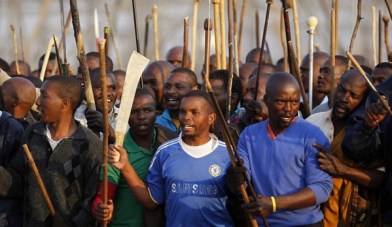
On Sunday, Lonmin issued an ultimatum to its employees: if they did not return to work on Monday, they could be fired summarily.
“The final ultimatum provides RDOs [rock drill operators] with a last opportunity to return to work or face possible dismissal,” the company statement said. “Employees could therefore be dismissed if they fail to heed the final ultimatum.”
News reports out of Marikana said that the news was greeted with anger. The unsanctioned strike would continue unless the miners got the 300% pay hike they were demanding.
The ultimatum came at a time when many friends and family of injured or dead miners were still trying to deal with the fallout of the shooting.
“London-based Lonmin accounts for 12% of global platinum output. It is already struggling with low prices, weak demand and may miss its annual production target of 750,000 ounces as the quarter to the end of September is typically its best,” Reuters said.
The ultimatum seems callous, and harkens back to the company’s unflattering roots on the continent.
Lonmin has always battled with unions in South Africa, but this particular incident is a nightmare on a scale that it will never have seen before.
Roland ‘Tiny’ Rowland was a British man (born Walter Furhop in India to German parents) who came to southern Africa in the aftermath of World War II to escape the heavy tax regime in England and to enjoy the higher standard of living that European colonialists enjoyed in Rhodesia (present-day Zimbabwe). He soon ingratiated himself well with African politicians.
The Independent said, “He became a pillar of the social circuit in Salisbury, southern Rhodesia – now Harare, the capital of Zimbabwe – earning his living as an upmarket car dealer. He soon discovered that his undoubted charm and dazzling smile worked well on African politicians eager for respectability and access to Western capital and know-how.”
In 1961 he was chosen to head the London and Rhodesian Mining Company (Lonrho) and quickly changed the way the company made money. He made the business depend heavily on his personal contacts and diversified swiftly. After that, he made some very risky calls on drawing up accounts, which spooked pension fund investors and lead to a commission of inquiry. The company then appointed non-executive directors to try to keep Rowland in check. The certain fight came when he tried to hide certain financial information from the board and the directors tried to get the company shareholders to jettison the volcanic chairman. The decision went the other way instead. It cemented Rowland’s reputation as something of an escape artist. The pension fund investors immediately dumped Lonrho’s shares.
The British prime minister at the time, Edward Heath, disgustedly labelled Lonrho an “unpleasant and unacceptable face of capitalism”. Rowland famously replied that he didn’t want to be its acceptable face.
Lonrho’s dealings in Africa were often viewed with suspicion. He was often accused of helping out less-than-savoury regimes in various ways, especially at times when the thrust of global opinion was not particularly favourable.
“In the 1980s he was accused of helping the Marxist government of Mozambique manage its agricultural resources, and he increased Lonrho’s South African holdings while sanctions against the Apartheid government were still in place,” the BBC said. “Then in 1992, Mr Rowland controversially sold a stake in some of Lonrho’s hotels to the Libyan leader, Colonel Gadaffi, only three years after the Lockerbie bombing which was attributed to Libyan terrorists.”
The board was especially stung by the Gadaffi revelation, and unseated him as chairman in October 1995. He was removed from the board of the company he had turned into a vast conglomerate the next year, and died in 1998.
At the news of his death, the eulogies from African leaders were extremely flattering. “He made an enormous contribution, not only to South Africa, but to the whole of Africa,” said former president Nelson Mandela, who had bestowed upon him the Order of Good Hope in 1996.
Two months before Rowland’s death, the company was split, and Lonrho Plc. was created to handle the non-African businesses and mining assets. In 1999 the company changed its name to Lonmin and narrowed its portfolio to the platinum metal group in the Bushveld Complex of South Africa.
The company struggled continuously with unions, both in its North West and Limpopo operations. In May last year, the company sacked more than 9,000 workers at its Karee mine near Rustenburg – then reinstated them afterwards. That particular call was made after a wildcat strike spurred by an internal union power struggle.
The company’s current CEO, Ian Farmer, was appointed in 2008. According to Bloomberg Businessweek, the company paid him £1,220,629 (R15,860,000) in 2011. His pay that year was 293 times more than what rock drill operators working at Lonmin’s Marikana mine earn.
The presidency issued a statement on Sunday saying that North West Premier Thandi Modise and the ministers of mineral resources Susan Shabangu, police Nathi Mthethwa, social development Bathabile Dlamini, co-operative governance Richard Baloyi, labour Mildred Oliphant, defence and military veterans Nosiviwe Mapisa-Nqakula, health Aaron Motsoaledi, state security Siyabonga Cwele, and home affairs Nkosazana Dlamini-Zuma would be deployed to Marikana to coordinate and lead support to the families and relatives of the dead or injured miners.
At that point, Lonmin’s representatives still had not shown face at the Marikana squatter camp, where the majority of the strike action had been concentrated. And now Lonmin, the company that was at the centre of the great calamity, has issued new threats to the rock drillers. The fact that the dead and injured, more than hundred of them, are still not even identified, seems of little importance. Unacceptable face of capitalism indeed, Lonmin. DM
See also:
Analysis: Cry the beloved country. Once more.
We might never know what was in the minds of mineworkers who advanced on police before the first blast of gunfire was heard at Marikana or
how it felt for officers to squeeze the triggers of their R5s, raining down live rounds on other human beings. What we do know now is that they should never have had to encounter each other on that dusty field where mindless horror reigned. By RANJENI MUNUSAMY.
Outrage at Marikana massacre grows around the world
As video footage of police opening fire and mowing down 36 miners at Lonmin’s platinum mine rolled on big and small screens across the world, the response from trade union and solidarity movements was fast and exacting. Organisations pointed their fingers at Jacob Zuma, the ANC, the tripartite alliance and SA’s growing elite. By MANDY DE WAAL.
Marikana massacre: Global media’s focus on tripartite failures and the growing class divide
In Limpopo, where provincial largesse, ANC patronage and cadre deployment ha The world’s most influential media weigh in on the Lonmin tragedy with analysis that points to South Africa’s growing class divide, and a tripartite alliance that’s becoming an unholy trinity for SA’s workers and the impoverished. By MANDY DE WAAL.
Lonmin: Malema fans the flames, but the victims are still out in the cold
Having been failed by the unions, the platinum company they worked for, and the government, the furious residents of the small squatter camp next to the Marikana shaft of the Lonmin Platinum Mine turned to someone outside of the system for comfort: Julius Malema. He said exactly what they had wanted to hear all along: they are victims of a vicious company, conniving unions and uncaring politicians. Behind the scenes, meanwhile, a few of the miners allowed us a tiny peek into their lives. It was heartbreaking. By SIPHO HLONGWANE (words) & GREG MARINOVICH (images).
Aubrey Masango: Marikana – Lonmin’s disquiet and the fight for manhood
There’s nothing wrong in revelling in the light entertainment of the Olympics, but let’s not let it cloud our view of the important things happening here at home. The reality at Marikana demands our attention.
Sipho Hlongwane: The Lonmin shootings could knobble Cosatu. Be afraid.
As the country begins to unpack the Lonmin shootings, Cosatu should be taking the events of the last week as a sign that it needs to think seriously about its own future. This was a significant display of weakness by its biggest affiliate trade union, NUM, and we should all be worried.
Lonmin’s killing fields: the inevitable, tragic next move
On Thursday morning, NUM’s leaders warned that the situation at the Marikana mine could result in deaths. Several hours later, a dozen or so striking miners were reported dead – shot by the police. The union said that it did what it could to quell the situation. Where was everybody else? By SIPHO HLONGWANE.
Beyond the chaos at Marikana: The search for the real issues
Violent clashes between police and striking miners have left between seven and 18 people dead at the last count. But the miners – specifically, the rock drillers – are determined to stay on their outcrop until they are heard. But it’s more than a strike, writes GREG MARINOVICH – it’s becoming a war.

 The New Dark Age
Leave a comment