Thursday, 26 June 2025 — Al-Akhbar
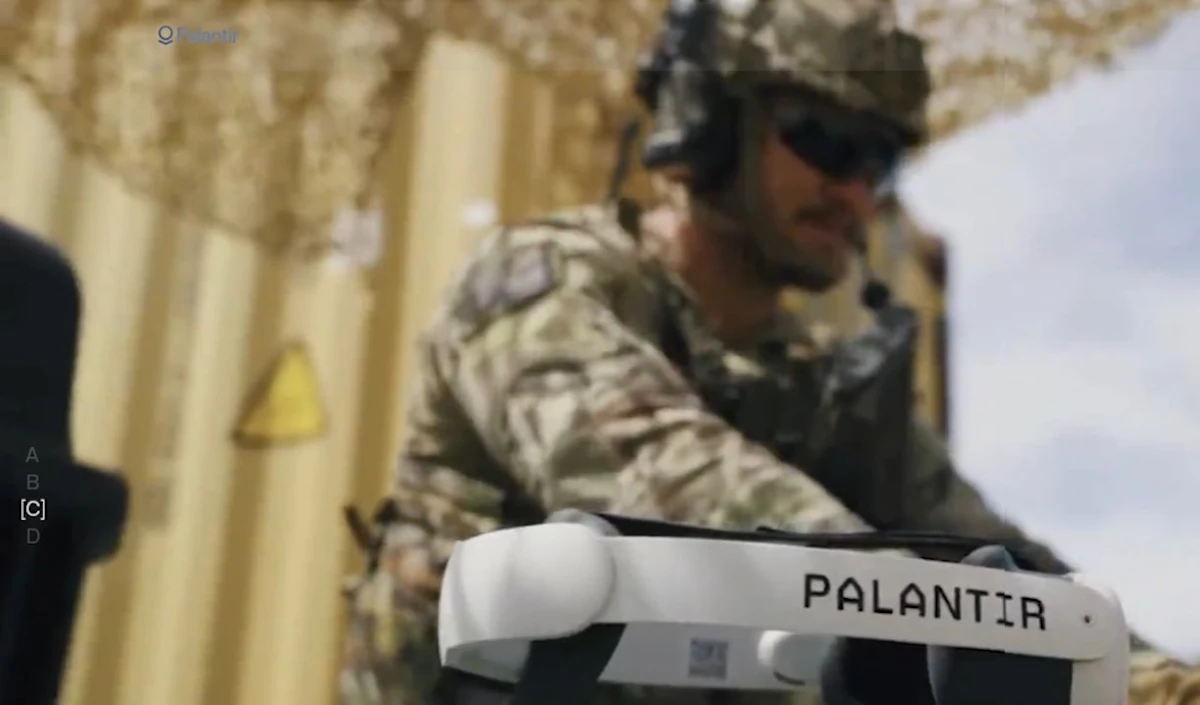
Palantir Technologies Inc. (PLTR)
In the early hours of June 13, 2025, Israel decisively expanded its war on the Axis of Resistance by targeting Iran directly. Prime Minister Benjamin Netanyahu hailed the strikes as a blow delivered directly to “the heart” of Iran’s nuclear ambitions, and, consequentially, to the regional resistance project. Justifying this aggression was an IAEA report alleging Iran’s accumulation of 408.6 kg of uranium enriched to 60%, a claim promptly mobilized as diplomatic cover for escalation and aggression.
Almost immediately, reactions flooded digital spaces. Numerous online accounts highlighted that much of this data was mediated not by traditional espionage alone, but significantly by algorithmic calculations, pointing explicitly toward Palantir Technologies, a surveillance behemoth named after the mythic “seeing stone” from Tolkien’s Lord of the Rings universe. Palantir’s data-mining capacities have long drawn scrutiny and suspicion, particularly given its extensive entanglements with military and surveillance operations worldwide. Though initially dismissed by some as conspiratorial conjecture, the accusations gained unsettling legitimacy in Palantir’s established role within the IAEA’s monitoring framework, since at least 2018. Indeed, Palantir emerged as central to the IAEA’s sophisticated $50 million analytical system, translating classified intelligence into actionable visualizations of Iran’s nuclear activities.
The rise of Palantir is intimately tied to the neoliberal fusion of technological innovation, state surveillance, and the military-industrial complex. Co-founded by Peter Thiel and his cohort from the “PayPal mafia,” it emerged as a pivotal tool in the post-9/11 “War on Terror,” transforming intelligence analysis from an opaque governmental prerogative into a privatized surveillance enterprise. Thiel, alongside CEO Alex Karp, leveraged connections with the CIA to later expand Palantir’s footprint through Pentagon contracts, embedding the company at the heart of the sprawling network of state security.
Karp and Benjamin Zamiska’s recent book, The Technological Republic: Hard Power, Soft Belief, and the Future of the West, outlines the ideological framework guiding Palantir’s operations. Palantir harbors clear ideological ambitions to lead a multi-front shadow war, aimed at consolidating US hegemony and extinguishing any vestige of anti-Western resistance. The “new moral and juridical order” is now extracted through technological supremacy, even as the very ideology of supremacy birthed the technology itself. Palantir’s operation extends far beyond the Arab region, with deployments in Sudan, Myanmar, and Libya, aggressively exported worldwide.
Palantir’s ideological blueprint
By commercializing surveillance practices initially developed to combat credit-card fraud at PayPal, Palantir blurred the distinctions between corporate and governmental power, embedding itself in both domestic law enforcement and military operations. Its executives advocated for an aggressively patriotic techno-nationalism, with Karp envisioning a world in which every American tech business “can play a role in the advancement and reinvention of a national project, both in the United States and abroad.”
Palantir’s surveillance logic traces back to DARPA-funded Cold War projects like Project Agile and Igloo White, efforts to preempt and control insurgent populations through predictive warfare, both abroad and domestically. Palantir’s sophisticated analytics, initially honed to track insurgencies in Afghanistan and Iraq. Essentially, Palantir’s predictive algorithms and data visualization technologies materialized what earlier programs like Project Camelot (a project dedicated to controlling counterinsurgency city) only imagined, which is an effective digital apparatus to preempt dissent and manage social control at home and abroad.
This ideological historicization helps explain why Palantir views Iran as an existential threat. The fixation has spurred numerous lucrative deals with Gulf countries, expanding Palantir’s reach as it supports twin projects of surveillance and geopolitical dominance, further entrenching regional divisions and securitized politics. Essentially, what we are witnessing today is how an American big-data company, seeded by CIA money, has become an indispensable broker of military AI, from Iran’s nuclear showdown to Israel’s multi-front battles and the so-called ‘tech cold war’ with China. In his books, Karp expresses his admiration for Israel’s “entanglement of the state and scientific research”, and notes that many early American leaders were engineers, therefore situating tech as the only way forward; the only path towards a “pure” world.
Palantir’s specific involvement in the region notably intensified around key diplomatic moments, exemplified by the February 2019 American-sponsored summit in Warsaw. Ostensibly convened to discuss regional peace and security, the gathering featured high-ranking officials from Saudi Arabia, the UAE, Qatar, Egypt, Jordan, Morocco, and Bahrain alongside Netanyahu and Vice President Mike Pence, with the explicit aim of confronting Iran.
Pence openly celebrated this unprecedented convergence, signaling a “new era” of collaboration. Netanyahu himself briefly revealed online that the summit’s primary focus was coordinating a collective response against Iran, before “diplomatically” deleting the statement.
It is not incidental that Palantir inked substantial contracts with nearly every nation represented. By embedding itself deeply within these diplomatic and military networks, it operationalized surveillance and data analytics as tools of collective geopolitical ambition.The Warsaw summit encapsulated Palantir’s evolution, not merely as a technological vendor, but as a strategic enabler of emergent political and military alliances shaping the region’s confrontation with Iran, and aligning with US interests.
This “data diplomacy” indeed bore fruit. The UAE and Bahrain normalized relations with Israel in the 2020 Abraham Accords, in part driven by concerns over Iran. Shared intelligence platforms may have eased that cooperation. When Israeli and Emirati analysts are both using Palantir systems, swapping data on common enemies becomes easier. Palantir has knitted together a pro-US bloc through interoperable technology, and feels threatened by China’s influence.
One high-profile example came in 2025, when the UAE’s national security advisor Sheikh Tahnoon bin Zayed Al Nahyan flew to Washington to meet with Alex Karp. The topic on the table: “cutting-edge technology cooperation” in defense and intelligence. According to insider reports, the UAE was keen to acquire Palantir’s latest AI systems for both military and internal security uses. Three focus areas were discussed: integrating Palantir’s Gotham platform to unify the UAE’s myriad surveillance databases, deploying Foundry for real-time logistics and battlefield awareness, and exploring new predictive policing models to preempt terror threats on UAE soil.
Saudi Arabia has also courted Palantir as part of its sweeping tech modernization (and as a hedge against Iran). In May 2025, during what was billed as President Trump’s triumphant return visit to the Middle East, US-Saudi deals worth trillions were announced. Among glowing quotes from corporate CEOs, Alex Karp chimed in: “Palantir is proud to play a role in forging the next generation of [the US-Saudi] alliance by enhancing US-Saudi cooperation on AI and defense.” It is no coincidence that trust is being built on the back of platforms like Palantir’s, which literally merge American and Gulf data streams in their war against existential threats, i.e. Iran and its counter-hegemonic project in the region.
Palantir’s strategic position against the China-Iran nexus
Today, Palantir sits at the nexus of a new AI-military complex, supplying advanced computational warfare tools to militaries and intelligence agencies around the world. “Our software powers real-time, AI-driven decisions from the factory floors to the front lines,” Palantir’s website proudly proclaims. In practice, that means Palantir isn’t just another defense contractor, it’s becoming the digital brains behind modern military operations.
Karp has unabashedly positioned the firm as an ideological warrior for the West. He argues in his book that Silicon Valley must shed its aversion to defense work and help the US and its allies maintain strategic supremacy. In public remarks, Karp warns that the United States will “likely” go to war with China and that the best way to prevent conflict is to “scare the crap out of your enemy,” in his words, by wielding superior technology. This simultaneously prophetic and hawkish ethos is baked into Palantir’s business model. Unlike many tech “unicorns,” Palantir focused on government contracts and military partnerships over consumer products. The company’s bread and butter is lucrative deals with the Pentagon, CIA, NSA, and foreign governments for tools that turn big data into actionable intelligence. Its platforms enable the fusion of surveillance data – from social media posts and phone records to satellite feeds – and present it in slick, gamified interfaces for analysts and commanders.
Palantir is now reportedly the front and center in two of today’s most prominent conflicts: Ukraine and Palestine. In Ukraine, its Artificial Intelligence Platform (AIP) has been described as “an intelligence and decision-making system that can analyze enemy targets and propose battle plans.” Karp himself boasts the company’s key role in “most of the targeting in Ukraine,” with algorithms identifying Russian targets so quickly that strikes can be carried out in “two or three minutes,” rather than six hours.
In January 2024, Karp and Thiel traveled to Israel to sign a strategic partnership with the Ministry of Defense. “Both parties mutually agreed to harness Palantir’s advanced technology in support of war-related missions,” announced the firm’s Josh Harris, as the company sold Israel an AI-driven targeting system that ingests reams of classified intel and spits out “life-or-death determinations” about whom to target. In Karp’s own admission: “Our product is used on occasion to kill people.”
In late 2023, following al-Aqsa Flood, several Palantir engineers resigned in protest, and demonstrations were held outside the company’s London office. Naturally, Palantir’s leadership was undeterred. Instead, they recruited Pentagon insiders, such as former congressman Mike Gallagher, a prominent China hawk hired to lead defense business, and to double down on an aggressive foreign policy stance. Gallagher’s call for an all-out “competition” with China that must be “won, not managed,” aligns perfectly with Palantir’s views.
The company’s very founding documents reflect its anti-China stance. In its 2020 IPO, Palantir declared that working with the Chinese Communist Party was “inconsistent with our culture and mission.” It then refused to host its platforms in Beijing or partner with Chinese firms, a rare stance in Silicon Valley where many tech giants covet China’s market. Thiel has gone even further, accusing Google of treason for its AI work in China and insisting that Chinese AI development is inherently military.
This ideological rigidity fuels Palantir’s hostility toward the China-Iran alliance. Under a 25-year strategic partnership signed in 2021, China pledged $400 billion in Iranian infrastructure, oil, and digital technology, including surveillance systems. Huawei has helped build much of Iran’s domestic internet firewall. For Palantir, unable to operate in China, Iran becomes both proxy and proving ground, a critical site to showcase the power of US AI dominance.
Palantir also supports the US strategy of decoupling from Chinese tech. In the Pentagon, the company has contracts to map out supply chain vulnerabilities – essentially identifying where Chinese components or software are lurking in American networks and weapons systems. One such project, known as Operation TITAN, has Palantir developing a next-gen Army ground station that fuses all-source intelligence; it is meant to be a China-killer in the sense that it can target mobile missile launchers and ships in a Pacific war scenario. The US Army proudly notes that Palantir’s TITAN will process data from spy satellites and drones to feed AI models that hunt targets – think hypersonic missiles and naval fleets. Karp explicitly writes, in his book, that the West must develop “unmanned drone swarms and robots that will dominate the coming battlefield” in any showdown with China, and he urges Silicon Valley to partner with the Pentagon to make it happen.
Palantir’s doctrine – predict war to prepare for war – could become a self-fulfilling prophecy. For Karp, “the absence of a rigid adherence to the boundaries between war and peace” is necessary to understand that Palantir, since its founding, has only been interested in preparing the groundwork for a ‘final battle’ in a true crusader style.
In sum, Palantir’s campaign against China is directly linked to its shadow war on Iran and the region. It provides the West with a perceived edge in intelligence and targeting, but it also entrenches a polarized world where each side develops ever-more-powerful AI for war. The nexus between China and Iran – one providing economic lifelines and possibly a digital shield, and the other serving as a test case for Western algorithmic warfare – shows how entangled these threads have become. A crisis in the Gulf could send ripples to the Taiwan Strait, and vice versa, all traveling along fiber optic cables and through AI models. Palantir thrives in this environment of pervasive insecurity, selling certainty, or the illusion of, to anxious governments. As Karp himself asks, the main question for Palantir is: “Are we tough enough to scare our adversaries so we don’t go to war? Do the Chinese, Russians, and Persians think we’re strong?”


 The New Dark Age
Leave a comment