Thursday, 15 January 2026 — The Tricontinental
The US bombing of Venezuela and kidnapping of its president and first lady showcased the current hyper-imperialist stage of the world order. Although a new mood has emerged in the Global South, it is not yet a developed challenge to the collective West.
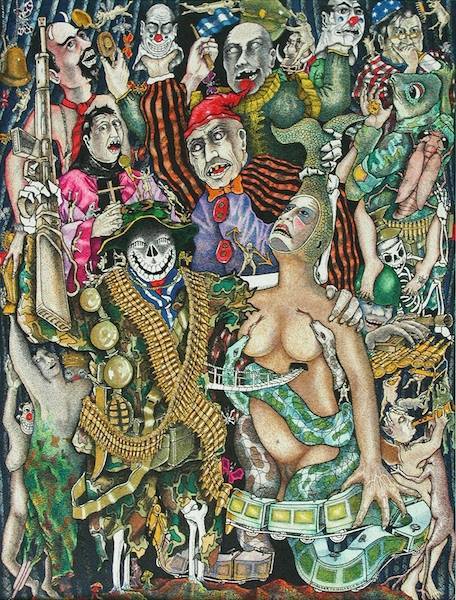
Dagoberto Nolasco (El Salvador), Premio de ganadores (Winners’ Prize), 1990.
Dear friends,
Greetings from the desk of Tricontinental: Institute for Social Research.
In 2024, our institute published two important texts – the study Hyper-Imperialism: A Dangerous Decadent New Stage and dossier no. 72, The Churning of the World Order. Taken together, they offer five key observations:
- US-led imperialism has entered a new, more aggressive stage, which we call hyper-imperialism. Since the Second World War, the global order has been marked by US dominance, visible in its network of more than 900 foreign military bases; in the concept of ‘Global NATO’ and the use of US-NATO military strikes to solve political disputes outside the North Atlantic; and in hybrid forms of power projection, including unilateral coercive measures, information warfare, new forms of surveillance, and the use of lawfare to delegitimise dissent. This hyper-imperialism is driven, we argue, by the relative economic and political decline of the Global North.
- The United States remains the central hegemonic power within a unifiedimperial bloc that we describe as the Global North. Rather than a multipolar, inter-imperialist rivalry between Western powers, we argue that the US dominates a militarily, politically, and economically integrated NATO+ bloc that has subordinated other Western powers. This US-led bloc seeks to contain what it sees as challenges – such as the rise of China – to its control over the Global South.
- The hyper-imperialist bloc aims to maintain its neocolonial control over the Global South and secure strategic dominance over the rising powers in Eurasia (China and Russia). Through the NATO+ bloc and its control over major financial institutions such as the International Monetary Fund (IMF), the United States seeks to repress national sovereignty and resist any challenge to its interests – as seen in the war in Ukraine and the genocide in Gaza. We also see this in the US’s withdrawal from any multilateral agreements that constrain its power, including key arms-control treaties such as the Anti-Ballistic Missile Treaty (2002) and the Intermediate-Range Nuclear Forces Treaty (2019), as well as the United Nations Framework Convention on Climate Change (2026).
- For the US-led NATO+ bloc, the rise of China and the shift of the centre of the world’s economy from the North Atlantic to Asia must be reversed. Our research highlights how the Global South – led by China and other emerging economies – has overtaken the Global North in gross domestic product (GDP) in purchasing power parity (PPP) terms and therefore represents a credible threat to Western economic hegemony. We show that control over raw materials, science, technology, and finance is being contested by these rising powers. This has provoked a strategic response from the NATO+ bloc. While the Global South wants to privilege peace and development, the Global North wants to impose war on the world.
- This current phase of imperialism intensifies the possibility of conflict and poses a danger to global stability. With the erosion of US economic and political power, military force and hybrid methods have become central for Washington to try and maintain its global influence. This increases the risk of widespread violence and confrontation that imperil the possibility of global peace, accelerate the climate catastrophe, and threaten the sovereignty of the peoples of the Global South.
The concept of hyper-imperialism is central for our work. What we are seeing now is hyper-imperialism on hyper-drive.
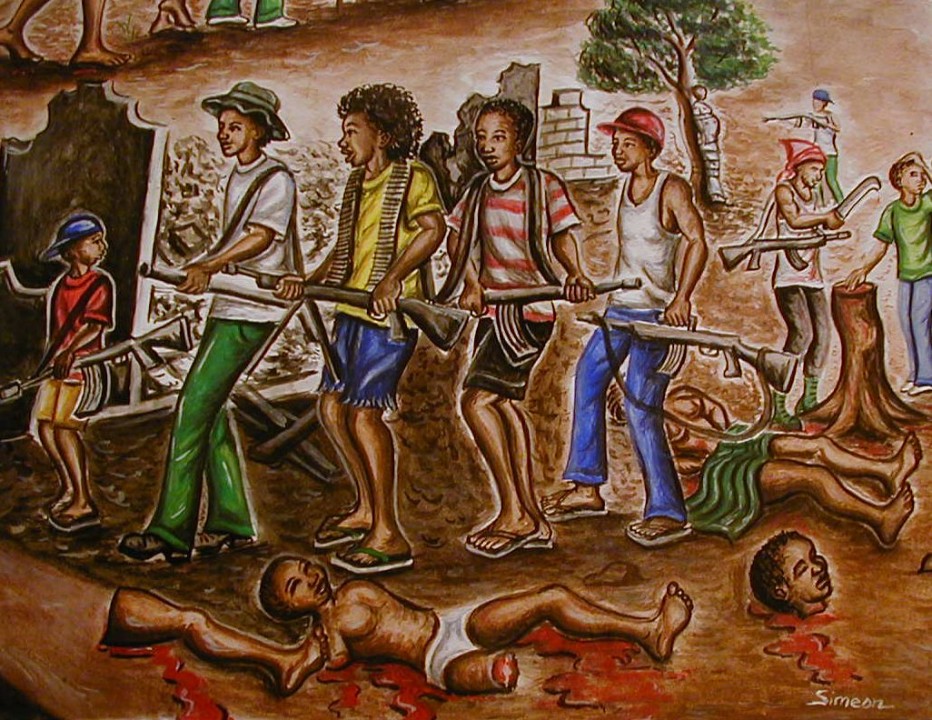
Simeon Benedict Sesay (Sierra Leone), Handiworks of Child Combatants, 2000.
The US attack on Venezuela on 3 January 2026 came on the same day as French and UK jets bombed an underground facility in the mountains near Palmyra (Syria) and just a few weeks after the US bombed villages in the Nigerian state of Sokoto. None of these attacks – all carried out under the pretence of fighting some form of ‘terrorism’ – had authorisation from the United Nations Security Council, making them violations of international law. These are all illustrations of the danger and decadence of this sulphurous hyper-imperialism. These are nothing more than instances of the NATO+ bloc demonstrating its power over the Global South through lethal military actions for which there is no defence.
Annual global military spending reached $2.7 trillion in 2024, with projections that it could reach between $4.7 trillion and $6.6 trillion by 2035 – the higher number nearly five times the level at the end of the Cold War and two and a half times the level spent in 2024. The same report estimates that it would take between $2.3 trillion and $2.8 trillion over ten years to eliminate extreme poverty globally. Over 80% of this military spending is done by NATO+ countries, with the United States far and away the largest military spender in the world. You do not spend so much on weapons of destruction without being able to destroy the world. No other country comes close to the ability of countries in the NATO+ bloc to intimidate by armed force.
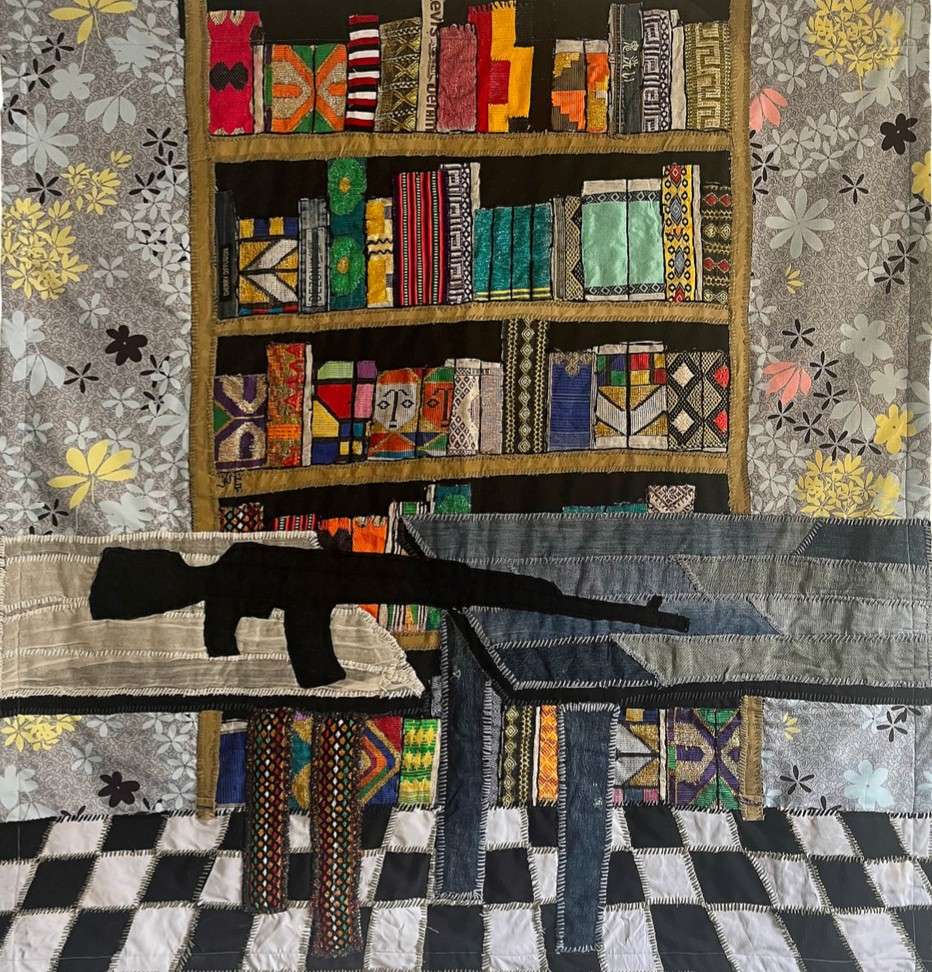
Kirubel Melke (Ethiopia), The Bookshelf 2, 2019.
The second key concept that our institute has developed over the past few years is the new mood in the Global South. We have argued that due to the economic rebalancing of the last period, space has opened for countries in Africa and Asia – in particular – to assert their sovereignty after several decades of suffocation. We saw this, for example, in the Sahel region with the creation of the Alliance of Sahel States (AES) by Burkina Faso, Mali, and Niger; in the reaction of several countries to the South African case in the International Court of Justice against Israel’s genocide; and in the attempt by countries from Indonesia to the Democratic Republic of the Congo to add value to their raw materials rather than exporting them unprocessed. These instances show how the countries of the Global South, led by China, have begun to test their ability to assert themselves against NATO+ authority across various institutions. But the key word here for us is ‘mood’: a new sensibility that is being tested but is not yet a developed challenge to the collective West.
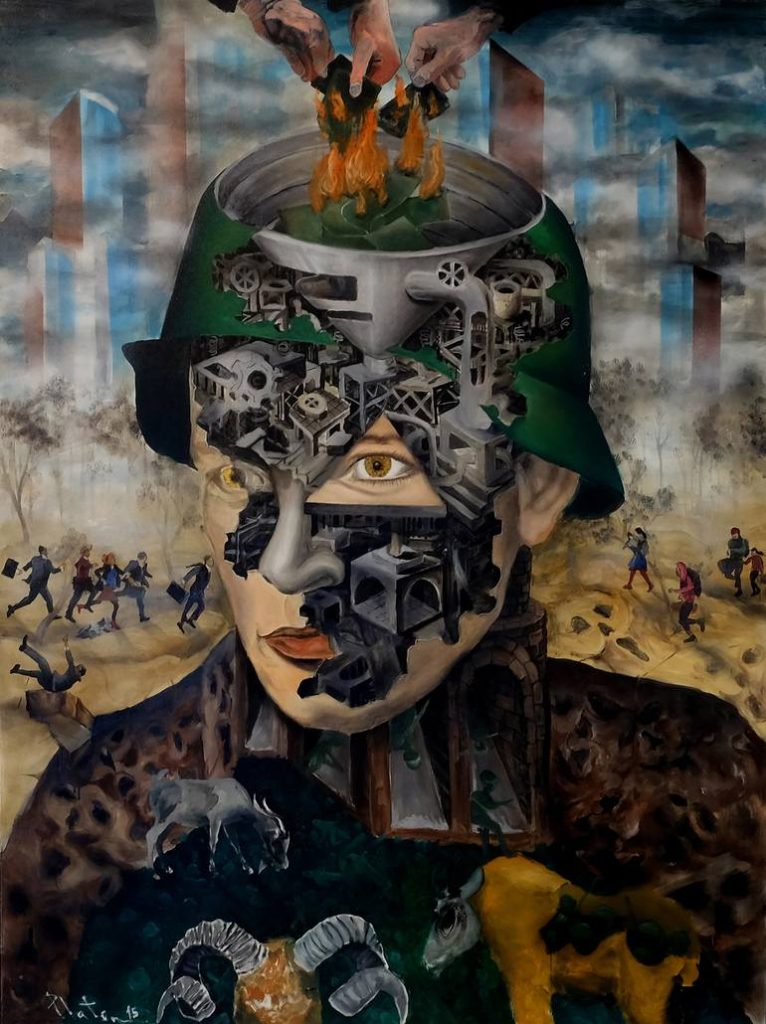
Obie Platon (Romania), Contemporary War, 2015.
A few hours before the attack on Venezuela, President Maduro met with Qiu Xiaoqi, China’s special envoy for Latin America, in Caracas. They discussed China’s third Policy Paper on Latin America (released 10 December 2025), in which the Chinese government affirmed: ‘As a developing country and a member of the Global South, China has always stood in solidarity through thick and thin with the Global South, including Latin America and the Caribbean’. They reviewed the 600 joint development projects between China and Venezuela and the roughly $70 billion in Chinese investment in Venezuela. Maduro and Qiu chatted and then took photographs which were posted widely on social media and broadcast on Venezuelan television. Qiu then left the meeting with the Chinese ambassador to Venezuela, Lan Hu, and the directors of the Ministry of Foreign Affairs’ Latin America and the Caribbean Department, Liu Bo and Wang Hao. Within hours, Caracas was bombed.
Shortly after the attack, the spokesperson for the Chinese Foreign Ministry said, ‘Such hegemonic acts of the US seriously violate international law and Venezuelan sovereignty and threaten peace and security in Latin America and the Caribbean region. China firmly opposes it’. Beyond that, little could be done. China does not have the capacity to roll back the savagery of US hyper-imperialism through military force. China and Russia have considerable military capacity, including nuclear weapons, but they do not have the global military footprint of the United States – whose military spending is more than double that of these two nations combined – and are therefore mainly defensive powers (that is to say, they are mainly able to defend their borders).
These recent events are a sign of the weakness of the new mood in the Global South at present, but not the vanquishing of that mood. Across the Global South, condemnations of the US violation of the UN Charter came thick and fast. The new mood remains, but it has its limitations.
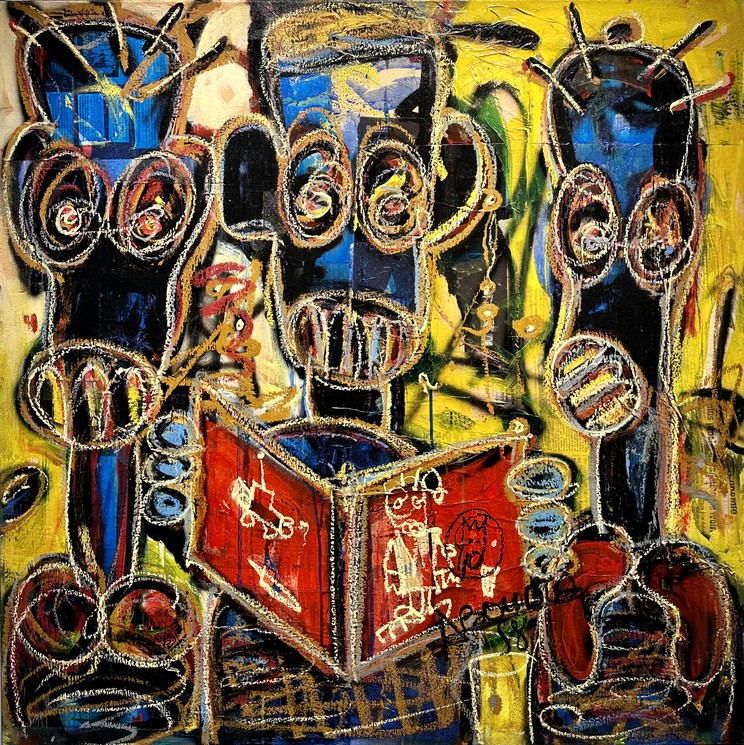
Aboudia (Côte d’Ivoire), Untitled, 2018.
The third key concept that our institute has developed is the far right of a special type. This far right has made a swift entrance into the halls of government in most continents, but it has done so with even greater speed in Latin America and the Caribbean. We argue that it has emerged for several reasons, including:
- The failure of social democrats to solve deep crises of unemployment, social anomie, and crime due to their commitment to IMF-imposed fiscal prudence and cruel austerity.
- The collapse of commodity prices that had allowed the social democratic forces to ride a ‘pink tide’ based on redistribution of increased national incomes and on modest social welfare policies that tackled the most urgent problems facing the population, including hunger and poverty. Part of the far right’s animosity has been directed at such income-redistribution schemes, which it claims are unfair to the middle class.
- The failure of social democrats – or even of the left when they have come to local power – to address the rise of criminality, partly associated with the drug trade, that has gripped working-class neighbourhoods across the Western hemisphere.
- Theweaponisation of the discourse of corruption by the far right of aspecial type to systematically delegitimise centre-left and socialdemocratic political figures. This system of lawfare has created a
highly moralised anti-politics that elevates an authoritarian desire fororder and punitive justice without any structural reform. - The emergence of a politics of fear in response to a manufactured civilisational crisis that is exemplified by the spectre of ‘gender ideology’, the racialised portrayal of Black youth in urban centres as a threat (so that police violence against them came to be treated as normal and expected), the land claims of Indigenous peoples, and environmentalist demands. The far right of a special type captured the imagination of enough of the population around the defence of their traditions and the need to restore their way of life, as if it was the feminists and the communists who had eroded society and not the fires of neoliberal destruction.
- The injection of massive amounts of money from the Global North into the Global South through transnational right-wing platforms (such as Spain’s Foro Madrid) to fuel evangelical networks and new digital disinformation ecosystems.
- The direct interference of the United States in the Global South through its dominance over financial institutions like the IMF and the World Bank, through global financial systems like SWIFT, and through direct military force and intimidation.
The far right of a special type in Latin America and the Caribbean was the imperial antidote to the return of the ideas of sovereignty articulated by Simón Bolívar and taken up by Hugo Chávez, which found expression in the pink tide. As the pink tide receded, an angry tide surged: we moved from leaders such as Chávez (Venezuela), Evo Morales (Bolivia), and Néstor Kirchner (Argentina) to Jair Bolsonaro (Brazil), Javier Milei (Argentina), Daniel Noboa (Ecuador), José Antonio Kast (Chile), and Nayib Bukele (El Salvador).

Pech Song (Cambodia), 7 Makara Maha Jog Jay (7 January Victory Day), 1980–1985.
The fourth key concept that our institute has developed, which helps us shape our thinking, is the future – not only as socialism, the objective, but as hope, the sensibility for such a future: the idea that we must not allow our thinking to be constrained by an eternal, ugly present, but instead orient it toward the possibilities that are inherent in our history and our struggles for a better world. The far right of a special type pretends, through the theology of prosperity, that it represents the future, when in reality it offers only a permanent present of austerity and war and portrays the left as the past. Nothing could be further from the truth. Our 100th dossier (May 2026) will explore this concept. We look forward to sharing it with you.
As Kwame Nkrumah used to say, ‘forward ever, backward never’.
Warmly,
Vijay

 The New Dark Age
Leave a comment