Thursday, 22 January 2026 — The Tricontinental
The US has set its sights on Greenland due to its mineral wealth and strategic location. But its people – the Kalaallit – are an afterthought in Washington’s machinations.
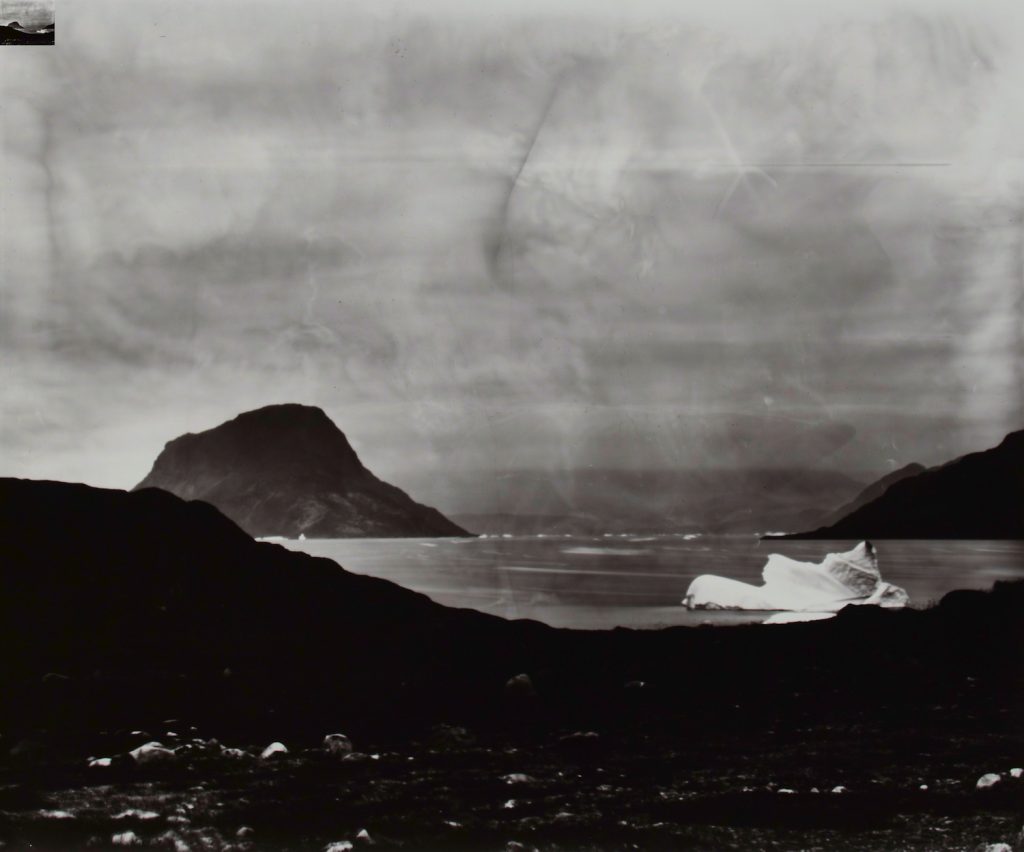
Pia Arke (Kalaallit Nunaat), Nuugaarsuk alias… 2, 1990.
Dear friends,
Greetings from the desk of Tricontinental: Institute for Social Research.
Every few years, the centre of the imperialist Global North – the United States – forgets its manners.
It is one thing to be rude to Iran or Venezuela, but it is another thing entirely to be rude to Denmark. The North Atlantic has not experienced internecine acrimony since – perhaps – Adolf Hitler turned on Poland in 1939. But to be fair to the United States, it has not coveted Denmark itself. Washington has licked its sticky fingers and placed them upon Greenland.
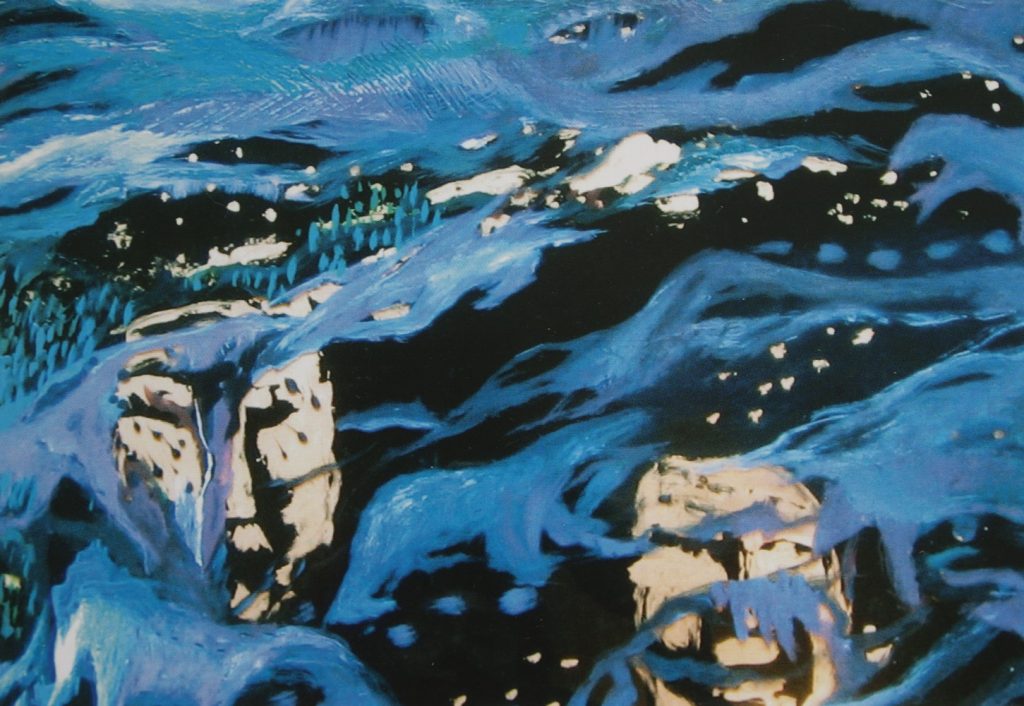
Aka Høegh (Kalaallit Nunaat), Bag maskerne (Behind the Masks), 2008.
Denmark began its colonisation of Greenland 305 years ago, in 1721. Constitutional scholars will say that the formal colonial status ended in 1953 when Greenland was incorporated into the Kingdom of Denmark and that Greenland gained a further measure of autonomy in 2009 when the Act on Greenland Self-Government was passed – but let’s be frank, it remains a colony.
For context, Greenland (over 2 million square kilometres) is fifty times larger than Denmark. For comparison, if placed over the United States, it would almost stretch from Florida to California. If it were an
independent country, it would be the twelfth largest in the world by area. Of course, the Arctic country has a very small population of around 57,700 (roughly equivalent to the population of Hoboken, New Jersey).
In Washington’s imagination, Greenland appears not as a homeland, but as a location – a place on a map or a signature on a radar screen. The words used to talk about it belong to the grammar of possession: purchase, control, seize. This is the language of domination – one imperialist power (United States) wanting to seize the land of a colonial power (Denmark).
But Greenland is not a prize.
The Inuit of Greenland call their country Kalaallit Nunaat: ‘Land of the Kalaallit’ (Greenlanders). When Trump and his allies speak of Greenland,they never speak of the people: the Kalaallit. Instead, Trump speaks of the strategic importance of the island and about what the US government sees as the perils of its Chinese and Russian capture (never mind that neither China nor Russia have made any claims over the territory). Greenland is always a place that someone else must hold, but not the Kalaallit. For people like Trump, or indeed for generations of Danish prime ministers (despite soft statements about the path to self-determination), the Kalaallit have no role as political subjects.
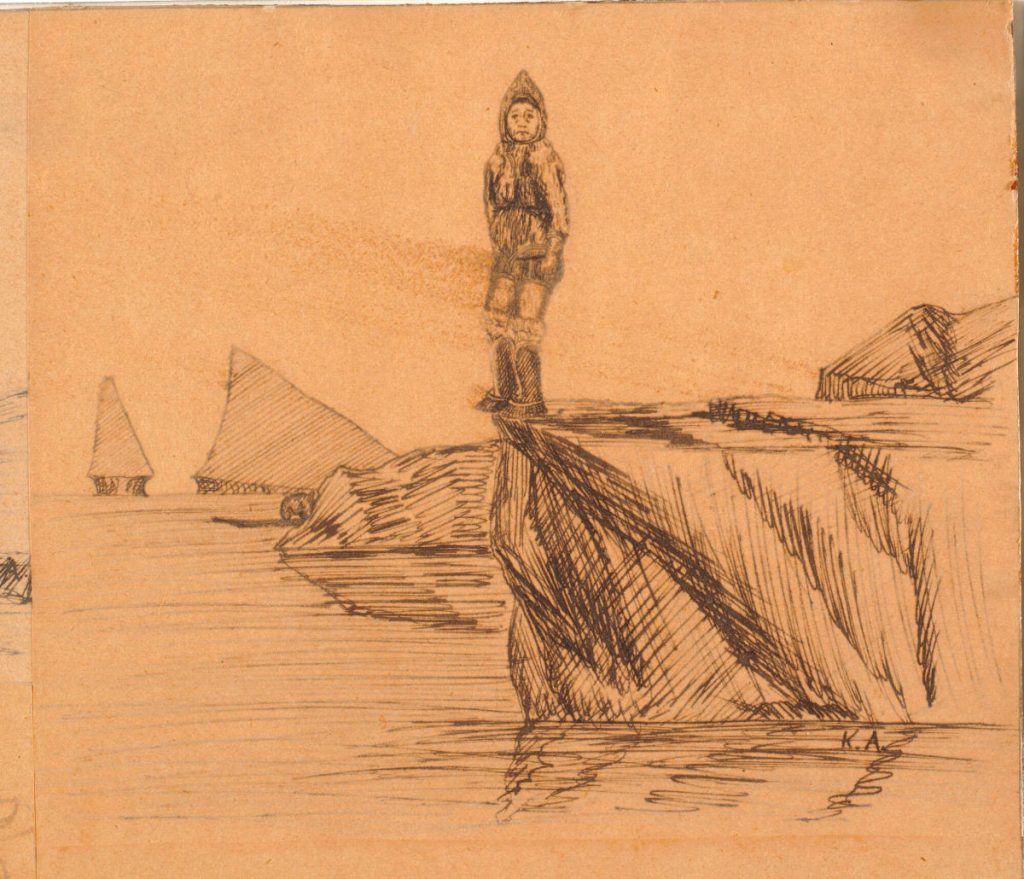
Kaarale Andreassen (Kalaallit Nunaat), Kvinde på en klippe (Woman on a Cliff), n.d.
Greenland grew in strategic and economic importance to Denmark after the 1794 discovery of cryolite, a key mineral used in the production of aluminium. This extractive focus continued after the 1956 discovery of uranium and rare earth elements in Kuannersuit (Kvanefjeld) in southern Greenland. In 1941, Denmark’s envoy in Washington, Henrik Kauffmann,signed an agreement that allowed the US to establish bases and stations in Greenland. In 1943, the US placed a weather station at Thule (Dundas) known as Bluie West 6, and in 1946 it added a small airstrip. After the Second World War, Denmark was an early entrant to the US effort to build a military bloc against the Soviet Union. In fact, it was a founder of the North Atlantic Treaty Organisation (1949) and then signed the Defence of Greenland Agreement (1951) that allowed the US to build the Thule Air Base under the codename Operation Blue Jay (now Pituffik Space Base). The base became useful not only as a place to watch the USSR, but also for missile warning, missile defence, and space surveillance – a strategic foothold that has grown more consequential as Greenland’s uranium and rare earth deposits have become central to the global contest for critical minerals.
As Greenland’s ice sheets have melted in recent decades due to the climate catastrophe, the country’s deep geology has become easier to survey and to mine. Feasibility studies and drilling in the early to mid-2010s (especially 2011–2015) showed that the land was teeming with graphite, lithium, rare earth elements, and uranium. As the United States imposed its New Cold War on China, it had to seek new sources for rare earths given China’s dominance of rare-earth refining and downstream magnet production. The island became not only a source of minerals or a geographical location for power projection, but also a critical node in the US-led supply-chain security architecture.
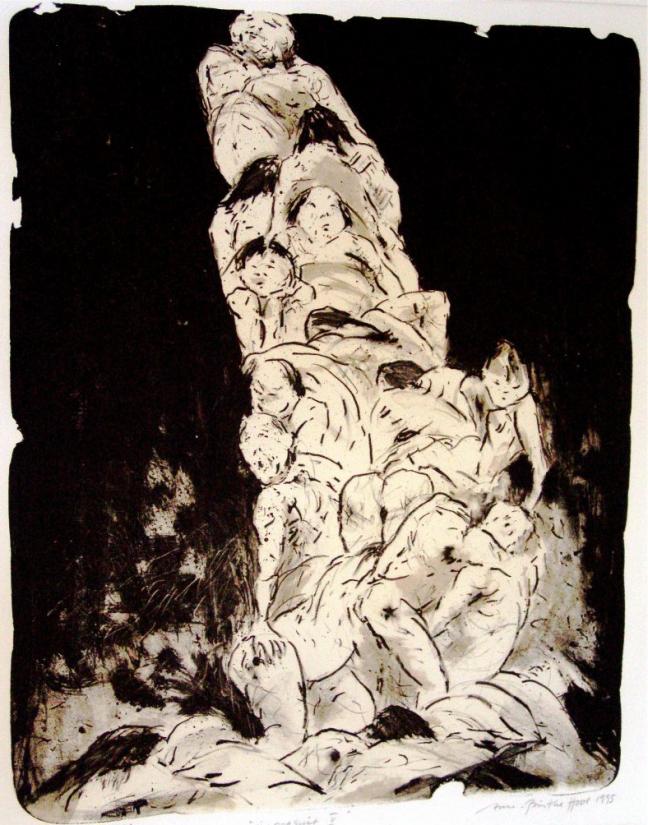
Anne-Birthe Hove (Kalaallit Nunaat), Inuppassuit V (Many People), 1995.
In August 2010, long before Canadian Prime Minister Mark Carney’s trip to China in mid-January 2026, the Canadian government released a report with an interesting title: Statement on Canada’s Arctic Foreign Policy: Exercising Sovereignty and Promoting Canada’s Northern Strategy Abroad. On the surface, the report is rather bland, making many pronouncements about how Canada respects the Indigenous peoples of the Arctic and how its intentions are entirely liberal and noble. That posture is difficult to square with the reality that major mining projects across the Canadian Arctic have repeatedly sparked Inuit concerns about impacts on wildlife and Inuit harvesting and that regulators have at times recommended against expansions, as in the case of Baffinland’s Mary River iron mine.
In fact, Canada is home to the world’s largest hub for mining finance (TSX and TSX Venture Exchange list more than half of the world’s publicly traded mining companies), which has been sniffing around the Arctic for decades in search of energy and minerals. The 2010 report does mention Canada’s ‘Northern energy and natural resource potential’ and that the government is ‘investing significantly in mapping the energy and mineral potential of the North’. But there is no mention of the large Canadian private mining companies that would benefit not only from Greenland’s mineral potential (for instance, Amaroq Minerals, which already owns the Nalunaq gold mine in South Greenland) but also from Canada’s Arctic region (for instance, Agnico Eagle Mines, Barrick Mining Company, Canada Rare Earth Corporation, and Trilogy Metals). What is significant about the report is that if it is put into operation, it would sharpen the long-running Canada-US dispute over Arctic navigation, particularly in the Northwest Passage, which Canada treats as internal waters and the US approaches as an international strait.
Canada is an ‘Arctic power’, the report says. There are seven other countries that have an Arctic foothold: Denmark, Finland, Iceland (through Grimsey), Norway, Russia, Sweden, and the United States (through Alaska). They are members of the Arctic Council, which was set up by Canada in 1996 to deal with environmental pollution in the Arctic and to create space for Indigenous organisations in the region to put forward their views. However, the Arctic Council has largely been paralysed since Russia’s invasion of Ukraine in 2022, when member countries paused normal cooperation with Russia and later resumed only limited project-level work that does not involve Russian participation, even though Russia holds roughly half of the Arctic coastline. With consensus required, this has narrowed the council’s role from a venue that could broker pan-Arctic coordination and even negotiate binding agreements to one largely confined to technical working-group projects and assessments. Canada’s claim to being an ‘Arctic power’ comes with bravado but lacks substance. Will it really prevent the US from using its sea lanes, and can it exercise a form of capitalist sovereignty for its mining companies in the Arctic region?

Buuti Pedersen (Kalaallit Nunaat), Kammannguara (My Little Friend), 2015.
In 2020, before the council paused cooperation with Russia, the North Atlantic Treaty Organisation (NATO) had already called upon its members to ‘set [their] sights on the high north’ (as NATO’s think tank, the Atlantic Council, noted in a report). After 2022, NATO developed a ‘high north’ strategy that can be best appreciated in its 2025 parliamentary report Renavigating the Unfrozen Arctic. The report identifies what it sees as the primary threat to NATO countries: China and Russia. One of them (Russia) is a major Arctic power, and the other (China) has two scientific stations in the north (Yellow River Station in Svalbard, Norway, which has been there since 2003 studying atmospheric and environmental science, and the China-Iceland Arctic Science Observatory in Kárhóll, Iceland, which has been there since 2018 studying Earth-system and environmental science). China has also indicated that the Arctic waters would be ideal for a Polar Silk Road, a trade corridor that would link China to Europe. But there is no Chinese military footprint in the region as of now.
On 9 January 2026, Trump said that he does not want China or Russia to get a foothold in Greenland. It is true that representatives of Chinese companies have been to Greenland and signed non-binding memorandums of understanding (MOUs), but it is equally true that none of them have gone forward. Trump fears that some of these MOUs might eventually turn into projects that could see Chinese companies on Greenland’s soil. However, since EU investment is so low in Greenland (around $34.9 million per year), and since US (around $130.1 million per year) and Canadian investment ($549.3 million per year) is higher but still lower than an anticipated Chinese investment (at least $1.162 billion), it is credible to fear the Chinese businesses. At the same time, it is worth noting that Danish and other Nordic diplomats have disputed Trump’s claims of Russian and Chinese warships operating ‘around Greenland’, for which Trump has offered no public evidence.
China’s anticipated investment in Greenland does not pose a military threat, nor is it something that the United States, Canada, or indeed Denmark should be concerned with. This should be a discussion and debate within Greenland.

Bolatta Silis-Høegh (Kalaallit Nunaat), Uagut (Us), 2021.
Greenland is not for sale. It is not a military platform or a mineral reserve waiting to be extracted. It is a society, alive with memory and aspiration. The Global South knows this story well – a story of plunder in the name of progress, of military bases in the name of security, of the suffering and starvation of the people who call this land their home.
Land does not dream of being owned. People dream of being free.
Ask Aqqaluk Lynge, a Kalaallit poet, politician, and defender of Inuit rights who wrote in his poem ‘A Life of Respect’:
On maps of the country
We must draw points and lines
to show we have been here –
and are here today,
here where the foxes run
and birds nest
and the fish spawn.You circumscribe everything
demand that we prove
We exist,
that We use the land that was always ours,
that We have a right to our ancestral lands.And now it is We who ask:
By what right are You here?
Warmly,
Vijay

 The New Dark Age
Leave a comment