Thursday, 29 January 2026 — The Tricontinental
India’s liberalisation beginning in the 1990s has led to a steady decline in manufacturing. To reverse this trend and expand productive employment, industrial policy must address structural issues of dependence and inequality.
 Gigi Scaria, Wheel, 2009.
Dear friends,
Greetings from the desk of Tricontinental: Institute for Social Research.
On India’s 79th Independence Day, in August 2025, Prime Minister Narendra Modi devoted his speech to Viksit Bharat 2047 (Developed India 2047) and announced a National Manufacturing Mission. The mission, he said, must ‘reduce import dependence and strengthen economic resilience’ in sectors ranging from aerospace to artificial intelligence. He urged India’s twenty-eight states, eight union territories, and the central government to identify 100 ‘priority products’ for domestic manufacturing and added that state governments should streamline regulations and approvals, ‘especially with respect to land, utilities, and social infrastructure’, in order ‘to attract global companies’. Viksit Bharat 2047 is a warmed-over version of Modi’s 2014 Make in India. Both projects are built on three premises:
- That foreign direct investment will drive domestic manufacturing.
- That Indian firms can manufacture goods, but only under the tutelage of foreign conglomerates.
- That even these firms need not build the entire supply chain – or even most of the value-added links – within India, since assembly is enough to qualify as ‘made in India’.
When India’s economy was opened to foreign investment in 1991, in the phase known as liberalisation, there was no clarity about the nature and composition of the investment needed to build industrial capacity and technological capability – or what conditions should govern foreign capital – nor a long-term plan for industrialisation. From
Tricontinental: Institute for Social Research comes our latest dossier, The Turbulence of the Indian Economy (January 2026), which analyses how liberalisation dismantled strategic public enterprises – such as electronics – and trapped India into being an exporter of services, while failing to address the enormous challenge of unemployment.
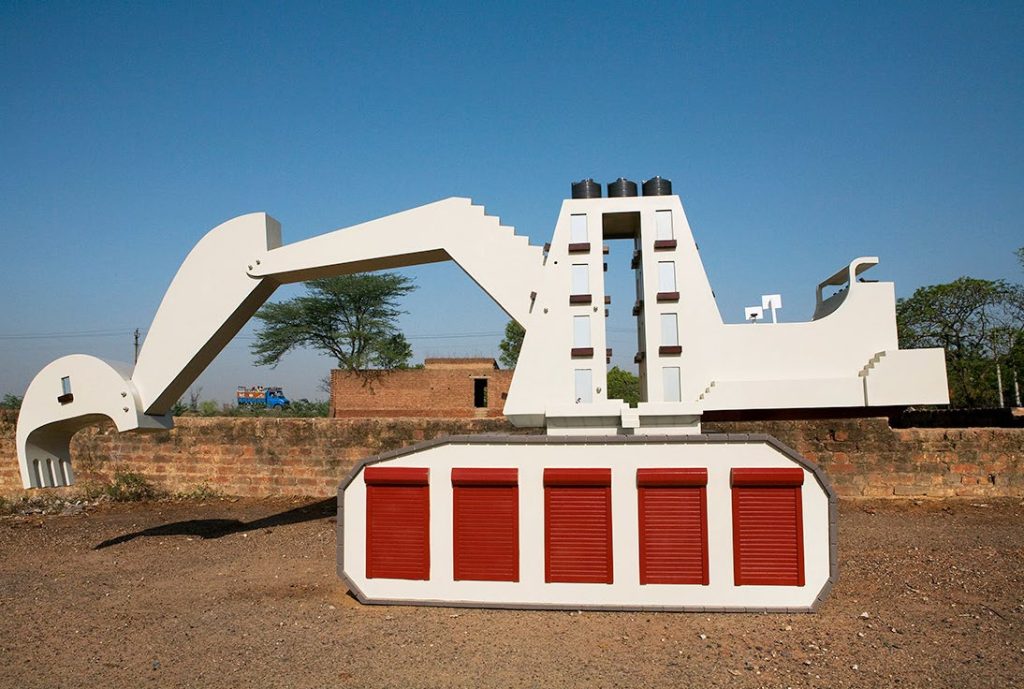
Gigi Scaria, Settlement, 2010.
Advanced capitalist economies did not achieve sustained industrialisation simply because they began earlier, nor because early manufacturing was intrinsically more labour-intensive. Their industrial development was made possible by political and economic conditions that are largely absent in postcolonial countries today: prolonged protection of home markets, access to colonial territories as sources of labour and raw
materials, and – crucially – external markets that could sustain demand for manufactured goods when deep domestic inequality restricted mass purchasing power.
Colonies played a central role in stabilising industrial accumulation in Europe and North America. They absorbed surplus labour, supplied cheap food and inputs, and functioned as captive or privileged markets for manufactured exports. This externalisation of demand meant thatproduction could continue to expand despite the limitation of domestic inequalities, allowing manufacturing employment to persist and
technologies to evolve. Even in the case of the United States, early industrialisation was supported by access to external markets, first through British trade deficits and later through its own hegemonic position in the world economy. In the postwar period, this system was reinforced by Keynesian demand management and by the strengthened bargaining power of labour, shaped in part by the existence of the socialist camp.

Gigi Scaria, Human Pull, 2018.
By contrast, Global South economies such as India’s operate within a global structure that restricts policy space, disciplines state intervention, and privileges trade liberalisation and capital mobility. In this context, the central constraint on industrialisation is not access to technology, but the lack of both domestic and external demand. In India, extreme income inequality limits domestic demand for manufactured goods, while external markets are highly competitive and dominated by firms and states with far greater technological depth and state support.
Manufacturing stagnation in India should therefore not be understood as the outcome of a missed historical window or an irreversible process of ‘premature deindustrialisation’. Formal industrial employment was never substantial to begin with, and its limited expansion has been followed by stagnation rather than collapse. The deeper problem lies in the selective erosion of industrial capacities critical to long-term development – such as capital goods, heavy machinery, and electronics – even as certain consumer-oriented industries such as automobiles have grown.
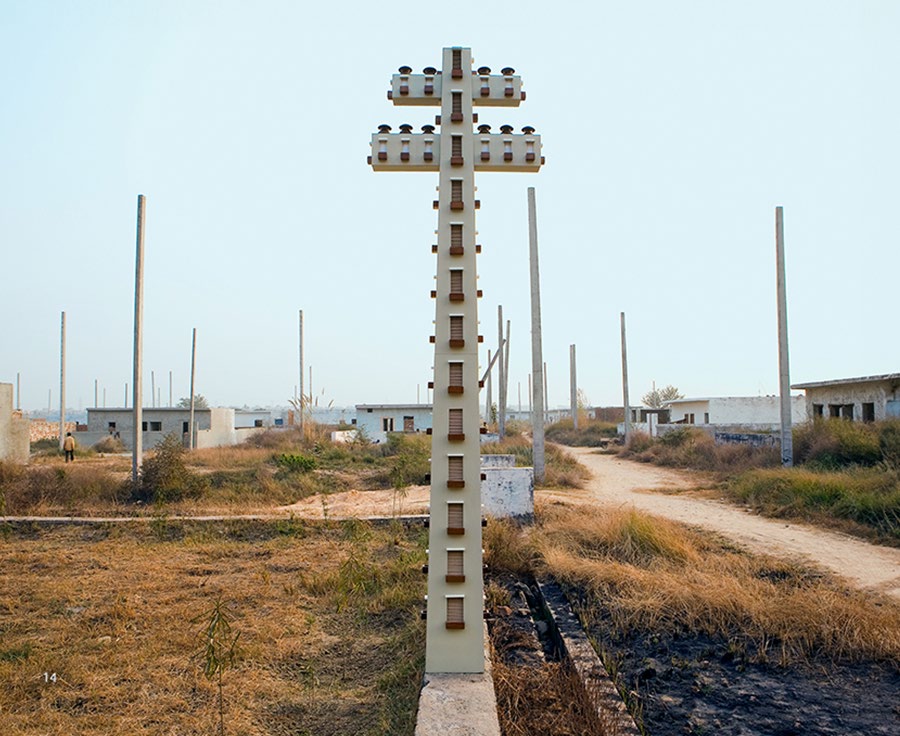
Gigi Scaria, Post Land, 2008.
The dossier thus argues that India’s industrial crisis is best understood as the result of political and policy choices that have constrained demand, weakened strategic industrial sectors, and integrated the
economy into global capitalism on subordinate terms. Manufacturing output has stagnated not because industrialisation is no longer possible, but because the conditions needed for its expansion – income redistribution, state-led industrial policy, and access to stable markets – have been systematically undermined.
Our dossier makes five key points:
- Since 2000, India has experienced a sustained decline in manufacturing, with its share of GDP falling to levels last seen more than sixty years ago. This has been accompanied by weak industrial growth and shrinking formal employment. Economist R. Nagaraj argues that India’s manufacturing share of GDP stagnated at 15%–17% even as the economy grew. The share of employment in manufacturing declined, while that of agriculture grew – both signs of premature deindustrialisation. Nagaraj points out that falling investment and dependence on imports, particularly of intermediate and capital goods, are proximate causes of this development.
- Successive policy initiatives – including Make in India, Atmanirbhar Bharat (Self-Reliant India), and Production Linked Incentive schemes – have failed to build a technologically advanced, broad-based industrial sector. Instead, they have encouraged assembly-based production that is dependent on imported components (as shown in a 2020 paper by Ramaa Arun Kumar and Biswajit Dhar).
- The failure to conduct agrarian reform and the intensity of class inequality in India have constrained domestic demand, limiting the scale of industrialisation.
- Trade liberalisation, privatisation, and the weakening of the public sector have eroded capital goods and intermediate industries, thereby increasing import intensity and undermining domestic technological capabilities (we show this through examples from the computer sector).
- Finally, we argue that service-led growth is a poor substitute for manufacturing since this type of growth – particularly in the IT and finance sectors – does not absorb labour or strengthen industrial capacity. This pattern leaves most workers trapped in low-wage, insecure employment and produces a precarious nation.

Gigi Scaria, Hesitant Attempt, 2018.
We propose the following points to continue the debate on Indian industrialisation:
- Industrial policy must be seen as a political programme, not a technocratic exercise. It requires the explicit mobilisation of the people – including trade unions, peasant unions, state governments, local self-government bodies, and other institutions and organisations – into an economic debate.
- The primary objective of any industrial policy must be productive employment (as Satyaki Roy argued a decade ago). Industrial success must be judged by the absorption of labour from agriculture and informal work, not by export volumes or stock-market valuations. This will require investment in education and training, so that India is not trapped in a low-skilled labour model.
- Redistribution needs to be seen as a precondition for industrial growth. Augmenting domestic demand requires raising wages, rural and urban employment guarantees, and universal public provisioning (of food, housing, health, education, and transportation).
- The state must be a producer, not just a regulator. This means that public sector capacity to produce capital goods, energy, machinery, pharmaceuticals, and transport equipment needs to be enhanced and developed through the creation of market competition within the public sector.
- Import dependence, the scourge of any developing country, needs to be overcome by the selective use of tariffs and quantitative restrictions on imports. There should be local content requirements for certain goods and public procurement systems that favour domestic producers.
- Any development project needs to be built around increased technological and scientific capacity. Integration into global value chains should not be an end in itself, but a means to increase learning through knowledge and technology transfer and to expand domestic research and development.
- The goals of industrial policy must be sector-specific. For instance,labour-intensive sectors such as textiles and light engineering should be geared toward employment absorption, while pharmaceuticals and electronics toward strategic sovereignty. Each sector requires tailored combinations of public investment, state protection, and regulation. Industrialisation must be decentralised and not confined to urban enclaves if it is to avoid both urban congestion and rural distress.
- Finance should serve production and not the other way around. Capital controls are necessary to curb speculative flows, credit should be channelled towards strategic sectors (particularly to small and medium enterprises), and public banks must be directed to work towards national developmental goals and not only private profit.
This is certainly not a comprehensive list, but rather an invitation for debate and discussion – not just in India but across countries of the Global South that are struggling to exit from the IMF model of development.

Gigi Scaria, Untitled, 2020.
While writing this newsletter, I thought about what all this talk of industrialisation might mean in the lives of women from oppressed castes, who are so often not the subject of industrial policy. I remembered the Tamil poet Sukirtharani, who rejected an award from the Adani Group, saying that its attitude toward the world ‘is antithetical to my principles’. A powerful poet who writes against patriarchy and the caste system, her poem ‘Nature’s Fountainhead’ gives us the sentiment of full human emancipation that should be central to all our thinking:
Say you bury me alive.
I will become a green grass-field
and lie outspread, a fertile land.
You may set me on fire;
I will become a flaming bird
and fly about in the wide, wide space.
You may wave a magic wand
and shut me up, a genie in a bottle;
I will vaporise as mercury
and stand upright towards the sky.
You may dissolve me into the wind
like water immersed into water;
from its every direction
I will emerge, like blown breath.
You may frame me, like a picture,
and hang me on your wall;
I will pour down, away past you,
like a river in sudden flood.
I myself will become
earth
fire
sky
wind
water.
The more you confine me, the more I will spill over,
Nature’s fountainhead.
Warmly,
Vijay

 The New Dark Age
Leave a comment