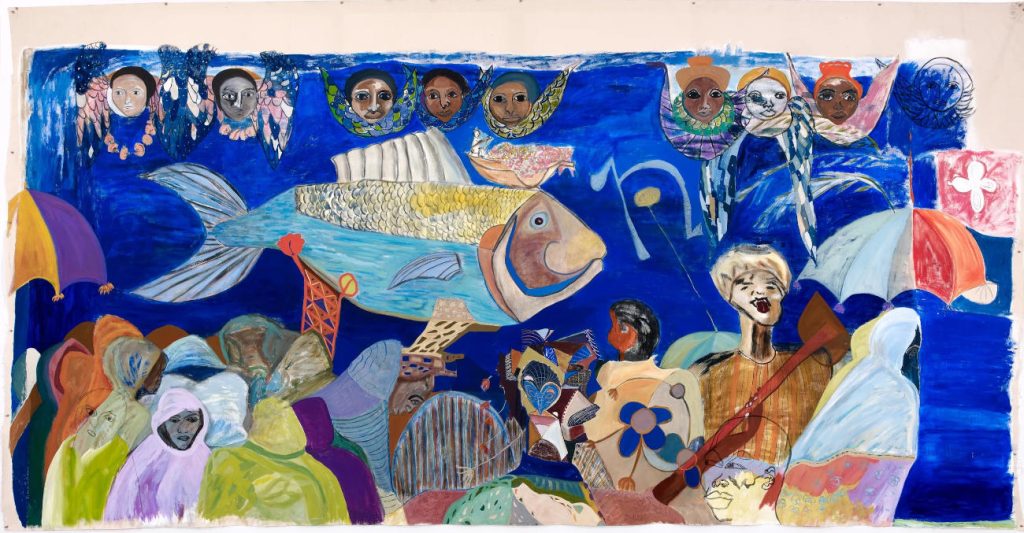
Ficre Ghebreyesus (Eritrea), The Sardine Fisherman’s Funeral, 2002.
Dear friends,
Greetings from the desk of Tricontinental: Institute for Social Research.
In 2014, the United Nations’ International Organisation for Migration (IOM) launched the Missing Migrants Project. The project, which ‘hosts the only open-access database of records of deaths during migration on the global level’, estimates that at least 33,220 migrants have died or disappeared while crossing the Mediterranean Sea since 2014. This is a very low estimate because the IOM admits that it cannot account for every boat that leaves the North African coast, let alone trace those that never arrive in Europe. South of the Mediterranean lies the Sahara Desert, where the dangers are even greater. The IOM estimates that more people die crossing the Sahara each year than they do crossing the Mediterranean, but because these deaths occur far from Europe’s shores, they receive far less attention.
It takes about three days to cross the Sahara from Agadez, Niger, to Sabha, Libya, if conditions allow and the sandstorms are not particularly brutal. Almost a decade ago, while travelling in the region, I heard survivors of the crossing describe how common it is to come across bodies half-buried in the sand and hear cries of distress from those left behind. It is routine for one or two migrants to die in a convoy; some fall from the back of a truck and are abandoned, while others are sometimes shot by smugglers. This corridor is used by people from across the continent, including Eritreans. As Teklebrhan Tefamariam Tekle, an Eritrean refugee in Sweden, told the UN High Commissioner for Refugees (UNHCR) as part of the Telling the Real Story project, ‘The accidents are back there in the Sahara. The Sahara is full of Eritrean bodies’. When Teklebrhan reached Libya, he was held in captivity. When he and others attempted to cross the sea, their boat was intercepted by the Libyan coast guards, and they were taken to a detention centre in the coastal city of Zuwara. After eight months, Teklebrhan signed up for what he thought was an evacuation flight, only to be sent back to Eritrea. He later fled again and eventually secured resettlement in Sweden.

Uzo Egonu (Nigeria), Stateless People, an Assembly, 1982.
I have been thinking about people such as Teklebrhan and others whom I met in the Sahara, who made brave journeys against all odds to reach Europe in search of work. Few of them wanted to get to Europe for the sake of the destination; their true destination was a livelihood, wherever that might be. Their countries, destabilised by war, sanctions, and plunder, cannot provide employment so long as they remain caged in neocolonial structures.
The data on migration tells an important story. The number of international migrants has doubled, from 154 million in 1990 to 304 million in 2024. If all these migrants formed one country, it would be the fourth most populous country in the world after India, China, and the United States. The World Bank estimates that global remittances increased by 4.6%, from $865 billion in 2023 to $905 billion in 2024. If these migrants were a country, their remittances would exceed the combined value of outward foreign direct investment from the United States, Japan, and China in 2024. One in eight people on the planet rely on these remittances to supplement their income and consumption patterns. The question of migration is not a rounding error in the world economy, it is one of its organising features.
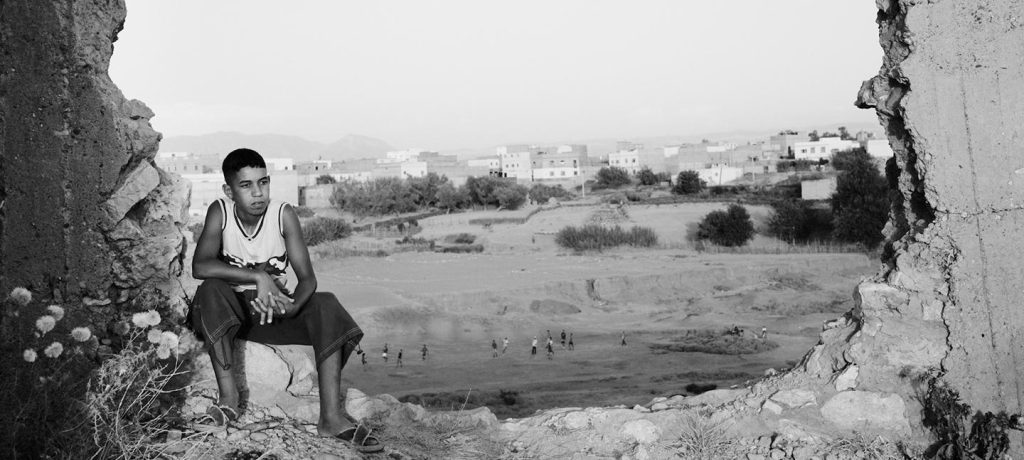
Leila Alaoui (Morocco), No Pasara (Entry Denied), 2008.
For the poorer nations, migration plays a key but contradictory role in development. On the one hand, the youth-led protests in Morocco and Nepal in 2025 showed that young people increasingly resent the economic compulsion to emigrate for precarious employment in foreign lands. They would prefer to work in their own countries so that they can live culturally and socially fulfilling lives with their family and friends. This puts pressure on governments in the Global South to build national development strategies that generate decent employment through measures such as agrarian reform, industrial policy, and public investment. On the other hand, in many countries remittances bring in more foreign currency than foreign direct investment (FDI) flows, especially as total FDI to developing countries fell by 7% in 2023 to $867 billion, with notable declines in Africa and Asia. This means that countries become structurally dependent on exporting labour simply to survive.
Any economic agenda in the Global South needs to grapple with the contradiction between the loss of labour to migration and the dependence on remittances for macroeconomic stability and household livelihoods. In the short term, the poorer nations need to link remittance flows to development finance, so that a share of these funds is not absorbed entirely by the immediate day-to-day needs of the working-class and poor households that depend on them. This can be done through voluntary public savings and credit instruments, rather than by attempting to control household transfers. In the longer term, productive investment is required to employ labour at home and end the economic compulsion to emigrate.

Frida Kahlo (Mexico), El camión (The Bus), 1929.
Mexico, under the presidency of Andrés Manuel López Obrador (AMLO), began an interesting experiment in 2023 to reduce remittance costs and expand access to public financial services. The AMLO government used an existing state financial vehicle – Financiera para el Bienestar (Finabien) – to promote lower-cost remittances and financial inclusion. Through the creation of a Finabien card and app, Mexican migrants in the United States were able to send money directly to their families through Finabien’s platform, reducing reliance on high-fee remittance intermediaries. The funds were deposited into digital accounts linked to the card. This policy reduced the transaction costs of remittances while bringing more recipient households into the formal financial system. Yet remittances are also a point of vulnerability, since the infrastructure that enables these transfers sits largely in the hands of the Global North. In the United States, the Trump administration has enacted a 1% excise tax on certain remittance transfers from 1 January 2026, echoing earlier threats to cut off remittances to the region as a tool of political pressure.
If a programme like Finabien were expanded and linked to a broader development strategy in other parts of the world, remittances entering these state-backed accounts could serve as a stable pool of deposits, allowing recipients to save and access credit, while strengthening the banking system’s deposit base and lending capacity. With the right public institutions – such as development banks and directed-credit programmes – a portion of this expanded deposit base could be channelled into long-term lending for infrastructure and productive industry. In this way, remittances could be given voluntary pathways into productive investment, rather than being absorbed entirely by day-to-day consumption needs.
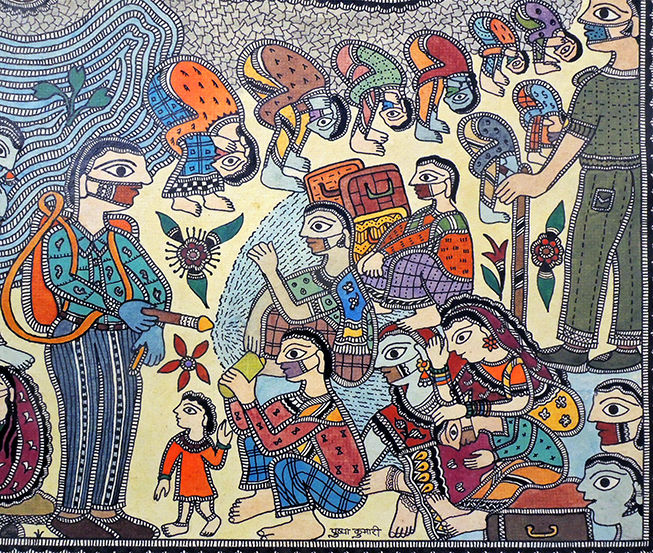
Pushpa Kumari (India), Migrant Labour Goes Home, 2020.
For decades, the International Monetary Fund (IMF)’s structural adjustment programmes (SAPs) imposed on the poorer nations have prioritised creditor and rentier interests, in the name of ‘macroeconomic stabilisation’, over productive investment and employment. SAP conditionalities consistently include fiscal austerity, limits on public-sector hiring, wage restraint, and reductions in state-led investment. These measures constrain the ability of governments to pursue industrial policy, expand public works, or actively create jobs. In practice, the IMF’s prescriptions create a ‘surplus population’ in the Global South that is compelled to emigrate for survival. This displacement is intensified by imperialist wars and by economic weapons such as unilateral coercive measures, which erode public revenue, destroy key infrastructure, restrict access to trade and finance, and fracture families. According to the UNHCR, by the end of 2024, 122 million people worldwide were forcibly displaced as a result of persecution, conflict, violence, and related violations.
Development strategies that fail to generate productive employment merely export labour while deepening dependency on remittances. Domestic job creation – through measures that raise productivity and expand public capacity, from agrarian reform and public investment to industrial policy and public services – allows people to remain rooted in their communities, strengthens national economies, and reduces forced migration. Development that does not create gainful employment ultimately displaces the poor rather than liberating them from poverty.
Migration must therefore be understood as a consequence of Global South underdevelopment and unequal exchange, not merely a security problem for the Global North. Creating dignified employment in the poorer nations is the primary answer to forced economic migration. But for that, the IMF’s austerity policies need to be replaced by a development agenda that expands fiscal space, supports public investment, and enables industrial policy.

Bassim Al Shaker (Iraq), Escape to Hell, 2021.
Of course, there are other issues at stake. With rapidly ageing populations and low birth rates, driven by a crisis in social reproduction, the Global North has come to rely on migrant labour from the Global South across key sectors, from care work and agriculture to construction and logistics. In the main settler-colonial states of the Global North, this dependence also extends to high-skilled labour in health, engineering, and universities, as gaps in public training and education are increasingly filled through immigration. Yet migrants are routinely vilified and criminalised, even as their labour becomes indispensable. This contradiction has not gone uncontested. On 30 January, mass mobilisations across the United States challenged the Trump administration’s highly militarised anti-immigrant campaign that has included mass raids, detention, and deportations. They came amid the deaths of dozens of migrants in immigration custody in 2025 and the fatal shootings of two US citizens in Minneapolis at the hands of federal immigration agents.
The tensions around migration are also reflected in international policy. The United Nations’ Global Compact for Safe, Orderly, and Regular Migration (GCM), endorsed by the General Assembly in December 2018, sets out 23 objectives. A close reading of the GCM’s objectives suggests three important policy points:
-
Address the root causes of migration through productive investment. This is raised in objective 2: ‘Minimise the adverse drivers and structural factors that compel people to leave their country of origin’. In principle, reducing forced migration requires expanding livelihoods at home, but that demands fiscal space and policy autonomy that austerity regimes routinely deny.
-
Align labour mobility with demographic realities. This is raised in objective 5: ‘Enhance availability and flexibility of pathways for regular migration’ and objective 18: ‘Invest in skills development and facilitate mutual recognition of skills, qualifications, and competences’. In effect, the GCM promotes regular labour mobility pathways that respond to labour market needs in destination countries, alongside mechanisms to recognise migrants’ qualifications. This can reduce irregular migration and exploitation, but it can also normalise labour export as a development ‘solution’.
-
Reduce the cost of remittances and promote financial inclusion. This is raised in objective 20: ‘Promote faster, safer, and cheaper transfer of remittances and foster financial inclusion of migrants’. The GCM also notes that remittances are private funds and ‘cannot be equated’ with other development finance, which underlines the contradiction: households are forced to shoulder burdens that should be met by public investment.

Pharaonic Roll No. 5, c. 1300–1200 BCE, Egypt Museum, Cairo.
While travelling in Libya two years ago, I was struck to see the nest of a barn swallow in an abandoned military truck. Barn swallows are migratory birds that cross the Mediterranean and the Sahara each year. They pay no heed to borders, and they often nest among us, even amid our wreckage. The swallow has long been a symbol of the long journey and the hope of return. In maritime tradition, sailors tattooed swallows as a sign of safe passage and homecoming. In parts of Europe, it is considered bad luck to destroy a swallow’s nest. Perhaps the old superstition carries a simple lesson: respect the traveller, and build a world in which no one is forced to risk death to find a livelihood. As the Palestinian poet Mahmoud Darwish wrote, ‘And as you return home – to your home – think of others’ (وأنتَ تعودُ إلى البيتِ، بيتِكَ، فكِّرْ
بغيرِ ).
Warmly,
Vijay

 The New Dark Age
Leave a comment