Sunday, 8 February 2026 — New Eastern Outlook
The rush of Western leaders to Beijing is less about ideology than survival, marking a strategic reset in a fragmented, increasingly multipolar global order.
What is a “middle power” in geopolitical terms?
In short, the parade to Beijing reflects not an ideological conversion, but a pragmatic adjustment to a fractured international order
In geopolitical theory, a middle power is a state that lacks the comprehensive dominance of a superpower but possesses sufficient economic, diplomatic, technological, or regional weight to influence international outcomes. Middle powers are not system-makers, but they are system-shapers. They rely on coalitions, institutions, and diplomacy rather than unilateral force. Countries such as Canada, Australia, the UK, France, Germany, and the Nordic states fall into this category, though their relative power has declined because of the rising states like India, Indonesia, or Brazil.
Crucially, “middle power” is not a collective identity. What unites them today is vulnerability: they are deeply embedded in global trade and security networks that are now being weaponized by great powers.
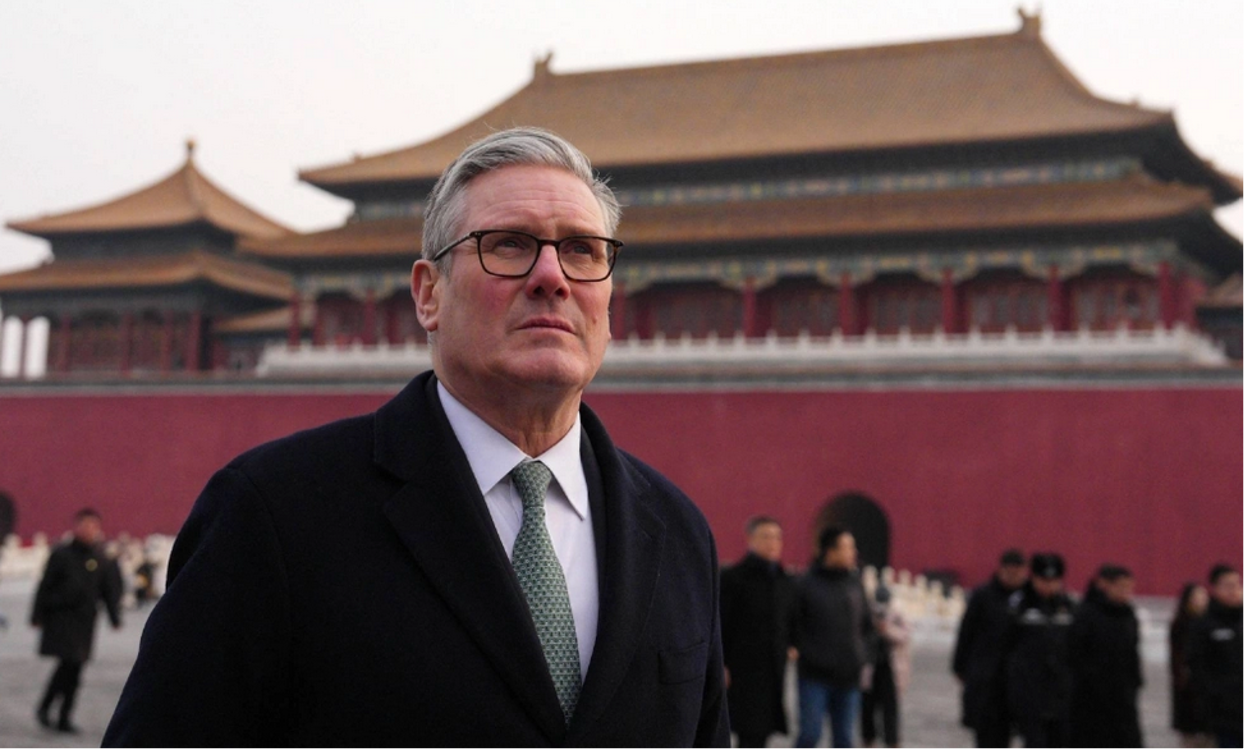
The Western middle powers parading in Beijing
Mark Carney’s blunt formulation—“either you are on the menu or on the table”—captures the dilemma facing middle powers. In an era where tariffs, sanctions, supply chains, and financial systems are instruments of coercion, dependence becomes a strategic liability. The Trump administration’s threats toward allies, such as tariffs on Canada and others, Greenland territorial grabbing, and transactional NATO politics, have destroyed the assumption that alignment with Washington guarantees stability.
For middle powers, engaging with China is less about ideological convergence and more about geopolitical survival. Beijing offers market access, investment, technological cooperation, and, above all, predictability. China now appears to the Western middle powers more consistent compared to an erratic United States that increasingly treats allies as leverage points rather than partners.
What did each country gain from engaging Xi Jinping
The outcomes of these visits have been pragmatic rather than transformative:
United Kingdom: Prime Minister Keir Starmer secured reduced tariffs (notably on whisky), visa-free travel, healthcare and trade agreements, and renewed investment flows. More importantly, London signaled it would not “go back and forth” between Washington and Beijing, asserting strategic autonomy.
Canada: Mark Carney’s visit yielded expanded trade channels, electric vehicle cooperation, and diversification away from overwhelming U.S. export dependence. Symbolically, it reinforced Canada’s refusal to accept U.S. economic coercion.
Finland and Nordic states: These visits focused on technology, clean energy, and industrial cooperation, reflecting China’s role in critical supply chains.
France and Germany: Paris and Berlin seek industrial access, climate cooperation, and technological engagement, while quietly hedging against U.S. unreliability. Germany’s interest in satellite and missile-detection technology underscores Europe’s push for strategic autonomy.
None of these states are “pivoting” fully to China. They are hedging, i.e., reducing exposure to any single great power.
Trump’s reaction and what it means for the U.S.
Donald Trump’s response has been openly hostile. He has described UK-China ties as “very dangerous” and warned Canada that “China is not the answer.” Yet this reaction is deeply revealing. From Washington’s perspective, Western leaders in Beijing represent a loss of control. The post-Cold War order depended not only on U.S. power but also on allied consent. That consent is now conditional.
Ironically, Trump’s threats validate Carney’s argument that economic integration is being used as a weapon. Every tariff threat and every public humiliation reinforces the incentive for middle powers to diversify away from the United States.
What do middle powers expect from China, and how does it change their U.S. relations
Middle powers are not seeking protection from China, but options. They want access to China’s vast market, participation in its industrial ecosystems, and cooperation in areas like green technology, infrastructure, and finance. Equally important, they want leverage: the ability to say “no” to Washington without catastrophic consequences.
Even Trump’s European best friend, Finland’s president Alexander Stubb, has urged Europe to recognise a shift in the United States, saying the current U.S. administration’s foreign policy ideology no longer aligns with Europe’s core values.
This does not end alliances with the U.S., but it rebalances them. The relationship becomes less hierarchical and more transactional. Middle powers are signaling that loyalty can no longer be taken for granted: it must be earned.
Geopolitical takeaways
Several broader conclusions emerge:
- The rules-based order has fractured: Not because rules never existed, but because the U.S. now openly ignores them when inconvenient.
- Middle powers are no longer passive: They are experimenting with coordination, diversification, and “variable geometry” coalitions rather than rigid blocs. Survival is the overriding priority.
- China benefits from U.S. overreach: Beijing’s posture of stability and dialogue contrasts sharply with Washington’s unpredictability and its coercive, abusive tone.
- Multipolarity is accelerating: Not through the rise of a new hegemon, but through the collective agency of states unwilling to be dominated by only one superpower.
- America First is coming to mean America Alone: Isolation is what Trump is producing; to avoid further isolation and disenchantment, coercion is applied.
In short, the parade to Beijing reflects not an ideological conversion, but a pragmatic adjustment to a fractured international order. As the United States increasingly sets aside its own rules and relies on coercion, middle powers are asserting agency through diversification, coordination, and flexible coalitions, with survival as the overriding priority.
China has benefited from this moment not by force, but by projecting stability, dialogue, and predictability in contrast to Washington’s volatility. The result is an accelerating multipolarity, driven less by the rise of a new hegemon than by the collective will of states unwilling to be subordinated to a single power. In this context, “America First” is increasingly perceived as America alone, while Beijing emerges as a central—if not indispensable—pole in a more plural global order.
Ricardo Martins, Doctor in Sociology with specialisation in geopolitics and international relations
Follow new articles on our Telegram channel

 The New Dark Age
Leave a comment