Thursday, 19 February 2026 — The Tricontinental
With New START now expired, the United States’ withdrawal from arms control treaties and its embrace of nuclear ‘warfighting’ doctrines are raising the risk of catastrophic conflict between nuclear powers.
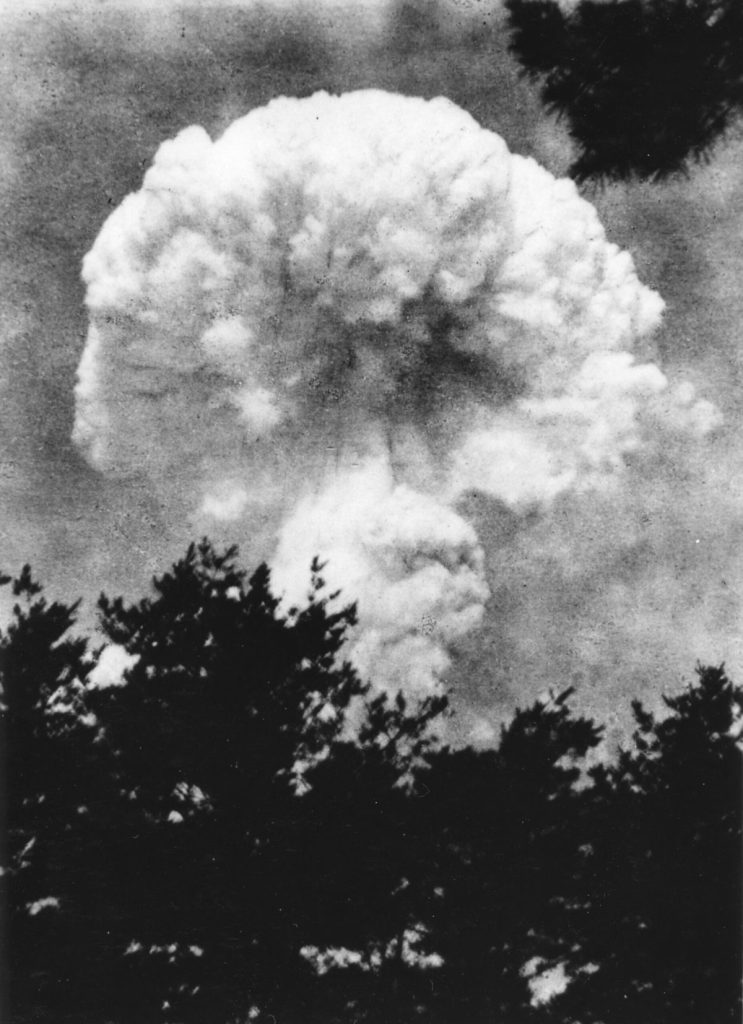 Yoshito Matsushige (Japan), Hiroshima, 1945.
Dear friends,
Greetings from the desk of Tricontinental: Institute for Social Research.
On 5 February 2026, the New Strategic Arms Reduction Treaty (New START) expired, ending the last surviving legal constraint on the strategic nuclear arsenals of the United States and the Russian Federation. New START, which was signed in 2010 and entered into force in 2011, should have been replaced by a successor agreement. The treaty limited strategic warheads and delivery vehicles deployed by each side and established a verification regime of inspection, notification, and information exchange. These measures were not cosmetic; they were thin threads that restrained the most destructive machinery ever assembled.
The expiration of New START did not arrive suddenly. Due to the decade-long breakdown in US-Russia relations, on-site inspections were paused by both sides in March 2020 and never resumed. In February 2023, Russia suspended its participation in New START, and the US responded in kind (Russia has publicly said it intends to continue observing New START’s numerical limits, provided the US does the same). By the time the treaty formally lapsed, its verification spine had already been severed.
We now live in a world where the two largest nuclear powers are unrestrained by any binding treaty limits.
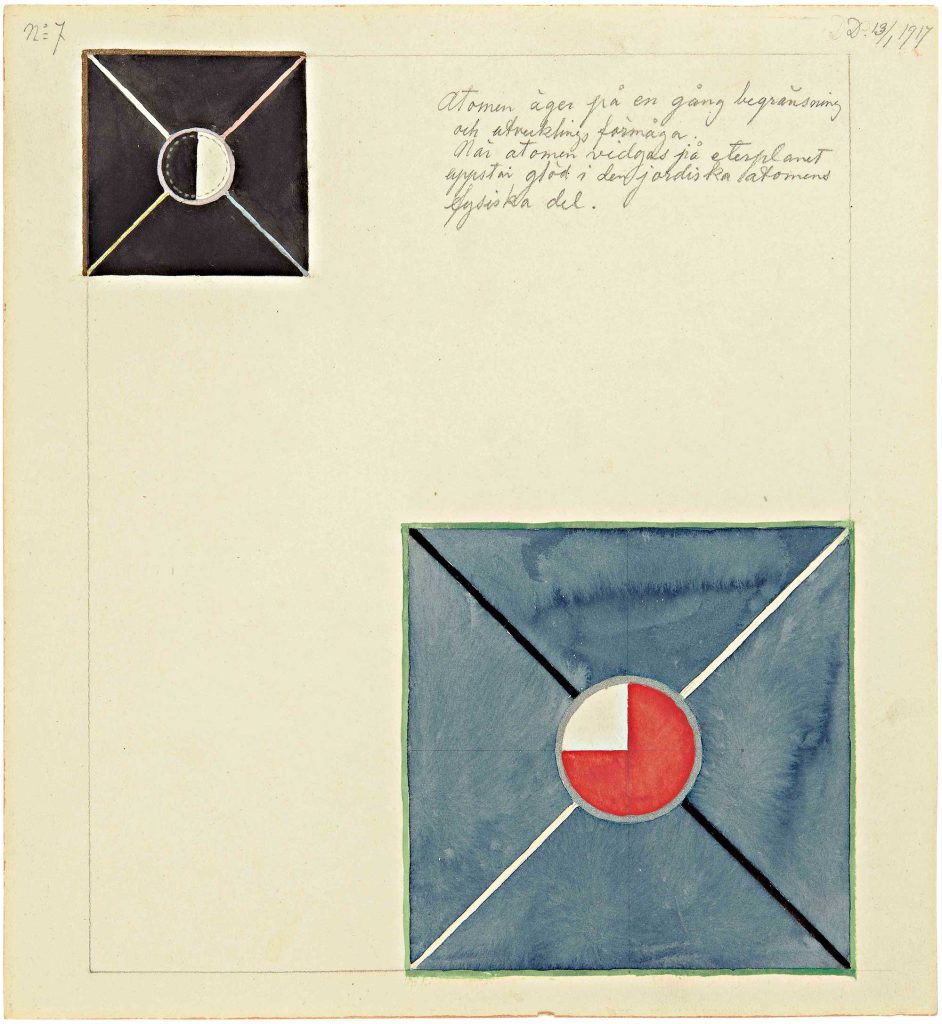
Hilma af Klint (Sweden), The Atom Series no. 7, 1917.
Since 2002, the United States has unilaterally exited one arms control treaty after another, eroding the architecture that helped stabilise deterrence. These treaties include the following:
-
The Anti-Ballistic Missile Treaty of 1972 – US withdrawal, June 2002.
-
The Intermediate-Range Nuclear Forces Treaty of 1987 – US withdrawal, August 2019.
-
The Treaty on Open Skies of 1992 – US withdrawal, November 2020.
-
The New START of 2011 – expired, February 2026.
The end of New START unfolds within a broader turn toward nuclear ‘warfighting’ doctrines, including a renewed emphasis on the diabolical idea of counterforce – the outlines of which appear in the 2018 US Nuclear Posture Review (NPR). The idea is simple: to attack an adversary’s nuclear forces and command systems rather than its cities. Such an attack is seen to be more rational and even more humane. In reality, an attack of this kind destabilises all deterrence systems. Counterforce doctrines reward speed, pre-emption, and first-strike advantage, thereby compressing decision-making time. The doctrine creates a use-it-or-lose-it pressure – the fear that you must launch before your forces are destroyed – that makes miscalculation structural, not accidental. As warfare technologies advance, this logic is amplified. Highly developed conventional strike systems, missile defences, hypersonic delivery systems, and integrated command-and-control networks (shared systems that link sensors, communications, and decision-making) blur the boundary between nuclear and non-nuclear war. A missile launched with conventional intent may be interpreted as a nuclear strike. Dual-use platforms – systems that can carry conventional or nuclear payloads – undermine signalling clarity by making it difficult to determine whether a launch is conventional or nuclear. Escalation ladders shorten. The margin for error narrows to seconds.

Enrico Baj (Italy), Two Children in the Nuclear Night, 1956.
The counterforce doctrine is not merely an abstract debate but has materialised in government budgets and arms procurement contracts. The 2022 US NPR affirmed the modernisation of the nuclear triad: land-based intercontinental ballistic missiles, submarine-launched ballistic missiles, and nuclear-capable strategic bombers. Crucially, the 2022 NPR rejects ‘no first use’ and ‘sole purpose’ policies (‘no first use’ means committing not to use nuclear weapons first; ‘sole purpose’ means limiting their role to deterrence and, if necessary, for responding to nuclear attack). The current policy holds that the US would only consider the use of nuclear weapons, under ‘extreme circumstances’, to defend its vital interests or those of its allies and partners, but it does not foreclose first use, and leaves open a ‘narrow range of contingencies’ in which nuclear weapons may deter attacks with ‘strategic effect’. This posture preserves the option to target adversary military capabilities – including their strategic forces if necessary – without overtly committing to the counterforce doctrine. The 2023 Congressional Commission on the Strategic Posture of the United States took this further, arguing that US nuclear planning should continue to target what adversaries ‘value most’. In these texts, nuclear weapons are not presented as tragic necessities of modern statecraft but as normal tools that can be used in certain circumstances.
The madness behind these attitudes is fuelled by the enormous profits earned by the arms industry, which seeks to modernise nuclear systems around the counterforce doctrine. A 2025 report by PAX and the International Campaign to Abolish Nuclear Weapons (ICAN) titled At Great Cost: The Companies Building Nuclear Weapons and their Financiers found that, between January 2022 and August 2024, 260 global financial institutions (including pension funds, insurance companies, and asset managers) financed 24 nuclear weapons producers, with investors holding just under $514 billion in shares and bonds and with around $270 billion provided in loans and underwriting. These companies include Airbus, BAE Systems, Bechtel, Boeing, General Dynamics, L3Harris Technologies, Northrop Grumman, and Rolls-Royce. ICAN’s 2025 report Hidden Costs: Nuclear Weapons Spending in 2024 estimates that the nine nuclear-armed states spent $100.2 billion on their nuclear arsenals in 2024, with the private sector earning at least $42.5 billion from nuclear weapons contracts. That sum could have paid the UN’s budget 28 times and fed 345 million people facing the most severe hunger for nearly two years. The nuclear weapons industry is a striking waste of human resources.
 Le Corbusier (France), Composition avec photo de la bombe ‘H’ (Composition with Photo of the ‘H’ Bomb), 1952.
Despite the collapse of the bilateral arms control regime, the global nuclear deterrence and eradication system has not vanished. But what remains is irradiated by US domination over the architecture of nuclear policy:
-
The Nuclear Non-Proliferation Treaty (NPT, 1970) remains in force even though it reinforces the system of nuclear apartheid (despite Article VI, which asks nuclear-armed countries to pursue disarmament). The expiration of New START deepens the NPT’s crisis of legitimacy and exposes the disarmament promise as perpetually deferred. India, Israel, and Pakistan never signed the NPT; the Democratic People’s Republic of Korea (DPRK) signed it in 1985 but withdrew in 2003.
-
The International Atomic Energy Agency (IAEA, 1957) operates a safeguards regime of inspections, material accountancy, and monitoring. The 1997 Additional Protocol to the IAEA extends these capacities, yet this mechanism remains plagued by selective enforcement. The IAEA’s investigations of Iran, for instance, are not shaped by evidence but by the Global North’s hostility to the Iranian government.
-
The Nuclear Suppliers Group (NSG, 1975) is an informal export-control regime for sensitive technologies and dual-use materials used in nuclear fuel-cycle and weapons-related programmes. While the purpose of the NSG is to constrain proliferation (reinforced by UN Security Council resolution 1540), it ends up reinforcing technological hierarchies. The nuclear-armed states dominate the informal institutions, exercising their authority while insisting on restraint from others.
 Krassimir Terziev (Bulgaria), Family, 2015.
Some tattered norms remain outside the full control of the United States, but they are fractured and unable to advance a comprehensive agenda. These include:
-
The Treaty on the Prohibition of Nuclear Weapons (2017). This is a legally binding instrument that represents a categorical rejection of nuclear arms. As of late 2025, ninety-nine countries had either ratified or signed the treaty, but none of the world’s nine nuclear-armed states are among them. In Europe, only Austria, the Holy See (Vatican), Ireland, Malta, and San Marino have ratified the treaty. The treaty, which was driven by the International Campaign to Abolish Nuclear Weapons, is largely a Global South initiative.
-
Nuclear Weapon Free Zones. Five regions of the world adopted treaties to make their territories free of nuclear weapons. These agreements are the Treaty of Tlatelolco (1967) covering Latin America and the Caribbean, the Treaty of Rarotonga (1985) covering the South Pacific, the Treaty of Bangkok (1995) covering Southeast Asia, the Treaty of Pelindaba (1996) covering Africa, and the Semipalatinsk Treaty (2006) covering Central Asia. These treaties are, in practice, among the most successful achievements in nuclear disarmament.
-
The Comprehensive Nuclear-Test Ban Treaty (1996). This treaty has not been able to enter into force because several required states have not ratified it, yet it remains politically significant because it prohibits nuclear test explosions and has helped make nuclear testing internationally taboo. The treaty’s monitoring system functions daily, detecting seismic and atmospheric signals, making tests harder to hide.
The post-New START landscape contains some institutions and norms, but the central restraint on the largest nuclear arsenals has vanished. What we have now are three overlapping crises:
-
A crisis of stability. With no transparency and verification on the largest nuclear weapons arsenals there is only suspicion between the major powers.
-
A crisis of legitimacy. The countries with the largest arsenals demand obedience to non-proliferation while abandoning their own treaty commitment to disarmament.
-
A crisis of conscience. Horrifyingly, nuclear weapons are now being spoken of as being usable, manageable, and necessary – as legitimate options on the battlefield.
A return to an arms control regime is necessary. But we need to consider a broader agenda. Even the best treaties only manage danger but do not eliminate it. The deeper contradiction remains intact: a world in which a few states claim the right to annihilate humanity in the name of security. The demise of New START strips away illusions to reveal a nuclear weapons order that preserves power and does not advance peace.
Libya abandoned its nuclear weapons programme in December 2003. Eight years later, a UN Security Council resolution (no. 1973) imposing an arms embargo and a no-fly zone was used by NATO to justify the military intervention that destroyed the Libyan state. It was logical, therefore, for the DPRK to test a nuclear weapon in 2006 and build a shield against the regime-change ambitions of the US and its East Asian allies. The counterforce doctrine of the US encourages countries to build such a shield, a painful reality in a world marinated in the anxieties provoked by hyper-imperialism.
 Shin Hak-Chul (Korea), Planting Rice, 1987.
In 2003, the British playwright Harold Pinter (1930–2008), exasperated by the Global War on Terror, wrote a powerful poem called ‘The Bombs’. I remember hearing Pinter read this poem in London, the cadence powerful, the hope in the ugliness clear. In his memory, here is the poem:
There are no more words to be said
All we have left are the bombs
Which burst out of our head
All that is left are the bombs
Which suck out the last of our blood
All we have left are the bombs
Which polish the skulls of the dead.
Warmly,
Vijay

 The New Dark Age
Leave a comment