Wednesday, 11 March 2026 — DD Geopolitics
Three Fronts, One Conflict, and the Lessons History Forgot
DD GEOPOLITICS | INVESTIGATIVE REPORT | MARCH 10, 2026
By: Kayla Dones | Analysis & Investigative Report
“Israeli media are reporting that Hezbollah’s ‘ghosts’ are back at the northern borders. In southern Lebanon, fighters are emerging from hidden positions, striking with precision and creating a severe operational crisis for the Israeli army. Conventional forces are struggling to respond to this underground, highly coordinated network, showing how Hezbollah can turn the terrain itself into a strategic advantage.”
— Ibrahim Majed, @IbrahimMajed, X.com, March 10, 2026
The First Attack: How Phones Became A Battlefield for The Mind
Before missiles fly, words do. On March 8, 2026, something unprecedented happened: the Islamic Revolutionary Guard Corps (IRGC) transmitted mass text messages directly to Israeli citizens’ civilian phones. The message was blunt and deliberate.
As reported by the International Business Times UK, the IRGC sent a chilling alert stating that U.S. radar systems in the region had been destroyed, that the Israeli government was deceiving its own people, andthat no shelter could guarantee their safety from incoming missiles.

The IRGC had already claimed publicly, via its official outlet Sepah News, that American THAAD radars deployed in the UAE and Jordan, as well as the U.S. FPS-132 over-the-horizon radar system known as ‘Desert Eye’ stationed in Qatar, had been destroyed by IRGC missile and drone units. That claim formed the factual basis of the warning broadcast into Israeli pockets and purses through the transmission of mass text
messages.
The IRGC announced through official channels that ‘the eyes of the U.S. and the Zionist regime in the region have been blinded’ after claiming the destruction of more than seven advanced radar installations. Neither the United States nor Israel has confirmed the full destruction of those radar systems. The IDF has, however, acknowledged that Iran’s attacks have targeted regional military infrastructure throughout the conflict.
This is not propaganda for distant consumption. This is a psychological battle as much as a physical one. This action can be an interpretation of intemidation aimed at creating civilian panic from within or it may be a final warning. The coming hours and days will bring more to light. Ibrahim Majed captured what the text messages represent: a declaration that the conflict has no safe perimeter anymore. Not for civilians. Not for radar operators. Not for air defense command centers. And its worth noting in this hype technological era that history tells us in asymmetric conflicts, the war on perception is often the decisive one.
THREE FRONTS: THE STRATEGIC LANDSCAPE
Hezbollah today operates across a multi-front strategic environment unlike anything the movement has faced in its forty-year history. As Ibrahim Majed writes:
“Hezbollah today operates in an increasingly complex strategic environment where threats can emerge from multiple directions simultaneously. The movement is no longer positioned on a single battlefield but across several potential arenas of confrontation.”
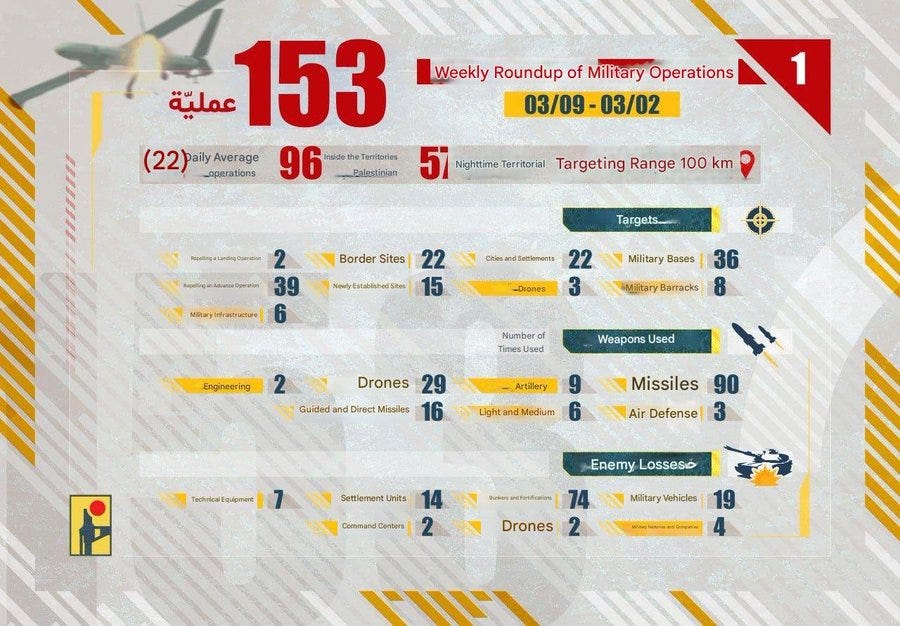
That is not rhetorical framing. It is a battlefield fact confirmed by every major international news outlet now tracking this conflict.
The Southern Front: The Historical Core
The Lebanese border with occupied Palestine remains the primary axis of confrontation — and it is now fully active. Israeli ground incursions into southern Lebanon have transformed what was long a deterrence line into a live theater of war.
Reuters, sourcing four Lebanese contacts directly familiar with Hezbollah military operations, reported on March 10, 2026 that Hezbollah has returned to its roots in guerrilla warfare, operating in small decentralized units, rationing anti-tank rocket use, and deliberately avoiding communication devices vulnerable to Israeli signals intelligence. The elite Radwan fighters — who had withdrawn from the south following the 2024 ceasefire — have returned. Their focus: Khiyam, near the intersection of Lebanon’s border with both Israel and Syria, which Hezbollah identifies as the most likely launchpoint for any full Israeli ground invasion.

An Israeli security source told Reuters that far from looking to de-escalate, Hezbollah appears to be stabilizing its ranks and executing decisions with increasing effectiveness. The group has reportedly assigned four deputies to every field commander — a redundancy architecture designed to ensure operational continuity even as Israel targets leadership.
The Center for Strategic and International Studies (CSIS) assessed that the rocky hills of southern Lebanon create natural chokepoints that restrict heavy Israeli armor to major hardened roadways — rendering conventional forces systematically vulnerable to anti-tank guided missiles, IEDs, and ambushes. Lebanese army Brigadier General Nicolas Thabet told international media in November 2025 that since deploying south of the Litani River, troops had discovered 74 tunnels, 175 rocket launchers, and 58 missiles. One complex in the Zibqin Valley — roughly 100 meters long, outfitted with power, ventilation, first-aid infrastructure, and food stores — likely served as a Hezbollah command center.
Majed describes this precisely:
“In response, Hezbollah is employing a military doctrine built around extensive missile capabilities and deeply entrenched defensive infrastructure, capabilities developed precisely for the scenario of a large-scale Israeli ground advance.”
The Eastern Front: Syria’s New Wild Card
To the east, Syria’s political transformation has introduced a volatile new variable. The rise of Ahmad al-Sharaa — widely known as Abu Mohammad al-Jolani — to the Syrian presidency has reshaped the Lebanese-Syrian frontier in ways that remain dangerously fluid.
As Majed documents:
“Syrian airspace has been used or tolerated for Israeli aircraft launching strikes toward Lebanon, alongside attempts of Israeli airborne insertions into several villages in the Beqaa Valley, including Nabi Chit.”
Syrian officials and media figures have accused Hezbollah of attacking Syrian territory — accusations Hezbollah supporters have firmly rejected. Al Jazeera confirmed that Lebanese military sources reported Israeli ground troops present at numerous points a few kilometers inside Lebanese territory.
The Internal Front: Lebanon’s Fragile Political Arena
The third potential front is the most politically charged. Lebanon’s deep sectarian divisions and economic collapse create conditions for internal instability if the government were to attempt to forcibly disarm Hezbollah. Lebanese Prime Minister Nawaf Salam called Hezbollah’s military reentry a ‘strategic mistake.’ But retired U.S. Army Colonel Seth Krummrich, former chief of staff for Special Operations Command Central, told Al Jazeera directly that confronting Hezbollah battalions in combat would ‘deplete the army.’
Majed does not mince words:
“With the government reportedly backed by the United States, seeking to drive a confrontation between the Lebanese army and the resistance, and encouraging some domestic groups to clash with Hezbollah, this internal front remains volatile and could open at any moment.”
THE REGIONAL NETWORK: HEZBOLLAH IS NOT ALONE
The three-front analysis would be incomplete without the broader network of allied actors whose involvement could fundamentally alter the trajectory of the conflict. As Majed writes:
“Armed factions within the Iraqi resistance have already signaled that they could move toward the Syrian theater if Damascus were to take military action against Lebanon under the leadership of Ahmad al-Sharaa.”
That signal is not hypothetical. According to the Critical Threats Project, the Islamic Resistance in Iraq claimed 29 separate operations against U.S. and Israeli-linked targets across the region in just the first week of March 2026. The IRGC declared on March 8 that Iran is prepared to sustain ‘at least a six-month intense war at the current pace of operations,’ claiming strikes on more than 200 sites linked to U.S. and Israeli bases across the region. The ACLED March 2026 Special Issue confirmed Iran’s retaliatory campaign struck the UAE, Kuwait, Qatar, and Bahrain, and targeted vessels in the Strait of Hormuz.
Majed identifies the organizing principle:
“If multiple pressures were to unfold simultaneously, Hezbollah would be confronting a strategic landscape unlike any it has faced before: a military confrontation with Israel in the south, rising tensions along the Syrian frontier in the east, and a fragile political arena at home. Yet such a scenario would also carry the risk of transforming a localized conflict into a multi-theater regional crisis, drawing in actors across the Middle East.”
THE GHOST OF VIETNAM: WHEN TERRAIN DEFEATS FIREPOWER
What is unfolding in the limestone hills of southern Lebanon is not new. History has already written this script — in the jungles of Southeast Asia, five decades ago.
From the late 1940s through 1975, Vietnamese Communist forces built one of the most formidable guerrilla warfare infrastructures in military history. The Cu Chi tunnel network alone stretched 250 kilometers — from the outskirts of Saigon to the Cambodian border. It contained field hospitals, kitchens, sleeping quarters, command centers, and classrooms. It had ventilation shafts, trap doors, and escape hatches wired with booby traps designed to kill any enemy soldier who entered.
The United States, commanding the most technologically advanced military force in the world at the time, could not destroy it.
In January 1966, 8,000 American and Australian troops launched Operation Crimp, preceded by B-52 carpet bombing. They found the tunnels. They could not eliminate them. The Viet Cong returned within months. In January 1967, Operation Cedar Falls deployed 30,000 troops against the same network — uncovering the Viet Cong district headquarters and half a million documents. The Viet Cong returned within months. By 1969, B-52s were targeting Cu Chi exclusively. Even carpet bombing could not destroy most of the system.
The Viet Cong were so well entrenched by 1965 that they controlled where and when battles would take place — the definition of strategic dominance achieved not through air power or naval supremacy, but through terrain knowledge and underground infrastructure.
The parallels to southern Lebanon are structural, not incidental:
- Terrain as equalizer: Rocky hills restrict mechanized movement. Tunnels carved into limestone cannot be carpet bombed into submission.
- Decentralized command: Hezbollah’s four-deputies-per-commander structure mirrors the NLF’s cellular organization, designed to survive decapitation strikes.
- Strike and disappear: The ‘ghosts’ Ibrahim Majed describes — emerging from hidden positions, striking with precision, vanishing underground — are executing the Cu Chi playbook on Lebanese terrain.
- Psychological warfare: The IRGC mass text campaign is an information-era version of Radio Hanoi broadcasts aimed at breaking civilian morale and undermining the legitimacy of the opposing state.

The United States lost the Vietnam War not because it ran out of bombs. It had more bombs than it could drop. It lost because terrain and time favored the side fighting at home, inside its own geography, with infrastructure that no amount of aerial firepower could fully eliminate.
The question now is whether Israel — and its American backers — have studied that history. And whether the answer changes anything on the ground.
SOURCES
Reuters (March 10, 2026) — Confirmed Hezbollah’s guerrilla tactical pivot and Radwan force return to Khiyam.
Al Jazeera (March 10, 2026) — Confirmed Israeli ground presence in Lebanon and Lebanese army disarmament status.
International Business Times UK (March 8, 2026) — Confirmed IRGC mass text messages to Israeli civilian phones.
IRGC / Sepah News (Primary Source) — IRGC’s own claims regarding radar destruction. Independent verification of all claimed radar destruction remains incomplete.
ACLED March 2026 Special Issue — Confirmed scope of Iranian retaliatory strikes across the Gulf region.
House of Commons Library (March 10, 2026) — Confirmed U.S.-Israeli strikes timeline beginning February 28, 2026.
Critical Threats Project (March 5, 2026) — Confirmed Iraqi militia operations and campaign phase analysis.
CSIS (October 2024) — Confirmed terrain and strategic geography analysis of southern Lebanon.
Modern War Institute, West Point (November 2024) — Confirmed Hezbollah tunnel infrastructure assessment.
History.com / Cu Chi Tunnels records — Confirmed Vietnam War guerrilla warfare and tunnel doctrine.
DD Geopolitics is an independent analytical publication. This article integrates primary source reporting, international newswire verification, and analytical commentary sourced from Ibrahim Majed (@IbrahimMajed on X), whose original strategic framework is quoted with attribution throughout. Ibrahim Majed’s analysis represents his independent views and is presented as a cited source.
Published: March 11, 2026 | DD Geopolitics

 The New Dark Age
Leave a comment