Sunday, 22 March 2026 — Weaponized Information
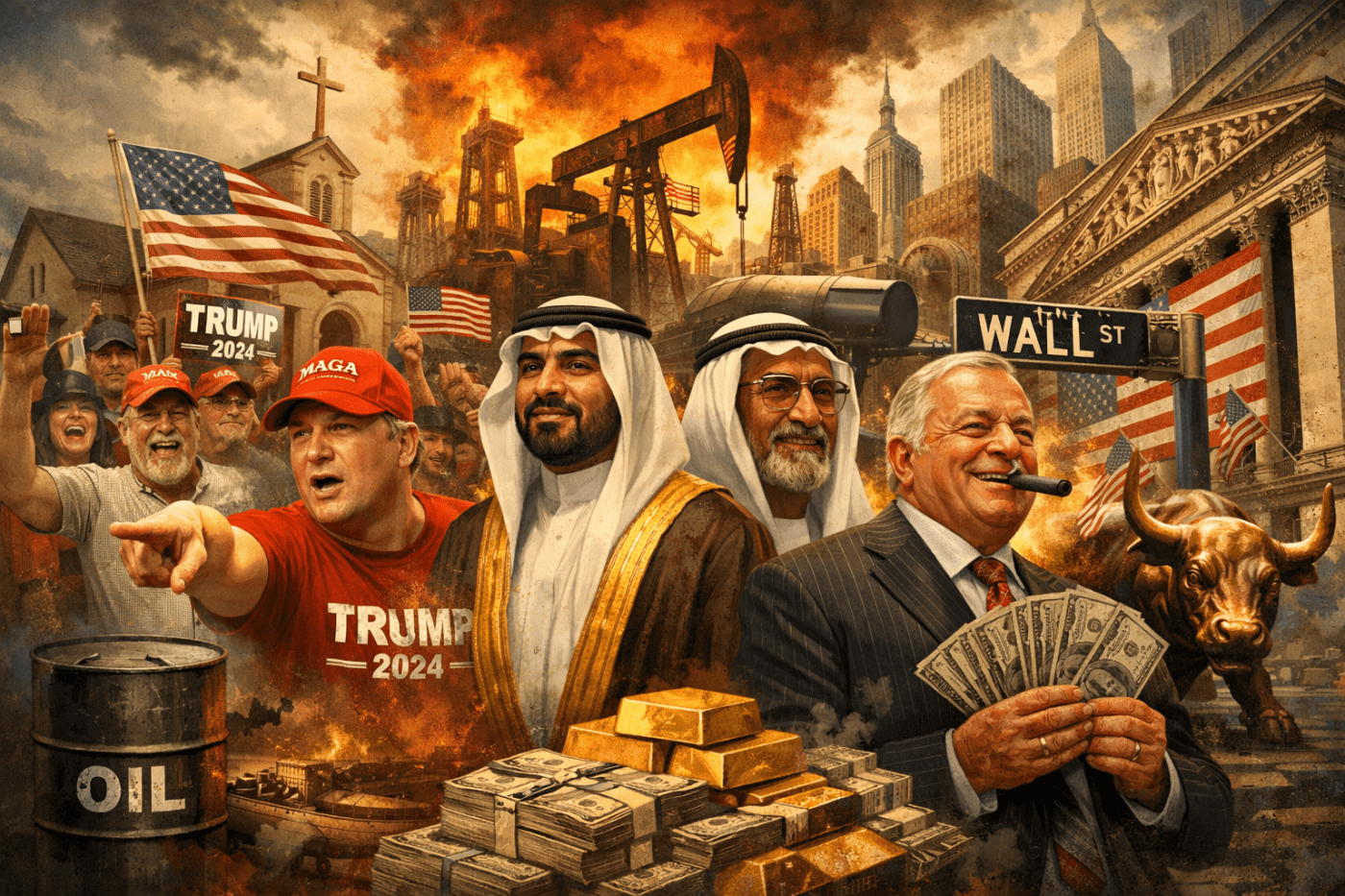
A dissection of how energy dependence, apocalyptic politics, and debt-fueled capitalism fused into a governing logic of U.S. power—and why, nearly two decades later, the contradictions Phillips identified have not resolved but intensified under the pressures of imperial decline and global realignment.
By Prince Kapone | Weaponized Information | Weaponized Intellects Book Review | March 22, 2026
The Republic Runs on Oil, Not Sermons
Kevin Phillips opens American Theocracy with a blunt reminder that the power of nations has never floated on the clouds of moral philosophy. Empires do not rise because they possess better slogans about liberty. They rise because they command resources, energy, and the physical machinery of production and war. Phillips begins where every serious political analysis must begin: with fuel. Coal powered Britain. Oil powered the twentieth century. And the United States—self-proclaimed city upon a hill—became the dominant power of the modern world not because Providence favored its flag, but because petroleum fed its engines, its industries, its suburbs, and its military machine.
There is something refreshing, almost shocking, in the way Phillips strips away the patriotic mythology here. American political culture prefers to speak in the language of destiny and democracy. Presidents stand behind podiums and recite scripture about freedom, while aircraft carriers glide silently toward the next chokepoint. Phillips interrupts this performance with an inconvenient fact: the American century was an oil century. From the early discoveries in Pennsylvania and Texas to the vast networks of pipelines, refineries, and corporate monopolies that followed, the United States built its economic and geopolitical supremacy atop hydrocarbons buried beneath the earth. The republic’s prosperity was not ordained by heaven; it was drilled, pumped, refined, and transported.
This insight may sound obvious today, but Phillips wrote these words at a moment when the political class preferred not to speak so plainly. By the early twenty-first century, the United States had already crossed a historical threshold. It remained the largest consumer of oil on the planet while its domestic reserves declined. The industrial colossus that once supplied the world now depended on flows of energy from far beyond its own borders. This shift did not merely affect economics. It reorganized the entire logic of American foreign policy. Regions once considered distant or peripheral—above all the oil-rich lands of West Asia—became the beating heart of Washington’s strategic calculations.
Phillips does not need to shout this conclusion; the historical record does the shouting for him. The map of American military deployments, alliances, coups, and interventions follows the geography of energy with eerie precision. Wherever the arteries of petroleum run—across deserts, through straits, under seas—you will find the shadow of American power. This is not conspiracy theory. It is the ordinary functioning of an empire whose economic metabolism depends on constant flows of fuel. Remove the oil and the suburban dream collapses like a house built on sand.
The beauty—and the tragedy—of Phillips’ argument is that he recognizes something many mainstream commentators still refuse to admit: the American political system is structurally incapable of confronting this reality honestly. The nation that proclaims itself the guardian of democracy cannot openly confess that its prosperity depends on controlling resources beyond its borders. Instead it speaks a different language. Wars are fought for stability, for freedom, for the rights of women, for the defense of civilization itself. Meanwhile the pipelines remain full and the tankers keep moving.
For a reader approaching this book today, nearly two decades after its publication, the significance of this opening becomes impossible to ignore. Phillips is not yet speaking about religion, nor about the rise of political fundamentalism that later chapters explore. But the stage is already set. A society that depends so completely on fossil energy, yet refuses to reorganize its economic life around that fact, must compensate somehow. It must tell stories powerful enough to hide the contradiction between its ideals and its material interests.
That is the quiet brilliance of Phillips’ opening move. Before we reach the sermons, before we encounter the prophets of apocalypse and the preachers of American destiny, he takes us underground to the pipelines and reservoirs where the real foundations of power lie. The republic, for all its rhetoric, runs on oil. And once you understand that simple truth, the rest of the book begins to unfold like a map of empire drawn in petroleum ink.
Empire at the Pump: The Politics of Oil Dependence
Having established that modern power runs not on abstract ideals but on the brute material of energy, Phillips moves quickly to the uncomfortable implication: the United States built the architecture of its prosperity during an era when oil seemed limitless. Cheap petroleum fueled the suburban explosion, the interstate highway system, mass automobile culture, aviation, plastics, industrial agriculture, and the global projection of American military force. The twentieth century American way of life—what politicians and advertisers alike packaged as freedom—was in reality a hydrocarbon civilization. It was a society organized around the assumption that the fuel tank of history would never run dry.
But geology has a way of interrupting ideology. By the late twentieth century the United States had crossed the threshold from energy exporter to energy dependent power. The nation that once dominated global petroleum production found itself importing increasing volumes from abroad, particularly from the volatile and contested fields of West Asia. Phillips traces this shift with the quiet patience of a historian who understands that empires rarely recognize their turning points while they are happening. The American political class continued to speak as if the country remained self-sufficient, even as the pipelines of dependence stretched across oceans and deserts.
This transformation did more than alter trade balances. It rewired the geopolitical nervous system of the American state. Oil became the hidden grammar of foreign policy. Diplomatic alliances, military bases, arms sales, intelligence operations, and wars increasingly revolved around one overriding concern: maintaining secure access to petroleum flows that the domestic economy could no longer provide for itself. Phillips does not frame this as a conspiracy. He presents it as structural logic. A society whose transportation, food system, industrial production, and military apparatus depend overwhelmingly on oil cannot simply treat energy as another commodity. It becomes a strategic lifeline.
The irony, of course, is that American political culture refuses to speak this language openly. Instead it wraps its policies in the comforting mythology of democratic mission. Presidents announce that troops are being sent abroad to defend liberty, stabilize regions, or prevent tyranny. Meanwhile, beneath the surface of these proclamations, the material calculus remains remarkably consistent: where the oil flows, American power tends to follow. Phillips’ argument here slices through decades of public relations varnish. It reminds the reader that empires rarely describe themselves honestly. They narrate their expansion as benevolence even when the material incentives are glaring.
Yet Phillips also recognizes something subtler and perhaps more troubling. The American public itself is entangled in this system of dependence. The suburban commuter filling a gasoline tank, the airline passenger boarding a jet, the farmer operating diesel machinery, the consumer purchasing goods manufactured through petroleum-based supply chains—each participates in a civilization built on fossil energy. This makes the politics of oil uniquely difficult. It is not merely an elite project imposed from above; it is woven into the everyday habits and expectations of modern life.
The result is a profound political paralysis. Meaningful reductions in oil dependence would require restructuring transportation systems, rethinking land use, transforming industrial production, and confronting powerful corporate interests that profit from the status quo. Such transformations demand long-term planning and political courage—qualities rarely abundant in a system designed around short election cycles and donor-driven policy. Instead the easier path is to maintain the illusion that the existing way of life can continue indefinitely, provided the pipelines remain open and the tankers keep arriving.
In this sense Phillips is describing something larger than energy policy. He is mapping the contradictions of a civilization that cannot imagine itself beyond the fuel that built it. The American empire, at the dawn of the twenty-first century, finds itself locked into a relationship with oil that is simultaneously economic, political, and psychological. It is not simply dependent on petroleum; it is organized around it. The highways, the suburbs, the logistics networks, the military doctrines, even the rhythms of daily life all assume the continuous availability of cheap energy.
Once that assumption begins to wobble, the consequences ripple outward through the entire political order. Foreign policy grows more aggressive. Domestic politics grows more anxious. Ideologies that promise national renewal or divine destiny find receptive audiences. Phillips has not yet turned fully toward the religious dimension of American politics that will dominate the next chapters, but the groundwork is already visible. A society that cannot confront the material limits of its economic model often seeks reassurance elsewhere—sometimes in markets, sometimes in myths, and sometimes in the language of providence itself.
The pump, in other words, is not merely a place where gasoline flows. It is the quiet center of a vast geopolitical system. Every time the nozzle clicks and the tank fills, the machinery of empire hums in the background—tankers crossing oceans, pipelines threading through contested territory, alliances maintained, wars rationalized, and political narratives carefully crafted. Phillips’ analysis exposes this machinery with a calm clarity that makes the reader uneasy. Because once you see the empire at the pump, it becomes impossible to pretend that the story of American power was ever just about democracy.
Democracy with a Pipeline Running Through It
Once the reader understands that the American system runs on oil, the next question becomes unavoidable: how does a nation that claims to spread democracy reconcile that self-image with a foreign policy so deeply entangled with energy extraction and control? Phillips steps directly into this contradiction. He does not approach it as a moralist wagging his finger at hypocrisy. Instead he treats it as a structural tension baked into the operating logic of American power. The United States speaks the language of democratic mission while navigating a global energy map that is anything but democratic.
The twentieth century offers the historical backdrop. As oil replaced coal as the central fuel of industrial civilization, control over petroleum reserves became inseparable from geopolitical influence. Phillips reminds us that the American state gradually transformed from a continental industrial power into the central manager of a global energy system. Tankers, pipelines, military alliances, intelligence operations, and diplomatic pressure all converged around one overriding concern: maintaining stable flows of oil to the industrial economies of the West. The political vocabulary used to justify these arrangements was often lofty—freedom, stability, modernization—but the material objective remained remarkably consistent.
What Phillips shows, with quiet persistence, is that the rhetoric of democratic expansion frequently collided with the practical requirements of energy security. Democracies were praised when they aligned with strategic interests and quietly ignored when they threatened them. Authoritarian governments that cooperated with Western energy structures found themselves embraced as partners in stability, while governments that challenged those structures encountered a colder reception. The pattern appears again and again across decades of policy, forming a kind of unspoken rule: democracy is celebrated in principle but subordinated in practice whenever the pipelines are at stake.
None of this should surprise a serious student of empire. Every great power has wrapped its strategic necessities in moral language. Rome spoke of civilization, Britain spoke of commerce and progress, and the United States speaks of liberty. Phillips’ contribution is to place the petroleum infrastructure squarely beneath this rhetorical scaffolding. When viewed through this lens, the relationship between American foreign policy and oil begins to resemble less a coincidence than a governing logic. The rhetoric of freedom becomes the music playing over the machinery of resource management.
Yet the contradiction carries consequences at home as well as abroad. A political culture that celebrates democratic virtue while operating within an energy empire inevitably generates tension. Citizens are told they inhabit a republic guided by principle, yet they observe their government repeatedly entangled in conflicts whose underlying motivations seem difficult to explain through the language of ideals alone. This gap between story and structure slowly erodes trust in institutions. The more insistently leaders speak about moral crusades, the more skeptically the public begins to examine the economic realities lurking beneath those speeches.
Phillips suggests that the United States entered the twenty-first century already caught within this tension. The country remained the dominant military and economic power, yet its prosperity depended on an increasingly fragile web of energy relationships across the globe. Maintaining that web required constant political management, diplomatic maneuvering, and at times the use of force. The more extensive the system became, the more difficult it grew to reconcile with the self-image of a nation spreading freedom simply because it believed in freedom.
The result is a peculiar form of political theater. American leaders trumpet democratic values while quietly navigating the geopolitics of oil. Citizens vote in elections and debate ideology while their economy continues to depend on the uninterrupted flow of petroleum from distant regions. The two narratives coexist uneasily, each reinforcing the other even as they pull in different directions. Democracy provides the language through which the empire explains itself; oil provides the material basis that allows the empire to function.
By the end of this section of the book, Phillips has done something deceptively simple but profoundly unsettling. He has taken the grand narrative of American democratic leadership and placed a pipeline running straight through its center. Once that image settles in the reader’s mind, it becomes impossible to see the story of U.S. power in quite the same way again. The speeches remain the same, the flags still wave, and the rhetoric of freedom continues to echo from podiums. But behind the spectacle stands the quiet infrastructure of energy, reminding us that the republic’s global mission has always been accompanied by the steady hum of pumps and pipelines.
When Providence Meets the Ballot Box
Having taken the reader through the hard material foundations of American power—the pipelines, the tankers, the quiet empire of petroleum—Phillips now turns to a force that seems, at first glance, to belong to an entirely different universe: religion. But the move is not accidental. If the previous chapters show the machinery that keeps the system running, this section begins to examine the moral language used to justify that machinery. And here Phillips makes a point that liberal commentators have long preferred to ignore: militant religious politics is not some foreign contagion that recently slipped into the bloodstream of American democracy. It is as American as apple pie.
The United States has always been a nation where religion and politics move through the same bloodstream. From the earliest colonial sermons declaring the New World a divine experiment to the nineteenth-century language of manifest destiny, the idea that the American project carried sacred significance has never been far from the surface. Phillips reminds us that the modern surge of evangelical political power did not appear out of thin air. It emerged from older currents deeply rooted in the country’s cultural soil—revivalist Protestantism, biblical literalism, apocalyptic prophecy, and the persistent belief that history itself unfolds according to a providential plan.
What changed in the late twentieth century was not the existence of these beliefs but their political organization. Religious networks that had once operated primarily within churches and communities began building national infrastructures capable of influencing elections, shaping party platforms, and mobilizing voters with remarkable efficiency. Televangelism, radio ministries, political action committees, and megachurch networks transformed religious enthusiasm into a formidable electoral force. Faith did not merely guide private morality; it became a strategic instrument within the machinery of American politics.
Phillips approaches this development less as a theologian than as a historian of power. His concern is not whether religious belief is sincere but how it functions once it enters the political arena. And the function is unmistakable. The rise of evangelical political movements helped consolidate a new conservative coalition, particularly within the Republican Party. Issues framed in moral or spiritual terms—abortion, school prayer, family values, biblical authority—became rallying points capable of mobilizing millions of voters who might otherwise have remained politically disengaged.
The political implications were enormous. Once religion became intertwined with electoral strategy, political debates began to take on the tone of moral crusades rather than policy disagreements. Compromise became more difficult because the issues at stake were no longer framed simply as legislative choices but as battles between righteousness and corruption. The language of politics shifted subtly but decisively. Campaigns increasingly invoked divine guidance, national destiny, and cosmic struggle, giving political conflict the emotional intensity of religious conviction.
Phillips does not argue that religion alone drives American politics. Instead he shows how it interacts with the other forces already examined in the book—energy interests, geopolitical strategy, and economic anxiety. In moments of uncertainty, religious narratives offer reassurance. They promise that history has meaning, that national struggles fit within a divine story, and that victory ultimately belongs to the righteous. Such narratives become particularly powerful when societies feel their foundations shifting beneath them.
In this sense, the rise of politically mobilized evangelicalism cannot be separated from the broader tensions Phillips has been mapping. A country confronting growing dependence on foreign energy, mounting economic imbalances, and geopolitical instability becomes fertile ground for movements that promise moral clarity and divine purpose. Religion provides not only a worldview but also a political language capable of transforming anxiety into certainty and complexity into cosmic struggle.
By the time Phillips finishes this chapter, the reader begins to see the outlines of a new synthesis forming within American politics. The oil-powered empire described in the earlier sections now finds itself accompanied by a powerful current of religious nationalism. One speaks in the language of pipelines and markets, the other in the language of prophecy and salvation. Together they shape a political culture that interprets global events not only as strategic challenges but as moments within a grand moral drama. And once politics begins to resemble theology, the distance between policy debate and crusade grows dangerously thin.
The Resurrection of the Confederacy in Modern Politics
If the previous chapter shows how religion re-entered American politics with new institutional power, Phillips now turns to the geographical and historical terrain where that power found its deepest roots: the American South. What he calls the “Southernization” of national politics is not simply a cultural observation about accents, barbecue, or country music drifting northward. It is a political transformation whose origins reach back to the wreckage of the Civil War and the long, unfinished struggle over the meaning of American democracy. The defeated Confederacy did not disappear into the graveyard of history. It reorganized itself, slowly, patiently, and with remarkable strategic success.
Phillips traces how the political traditions of the South—evangelical religiosity, suspicion of centralized authority, militant nationalism, and a deep memory of historical grievance—gradually migrated into the bloodstream of the national Republican coalition during the late twentieth century. What began as a regional political culture became the gravitational center of a new electoral order. The Republican Party that emerged by the end of the twentieth century bore little resemblance to the party of Lincoln. It had absorbed the ideological energy of the former Confederacy and repurposed it as the engine of modern conservatism.
The process was not sudden. It unfolded through decades of political realignment. After the civil rights struggles of the 1950s and 1960s shattered the old Democratic dominance in the South, conservative strategists recognized an opportunity. Appeals to cultural identity, religious tradition, and resentment toward federal authority proved remarkably effective in mobilizing Southern voters who felt alienated from the direction of national politics. Gradually the region that had once been the Democratic Party’s fortress became the backbone of Republican electoral power.
Phillips describes this transformation with the calm eye of someone who understands how political coalitions actually form. Parties do not simply change ideology overnight. They absorb constituencies, adapt rhetoric, and reorganize their priorities around new blocs of voters. In the case of the Republican Party, the incorporation of the South reshaped the party’s tone and worldview. Religion gained new prominence, cultural conflict intensified, and national identity became entwined with a sense of embattled moral mission.
The implications reach far beyond electoral arithmetic. When the political culture of one region becomes dominant within a national party, its historical memories and emotional rhythms travel with it. The South carried into the new conservative coalition a powerful mixture of evangelical faith, populist distrust of elites, and a lingering narrative of righteous defiance against outside authority. These elements proved extraordinarily potent when combined with the economic and geopolitical tensions Phillips has already described elsewhere in the book.
The result was a new kind of political synthesis. Oil interests, financial power, and religious activism found common cause within a coalition whose strongest electoral base lay in the South and the rapidly expanding suburban regions culturally aligned with it. The rhetoric of this coalition frequently invoked national renewal, moral restoration, and the defense of traditional values. But beneath these themes lay a deeper transformation: the ideological center of gravity in American politics had shifted.
Phillips does not frame this development as a simple moral decline. Instead he treats it as a structural reorganization of political power. Regions that once occupied the margins of national influence now stood at its center. Their worldview—shaped by a distinct historical experience of defeat, resistance, and religious revival—began to define the tone of American conservatism. National debates increasingly echoed with the language of cultural struggle and spiritual destiny rather than the pragmatic managerial language that had dominated mid-twentieth-century politics.
By the time Phillips finishes this section, the reader sees how the three strands of his argument are beginning to intertwine. The energy politics of empire, the rise of militant religious activism, and the political ascendancy of the South are not separate developments moving on parallel tracks. They reinforce one another, producing a new configuration of power that reshaped American political life at the dawn of the twenty-first century. What appears on the surface as ordinary electoral politics is, in fact, the culmination of a long historical migration of ideas, institutions, and identities that once seemed confined to a single region but have now spread across the national stage.
The Nation in a Dixie Cup
By the time Phillips reaches this stage of his argument, the reader begins to understand that the transformation he is describing is not simply a regional political shift but the nationalization of a particular worldview. What once belonged primarily to the American South—its evangelical religious intensity, its culture of moral struggle, its distrust of federal authority combined with fierce patriotism—has now spread across vast stretches of the country. The United States, Phillips suggests with deliberate irony, has begun to resemble the South on a national scale. It is as if the political culture of Dixie has been poured into the cup of the entire republic.
This transformation did not happen through accident or demographic drift alone. It was facilitated by powerful institutional networks that carried Southern-style evangelical politics far beyond the borders of the former Confederacy. Churches expanded into megachurches. Religious broadcasting built national audiences. Political organizations translated moral grievances into voter turnout with remarkable efficiency. The result was the construction of an infrastructure that could mobilize millions of citizens through a shared language of faith, identity, and cultural threat.
Phillips is careful to show that this movement thrived precisely because it spoke to anxieties that were spreading across American society. Economic restructuring had destabilized entire regions of the country. Manufacturing jobs disappeared, communities fragmented, and the social certainties of the postwar decades began to dissolve. In such moments of dislocation, political movements that promise moral clarity and spiritual certainty gain enormous traction. The evangelical political resurgence offered exactly that: a narrative in which national problems could be understood as symptoms of moral decay and national renewal could be achieved through a return to righteous principles.
What made this development politically explosive was the way it intersected with the electoral system. The Republican Party discovered that mobilizing religious voters around cultural and moral issues produced extraordinary political dividends. Issues framed in biblical or moral terms—abortion, sexuality, family authority, religious education—proved capable of galvanizing turnout far more effectively than the technocratic policy debates that dominated earlier eras. Faith became not merely a personal conviction but a central engine of political participation.
Phillips observes that the growth of these networks also transformed the media environment of American politics. Religious broadcasting and conservative talk radio created parallel channels of information through which political narratives could circulate largely outside the traditional journalistic gatekeepers. Within these spaces, politics was frequently interpreted through an explicitly theological lens. National events were framed not simply as policy disputes but as episodes within a larger cosmic struggle between righteousness and corruption.
The result was a powerful feedback loop between religion and politics. Political leaders increasingly adopted the language of faith in order to resonate with this growing constituency, while religious leaders encouraged their congregations to view electoral participation as a moral duty. Each sphere reinforced the other. Campaigns sounded more like revivals, and sermons began to resemble political speeches. The boundary between the pulpit and the podium grew steadily thinner.
For Phillips, this fusion carries consequences that extend beyond electoral outcomes. When political disagreements are framed in moral or theological terms, compromise becomes far more difficult. Opponents are no longer merely advocates of different policies; they become agents of moral decay or obstacles to divine purpose. Politics, once understood as the messy negotiation of competing interests, begins to resemble a battle between righteousness and sin.
By the time this process matures, the entire national atmosphere changes. Public debate becomes sharper, identities harden, and the language of crisis spreads. Phillips is not arguing that religion alone produces these tensions. Rather, he shows how it amplifies anxieties already present within a society confronting economic transformation, geopolitical uncertainty, and the pressures of maintaining global dominance. In such circumstances, movements that promise moral certainty can flourish with remarkable speed.
What emerges is a portrait of a republic whose political culture has shifted dramatically. The United States that once prided itself on secular pragmatism now finds itself immersed in a political environment where faith-infused narratives shape electoral behavior, public discourse, and national identity. The Dixie cup has overflowed. The regional currents that once defined Southern politics now circulate through the bloodstream of the entire nation, reshaping the tone and direction of American political life.
When Empires Start Quoting Scripture
Having traced the spread of evangelical political power across the national landscape, Phillips now widens the historical lens. The question before him is not simply why religion has become more visible in American politics, but what this development means for a great power navigating the uncertain waters of imperial maturity. History, Phillips reminds us, offers more than a few warnings. Empires that approach the later stages of their power often experience a curious intensification of religious fervor. When material contradictions accumulate and confidence in worldly institutions begins to fray, societies frequently turn toward spiritual explanations that promise moral clarity and cosmic reassurance.
Phillips reaches back through history to illustrate this pattern. Spain during the era of imperial overreach found itself increasingly defined by militant Catholic orthodoxy. Britain, even as its industrial supremacy waned, experienced periodic surges of evangelical revivalism that intertwined religious conviction with national destiny. Rome itself, during its centuries of transformation and strain, witnessed the growing political influence of religious movements promising salvation beyond the crumbling structures of earthly authority. The lesson Phillips draws from these precedents is not that religion inevitably causes decline, but that it often flourishes in moments when powerful societies feel their foundations beginning to shift.
In the American case, the intersection of religious revival and geopolitical power creates a particularly volatile mixture. The United States remains the most formidable military force on the planet, with a global network of bases, alliances, and strategic commitments stretching across continents. At the same time, the political culture of the country increasingly embraces narratives of providence, divine mission, and apocalyptic struggle. When a superpower begins to interpret its role in world affairs through the language of sacred destiny, the boundary between strategic calculation and moral crusade becomes dangerously blurred.
Phillips approaches this development with the caution of a historian who has seen similar dynamics before. Religious conviction can provide cohesion, discipline, and a sense of shared purpose within a society. But when fused with state power it can also harden political conflicts into existential struggles. Policies become moral imperatives. Wars acquire the aura of holy campaigns. Opponents are not merely adversaries but embodiments of evil. Under such conditions the pragmatic flexibility that once characterized successful diplomacy begins to erode.
The American political landscape at the beginning of the twenty-first century reflects precisely this tension. Religious language appears more frequently in presidential speeches, campaign rhetoric, and policy debates. Leaders invoke divine guidance when describing national decisions. Political movements frame global events as moments within a larger spiritual drama. The nation that once celebrated its separation of church and state now finds itself navigating a political culture where those boundaries have become increasingly porous.
Phillips does not claim that the United States is destined to follow the exact trajectory of past empires. History never repeats itself with mechanical precision. But the parallels are troubling enough to demand attention. A society that combines immense military power with an expanding sense of religious mission may begin to interpret geopolitical conflicts through a lens of moral absolutism rather than strategic restraint. The consequences of such thinking can extend far beyond domestic politics, shaping the decisions that determine peace and war.
By placing the American experience alongside earlier imperial histories, Phillips invites the reader to consider the deeper forces at work beneath the headlines. The rise of politicized religion is not merely a cultural curiosity. It may be part of a broader pattern that emerges when powerful societies confront the limits of their own expansion. As material challenges accumulate—economic imbalances, energy constraints, geopolitical competition—narratives of divine purpose grow louder, offering reassurance that history still bends toward the nation’s triumph.
Whether such reassurance strengthens or endangers the republic remains the central question of this chapter. What Phillips makes unmistakably clear is that the fusion of religion and empire is not a trivial development. It is a structural shift in the political psychology of a superpower, one that shapes how leaders interpret threats, justify actions, and imagine the future of the world they seek to lead.
The Republic of Borrowed Money
Up to this point Phillips has taken the reader through two of the great pillars supporting the political order he is dissecting: oil and religion. One provides the material energy of empire, the other the ideological language through which that empire understands itself. Now he turns to the third pillar, and in many ways the most quietly dangerous one—debt. If petroleum fuels the machinery of American life and religious nationalism supplies the moral drama surrounding it, borrowed money has increasingly become the financial oxygen keeping the entire system breathing.
Phillips approaches the subject not as a technical economist but as a historian of national trajectories. Great powers rarely collapse overnight from military defeat alone. More often they drift into decline through subtler processes: the hollowing out of productive industry, the rise of speculative finance, and the gradual replacement of earned wealth with borrowed prosperity. What appears outwardly as continued affluence is in reality sustained by credit, leverage, and the willingness of lenders to believe that tomorrow’s economy will somehow pay for today’s excess.
By the final decades of the twentieth century, Phillips argues, the United States had begun moving down precisely this path. The industrial foundation that once defined the American economy—steel, manufacturing, engineering, and the enormous productive capacity that emerged during the Second World War—was slowly giving way to a new economic structure dominated by finance, speculation, and services. Wealth was increasingly generated not through the production of tangible goods but through the manipulation of capital itself. Wall Street rose as factories closed.
This transformation created the illusion that prosperity could continue indefinitely without the underlying industrial base that had once supported it. Credit expanded to fill the gap. Households borrowed to maintain living standards. Corporations borrowed to sustain expansion and stock valuations. The federal government borrowed to finance wars, tax cuts, and the growing obligations of an empire whose commitments stretched across the globe. Debt became the lubricant that allowed the entire system to function without confronting its structural weaknesses.
Phillips is particularly concerned with the cultural consequences of this shift. A society that becomes accustomed to living on credit gradually loses its sense of economic limits. Easy money encourages speculative manias, from real estate booms to stock market bubbles. Political leaders find it easier to promise benefits than to impose discipline. The financial system, meanwhile, develops powerful incentives to encourage ever greater borrowing because debt itself becomes the raw material from which profits are generated.
What makes this development historically significant is the way it mirrors patterns seen in earlier great powers. Phillips notes that the Netherlands and Britain both experienced similar transitions during the later phases of their imperial dominance. As their productive economies weakened relative to emerging rivals, financial speculation expanded to compensate for the loss of industrial dynamism. Credit markets flourished even as the underlying engines of economic growth slowed. The illusion of wealth could be maintained for a time—but only for a time.
In the American case the scale of this transformation is amplified by the country’s global position. Because the U.S. dollar serves as the central currency of the international financial system, the United States has been able to borrow on a scale that would be impossible for other nations. Foreign governments and investors purchase American debt, effectively financing the consumption patterns and fiscal policies of the world’s largest economy. This arrangement allows the United States to sustain a level of economic activity that might otherwise prove unsustainable.
But Phillips warns that such arrangements carry long-term consequences. Dependence on foreign creditors gradually shifts the balance of economic power. The nation that once financed the world begins to rely on the savings of others. Strategic autonomy becomes entangled with financial obligations. In the short term this system appears stable—even prosperous—but beneath the surface it represents a profound structural vulnerability.
When Phillips places this financial transformation alongside the earlier themes of oil dependence and religious politics, the outlines of his argument come sharply into focus. The United States has entered the twenty-first century sustained by three volatile forces: an energy system reliant on foreign resources, a political culture increasingly animated by religious certainty, and an economic order propped up by unprecedented levels of debt. Each of these forces might be manageable in isolation. Together they create a precarious balance that raises unsettling questions about the long-term trajectory of the American republic.
Debt as the Empire’s Painkiller
Phillips deepens the financial argument in the next movement of the book by stepping back from the immediate American scene and examining the long historical relationship between empire and debt. This is where his method becomes unmistakably historical. Nations rarely recognize their decline in the moment it begins. Instead they develop mechanisms that dull the pain of structural weakness. Debt, Phillips argues, has often served precisely this function. Borrowing allows a great power to postpone difficult adjustments, to preserve the appearance of prosperity, and to maintain imperial commitments long after the underlying economic foundations have begun to erode.
History offers sobering examples. The Dutch Republic, once the commercial marvel of Europe, gradually shifted from productive trade dominance toward financial speculation as its industrial vitality waned. Britain followed a similar path during the later stages of its imperial supremacy, when the City of London increasingly overshadowed the factories that had once defined the British industrial revolution. In both cases finance grew precisely as production slowed. Capital circulated ever faster while the material basis of national wealth grew thinner. The illusion of strength could be maintained, but the underlying trajectory had already changed.
Phillips suggests that the United States has begun walking down a comparable road. The transformation described in the previous chapter—where manufacturing recedes and financial engineering expands—does not merely alter the composition of the economy. It changes the psychological relationship between a society and its wealth. Production disciplines a nation. It ties prosperity to labor, industry, and tangible output. Finance, by contrast, creates a world where money seems capable of multiplying itself without the friction of physical reality. Markets surge, assets inflate, and credit expands, all producing the seductive impression that wealth has become detached from the constraints of material production.
In such an environment, debt becomes normalized. Governments borrow to smooth over budget deficits. Corporations leverage their balance sheets to inflate stock valuations. Households take on mortgages, credit cards, and loans in order to sustain consumption. Each layer of borrowing feeds the next, producing an expanding financial ecosystem that appears healthy so long as confidence remains intact. But beneath the surface lies a fundamental fragility. A system built on borrowed money must continually expand credit in order to remain stable. Once that expansion slows, the architecture begins to creak.
Phillips’ warning is not simply about fiscal prudence; it is about historical patterns. Empires in their prime generate wealth through production, trade, and technological innovation. Empires in their later phases increasingly rely on financial mechanisms to sustain the illusion of continued supremacy. The shift is subtle enough that it often goes unnoticed by contemporaries. Markets remain vibrant. Capital flows freely. Wealth appears abundant. Yet the underlying balance between productive capacity and financial speculation has already begun to tilt.
The American case contains an additional layer of complexity. Because the dollar functions as the world’s primary reserve currency, the United States possesses a unique ability to finance its deficits through global capital flows. Foreign governments, central banks, and investors purchase American treasury securities and other financial assets, effectively lending the United States the resources required to sustain its consumption and geopolitical commitments. This arrangement creates an extraordinary privilege—but also a long-term vulnerability. The empire’s financial stability increasingly depends on the willingness of outsiders to continue financing it.
Phillips describes this dynamic with the unease of someone who recognizes how fragile such arrangements can be. Confidence in financial systems can persist for years or even decades, but when it falters the consequences arrive with startling speed. A nation that has grown accustomed to borrowing on a vast scale may suddenly discover that its creditors possess leverage of their own. Economic sovereignty becomes entangled with global finance in ways that limit the freedom of action once taken for granted.
When viewed alongside the earlier chapters of the book, the significance of this financial evolution becomes clearer. Oil dependence forces the United States to remain deeply engaged in volatile regions of the world. Religious politics reshapes the moral language through which national decisions are justified. And debt quietly accumulates beneath the surface, allowing the system to function without confronting its structural contradictions. Each element reinforces the others, producing a political economy that appears stable yet rests upon increasingly uncertain foundations.
Phillips stops short of declaring that decline is inevitable. Historians are cautious about such predictions. But the parallels he draws with earlier imperial experiences are difficult to ignore. Debt, when used as a temporary instrument, can smooth economic cycles. When it becomes the central pillar supporting national prosperity, it begins to resemble something else entirely: a painkiller administered to an empire reluctant to acknowledge the deeper ailments affecting its body.
Bubble Economics and the Quiet Rise of Foreign Creditors
By this point in the book Phillips has already taken the reader through the historical warning signs: energy dependence, militant religio-political mobilization, and the expansion of debt as a structural feature of the American economy. In this section he sharpens the focus even further by examining the unstable architecture of the financial system itself. The United States, he argues, has entered an era defined by serial bubbles—economic booms built less on productive expansion than on waves of speculative enthusiasm that inflate and burst with remarkable regularity.
The pattern had already become visible by the early years of the twenty-first century. The stock market mania of the late 1990s, centered on technology and internet companies, created extraordinary paper wealth before collapsing in dramatic fashion. In its aftermath another speculative engine quickly emerged, this time in real estate and housing finance. Credit expanded rapidly, property values surged, and millions of Americans were encouraged to believe that homeownership itself had become a permanent pathway to effortless wealth. The cycle of optimism, speculation, and collapse had begun to resemble a structural rhythm of the modern American economy.
Phillips is not interested merely in describing financial turbulence. What concerns him is the deeper economic logic behind these bubbles. When productive investment slows and wages stagnate, speculative finance becomes a substitute engine for growth. Asset inflation replaces industrial expansion as the mechanism through which prosperity appears to increase. Stock portfolios rise, housing prices soar, and consumer confidence surges, even as the underlying productive economy struggles to maintain momentum. Wealth, in this environment, becomes increasingly detached from the material processes that once generated it.
Beneath the spectacle of rising markets lies another transformation that Phillips considers even more consequential: the growing dependence of the United States on foreign capital. As Americans borrowed more—through mortgages, credit cards, corporate leverage, and government deficits—the financing of this borrowing increasingly came from abroad. Governments and financial institutions in Asia, particularly those running large trade surpluses with the United States, accumulated vast holdings of American debt instruments. Treasury bonds, mortgage securities, and other financial assets flowed steadily into foreign portfolios.
The arrangement appeared mutually beneficial on the surface. The United States gained access to enormous pools of capital that allowed it to maintain consumption, investment, and global military commitments. Export-oriented economies gained a reliable market for their goods and a place to invest the proceeds. But Phillips notes that such relationships subtly alter the balance of economic power. The nation accustomed to financing the world gradually becomes the nation financed by it.
This shift carries implications that extend beyond economics. Financial dependence introduces new strategic vulnerabilities into the structure of national power. Decisions about interest rates, currency stability, and fiscal policy begin to reverberate through global creditor networks whose confidence becomes essential to maintaining stability. The more debt accumulates, the more delicate the equilibrium becomes. What once seemed like a permanent privilege—the ability to borrow cheaply and endlessly—begins to resemble a fragile arrangement sustained by trust rather than inevitability.
Phillips is careful not to dramatize this situation into immediate catastrophe. Financial systems rarely collapse overnight without warning. More often they drift toward instability through a series of seemingly manageable adjustments. Each bubble, each surge of borrowing, each expansion of credit postpones the moment when deeper structural questions must be confronted. Markets recover, confidence returns, and the cycle begins again.
Yet the cumulative effect of these cycles gradually reshapes the economic landscape. A society becomes accustomed to wealth that appears suddenly and disappears just as quickly. Political leaders grow comfortable governing through financial expansion rather than structural reform. And the public, encouraged by rising asset values, may overlook the deeper vulnerabilities accumulating beneath the surface.
When Phillips places this financial pattern alongside the earlier themes of energy dependence and religious mobilization, the portrait of the American system becomes increasingly complex. A superpower sustained by imported energy and financed by foreign creditors must navigate a world where economic stability depends on forces beyond its direct control. The bubbles of modern finance, glittering and seductive as they appear, may in fact represent the final layer of insulation protecting a political order reluctant to confront the limits of its own economic foundations.
The Coalition That Mistook Power for Destiny
By the time Phillips arrives at the political conclusion of his book, the pieces of the puzzle are already on the table. Oil dependence has reshaped foreign policy. Religious mobilization has transformed the tone of domestic politics. Debt and speculative finance have quietly altered the economic foundations of the republic. The final task is to examine the political coalition that presided over this convergence of forces. Phillips focuses his attention on the Republican majority that rose to dominance in the closing decades of the twentieth century and the early years of the twenty-first—a coalition that believed itself to be the steward of American renewal but which, in Phillips’ judgment, was in fact steering the country deeper into structural peril.
Phillips approaches this subject with the peculiar authority of a political insider who has become a critic of the very movement he once helped shape. Decades earlier he had been among the strategists who recognized the electoral potential of aligning the Republican Party with Southern voters, suburban conservatism, and culturally traditional constituencies. The coalition that emerged from that strategy proved extraordinarily effective at winning elections. But success at the ballot box, Phillips now suggests, does not necessarily translate into wise stewardship of national power.
The governing philosophy of this coalition combined several powerful elements. Free-market orthodoxy championed deregulation and tax reductions, particularly for corporations and high-income earners. Religious activism supplied a moral narrative that energized voters and framed political conflicts in spiritual terms. National security rhetoric emphasized military strength and the defense of American leadership in the world. Together these components produced a political movement capable of mobilizing large segments of the electorate while maintaining strong ties to influential economic interests.
Phillips’ concern is that this synthesis encouraged a dangerous complacency about the structural challenges confronting the country. Tax cuts reduced government revenue even as military spending expanded and entitlement obligations continued to grow. Financial deregulation accelerated the speculative dynamics already transforming the economy. Energy policy remained closely aligned with fossil fuel interests despite mounting evidence of long-term dependence on imported oil. Meanwhile the cultural and religious dimensions of the coalition often diverted political debate toward symbolic moral conflicts rather than the economic transformations unfolding beneath the surface.
In this environment, the illusion of national strength remained remarkably resilient. Economic bubbles generated the appearance of prosperity. Military dominance reinforced the perception of geopolitical supremacy. Political victories at the polls seemed to confirm the righteousness of the governing ideology. Yet Phillips argues that these successes masked deeper contradictions. A nation cannot indefinitely sustain tax reductions, rising debt, expensive military commitments, and structural energy dependence without eventually confronting the arithmetic of its own policies.
The danger Phillips identifies is not merely fiscal imbalance but a broader political culture that interprets power as confirmation of destiny. When electoral victories and military superiority are taken as proof of historical inevitability, self-correction becomes difficult. Political leaders grow reluctant to acknowledge structural weaknesses for fear of undermining the narrative of national greatness that sustains their coalition. Critics are dismissed as pessimists or defeatists, while the underlying problems continue to accumulate.
Phillips does not argue that these tendencies are unique to one party or ideology. Political movements throughout history have often mistaken temporary success for permanent validation. But in the case of the early twenty-first-century United States, the stakes were unusually high. The coalition in power governed the world’s most powerful economy and commanded the largest military apparatus in human history. Decisions made within this political environment would shape not only domestic policy but the trajectory of global politics for years to come.
The chapter therefore serves as a kind of political reckoning. The Republican majority that once promised renewal had become, in Phillips’ telling, a vehicle through which the deeper contradictions of the American system were expressed rather than resolved. Energy policy remained tethered to fossil fuel interests. Economic policy encouraged debt and speculation. Cultural politics intensified polarization while distracting attention from structural economic change. What appeared outwardly as confident governance increasingly resembled a coalition mistaking its electoral power for historical destiny.
Empire, Prophecy, and Debt: Reading American Theocracy in 2026
Some books age like milk. Others age like dynamite. Kevin Phillips’ American Theocracy, written back in 2006 when the Bush administration still strutted around the globe like a Roman centurion who had misplaced his helmet but not his arrogance, belongs to the second category. Phillips was not writing as a revolutionary. He was writing as a disillusioned insider—one of the engineers of the Republican electoral machine who began to notice that the engine he helped build was running on fumes, scripture, and borrowed money. At the time, his warning sounded like a cranky memo from a worried accountant at the back of the imperial boardroom. Today, nearly twenty years later, it reads more like an early weather report for the storm we now find ourselves standing in.
Phillips’ central argument was disarmingly simple. The United States, he said, was being carried forward by three unstable pillars: dependence on fossil energy, the rise of militant religious politics, and an economic order increasingly sustained by debt and financial speculation. He did not frame these as temporary problems or policy mistakes. He treated them as structural tendencies shaping the direction of the American system itself. Strip away the patriotic bunting, Phillips implied, and you would find a political economy held together by oil wells, revival tents, and credit cards.
The financial dimension of that diagnosis proved almost prophetic. Two years after the book appeared, the global financial system collapsed in the crisis of 2008, exposing just how much of the American economy had come to depend on speculative bubbles and borrowed wealth. But the collapse did not fundamentally change the structure Phillips had described. The United States doubled down on the very mechanisms that had produced the crisis in the first place. Central banks flooded markets with liquidity, asset prices soared, and the financial sector grew even more central to the organization of economic life. Wall Street recovered faster than the working class, which is one of capitalism’s more reliable party tricks.
The religious dimension of Phillips’ thesis has proven equally durable. The fusion of evangelical Christianity with reactionary politics did not fade into the background of American life. It hardened. Political movements increasingly framed global events as moral or even apocalyptic struggles. Leaders spoke openly about divine mission, civilizational destiny, and the cosmic battle between good and evil. For a nation that once congratulated itself on the separation of church and state, the American republic has developed a remarkable talent for mixing the pulpit with the Pentagon.
And then there is the energy question—the quiet engine beneath the whole arrangement. Phillips understood that the American century was an oil century. Petroleum powered the suburban economy, the global logistics network, and the vast military infrastructure through which Washington projected its authority around the world. Two decades later that reality has not disappeared. It has simply become entangled with a wider struggle over supply chains, critical minerals, technological dominance, and the shifting geography of industrial power. The pipelines remain, but they now run through a world that looks far less obedient to Washington’s commands than it did when Phillips first wrote his book.
What Phillips did not fully articulate—perhaps because he remained a bourgeois dissident rather than a revolutionary critic—is the deeper structure connecting these phenomena. Oil dependence, religious nationalism, and financialization are not random pathologies that infected an otherwise healthy republic. They are historical expressions of a settler-capitalist empire confronting the limits of its own expansion. When the material engine of accumulation begins to strain, ideology grows louder and finance grows more creative. The empire begins to preach more fervently and borrow more heavily at the same time.
That is why rereading American Theocracy today feels less like revisiting a dated political commentary and more like studying an early reconnaissance report from the edge of imperial transition. Phillips saw the outlines of the problem before many liberals had even realized there was a problem. He noticed that the American system was increasingly governed by forces that thrive during moments of structural strain: energy insecurity, financial speculation, and ideological mobilization rooted in religious certainty.
From the vantage point of March 2026 the United States remains enormously powerful, but the contradictions Phillips identified have not been resolved. The economy still leans heavily on financial markets rather than productive industry. Political culture remains deeply polarized, often expressed through the language of moral crusade. And the global system that once revolved almost entirely around American power has begun to fracture into a far more complex and contested terrain.
Empires rarely collapse in the dramatic fashion imagined in Hollywood disaster films. They drift. They improvise. They attempt to stabilize contradictions that cannot easily be stabilized. Phillips captured a moment when those contradictions were beginning to surface in the American political economy. What he offered was not a revolutionary roadmap but an unusually clear warning from within the imperial camp itself.
The task for readers today is to understand that warning more deeply than Phillips himself could. Oil, prophecy, and debt were never separate phenomena. They were the intertwined expressions of a system attempting to sustain global dominance in a world where the material foundations of that dominance were beginning to shift. Once you see that structure clearly, the present moment becomes easier to understand. The empire is still powerful. But it is also navigating a terrain of contradictions that no amount of patriotic rhetoric—or biblical prophecy—can permanently conceal.

 The New Dark Age
Leave a comment