Tuesday, 31 March 2026 — Weaponized Information
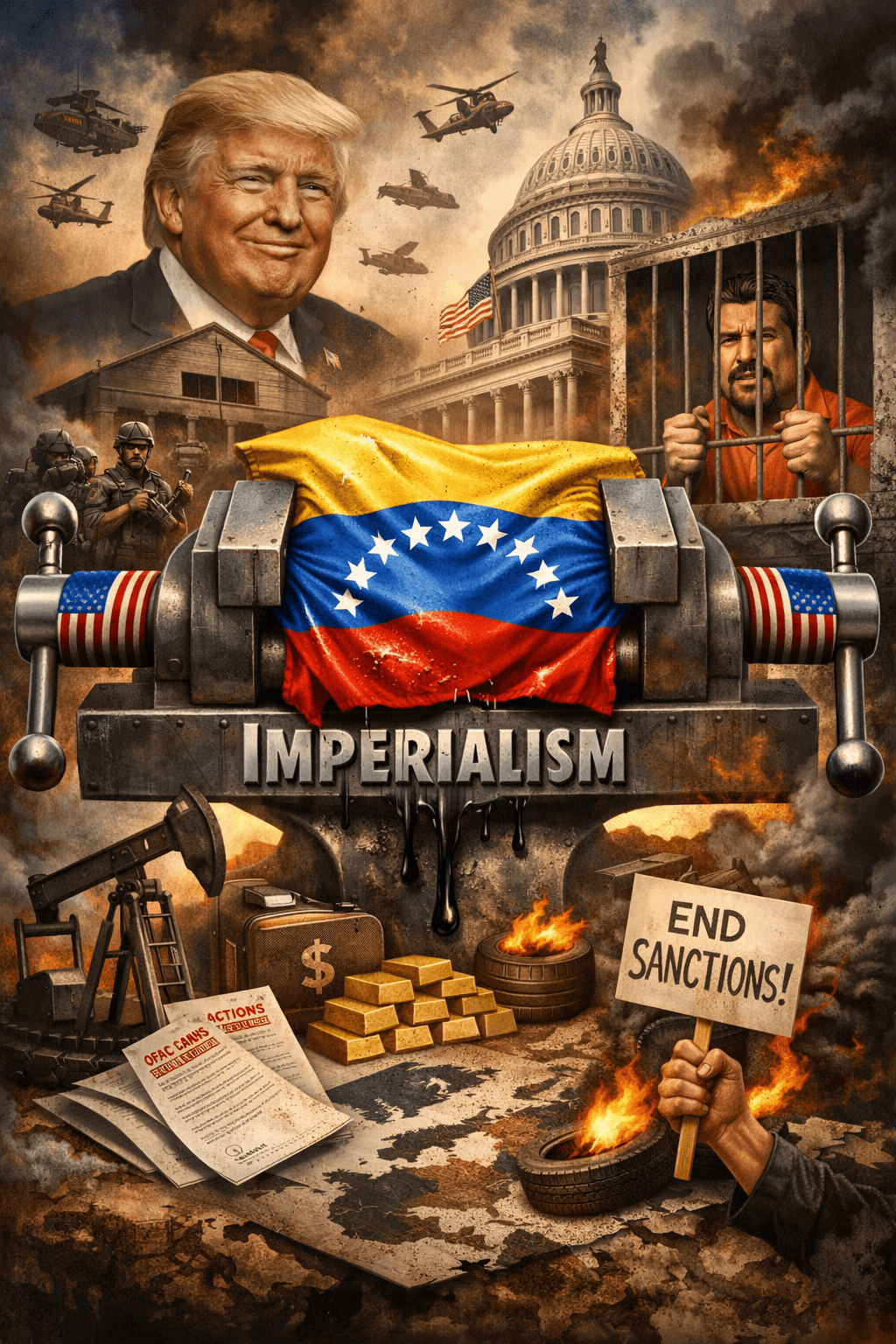
The Intercept’s account of Trump’s Venezuela “success” exposes colonial features of the new order, but still stops short of naming the imperial body on the table. Beneath the language of reform and normalization lies a forced recalibration: oil, minerals, law, diplomacy, and public finance are being reorganized under duress while the Bolivarian state struggles to survive an open imperial assault. What looks from afar like accommodation is, in material reality, constrained sovereignty—a revolutionary process fighting to preserve continuity while governing with its constitutional president held captive in the belly of the empire. The task for us is to move from recognition to alignment by targeting the sanctions architecture, extractive restructuring, energy siege, and institutional machinery through which U.S. power seeks to turn coercion into permanent rule.
By Prince Kapone | Weaponized Information | March 31, 2026
The Liberal Autopsy of Empire That Refuses to Name the Body
Gabriel Hetland’s article, “Trump Wanted to Replicate His Venezuela ‘Success’ in Iran. What Has It Even Looked Like?”, published by The Intercept on March 31, 2026, arrives wearing the clothes of contradiction. Trump, with the vulgar honesty that so often makes him useful to analysis, boasts of Venezuela as a “perfect scenario,” as though the wrecking of a nation were a business case to be studied and franchised. Hetland, to his credit, does not simply swallow the line. He takes the reader through the debris field and shows that whatever this “success” may be, it does not look like freedom, it does not smell like democracy, and it does not resemble the triumphant restoration of constitutional order that U.S. officials love to sermonize about before microphones and flags. What it resembles, rather, is supervision. Management. Conditional sovereignty. A nation permitted to breathe only through a tube held by somebody else’s hand.
That is the strength of the piece. Its limit is that it gets close enough to feel the heat of the fire, but still stops short of saying plainly who lit the match and what the house was built for in the first place. This is the old liberal habit. It can describe the bruise in great detail, measure the swelling, trace the broken capillaries, interview the doctors, and even admit that the violence was ugly and perhaps unnecessary. But when it comes time to name the assailant, liberalism suddenly develops the manners of a butler. It coughs into a napkin. It lowers its voice. It says there were “excesses,” “distortions,” “contradictions,” “institutional failures.” It will describe domination until the room grows uncomfortable, then stop just before the word domination has to be spoken in its full historical and structural meaning.
This is not because The Intercept is uniquely dishonest. On the contrary, it is because it occupies a very familiar and very functional place inside the U.S. media order. It is the house organ of internal correction, not rupture. It is often sharper than the corporate press, less obedient, less perfumed, more willing to peer into the engine room and show the grease and blood on the gears. But it remains a publication whose criticism usually operates within the moral and intellectual horizon of reform. It can expose hypocrisy, but rarely the system that requires hypocrisy. It can expose policy failure, but not always the class and imperial interests for which that policy was rational from the beginning. It can reveal brutality, but often in a register that still treats brutality as a deviation from the rules rather than one of the ways the rules are enforced.
That matters here, because Hetland is not writing like a fool. He writes with seriousness and with the authority of someone who has studied democracy, labor, and Latin American political life. That gives the article texture and weight. He can see what many court stenographers of empire still refuse to see. He can see oil being reorganized. He can see public finance bending beneath outside pressure. He can see legal structures being altered, political life being narrowed, sovereignty becoming something less like a right and more like a permit issued under supervision. He is not blind. But what he offers the reader is still filtered through the language of democratic concern, institutional deformation, and governance gone wrong. The reader is invited to think: this is a distortion of proper order. What the reader is not pushed hard enough to ask is whether this is the order, whether this is how power in the imperial world actually functions when it has stripped off the makeup and stopped pretending to be the United Nations in a necktie.
The narrative structure of the article itself carries this limit inside it. Trump is permitted to establish the horizon. His phrase—“perfect scenario”—is the opening note, the tune everybody else must then respond to. Only after the empire speaks does critique begin its work of correction. This is one of liberal journalism’s favorite little rituals. First let power announce itself in its own language, then come behind it with fact-checks, context, and human concern. But because power is allowed to set the stage, critique often ends up fighting on terrain already chosen for it. The question subtly shifts. Instead of asking what kind of social order U.S. power is constructing in Venezuela, the discussion becomes whether the policy succeeded, whether the administration overreached, whether the outcome matches the democratic rhetoric. The empire writes the exam, and liberal journalism contents itself with grading the answers in red ink.
The sourcing tells the same story. The article moves through polling, experts, recognized officials, major newspapers, statements that circulate comfortably inside U.S. discourse. That source hierarchy produces a certain kind of intelligibility. It tells the reader: these are the authorized voices, the voices fit to diagnose reality. But what remains subdued are the organized social forces within Venezuela itself. Workers. Communal structures. Anti-imperialist formations. Popular sectors not merely as recipients of suffering, but as makers of history. They appear, when they appear at all, first as data points, then as sentiment, then maybe—only maybe—as actors. That is not some innocent stylistic quirk. It is part of the deeper grammar of liberal politics, in which the masses are first observed, measured, sympathized with, and only belatedly granted subjecthood.
There is also the matter of personalization. Trump, Maduro, María Corina Machado, Delcy Rodríguez, Marco Rubio—these are the faces marching across the stage. Their rivalries, speeches, calculations, and movements narrate the crisis. But the machinery underneath them does not receive equal dramatic weight. The sanctions architecture. The legal rewrites. The channels through which oil receipts are placed under outside supervision. The administrative re-entry of diplomatic management. The slow, disciplined institutional labor of converting an invaded country into a managed space for capital. These things are less photogenic than politicians, less marketable than personality, less attractive to liberal storytelling. But they are precisely what make domination durable. Politicians come and go. Systems remain at the desk long after the speech is over.
To be fair, the article does not entirely hide the colonial content of the arrangement it is studying. It points toward external control over oil. It notices pressure on public finances. It acknowledges legal and economic restructuring. These are not small admissions. But they are delivered in a controlled voice, a voice calibrated for the liberal reader who wishes to be disturbed without having to change categories. Enough revelation to unsettle. Not enough to force a break. Enough to say something ugly is happening. Not enough to say that the ugliness is not accidental, but native to the structure under examination.
Even the organization of sympathy follows the familiar script. Venezuelans enter the piece first as sufferers. They are navigating scarcity, instability, fear, uncertainty. All of that is real. None of it should be denied. But only later, almost in passing, does another possibility emerge—that workers, organized communities, and popular sectors might not merely endure the crisis, but shape its outcome. That sequencing matters. First pity. Then awareness. Then, if there is room at the back of the theater, perhaps agency. Liberalism has always loved the suffering poor far more than the organized poor. It likes the people as wounded flesh, not as a force.
So what remains at the end is a recognizable and in some ways admirable liberal form: a sharp article, informed and at moments courageous, that circles the truth like a bird unwilling to land. It identifies contradiction. It punctures official mythology. It names certain mechanisms. But it remains bound to a framework that can describe the wound without naming the body on the slab. And in that refusal, it reveals not merely its own limit, but the limit of a broader liberal tradition that can write a moving autopsy of empire while still declining to say that empire is what died, what kills, and what stands in the room pretending to grieve.
Under New Management: How the Protectorate Was Built
What Hetland gives in fragments has to be forced back into totality, but totality must also be handled with political discipline. Venezuela after January is not a free government strolling into a new economic model because it has suddenly fallen in love with investor language and foreign arbitration. It is a government operating inside an imperial emergency. Its constitutional president has been seized and carried into the belly of the empire, where he now sits in U.S. custody while Washington and its media chorus try to dress kidnapping up as law. Under those conditions, every reform, every diplomatic gesture, every legal adjustment, every carefully managed concession has to be read not as the calm preference of an unconstrained state, but as movement inside a field of coercion where the alternative hanging over the nation is not some polite disagreement among technocrats, but renewed destabilization, deeper strangulation, and brutal violence. :contentReference[oaicite:1]{index=1}
That is why the extractive question has to be handled carefully. The first thing one notices is that Caracas moved to reassure outside capital. The National Assembly itself said on January 29 that the hydrocarbons reform was meant to attract foreign investment into the oil sector. Days later, Delcy Rodríguez went before investors and, as Venezuelanalysis reported, praised the pro-business overhaul of the Hydrocarbon Law as offering “flexibility,” “guarantees,” and “security”. The same report noted expanded room for private control, arbitration, and negotiated royalties and taxes. And yes, Carlos Mendoza Potellá argued that the reform represented a surrender of Venezuelan sovereignty to the maximum demands of Western oil interests. That warning must be taken seriously. But the full political reality is not captured by reading these changes as though they emerged in a vacuum. A government whose president has been abducted, whose state has been sanctioned, whose economy has been strangled, and whose room to maneuver has been narrowed by force is not making choices on an open chessboard. It is trying to keep pieces alive while the other side has already flipped half the board over.
The same must be said of the mining front. By March 10, the Assembly was advancing a new framework and the creation of a “Fondo Minero” tied to the reorganization of the sector. Then on March 27, OFAC issued General Licenses 51A, 54, and 55 authorizing activities involving Venezuelan-origin minerals and contingent contracts for investment in the minerals sector. Venezuelanalysis described those licenses as opening Venezuela’s mining sector to Western firms. That is a dangerous development, and it must be named as such. But even here, the decisive point is not that the Bolivarian state has simply chosen recolonization out of convenience or greed. The decisive point is that imperial power is trying to convert coercion into structure, trying to turn temporary duress into a durable reordering of the national economy. Caracas is maneuvering inside that pressure, recalibrating tactically in order to keep the broader revolutionary project from being smashed altogether. In other words, the contradiction is real, the danger is real, but the terrain is still one of forced adaptation under siege, not some carefree ideological conversion to neoliberal bliss.
Political management reveals the same pressured logic. The post-January order has mixed selective opening with retained coercive capacity. Even after public gestures toward normalization, Foro Penal still counted 503 political prisoners on March 23. That fact cannot be explained away. But neither should it be flattened into the kind of cheap moral tale that lets empire off the hook by pretending Venezuela exists in a normal constitutional environment. A state whose elected leadership has been violently disrupted from abroad, whose enemies are backed by the most predatory power on earth, and whose internal field remains vulnerable to fragmentation and infiltration is not confronting the same problem set as a peaceful Scandinavian ministry deciding whether to fund another bicycle lane. The contradiction here is not that the state is confused. It is that the state is trying to stabilize social life, advertise enough opening to reduce pressure, and still retain the coercive means it believes necessary to survive an imperial assault that has not ended.
The regional dimension makes the duress even clearer. Cuba’s energy crisis is not some neighboring tragedy that happens to run parallel to Venezuela’s own ordeal. It is part of the same hemispheric machinery. On March 31, Cubadebate reported that Cuba faced a generation shortfall of roughly 1,920 megawatts at peak demand. In February, ACERE warned that renewed U.S. threats against countries supplying oil to Cuba would deepen humanitarian harm by striking at ambulances, hospital generators, food transport, water systems, and agricultural production. That means the Venezuelan question cannot be read inside a narrow national box. A move against Caracas is a move inside a broader campaign to discipline the hemisphere through energy, sanctions, and scarcity. Under those conditions, any Venezuelan tactical recalibration has to be understood in relation to a larger anti-imperialist struggle in which one besieged state’s forced concessions may be part of a wider effort to prevent the total rupture of the camp of resistance.
The question of oil revenue sharpens the matter still more. Reuters reported that Venezuelan oil proceeds were being routed into a Qatar-based account under external supervision. Later, Representative Gregory Meeks demanded answers about the account holding Venezuela’s oil revenue. There it is, plain as daylight: the fiscal bloodstream of the nation is being handled under outside oversight. If one keeps that fact firmly in view, then the broader picture becomes harder to misread. Caracas is not negotiating from a position of sovereign abundance. It is dealing with a reality in which the commanding revenue stream of the state is already being pressed, supervised, and leveraged by foreign power. To speak of tactical recalibration under those conditions is not to romanticize concession. It is to recognize that a state with a gun at its head will sometimes speak softly in order to keep the trigger from being pulled while it searches for room to breathe.
The legal field has been bent by the same pressure. Reuters reported that the new oil framework expanded foreign operators’ autonomy while reducing effective state control. Meanwhile, Rodríguez presented the Hydrocarbon Law overhaul as creating private-sector control mechanisms and alternative conflict-resolution processes such as international arbitration. On the surface, this looks like accommodation to capital—and in important respects, it is. But the deeper issue is that imperialism has succeeded in forcing the terrain onto which Venezuela must now step if it is to avoid deeper strangulation in the short term. This is what coercion does in the contemporary world. It does not always abolish the state outright. Sometimes it compels the state to sign papers it would never sign under conditions of genuine self-determination. The form remains national. The field of decision is constricted. What appears as legal flexibility may in fact be the choreography of survival under duress.
Diplomatic re-entry must be read through that same lens. By the end of March, the United States had formally resumed embassy operations in Caracas. This is not a neutral restoration of ordinary bilateral relations between equals. It is the institutional normalization of an order born in violence. The embassy does not arrive carrying peace lilies and constitutional niceties. It arrives as an instrument of monitoring, coordination, reassurance for capital, and ongoing political management. But once again, that fact does not automatically imply that Caracas has embraced its own domination as a preferred outcome. It implies that the state is being forced to manage a relation of unequal power while trying to preserve as much national continuity and as many material bases of the Bolivarian project as remain salvageable.
This is why the historical direction of the shift must be handled dialectically. Reuters acknowledged that companies such as Shell had previously left rather than operate under tighter state terms. Yes—what is happening now runs against the grain of stronger nationalist control built during the Chávez years. That contradiction is real. But contradiction is not capitulation by definition. The revolutionary process is not a children’s story in which every retreat equals treason and every tactical bend equals ideological collapse. The question is whether these pressured adjustments represent the abandonment of the Bolivarian horizon, or an attempt to preserve the conditions for its survival in the face of an assault so severe that the constitutional president now sits in a U.S. jail cell. The latter reading is the more disciplined one.
Debt and geopolitical rivalry complete the picture of constraint. Reuters noted that U.S. control over Venezuelan oil flows immediately raised questions about debt restructuring and Chinese claims. Once revenue is externally managed, future maneuverability is also externally pressured. Repayment, credit, alignment, and long-term development all become more vulnerable to outside command. In such a setting, every internal policy move has to be read against a backdrop in which the state is not simply governing, but surviving—trying to keep open some path, however narrow and compromised, through which national life can continue and revolutionary continuity can be defended.
And that is where the whole thing lands: in daily life. In wages, in pensions, in electricity, in imports, in fuel, in public services, in the cost of reproducing social existence. Reduced public command over hydrocarbons weakens direct command over the revenue base of the nation. Mining openings expose another strategic frontier to outside power. Regional energy disruptions travel outward and inward alike. External custody compresses budgetary autonomy. These are brutal realities. But they are not best understood as the chosen program of a government cheerfully betraying its own history. They are the lived contradictions of a besieged state trying to preserve national continuity, social order, and the long arc of the Bolivarian project while operating under blackmail, capture, sanctions, and the permanent threat of deeper imperial violence.
Once the fragments are put back together in that context, the pattern is not one of simple surrender. It is one of coerced restructuring under conditions of siege. Resource openings, mineral licenses, offshore fiscal custody, legal redesign, embassy normalization, selective containment, regional energy pressure—these are the interlocking components of an imperial assault that seeks to convert duress into durable structure. What is unfolding, then, is not the calm self-revision of a revolution that has forgotten itself. It is a tactical recalibration by a state under extraordinary coercion, trying to sustain as much of the Bolivarian process as can still be defended while imperialism attempts to force the entire country into a protectorate form.
Between Survival and Sovereignty: A Nation Under Siege Rewired
Once that factual terrain is reconstructed, one conclusion becomes unavoidable: Venezuela is not moving through a self-directed “transition” in any meaningful liberal sense of the term. It is moving inside a field of coercion. Strategic sectors are being reopened under pressure. Revenue is being held under outside supervision. Diplomacy has re-entered not as neutral dialogue between equals, but as an apparatus of oversight. Regional energy circuits are being weaponized around the country. Whatever polished commentators may call this arrangement over coffee and op-ed drafts, it is not ordinary political succession.
That is why the word “transition” obscures more than it reveals. A transition suggests choice among internally generated paths, a political society adjusting itself according to its own contradictions and priorities. But the material picture laid out above points elsewhere. The field of action has been compressed. Decisions about hydrocarbons, minerals, budgets, legal protections, and external relations are increasingly shaped by structures imposed from outside. That does not mean domestic actors vanish into irrelevance. It means they are operating on narrowed terrain, where sovereignty still exists but in a form bent by pressure and threat.
This is why the contradiction cannot be adequately captured either by liberal fantasy or by shallow moral denunciation. Liberalism wants to narrate democratic restoration. Cruder forms of opposition want to narrate uncomplicated betrayal. But the more difficult and more truthful picture is one of constrained sovereignty. The state has not disappeared. Ministries still function. Laws are still passed. Officials still invoke the nation. There remains a political shell, and inside it, real struggle. But the decisive command points—the channels through which resources are monetized, revenue is held, law is arbitrated, and diplomatic leverage is exercised—have been sharply restricted. The state remains, but under a kind of pressure that bends choice toward accommodation without dissolving all possibility of resistance.
That helps explain why the extractive opening cannot simply be read as free policy preference. The hydrocarbons overhaul, the mining reorganization, and the guarantees made to investors did not arise in a vacuum where all strategic options stood equally available. They emerged after sanctions, after siege, after financial pressure, after the deliberate narrowing of national room to breathe. Under those conditions, the question is not whether one approves of each move in abstraction, as though politics were a clean moral seminar held in a well-lit room. The question is what options remain when the means of national reproduction have already been compressed by external force.
The same is true of the coexistence of selective amnesty and continued detention. Section II established that political release has not displaced coercive capacity. What that suggests is not a clean story about either liberalization or immutable dictatorship, but a contradictory mode of state management under siege. A government facing external violence, internal fragmentation, and economic strangulation is trying at once to advertise normalization, maintain order, avoid collapse, and retain coercive means it believes necessary to stabilize the social field. That does not absolve coercion. But neither does serious analysis flatten it into a bedtime fable about pure evil and pure innocence. Contradiction is not innocence. It is contradiction.
The regional energy picture sharpens the larger logic still further. Cuba’s electrical crisis and the campaign against oil suppliers to the island show that what is underway is not just a dispute over one presidency or one national electoral cycle. It is part of a wider imperial regime of discipline operating through energy, finance, law, and logistics. Venezuela is one node in that architecture, not because it is identical to every other target, but because its strategic resources and geopolitical position make it central to the reorganization of hemispheric command under conditions of imperial strain.
At the level of class, the meaning is even less ambiguous. These changes do not remain suspended in elite documents and investor presentations like dead insects in amber. They enter daily life. They appear in wages, in pensions, in food prices, in transport, in electricity, in public services, in the cost of reproducing life from one week to the next. The working class and poor are not standing outside the story with notebooks in hand, observing developments from a safe analytical distance. They are living this restructuring in the flesh. And their endurance, organization, political clarity, and capacity to resist or redirect these pressures will shape whether the externally managed arrangement stabilizes or fractures.
What emerges, then, is neither a story of intact sovereignty nor one of total subjugation completed once and for all. It is a story of sovereignty compressed but not extinguished, bent but not dissolved, contested from the treasury to the oil field to the legal code to the fuel grid. To tell the story this way is to refuse liberal illusion and also refuse shallow denunciation masquerading as analysis. It is to recognize Venezuela as a society being reorganized under coercion, while also recognizing that coercion has not yet produced perfect erasure. The struggle is not over. The cage is being tightened. The bird is not yet dead.
From Analysis to Alignment: Building Against the Machinery of Siege
If that is the terrain, then mobilization cannot be built out of generic antiwar sentiment floating in the air like incense. It has to begin where power is actually operating. The pressure points are not hidden in some secret archive beneath the Pentagon. They are visible. OFAC’s mineral licenses 51A, 54, and 55 are visible pressure points. The external custody of Venezuelan oil revenue is a visible pressure point. The diplomatic re-entry that normalizes supervision is a visible pressure point. The campaign to choke Cuba’s fuel lifelines is a visible pressure point. A serious mobilization section has to start there, where domination becomes administrative fact.
That means aligning not with fashionable outrage, but with formations whose work already intersects these contradictions in concrete ways. Black Alliance for Peace has explicitly condemned U.S. attacks on Venezuelan sovereignty and linked them to a broader anti-imperialist struggle, and states that it is fiscally sponsored by Community Movement Builders, a 501(c)(3). Venezuela Solidarity Network identifies its mission as building North American solidarity against sanctions and imperialist attacks on Venezuela, while its listing notes that it operates as a project of the Alliance for Global Justice. On the Cuba front, ACERE explicitly opposes interference in Cuba’s internal affairs and defends Cuba’s right to self-determination, and states that donations are processed through its fiscal sponsor, etina.org. ANSWER has long treated sanctions on Venezuela as a form of war rather than a peaceful alternative, and identifies the Progress Unity Fund as its fiscal sponsor. CODEPINK is actively organizing against war and oil siege targeting Cuba, and states on its own site that it is a 501(c)(3) nonprofit organization.
But naming organizations is not enough. One can make a directory of the righteous and still accomplish nothing if the politics remain vague. The task is to direct people toward campaigns that correspond to the actual structure of the attack. The first line of work is anti-sanctions struggle in the narrow and technical sense, because technique is where imperialism often hides its dirtiest work. Expose and challenge the licenses, waivers, custodial accounts, Treasury mechanisms, and legal instruments through which Venezuelan oil and minerals are being brought under foreign command. Do not simply say “hands off Venezuela” as though the hand were floating in mid-air like a ghost. Identify the wrist, the desk, the department, the account, the paper trail.
The second line of work is hemispheric energy solidarity. The Venezuelan question must be tied directly to the fuel siege on Cuba, because the same regime that rearranges oil governance in Caracas is helping determine whether Havana has electricity, transport, refrigerated medicine, and the ordinary mechanical conditions necessary for life. Energy war is not a side issue. It is one of the principal ways empire disciplines societies without having to send the Marines to every block.
The third line of work is political education rooted in class consequences, because too much antiwar rhetoric in the imperial core still treats foreign suffering like a tragic movie one is asked to applaud sympathetically from a seat at home. The truth is harder and more useful. These foreign-policy arrangements come home. Militarized budgets come home. Austerity comes home. The permanent robbery of social need in order to sustain imperial maintenance comes home. To teach that connection is not rhetorical flourish. It is strategic necessity.
This also means sharpening the targets of agitation. It is not enough to denounce “intervention” in the abstract and then go home satisfied that one’s conscience has taken a revolutionary shower. The institutions to pressure are identifiable: Treasury bodies issuing mineral and investment licenses, State Department machinery legitimizing diplomatic recolonization, political offices defending the offshore custody of oil proceeds, and the corporations preparing to profit from hydrocarbon and mining openings. Organizing can take many forms—teach-ins, pressure campaigns, demonstrations, labor resolutions, delegations, media work, local study circles that grow into disciplined formations—but it has to be aimed at the nodes where extraction, finance, and supervision are being made durable.
Just as important, the anti-imperialist struggle has to be bound to social struggle inside the United States itself. A movement that treats Venezuela as a distant morality tale, fit only for weekend outrage and the occasional well-phrased statement, will remain thin, episodic, and politically sentimental. A movement that understands that sanctions, energy warfare, and fiscal domination abroad are tied to austerity, repression, militarization, and class discipline at home begins to stand on sturdier legs. The point is not charity. The point is alignment against a common machinery of rule.
That is why verification still matters. Not every formation speaking the language of democracy, humanitarian concern, or human rights is positioned against the structure described in this essay. Some are woven into it. Some function as moral detergents for the very order they claim to criticize. The organizations worth building with are those that oppose sanctions, coercion, and intervention at the level of structure and can show plainly how they are organized, how they are funded, and where they stand. That is not bureaucratic fussiness. It is the minimum political hygiene required if solidarity is to be material rather than decorative.
Venezuela’s future remains unsettled. So does Cuba’s energy survival. So does the broader hemispheric fight over sovereignty, extraction, and command. Nothing here is finished. But the lines are clear enough for anyone willing to look without asking permission from liberal respectability. The work now is to move from recognition to alignment—against sanctions, against offshore revenue seizure, against extractive recolonization, against energy siege, and against the whole machinery that makes national life conditional on imperial approval. To see that machinery and do nothing is to become one more spectator in the theater of managed collapse. To see it and align against it—that is where politics begins.

 The New Dark Age
Leave a comment