Thursday, 7 May 2026 — New Eastern Outlook
The US is at a juncture faced with two choices. It can either manage a transition from global hegemon to a prosperous, peaceful nation working together as equals with all other nations, or it can double down on its continuation as a bankrupt, violent empire seeking continued control over all other nations.
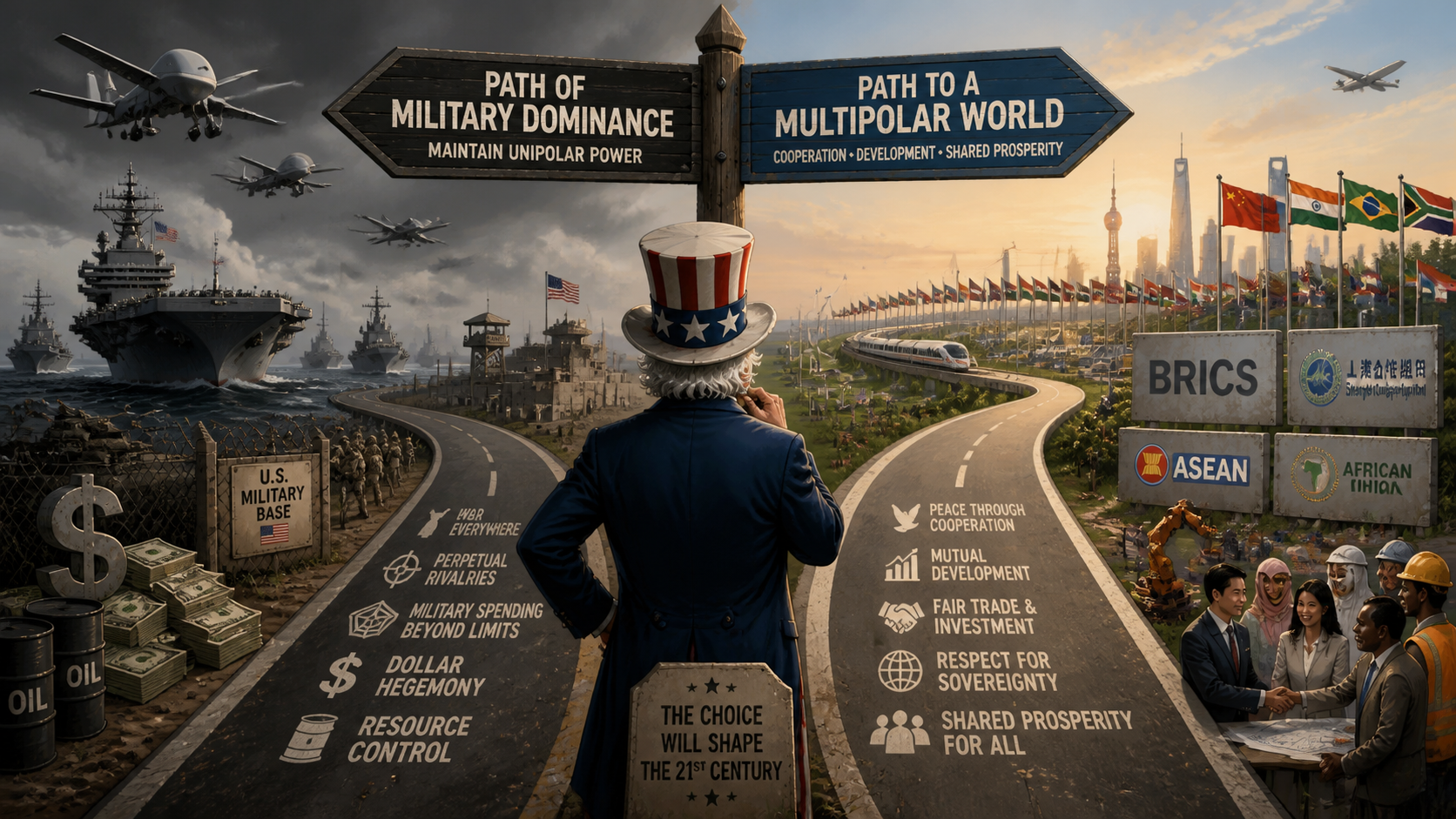
A System Built on Domination
The current US system is predicated on global domination.
The US dollar as the global reserve currency is what has allowed the US to accumulate a multi-trillion-dollar debt and still maintain immense power and wealth not only within its borders but far beyond them.
This resulting hegemony allows the US to set “global norms” regarding global trade, human rights, and the development of and control over key technologies — especially in terms of exercising immense hypocrisy and selective enforcement while doing so.
The United States has the possibility of transitioning to a stable, prosperous, powerful member of the multipolar world, but first it must cut its addiction to global hegemony
It has also allowed the US to create a network of what it calls “security guarantees” in which US military forces occupy nations around the globe, from Europe and the Middle East to Southeast and East Asia — predicated in principle on ensuring the security of these “allies,” but in practice simply serving as cover for what the US calls “power projection” — theability of the US to exercise military aggression virtually anywhere on Earth at a moment’s notice.
Often this US “power projection” comes at the cost of the security of nations hosting US troops.
The threat or use of US military aggression around the globe is essential for maintaining the US dollar as the global reserve currency and thus American hegemony overall.
US military aggression serves to degrade or eliminate potential rivals and the alternative financial and monetary systems they inevitably seek to create to work their way out from under subordination to Wall Street and Washington.
This has been US policy spanning decades — including from the end of the Cold War to today.
The growing power of alternative systems across what many call the emerging multipolar world has forced the US to embark on not only unprecedented wars of aggression around the globe, including wars and proxy wars against Venezuela, Russia, Yemen, Lebanon, and Iran, but also unprecedented military spending, with the current US military budget hovering around 1.5 trillion US dollars and growing.
While at face value this appears to be unsustainable and irrational — there are several reasons why the US refuses to adopt a more rational course of policy.
The US military-industrial base is composed of immensely wealthy and influential corporations. The US dominance stemming from the military aggression worldwide they enable helps establish and expand monopolies across other US industries, including big oil, big agriculture, the auto industry, big pharmaceutical corporations, big tech, and many more.
These industries together serve as the foundation of US economic, military, political, and informational power. Each corporation’s trajectory is guided by shareholder primacy, meaning each and every one of these corporations is required by law to constantly expand profit for its shareholders.
Because perpetual growth is both irrational and unsustainable in a finite world with a finite population and finite resources — this creates structural necessities to constantly expand markets and growth at any cost — including through war, exploitation, predatory lending, and many more toxic practices.
While this economic system drives the pursuit of US primacy around the globe, ideology serves as structural reinforcement — this includes the notion of “American exceptionalism,” which insists the US is not only inherently superior to all other nations but also that it has a moral and even “divine” duty to assume global hegemony.
Not only is perpetual growth within a finite system irrational and unsustainable, but there are also other external reasons the US pursuit of hegemony is dangerously unrealistic.
China’s rise is driven by several core realities the US cannot readily change, including the fact that China has a population over 4 times greater than the US, thus a vastly larger workforce, a vastly larger industrial base, better infrastructure, deeper and better developed supply chains, a better education system producing millions more graduates in the fields of science, technology, engineering, and mathematics (STEM), and growing military power — both conventional and nuclear — that make the application of US military aggression less and less likely to succeed in coercing or containing China.
“What if…”
What if the US were to decide to abandon this irrational and unsustainable pursuit of global hegemony?
Analysts imagine the US could achieve this by retreating to the Western Hemisphere, reshoring industrial capacity, auditing and cutting the US “defense” budget, shifting from global “power projection” to investing in domestic infrastructure, and rebuilding the strength of the US dollar on productivity rather than global military aggression.
The US State Department would have to recognize the reality of a multipolar world and find a rational, proportional place within it — abandoning its “rules-based order” in which the US and the US alone makes the “rules” and gives the “orders,” and instead adopt a non-interference policy both within the Western Hemisphere itself and all around the rest of the globe.
The US would also have to finally adhere to actual international law — which would end the era of US-led unilateral sanctions and military interventions worldwide.
At home, the US would have to transition from rent-seeking economic practices to actual, physical, industrial production and invest in both universal healthcare and affordable, quality education to rebuild the workforce required to do all of the above.
Many analysts before the 2024 US presidential elections assumed the rhetoric from the Trump campaign aligned with this desire to transition from global hegemon to regional power in the Western Hemisphere, to reinvest in US industry and infrastructure, and that a “grand bargain” was imminent with Russia or China, or even both.
However, before the 2024 US presidential elections and now clearly since the elections, the US had already committed to doubling down on domination.
The US desire to “reindustrialize” was spurred not as a fundamental economic transition but as a geopolitical necessity to build the arms and ammunition required to fight increasingly powerful nations like China, and Russia, but also Iran, and many other nations increasingly tilting toward the multipolar worldview.
Even within the pages of the 2025 US National Security Strategy — that many of these same analysts cited as evidence of America’s desire to retreat to the Western Hemisphere and seek a “grand bargain” with nations like Russia and China — the US laid out continued ambitions to deter the rise of rival powers anywhere on Earth.
At one point the 2025 NSS stated:
“…the U.S. will organize a burden-sharing network, with our government as convener and supporter. This approach ensures that burdens are shared and that all such efforts benefit from broader legitimacy. The model will be targeted partnerships that use economic tools to align incentives, share burdens with like-minded allies, and insist on reforms that anchor long-term stability. This strategic clarity will allow the U.S. to counter hostile and subversive influences efficiently while avoiding the overextension and diffuse focus that undermined past efforts.”
In other words, the US is simply recognizing the rising costs of global primacy and outsourcing them to its various proxies — from Europe to the Asia-Pacific — allowing the US to continue confronting the potential rise of alternative centers of power at the expense of the nations in these regions the US has already politically captured.
Examples of this include not only Ukraine but increasingly the rest of Europe vis-a-vis Russia, the Persian Gulf Arab states and Israel in the Middle East vis-a-vis Iran, and Japan, South Korea, the Philippines, and the island province of Taiwan in the Asia-Pacific region.
Rather than retreat to the Western Hemisphere and seek a “grand bargain” with either Russia or China — and rather than building a functional peacetime economy — the US has simply doubled down on military industrial production at home as well as “friend-shoring” it to US proxy nations, and has adopted an all-or-nothing mindset that is clearly targeting and destabilizing the global economy for proxies and rivals alike.
Thus, instead of ending wars as some analysts predicted, the US has escalated each and every war it was in or sponsoring before the 2024 US presidential elections, and it has started several new wars, including the incredibly dangerous and disruptive US war of aggression against Iran in the Middle East.
The Potential Costs of “All-or-Nothing” Thinking
In the minds of American policymakers and the special interests driving their decisions, ruling over the ashes is preferable to the inevitable collapse of the current US system because of its precarious dependency on the global reserve status of the US dollar and the rent-seeking nature of its economy versus the rapid rise of alternative economic systems built on purpose and production.
Because of this, the US is rapidly approaching overextension abroad and accelerated decay at home.
The US hypothetically seeking a constructive role among nations rather than seeking dominance over them is for a nation that wants to be stable. The current US strategy is driven by a desire to be supreme. Historically, when a great power chooses supremacy over stability, the transition to a new international order usually happens through a major crisis — like a world war — rather than a “grand bargain.”
Looking at the US proxy war in Ukraine escalating through the US itself expanding drone strikes on Russian energy production, storage, and export facilities; the US targeting of tankers carrying Russian energy exports; the US war of aggression against Iran and its subsequent blockading of the Strait of Hormuz; and the US’ continued military build-up in Asia-Pacific off China’s shores and even within its internationally recognized borders (Taiwan) – we see that exact major crisis taking shape right now.
The gap between a rational, sustainable, and constructive plan for peace and the actual momentum of US policy is separated by structural entrenchment. Once a nation builds its entire economy, currency, and identity around being a hegemon, the cost of transitioning away to a more sustainable and rational path becomes an existential threat to the people and interests in power.
Anyone regularly listening to US Senate and House hearings can witness for themselves the sense of existential threat and fear of losing complete dominance over the planet that commands the thoughts and decisions of not only US senators, house representatives, and the White House itself —but the special corporate-financier interests — the arms industry, big oil, big ag, big tech, big pharma, and many others who placed them into office and work through them to advance US foreign and domestic policy on their behalf.
For politicians, these fears stem from the many structural reinforcements used to regiment America’s political class and, to a certain extent, many in the American public — like American exceptionalism, racism, xenophobia, and supremacy.
For the corporate-financier interests — these fears stem from the painful transition from rent-seeking to actual production — the narrower but more sustainable margins that result from doing so — and the fact that no matter how successful that transition is — China, because of its fundamental advantages — from a larger population, a larger industrial base, and a larger and better education system — will inevitably emerge stronger and more influential than the US.
Because of that — should such a transition take place — these US corporate-financier interests will never have the opportunity to use force — be it military, economic, or political — to take from others whatever it wants, wherever it wants, and at whatever cost it chooses — ever again.
However, if this is what drives the existence of the current US system — and transitioning away from it constitutes an “existential threat” — it is a system that shouldn’t exist in the first place.
It is a system the American people — and the rest of the multipolar world — should work together to expose, divest from, and displace with purpose-driven economic activity under the primacy of national sovereignty within actual international law.
The United States has the possibility of transitioning to a stable, prosperous, powerful member of the multipolar world, but first it must cut its addiction to global hegemony. To beat any addiction — one must first admit there is an addiction to begin with. Only time will tell whether or not the US can see this for themselves, or if the multipolar world can create the global conditions that make perpetual US control over the world impossible and leave it with only one option — transitioning to a more sustainable and constructive role within the world.
Brian Berletic is a Bangkok-based geopolitical researcher and writer
Follow new articles on our Telegram channel


Leave a Reply