Friday, 27 November 2026 — Weaponised Information
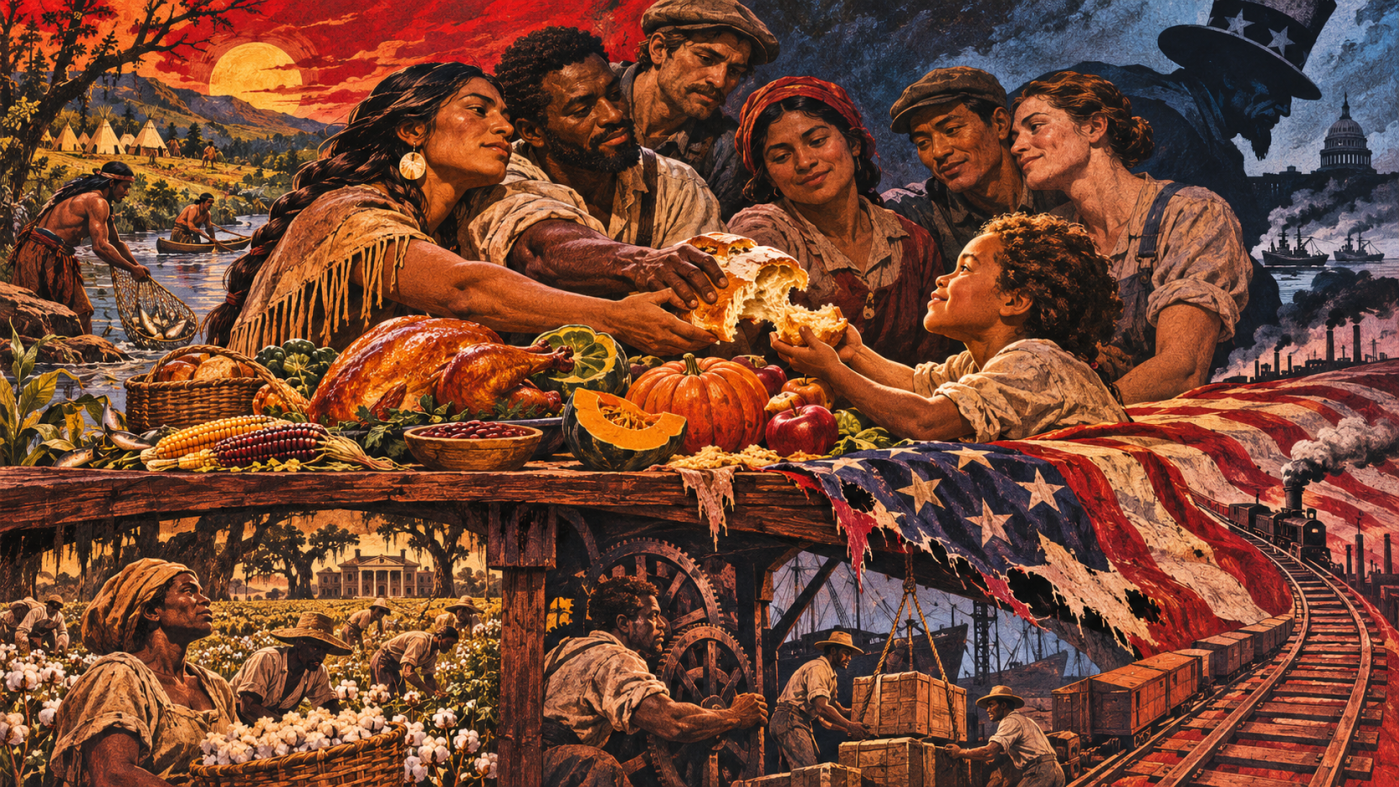
A Thanksgiving rumination on the colonial making of America, the invention of whiteness, the contradictions dividing the working class, and the revolutionary struggle to reclaim a human inheritance greater than any empire.
By Prince Kapone | Weaponized Information | November 26, 2026
I. What Are We Giving Thanks For?
It’s Thanksgiving, and I’ve got plenty of things in my life to be thankful for. I’ve got children I love, friends who’ve stood beside me through some of the most difficult periods of my life, and a lifetime’s worth of memories rooted in the Pacific Northwest. I was born in Seattle, and there’s something about these mountains, rivers and forests that makes me feel at home no matter how long I’ve been away. But what the hell does any of that have to do with my allegiance to the United States of America?
There’s something profoundly human about gathering around a table with the people we love, sharing a good meal, telling stories, laughing at one another’s foolishness and taking a moment to appreciate the fact that we’ve made it through another year on this troubled little planet. Human beings were doing these things thousands of years before an American flag ever flew over this continent. The American ruling class didn’t invent our capacity to love one another, and it sure as hell doesn’t own it.
Yet every November we’re invited to express those perfectly genuine human sentiments through the founding mythology of the United States. Schoolchildren dress up as Pilgrims and Indians, families gather around their televisions to watch the annual festivities, and the history of colonial settlement gets transformed into a heartwarming story about cooperation, generosity and the birth of a nation. The affection we feel for the people around our dinner tables becomes entangled with a remarkably selective account of how the society in which we live came into existence.
Consider the food on that table for a moment. Farmworkers harvested the crops, meatpackers processed the animals, truck drivers hauled the produce across the country, warehouse workers unloaded the trucks, and somebody probably spent half the damn day in the kitchen preparing everything. Much of the unpaid household labor that makes these gatherings possible, work disproportionately performed by women, never figures into the accounting books of the corporations selling us the ingredients. Yet without that labor there’d be no dinner, no functioning workforce and no society capable of reproducing itself from one generation to the next.
If we’re giving thanks for the material conditions of our existence, it seems reasonable to begin with the human beings whose labor sustains them. But who owns the land upon which that food was grown, and how did they acquire it? The people harvesting the crops don’t necessarily own the farms, the people working in the meatpacking plants don’t determine how the profits are distributed, and plenty of the workers responsible for feeding this country struggle to feed their own families. There’s already a contradiction at the dinner table long before anybody brings up George Washington or the Mayflower.
Meanwhile, in Plymouth, Massachusetts, Indigenous people and their supporters have gathered on Thanksgiving Day since 1970 to observe a National Day of Mourning. The observance originated when Wamsutta Frank James, an Aquinnah Wampanoag elder, was invited to address a banquet commemorating the 350th anniversary of the Pilgrims’ arrival. Massachusetts officials objected to the historical account he’d prepared and attempted to have him deliver a more agreeable speech. James refused, and Indigenous people organized their own gathering in Plymouth, establishing a tradition of remembrance and resistance that’s endured for more than half a century.
The significance of that episode extends considerably beyond a disagreement over how to celebrate a holiday. Government officials wanted an Indigenous man to participate in a celebration of colonial settlement, but they weren’t prepared to let him speak about what that settlement had meant for his own people. James and his comrades challenged the authority of the people organizing the commemoration to determine whose history could be told and on whose terms. Their refusal ought to give any historical materialist something to chew on besides a goddamn turkey.
The same historical process that established the territorial and economic foundations of American society brought devastating consequences to peoples whose lands and labor were appropriated in its development. Those consequences haven’t been distributed equally among the generations that followed, and neither have the opportunities, wealth and political power arising from that history. The Thanksgiving mythology smooths over those antagonisms by incorporating everybody into the story of a common national inheritance. But the people whose ancestors extended their hospitality to the English settlers had a history of their own, and so did the people whose ancestors subsequently arrived from Africa in chains. Even the Europeans who crossed the Atlantic possessed histories extending far beyond their eventual incorporation into American society.
The United States came into existence within a world already inhabited by peoples who’d spent thousands of years producing their own material conditions of life, developing political institutions, accumulating knowledge and establishing relationships with one another. Their land didn’t become land when Europeans arrived, and their history didn’t become history when somebody began writing it in English. America was born out of the violent transformation of a world that existed long before it, and it’s within that world that the story of America properly begins.
II. Before America, There Were Peoples
We’re taught from a remarkably early age that Christopher Columbus discovered America in 1492, as though the millions of human beings inhabiting this continent had spent thousands of years waiting for some Genoese sailor in the service of the Spanish monarchy to come along and announce their existence to the world. Apparently, a place doesn’t properly exist until a European knows where the hell it is. Behind the absurdity of that proposition lies a conception of history in which European peoples appear as its principal subjects, while everybody else enters the story at the moment their existence becomes consequential to Europe.
When the English established their settlement at Plymouth in 1620, they entered a world organized through political institutions and territorial relationships considerably older than their little colony. The Wampanoag Nation encompassed dozens of distinct communities, whose people sustained themselves through agriculture, fishing and other activities governed by their own social arrangements. The Aquinnah Wampanoag history identifies the introduction of European systems of private land ownership as a particularly destructive development, because those systems conflicted with established communal practices through which Wampanoag people organized their relationship to the land.
The decision of the Wampanoag leader Ousamequin to establish an alliance with the English in 1621 arose from concrete political circumstances. Epidemic disease had devastated Wampanoag communities, altering their relationship with the neighboring Narragansett, and Ousamequin recognized that an alliance with the newcomers might strengthen his people’s position. Other Wampanoag leaders, including the Pocasset sachem Corbitant, opposed the alliance because they distrusted the English. Here we encounter Indigenous people deliberating over matters of diplomacy, military security, trade and the preservation of their communities. Their relationship with the English emerged through their own political struggles and calculations, not through some universal enthusiasm for the establishment of European civilization on their land.
Even here in the Pacific Northwest, where the names of European-American politicians, businessmen and military officers have been stamped across the landscape, Indigenous peoples had developed sophisticated relationships with the ecological resources of the region long before Seattle acquired its present existence. Fishing was integral to the material and cultural life of the peoples of Puget Sound, whose knowledge of the waterways, construction of canoes and methods of harvesting and preparing salmon sustained communities over generations. The waters that would eventually become objects of commercial investment, industrial development and disputes over American property rights already formed part of the material foundation of entire societies.
The American founding mythology accomplishes a remarkable reversal of this history. It reduces the Indigenous inhabitants of the continent to supporting characters in the historical development of the Europeans who came to occupy their territories, and even appropriates their generosity toward strangers as evidence of the virtues of the society that subsequently dispossessed them. We’re practically invited to believe that the Wampanoag were giving thanks for the future establishment of the United States of America!
Much the same disappearance occurs in accounts of African history that introduce Africans to the reader at the moment Europeans began forcibly transporting them across the Atlantic. As Hosea Jaffe demonstrates in A History of Africa, the recovery of Africa’s historical existence became an integral component of the intellectual and political struggles of African liberation movements. Colonialism had appropriated African resources and labor while cultivating a historical consciousness in which Africa appeared incapable of producing civilization without the intervention of Europe. The struggle against colonial domination consequently involved a struggle over who possessed the authority to interpret the history of African peoples themselves.
Centuries before the establishment of the United States, the Mali Empire participated in extensive commercial networks connecting West Africa with North Africa and the wider world. In southern Africa, the people who built Great Zimbabwe developed a substantial agricultural and commercial center sustained through cattle husbandry, cultivation, metallurgy and long-distance trade. Archaeological discoveries of imported ceramics and glass beads establish connections between this African society and commercial networks extending across the Indian Ocean. There were already merchants, agricultural producers, craftsmen, political authorities and competing social interests within these societies, and the subsequent activities of European merchants have to be understood partly through their encounters with these historically developed concentrations of African wealth and productive capacity.
Nor did the Europeans who eventually crossed the Atlantic constitute an undifferentiated population of white people. My European ancestors emerged from societies that spoke different languages, organized production in different ways and frequently stood in antagonistic relationships with one another. An English aristocrat and an Irish peasant possessed very different relationships to land, political authority and the appropriation of the products of human labor. Their subsequent classification as members of the same race in Anglo-American society tells us remarkably little about the historical relationships that existed between them in Europe.
Michael Hechter’s investigation of British national development in Internal Colonialism offers a particularly useful illustration of the complexity of these relationships. The consolidation of the British state didn’t extinguish the collective identities of the Irish, Welsh and Scottish peoples, and neither did those identities establish that all their members occupied identical relationships to British imperialism. In his later reconsideration of Scotland, Hechter confronted the difficulty of explaining its uneven development and continued institutional distinctiveness alongside the economic achievements of parts of Scottish society. Indeed, the University of Glasgow’s own historical slavery investigation documents how the institution benefited financially from relationships connected to African enslavement while many of its scholars actively opposed slavery. Scottish national identity, participation in British imperial accumulation and resistance to particular forms of imperial exploitation could coexist within the same society.
These contradictions matter because the development of a collective European identity across the Atlantic involved a transformation of historically distinct peoples and class relationships. European merchants sought profitable investments, peasants struggled against established property relations, religious minorities experienced persecution, and impoverished laborers confronted increasingly restricted opportunities to sustain themselves independently. Some of the people who crossed the Atlantic possessed capital of their own, while others arrived bound to employers for years of compulsory labor. Their eventual incorporation into a society organized through racial distinctions requires considerably more historical explanation than the observation that they possessed similar skin pigmentation.
The Indigenous peoples weren’t waiting to become American Indians, the Africans weren’t waiting to become African Americans, and the Europeans weren’t waiting to become white Americans. They possessed their own histories, productive relationships, political institutions and contradictions before anybody conceived of organizing them within the boundaries of an American state. What brought these peoples into their subsequent relationships with one another was the expansion of commercial and political forces that increasingly sought command over the land, labor and wealth of the world. The emergence of America belongs to the history of that expansion, and the material interests driving it would profoundly transform not only the peoples subjected to colonial conquest, but European society itself.
III. The Making of an American World
By the fifteenth century, Genoese merchants and financiers were working with the Portuguese monarchy to extend commercial networks down the Atlantic coast of Africa. The merchants brought capital, commercial experience and connections to distant markets, while the monarchy furnished ships, military protection, royal charters and the political authority to enforce commercial privileges. When the Portuguese constructed Elmina Castle on the coast of present-day Ghana in 1482, they sought direct access to the African gold trade. They entered a world of established African states, commercial networks and political authorities whose cooperation, resistance and competing interests would shape the subsequent development of European expansion.
Meanwhile, on the Atlantic islands of Madeira and São Tomé, European merchants and colonial proprietors were developing forms of agricultural production that would acquire enormous historical significance. Land grants, merchant credit, irrigation systems, sugar mills and increasingly extensive reliance upon enslaved African labor brought the production of agricultural commodities under the command of commercial capital. By the 1530s, São Tomé’s sugar plantations had surpassed Madeira in supplying European markets, establishing a particularly brutal model of plantation slavery that subsequently developed on a vastly greater scale in Brazil and the Caribbean.
These plantations were also places of fierce class struggle. In 1595, enslaved Africans led by Amador launched a massive insurrection against the colonial order in São Tomé. Resistance, the destruction of sugar mills and competition from Brazilian producers contributed to the island’s declining position in the Atlantic sugar economy. Some plantation owners subsequently relocated to Brazil. The geography of capitalist accumulation was being shaped by competition among capitalists, but also by the struggles of the human beings whose labor generated their wealth.
Across the Atlantic, the Spanish Crown confronted the problem of converting its territorial conquests into a dependable source of wealth. At Potosí, in present-day Bolivia, the colonial administration reorganized silver production during the 1570s through a combination of privately operated mines, mercury refining, hydraulic infrastructure, taxation and the compulsory recruitment of Indigenous workers. Under the reorganized colonial mita system, Indigenous communities were compelled to furnish workers for the mines and refining mills. Drafted workers received wages, but the communities from which they came helped bear the costs of maintaining and reproducing their labor. The colonial economy appropriated the resources of entire communities to keep the mines operating and the silver flowing.
That silver traveled through commercial networks connecting the Americas, Europe and Asia. It helped finance the expenditures of the Spanish monarchy, service its debts and sustain international commerce. A European financier could accumulate wealth through transactions conducted thousands of miles from the Indigenous workers whose bodies bore the physical costs of its production. The distance between the countinghouse and the mine concealed the social relationship between them quite nicely. Capital has always possessed a remarkable talent for separating the enjoyment of its profits from the unpleasant business of producing them.
The English entered this developing colonial economy through institutions of their own. In 1606, the English Crown granted a charter to the Virginia Company of London, whose investors established Jamestown the following year. Among the company’s leading figures were merchants already involved in England’s expanding international commerce. With the development of commercial tobacco production, the colony acquired a profitable export commodity, and the demand for cultivable land and agricultural labor grew accordingly. The expansion of English settlements into Powhatan territory intensified the struggle over land and political authority, culminating in a coordinated offensive led by Opechancanough in 1622 and a prolonged colonial war.
At the same time, transformations in European agriculture were depriving sections of the peasantry of their customary access to land and means of subsistence. Enclosures, commercial agriculture, rural impoverishment and the growing dependence of workers upon wages helped produce a population from which merchants, naval authorities and colonial proprietors could recruit sailors, soldiers, servants and laborers. As Peter Linebaugh and Marcus Rediker demonstrate in The Many-Headed Hydra, the formation of this Atlantic working population involved extraordinary violence, but it also generated new possibilities for cooperation and rebellion among people brought together by the expanding commercial economy.
Colonial expansion presented European laborers with contradictory prospects. They could be subjected to years of servitude under brutal plantation masters, yet the conquest of Indigenous territory also created opportunities for some of them to acquire land and property that would’ve been difficult to obtain back in Europe. The dispossession of one population could furnish another with the prospect of escaping its own propertylessness. Here we encounter one of the material foundations upon which the ruling classes of the emerging settler societies would subsequently build their political power.
In Capitalism and Slavery, the Trinidadian historian Eric Williams traced the connections between plantation slavery, British commerce and industrial development. Enslaved Africans produced commodities whose sale sustained merchants, shipowners, sugar refiners, manufacturers and financial interests. North American merchants supplied Caribbean plantations with provisions and timber, while British manufacturers furnished goods for the expanding Atlantic trade. The profits, markets and commercial institutions generated through these relations helped create conditions favorable to industrial accumulation in Britain. The apparent prosperity of one part of the world was being produced, in considerable measure, through the organized exploitation of another.
Capitalism’s emergence as a world system brought together wage labor, indentured servitude, chattel slavery, compulsory mining labor and colonial land appropriation. These forms of exploitation were historically distinct, but they became economically connected through commodity production, merchant capital, credit and the armed power of expanding European states. The development of capitalist relations within Europe and the subordination of peoples outside Europe became mutually reinforcing historical processes, though the benefits and burdens of those processes were distributed in radically unequal ways.
The American Revolution of 1776 transferred political authority away from the British monarchy and, through the subsequent victory of the revolutionary forces, established the conditions for an independent republic. It was a real historical rupture with British colonial rule, accompanied by popular struggles that opened possibilities for democratic advancement. Yet the colonial proprietors who secured their independence from Britain retained much of the property and wealth they’d acquired under British rule, including their ownership of enslaved human beings. The independent republic would also claim the authority to expand across territories belonging to Indigenous nations. Freedom from the British Empire furnished the American ruling class with greater freedom to pursue its own expansion.
The American bourgeoisie could speak sincerely enough about its objections to foreign rule while remaining perfectly comfortable ruling over other peoples. It could proclaim the sacred rights of property without dwelling too much upon how the goddamn property had been acquired in the first place. The contradiction was embedded in the material foundations of the society whose independence it celebrated.
But the colonial ruling classes had inherited another problem. The accumulation of their wealth depended upon the labor of people they exploited, dispossessed and frequently subjected to extraordinary violence. European servants, enslaved Africans and Indigenous peoples occupied different positions within this developing social order, yet their struggles repeatedly threatened the security of colonial property and the authority of its owners. The survival and expansion of that order would require more than soldiers, overseers and gallows. It would require the political organization of the population itself, the distribution of privileges among the exploited and the construction of a social identity through which sections of the laboring population could be recruited into the defense of colonial power.
IV. How Europeans Became White
The Virginia tobacco planter faced a problem. The more laborers he acquired to cultivate his tobacco, the more people he brought together who had good reason to despise him. During much of the seventeenth century, the plantation economies of Virginia and Maryland depended heavily upon European indentured servants. Masters could sell their remaining terms of service, restrict their movements, subject them to corporal punishment and seek extensions of their bondage. African laborers were increasingly subjected to lifelong servitude, but the elaborate system of racial privileges that would eventually separate the two populations was still taking shape.
In 1640, three laborers escaped from Virginia into Maryland. One was Dutch, another Scottish, and the third was an African named John Punch. When the authorities apprehended them, the Virginia General Court extended the Europeans’ terms of service but condemned Punch to bondage for the remainder of his life. The three laborers had recognized a common interest in escaping their master, while the colonial authorities were already establishing different consequences for the exercise of that common interest. It’s through contradictions such as these that Theodore W. Allen, in The Invention of the White Race, reconstructs the emergence of racial oppression as a system of ruling-class social control.
The plantation owners were also acquiring increasingly extensive powers over the reproduction of the people whose labor they appropriated. In December 1662, the Virginia General Assembly established by law that children born in the colony would inherit the condition of bondage or freedom of their mothers. A plantation owner could sexually exploit an enslaved African woman and subsequently claim ownership over the children she bore. Every child born into hereditary slavery represented an addition to somebody’s property and a prospective source of labor. While the enslaved woman endured the physical and emotional burdens of bringing another human being into the world, the law furnished her owner with the means of converting that new life into wealth. Five years later, the assembly declared that baptism conferred no right to freedom upon an enslaved person. The sacred rights of private property apparently required a few amendments to the teachings of Jesus Christ.
By the 1670s, Virginia’s ruling class was confronting an increasingly unstable situation. Wealthy plantation owners had accumulated vast tracts of land, and falling tobacco prices, taxation and indebtedness placed considerable pressure upon smaller producers. Former indentured servants found themselves competing for access to land and struggling to establish independent livelihoods. Meanwhile, Indigenous nations continued to defend their territories against colonial encroachment. These antagonisms converged in Bacon’s Rebellion of 1676, when a conflict within the colonial ruling class over its policy toward Indigenous peoples developed into a civil war that threatened the established authorities of Virginia.
Nathaniel Bacon was himself a wealthy planter, and his followers perpetrated massacres against Indigenous communities in pursuit of further territorial expansion. Yet the rebellion also unleashed forces whose interests extended beyond the ambitions of its leadership. European and African laborers took up arms against the colonial authorities, and some continued fighting even after Bacon’s death. Captain Thomas Grantham, who helped suppress the rebellion, promised freedom to the servants and enslaved people who agreed to surrender. In his account reproduced by Allen, Grantham described a remaining contingent of approximately eighty African and twenty English rebels who refused to relinquish their weapons. He eventually secured their surrender through deception and the threat of naval gunfire.
The rebellion exposed the double-edged character of the social forces generated by colonial expansion. Impoverished Europeans could challenge the authority of the plantation elite while pursuing their own interests in the appropriation of Indigenous land. But the experience of common exploitation could also bring European and African laborers into armed struggle against their masters. The ruling class had already begun establishing hereditary racial slavery before the rebellion, and the subsequent expansion of the Atlantic slave trade facilitated its consolidation. The political lesson of the rebellion, however, was that plantation owners needed a dependable means of preventing the grievances of their European laborers from finding common cause with African resistance.
In 1691, the Virginia General Assembly prohibited intermarriage between free Europeans and African or Indigenous people, prescribing banishment for those who violated the prohibition. The same legislation severely restricted emancipation by requiring that newly freed Black people be transported out of the colony. The authorities were intervening directly in the formation of households, the relationships people established with one another and the prospects of their children. Even the decision of a slaveholder to emancipate an enslaved person was subordinated to the ruling class’s broader interest in preserving the racial order.
The Virginia slave code of 1705 prohibited masters from whipping white Christian servants naked without authorization from a justice of the peace. The legislature also specified the material provisions due to servants upon completing their terms of bondage. Male servants without annual wages were entitled to corn, money or its equivalent, and a firearm, while female servants were entitled to specified quantities of corn and money or goods. Meanwhile, the same code required churchwardens to confiscate and sell horses, cattle and hogs belonging to enslaved people. The law furnished one laborer with resources for establishing an independent livelihood while depriving another of the modest property he’d managed to accumulate through his own efforts.
In 1723, the General Assembly went further, disenfranchising free Black, mixed-descent and Indigenous people regardless of whether they met the otherwise applicable property qualifications. When British officials questioned the justification for the legislation, Virginia Governor William Gooch defended it in a letter of 1736. He explained that the authorities suspected free African-descended people of sympathizing with enslaved people and participating in their resistance, although he acknowledged the absence of legal proof concerning their involvement in an alleged conspiracy. The assembly sought to establish what Gooch called a “perpetual Brand” upon the free African-descended population and prevent its descendants from attaining equality with the descendants of Englishmen.
The legislatures of 1705 and 1723 even required colonial officials to read their racial legislation publicly at churches and courthouses, imposing fines upon officials who failed to perform that duty. The ruling class was instructing the population in the meaning of its newly established social distinctions through institutions embedded in everyday life. Contrary to the mythology that subsequent generations would inherit, the colonial authorities weren’t simply administering a racial order that existed naturally among the people they governed. They were producing the damn thing.
A propertyless European laborer could now possess legal protections and exercise forms of authority denied even to an African-descended person who owned considerably more property than he did. He could eventually complete his servitude, receive provisions for his livelihood and, as a free man, become eligible to exercise political rights subject to the prevailing qualifications. He could also be recruited into the militia and the institutions responsible for policing enslaved Africans. The planter retained his estate and his command over labor, but he’d acquired a broader social constituency with something of its own to defend. The privileges distributed among poorer Europeans cost the plantation elite considerably less than the loss of its power.
J. Sakai’s Settlers: The Mythology of the White Proletariat takes the argument further by examining how the appropriation of Indigenous territory transformed the class structure of European settler society. Colonial expansion opened opportunities for Europeans to acquire farms, establish businesses and become independent producers. The Bristol Archives preserve records of thousands of indentured migrants whose contracts could furnish them with land, money or tools upon completing their service. Such arrangements offered a prospective route out of propertylessness, and those who actually acquired productive property could establish households capable of transmitting wealth to subsequent generations.
Of course, the opportunity to acquire property doesn’t establish that everyone acquired it, any more than the possibility of becoming a millionaire makes every damn American worker a millionaire in waiting. Allen documents the concentration of land in the hands of wealthy colonial proprietors and the persistence of substantial landless populations within the European-American community. Sakai’s broader characterization of colonial society as overwhelmingly composed of property owners consequently requires historical qualification. But his central observation remains indispensable: the expansion of colonial territory could provide poorer Europeans with material opportunities for advancement that depended upon the dispossession of Indigenous peoples.
There’s a substantive disagreement between Allen and Sakai that bears directly upon revolutionary political economy. Allen emphasizes how racial privileges bound European-American laborers to a ruling class whose domination obstructed their collective emancipation. Sakai places greater emphasis upon what those laborers and settlers could actually acquire through colonial expansion, arguing that these opportunities frequently altered their class position and established material interests in the preservation of colonial domination. For the laborer hoping to become a farmer, the conquest of another people’s territory could offer a real economic advantage. And if he acquired that farm, his relationship to productive property changed considerably. His immediate interests couldn’t simply be deduced from the circumstances of his previous exploitation.
Nor were the colonial authorities the only people administering this system once they’d established it. Allen documents the efforts of white artisans to exclude free and enslaved African workers from skilled occupations throughout the Atlantic seaboard. European-American workers could defend their position within particular trades by restricting the competition of African workers, even while remaining subject to exploitation by their own employers. Racial privileges had acquired an economic significance that could furnish subordinated people with reasons to actively reproduce the institutions of their subordination.
Whiteness developed through this historical process as a form of Pan-European political incorporation into colonial society. People whose ancestors had spoken different languages, practiced different religions and fought bitter wars against one another could now occupy a common position in relation to colonized peoples. That position was sustained through rights, property, employment opportunities and the exercise of political authority. It furnished the colonial ruling class with a means of organizing allegiance across the class divisions within its own settler population. The biological mythology of race supplied a naturalistic justification for an arrangement that human beings had constructed through centuries of struggle over labor, land and power.
But capitalism’s subsequent development would transform the very class structure upon which this arrangement had been established. Industrialization would produce an expanding European-American population dependent upon wages rather than independent property, while the abolition of chattel slavery would compel the ruling class to reorganize its exploitation of African labor. The descendants of the settlers would increasingly confront their own bourgeoisie as wage workers, carrying into that confrontation the contradictory political and material inheritance of a society founded upon colonial conquest.
V. The Empire Inside the Working Class
When the Civil War destroyed the legal institution of slavery, the plantation owners lost their right to own African people, but much of the land remained in the hands of the former slaveholding class. The failure of Reconstruction to establish a lasting redistribution of Southern agricultural property meant that millions of formerly enslaved people and their descendants had to secure their livelihoods under conditions largely dictated by landowners. Through sharecropping, political repression and racial terror, the Southern ruling class reorganized its exploitation of African labor. Meanwhile, the expansion of industrial capitalism was transforming increasing numbers of European-Americans into wage workers. The growth of Northern industry and the migration of African people out of the South would eventually bring workers from these different historical circumstances together on the same factory floors.
One of the great weaknesses of an economistic approach to Marxism is that it begins its investigation of the working class at the factory gate. The capitalist purchases the labor power of two workers, and we’re supposed to have discovered the entirety of their class interests. But those workers have already lived entire lives before punching the goddamn time clock. One may come from a family that’s accumulated property over several generations, while the other comes from a family that’s spent those generations fighting for access to land, housing and employment. Both confront the boss as sellers of labor power, but the wage relationship doesn’t exhaust the material circumstances governing their lives. And those circumstances help determine what each worker stands to gain or lose through particular forms of political struggle.
Industrial capitalism created enormous opportunities for workers to overcome some of the divisions that capital had inherited and cultivated. When workers occupied General Motors plants during the Flint sit-down strike of 1936–37, they effectively seized control over the machinery upon which the corporation’s profits depended. After weeks of struggle, General Motors signed an agreement with the UAW recognizing the union as the bargaining representative of its members and promising protection against retaliation for their union activities. Industrial unionism opened possibilities for collective organization across occupations and racial boundaries that many of the older craft unions had obstructed. These were genuine advances. Workers fought like hell for them, and there’s no revolutionary merit in pretending otherwise.
But the power of a labor organization could also be employed to perpetuate the subordination of other workers. In 1944, an African-American locomotive fireman named Bester William Steele brought a case before the United States Supreme Court concerning an agreement negotiated between the Louisville and Nashville Railroad and the Brotherhood of Locomotive Firemen and Enginemen. The Brotherhood excluded Black workers from membership while possessing the statutory authority to represent them in collective bargaining. Steele’s complaint described how the union negotiated arrangements favoring white firemen and how he’d consequently lost a more desirable assignment to a junior white worker. In Steele v. Louisville, the Court ruled that the union’s authority carried a corresponding obligation to represent all workers in the bargaining unit without racial discrimination. Here was a labor union exercising power acquired through the collective organization of workers to defend the economic position of some workers against others. And here was an African worker fighting to transform that relationship.
The federal government was simultaneously creating institutions through which the circumstances of working-class life would be transformed for generations. The National Labor Relations Act of 1935 excluded agricultural laborers and domestic servants from its statutory definition of protected employees. The old-age insurance provisions of the original Social Security Act also excluded agricultural and domestic employment. According to an examination of the 1930 census figures published by the Social Security Administration, approximately 65 percent of gainfully employed African-Americans worked in those two sectors. Whatever the contested legislative motives behind these exclusions, their effects operated upon an occupational division of labor that had been produced through the history of slavery and its aftermath. Congress subsequently extended Social Security coverage to these occupations through legislation in 1950 and 1954, but the original arrangement illustrates how an apparently race-neutral distinction among occupations could reproduce historically established racial inequalities.
The same process operated beyond the workplace. Beginning in the 1930s, the Federal Housing Administration helped make long-term mortgage financing more accessible by insuring loans against default. Yet its mortgage underwriting practices treated racial integration as a threat to property values and encouraged the preservation of racially restricted neighborhoods. As American capitalism entered its postwar expansion, many European-American working families acquired homes through a system of publicly supported private credit from which African families were frequently excluded. The difference between paying rent to a landlord and accumulating equity in a house could become the difference between passing property on to one’s children and leaving them to begin their working lives with virtually nothing. Two workers might earn the same union wage while the banks and the federal government helped establish profoundly unequal material futures for their families.
Even those arrangements were subject to the changing requirements of capital. Between 1947 and 1958, the three major American automobile manufacturers established 25 new factories in metropolitan Detroit, all in the suburbs. The geographical separation of employment from many predominantly African urban neighborhoods compounded the consequences of residential segregation, while automation reduced the labor required for production. Subsequent plant closures destroyed the livelihoods of thousands of workers. The bourgeoisie that could accommodate certain demands during an earlier period of industrial expansion was perfectly prepared to tear up the material foundations of that accommodation when profitability demanded it. And when the jobs disappeared, families confronted unemployment with vastly different reserves of property, savings and inherited wealth. Capitalism had transformed the older racial division of labor and then subjected the arrangements through which it reproduced itself to further transformation.
This history brings us to the substantive disagreement between Theodore W. Allen and J. Sakai. Allen understood the privileges attached to whiteness as instruments of ruling-class social control that obstructed the fundamental class interests of European-American laborers. Sakai, in Settlers, insists that colonial expansion and imperialist accumulation could establish material interests among sections of the settler population that were bound up with the preservation of the oppressive relationship itself. He distinguishes the existence of a European-American working class from its characterization as a revolutionary proletariat, challenging the assumption that wage employment establishes the political character of an entire population.
There’s a real contradiction here, and we shouldn’t resolve it by declaring that either of these comrades has rendered the other irrelevant. A worker may possess an immediate economic interest in preserving exclusive access to a particular occupation, even though that exclusivity undermines the collective power of labor against capital. A worker who acquires a home through a racially differentiated system of mortgage financing obtains a real material advantage, although owning a house ordinarily leaves that worker dependent upon wages. Someone who acquires sufficient productive property to employ other people’s labor may undergo an actual transformation of class position. These are different processes. What Allen helps us understand is how advantages can secure the political subordination of the people who receive them. What Sakai forces us to confront is the extent to which those advantages can become material interests that people actively organize to defend. The revolutionary character of a class must be established through its historical struggles and political practice, not simply inferred from its economic classification.
Marx himself confronted this problem in his investigation of Ireland. In his April 1870 letter to Sigfrid Meyer and August Vogt, he explained how competition between English and Irish workers helped sustain the domination of both by English capital. The English worker regarded the Irish worker as a threat to his standard of living, while his identification with the nation oppressing Ireland politically attached him to his own exploiters. Marx explicitly compared this antagonism to that between poor whites and Black people in the Southern United States. The English working class’s participation in the political subordination of Ireland was helping to reproduce its own subordination to the English bourgeoisie. Irish national liberation was therefore a material necessity for the emancipation of English labor itself.
With the development of monopoly capitalism and the increasing export of capital, this contradiction assumed an international dimension of enormous significance. In his 1916 essay Imperialism and the Split in Socialism, Lenin investigated the relationship between the extraordinary profits accumulated by imperialist capital and the ability of the bourgeoisie to accommodate the demands of privileged sections of its domestic working class. The significance of these profits lies partly in the additional room they give capitalists to make concessions without surrendering their ownership of production. Workers still have to organize and fight for those concessions, and the wealth appropriated internationally remains overwhelmingly under capitalist control. But through wages, employment, collective bargaining, taxation and public expenditure, the international accumulation of capital can help sustain domestic arrangements upon which sections of the working population come to depend.
Torkil Lauesen’s Riding the Wave brings this relationship into focus through the history of Sweden. In 1938, the Saltsjöbaden Agreement between organized labor and the employers’ association established an important institutional foundation for the Swedish class compromise. The subsequent expansion of Swedish industry, however, took place within an international economy that furnished its corporations with markets, investment opportunities and raw materials. Lauesen examines, for example, the participation of Swedish capital in the Liberian-American-Swedish Minerals Company, which began exporting iron ore from Liberia’s Mount Nimba in 1963. Swedish companies obtained commercial opportunities through the construction and operation of the mining enterprise, while Swedish technicians and other skilled personnel found employment within it. The mine, the railway transporting its ore and the international industrial enterprises consuming that ore belonged to the same economic process. Swedish workers genuinely struggled for their social protections, but the political economy of those achievements extends well beyond Sweden’s borders. A welfare state can’t be adequately understood by examining only what happens within the territory in which its benefits are distributed.
We must distinguish, then, between the appropriation of Indigenous territory that made colonial settlement possible, the racial organization of labor and property within the United States, and the subsequent international exploitation of labor and resources through imperialism. Each has helped shape the development of the American working class, but each operates through different material mechanisms. The labor aristocracy must be investigated through the actual advantages particular sections of workers possess and the political relationships those advantages sustain. There’s no scientific basis for calculating someone’s share of imperialist superprofits by looking at the color of their skin. Nor does the existence of impoverished European-American workers somehow establish that the colonial and imperial relationships within which they live have ceased to exist. Poverty, exploitation and participation in an oppressive national relationship can coexist within the circumstances of the very same human being.
In 1980, confronting a severe crisis in the automobile industry, the United Auto Workers petitioned the federal government for protection against automobile imports. Ford joined the union in seeking import restrictions. The U.S. International Trade Commission ultimately rejected the petition, finding that increased imports hadn’t constituted the requisite substantial cause of the industry’s injury. The union was fighting to preserve employment, while Ford was fighting to preserve its commercial position. Nevertheless, their immediate political objectives converged. Somehow the capitalist who’s spent his entire adult life figuring out how to pay his employees as little as possible discovers a magnificent community of interests between himself and those employees whenever his profits are threatened by foreign competition. And the worker who’s struggling to keep food on the table may come to regard the commercial fortunes of that capitalist as indispensable to the survival of their own family.
That’s the material foundation upon which imperial nationalism can acquire a genuine popular following. The bourgeoisie has established circumstances in which people struggling against its exploitation may simultaneously find their immediate livelihoods bound up with the success of its enterprises, the preservation of unequal property arrangements and the international power of its state. The contradiction runs through the working class itself. Workers have fought their own bourgeoisie for a greater share of the wealth accumulated under capitalism, while sections of that same working class have defended their particular place within the system that produces and distributes that wealth. And the American ruling class has given this profoundly unequal arrangement a deceptively simple political expression: the common interest of the American nation.
VI. The Nation That Claims Us All
Our. That little three-letter word does an extraordinary amount of political work. We’ve got our military, our economy, our foreign policy and our national interests. A politician gets on television and informs us that our interests are being threatened somewhere on the other side of the planet, and before we’ve had a chance to establish whose property, profits or political authority are actually under threat, we’ve already been enlisted in their defense. Considering how little authority most working people exercise over the corporations, banks and military institutions supposedly belonging to us, the whole arrangement borders on the ridiculous.
American national consciousness has a real history. Generations of people have developed common political institutions, cultural practices, experiences and attachments through their participation in the society that emerged from the European settlement of this continent. Capitalist development drew people from different European national backgrounds into a common economic and political life. But the territorial expansion of the United States also brought entire peoples under the authority of a state whose formation involved their dispossession. The history of American nationhood and the history of the territory governed by the American state are consequently two interconnected but distinct histories. Within the boundaries of that state are peoples whose own national histories, political institutions and claims to sovereignty continue to exist.
Here in the Pacific Northwest, that distinction has consequences for something as fundamental as putting food on the table. During the Fish Wars of the 1960s and 1970s, Indigenous people defended their treaty-reserved fishing rights against the authorities of Washington State. Puyallup activists, including Ramona Bennett, organized fish-ins and confronted arrests, beatings and police raids for exercising rights their people had reserved under treaties negotiated with the federal government. The Boldt Decision of 1974 reaffirmed those rights, recognizing treaty tribes’ entitlement to take up to half the harvestable fish passing through their traditional fishing areas. Today, the Puyallup Tribal Fisheries Department participates in managing fisheries, conducting research and restoring salmon habitat.
What survived through that struggle was considerably more than an ancient cultural custom. The Puyallup people defended a collective right to obtain food, sustain livelihoods, exercise political authority and transmit knowledge to subsequent generations. Their rights arise from their historical existence as a distinct people and political community. American citizenship didn’t create those rights, and the exercise of federal authority over their territory hasn’t extinguished their inherent sovereignty. The United States can issue a passport to an Indigenous person, but it can’t thereby acquire ownership of that person’s entire national history.
Puerto Rico presents another contradiction produced through a different history of conquest. Spain ceded Puerto Rico to the United States in 1898, and Congress extended statutory American citizenship to Puerto Ricans through the Jones-Shafroth Act of 1917. Puerto Rico possesses its own elected government, yet Congress retains territorial authority over the island. Its residents can’t vote in the U.S. presidential general election, and their elected Resident Commissioner can’t vote on the final passage of legislation on the House floor. Puerto Ricans themselves continue to debate independence, statehood and other political alternatives. Citizenship has altered their relationship to the United States without resolving the fundamental question of who ultimately exercises authority over Puerto Rico.
The historical sociologist Michael Hechter encountered a related problem in his investigation of British national development. Industrialization and political integration had failed to dissolve the distinctions among the peoples incorporated into the British state. In Internal Colonialism and his subsequent investigation of the cultural division of labor, Hechter examined how unequal economic positions and the concentration of particular populations within occupations and social networks could sustain collective identities even as capitalism integrated those populations into a common economy. The Scottish banker financing enterprises abroad and the Scottish worker subordinated to capital occupied profoundly different positions within that history. National differentiation could persist alongside class antagonism and even participation in the exploitation of other peoples. Hechter’s work helps us understand how economic integration can reproduce collective distinctions rather than dissolve them, although the existence and character of a colonial relationship must still be established through its particular history.
Chairman Omali Yeshitela’s objection to the designation African-American goes to the heart of this problem. In his discussion of Americanism, Yeshitela challenges the political incorporation of African identity into the national identity of the society built through African enslavement. From the standpoint of African Internationalism, the dispersal of African people throughout the world created different fronts of a common struggle for African liberation and national reunification. The African worker in Chicago, the African worker in London and the African worker in Johannesburg inhabit different political and economic circumstances, but Yeshitela understands their struggles as historically interconnected through the worldwide colonial relationship imposed upon African people.
J. Sakai’s account of the New Afrikan national struggle places greater emphasis upon the historical formation of an oppressed nation within the United States, including its territorial foundations in the Black Belt South. These different theoretical formulations have consequences for the geographical and organizational development of the national liberation struggle. Both demand that we investigate the history and political aspirations of African people independently of the nationality assigned to them by the American state. The damned passport office possesses neither the historical knowledge nor the political authority to settle the African national question.
Thanksgiving itself acquired its national character through a long process of political and cultural construction. When George Washington issued his 1789 Thanksgiving proclamation, he specifically included among the objects of gratitude the establishment of the new constitutional government. The Plymouth harvest gathering of 1621 had yet to acquire its familiar position in American national mythology. That connection gained considerable momentum during the nineteenth century, when the magazine editor Sarah Josepha Hale campaigned for a national Thanksgiving holiday and the antiquarian Alexander Young published Edward Winslow’s account of the Plymouth gathering. In an 1841 editorial footnote, Young designated the gathering as the first Thanksgiving. More than two centuries after the Wampanoag and the English had eaten together, their encounter was acquiring a distinctly American political meaning.
In 1863, with the country being torn apart by civil war, Abraham Lincoln established the precedent for an annual national Thanksgiving observance through a proclamation calling for gratitude and national reconciliation. Congress eventually standardized the holiday in 1941. Meanwhile, as the Smithsonian’s National Museum of the American Indian documents in its examination of Thanksgiving mythology, paintings, monuments, children’s literature, commercial advertising and school curricula helped transform the Plymouth encounter into a national origin story. Generations of children could learn to identify with the English settlers while encountering the Wampanoag primarily as supporting characters in the history of somebody else’s country.
That ideological achievement becomes more intelligible through Enrique Dussel’s The Invention of the Americas. European conquest established the material power through which Europe could subsequently represent itself as the principal subject of world history. American nationalism inherited and developed that historical consciousness. The histories of peoples who’d existed independently of the American nation became episodes in its biography, their achievements became part of its national inheritance, and even their struggles against its constituent institutions could eventually be celebrated as evidence of its greatness.
What a magnificent piece of ideological accounting. The African produces the wealth, the Indigenous people possess the territory, the worker produces the commodities, and America gets the credit. Workers occupy a factory and compel a corporation to recognize their union, and generations later the rights they fought to establish become evidence of the generosity of American democracy. Indigenous people endure beatings and imprisonment to defend their fishing rights, and the eventual recognition of those rights gets presented as testimony to the benevolence of American institutions. The ruling order appropriates the achievements of the very people who’ve been obliged to fight against it. Apparently, even getting your ass kicked by the authorities can eventually become an advertisement for the greatness of the country administering the beating.
This is why communists have historically insisted upon investigating the political content of patriotism. In his October 1938 intervention on the responsibilities of communists during the war against Japan, Mao distinguished Chinese patriotism in the struggle against imperialist conquest from the patriotism demanded by the Japanese ruling class in support of that conquest. The Chinese people’s defense of their national existence advanced the struggle against imperialism, while Japanese communists served the interests of their own people through opposition to the imperialist aggression conducted in their name. Internationalism demanded different political responsibilities from revolutionaries occupying different sides of the colonial relationship.
For communists living within the United States, internationalism requires recognition of the right of oppressed nations to determine their own political futures, including their right to independence. A working-class movement that makes the preservation of American territorial integrity or national supremacy a precondition for solidarity has already subordinated the liberation of other peoples to the requirements of the existing state. Putting a hammer and sickle on the American flag won’t resolve that contradiction. A socialist transformation worthy of the name must confront the colonial relationships upon which the authority of that flag was historically established.
Americanism derives its power from relationships that human beings encounter throughout their lives. People inherit property, learn particular histories, depend upon particular institutions and develop attachments to the communities in which they live. Through those experiences, the dominant national identity acquires a personal and emotional significance that can’t be dispelled by exposing the falsehoods in a history textbook alone. Yet the institutions that produced these relationships were themselves created, defended and transformed through human struggle. The historical forces that made us who we are haven’t relieved us of the capacity to become something else.
VII. Inheritance Is Not Destiny
Human beings don’t choose the historical circumstances into which they’re born. Nobody arrives in this world having negotiated the distribution of property, the boundaries of nations or the organization of labor. We inherit relationships that other human beings have spent centuries establishing, defending and fighting to change. But as Marx understood in The Eighteenth Brumaire, it’s precisely under these inherited circumstances that human beings make their own history. The people who overthrew feudalism were themselves products of feudal society. The people who abolished chattel slavery had lived within a world organized through it. History continually produces human beings who become capable of overturning the very relationships that produced them.
As a person of European descent born in the United States, I didn’t participate in the enslavement of African people or the original conquest of Indigenous territories. But the institutions through which I acquired my education, the property arrangements governing the communities in which I’ve lived and the political status I inherited all have histories considerably older than my own. I bear no personal responsibility for the acts of people who’ve been dead for centuries. I do bear responsibility for my political relationship to the world they helped create and the conditions under which other human beings are compelled to live today.
Chairman Omali Yeshitela drove this point home during his African People’s Solidarity Day address. Responding to white people who insist that they had nothing to do with slavery, Yeshitela observed that he hadn’t personally participated in that historical relationship either. What distinguished their respective circumstances was the unequal inheritance produced through slavery. The wealth accumulated through African exploitation entered into the development of property, commerce and institutions, while the deprivation imposed upon African people shaped the conditions under which subsequent generations struggled to sustain themselves. That inheritance has been redistributed and transformed through generations of class struggle and capitalist development. Its precise distribution varies enormously, but the death of the original slave owners and enslaved people didn’t bring the social consequences of their relationship to an end.
A landlord doesn’t have to have constructed the apartment building in which his tenants live to collect rent from them every goddamn month. His authority derives from a property relationship that exists today, irrespective of how many generations have passed since its establishment. The same principle applies to the institutions through which colonial conquest continues to exercise power over people’s lives. We’re dealing with living social relationships, not a dispute over the moral character of dead people. The bourgeoisie would much rather have us confess our historical sins than challenge the property arrangements through which the proceeds of those sins continue to circulate.
The African People’s Socialist Party confronted this question organizationally in 1976 when it established the African People’s Solidarity Committee to organize white people under African political leadership in support of African liberation. The committee’s work includes raising resources as reparations to support the political and economic institutions being built by the African liberation movement, including the Party’s Black Power Blueprint in St. Louis. Here, solidarity assumes a material form. Resources flow toward institutions African people are organizing to exercise greater control over their own economic lives, while the political relationship between those providing the resources and those directing their use changes. The descendants of Europeans are invited to participate in the destruction of colonial relationships through their actual political practice.
That distinction matters because the old tradition of colonial paternalism can survive quite comfortably beneath the language of progressive politics. A white socialist who insists upon determining the objectives of the African liberation struggle has scarcely escaped the political relationship they’re professing to oppose. African self-determination means that African people possess the authority to determine their own political future. Indigenous sovereignty means that Indigenous nations possess claims to territorial and political authority that have to be confronted materially, rather than politely acknowledged before everybody proceeds with business as usual.
Even J. Sakai, whose critique of the settler working class has provoked considerable controversy among American Marxists, explicitly rejects the abandonment of political work among white workers. In his later interview, When Race Burns Class, Sakai points out that revolutionaries regularly organize among students, teachers, doctors and other relatively privileged sections of society without first proclaiming them the revolutionary vanguard. Why the hell should organizing among European-American workers require such a proclamation? Sakai’s criticism concerns the strategy of making the immediate interests and existing consciousness of the settler majority the foundation of revolutionary politics. His historical assessment demands a different strategy for organizing workers, rather than their abandonment to the bourgeoisie.
There’s a particularly instructive example of what such political work can accomplish on the San Francisco waterfront. In 1976, inspired by the uprising of South African students in Soweto, African-American longshoreman Leo Robinson helped establish the Southern Africa Liberation Support Committee within Local 10 of the International Longshore and Warehouse Union. As the union’s own history records, African and white dockworkers organized together, collected food and medical supplies for liberation struggles in Southern Africa, screened films about apartheid and built relationships with anti-colonial organizations. They developed an internationalist political understanding through years of sustained organizational work.
On November 24, 1984, the Dutch cargo ship Nedlloyd Kimberley arrived at San Francisco’s Pier 80 carrying goods from South Africa alongside cargo from elsewhere. Working with sympathetic shipping clerks from Local 34, the longshoremen identified the South African freight, unloaded the other goods and refused to touch the commodities originating in apartheid South Africa. As labor historian Peter Cole documents in No Justice, No Ships Get Loaded, the workers sacrificed their guaranteed weekly pay, while hundreds of community supporters mobilized around the docks. The South African cargo remained aboard for ten days and was finally unloaded on the eleventh under the threat of federal legal action and substantial fines.
When Nelson Mandela visited Oakland in 1990, he publicly acknowledged the dockworkers and their contribution to the struggle against apartheid. What those workers had accomplished was possible precisely because they occupied a strategic position within the infrastructure of international capitalist commerce. Their employers depended upon them to move commodities across the world. Through political organization, the workers transformed that dependence into a means of interfering with the commercial relationships sustaining colonial domination. They’d developed sufficient solidarity with people thousands of miles away to sacrifice some of their own immediate economic security in the struggle for those people’s liberation.
Think about the significance of that experience against the history of American labor. The collective power of organized workers had previously been employed to exclude African people from occupations and defend relatively privileged positions within capitalist production. Here, workers employed that same collective power to support African liberation internationally. Their position within production furnished the possibility of either political course. The historical development of their organizations, their political education and their relationships with other struggling peoples helped determine which course they pursued.
That’s revolutionary political education in its fullest sense. We begin with people as they actually exist, with all the contradictory ideas, material interests and historical relationships they’ve inherited. We work with them to understand the world and develop the collective capacity to transform it. Leo Robinson and his comrades spent years doing precisely that work among people whose livelihoods depended upon international commerce. When the moment came to confront one of the oppressive relationships sustained through that commerce, they’d built an organization capable of doing considerably more than issuing a strongly worded condemnation of apartheid.
Communists who merely flatter the existing consciousness of the people among whom they organize have abandoned the transformative purpose of revolutionary politics. Those who regard that consciousness as permanently insurmountable have abandoned it from the opposite direction. Both surrender the possibility of changing human beings through changing their circumstances. As Marx recognized in his Theses on Feuerbach, the transformation of circumstances and the transformation of human beings occur together through revolutionary practice.
I regard my repudiation of Americanism as an affirmation of my humanity. There’s considerably more to my existence than the political identity fashioned through the colonial history of the United States. My capacity to love, learn, produce, struggle and establish relationships with other human beings belongs to a human history infinitely greater than that of any empire.
I inherited a world I didn’t create. What I participate in creating, and what I eventually leave to my children and the children of other peoples, remains a question of struggle.
VIII. A Humanity Greater Than America
The food on the Thanksgiving table embodies centuries of human ingenuity. Peoples separated by oceans developed the knowledge through which human beings learned to cultivate the earth, preserve its produce and nourish subsequent generations. Much of that knowledge traveled across the world alongside commodities, migrants, conquered peoples and enslaved laborers. Humanity possesses an extraordinarily rich collective inheritance, but the distribution of its fruits remains governed by relationships of property and power that have enabled some people to accumulate wealth through the deprivation of others. We’ve developed the means to sustain one another on a planetary scale while preserving a social order that continually pits our material security against that of other human beings.
Toward the conclusion of his African People’s Solidarity Day address, Chairman Omali Yeshitela brings the question of imperialism down to something as elementary as bread and the nourishment of children. His argument concerns the possibility of peaceful relations among peoples whose lives have become materially interconnected through an unequal distribution of the earth’s resources. So long as the abundance enjoyed in one part of the world depends upon the appropriation of resources necessary to sustain human life elsewhere, the material foundations of conflict will persist. No amount of diplomatic bullshit about our common humanity can reconcile that contradiction while leaving the underlying economic relationship intact.
Consider the absurdity of our circumstances. Agriculture has developed to the point where extraordinary quantities of food can be produced, yet whether someone gets to eat frequently depends upon whether their hunger can be converted into a profitable commercial transaction. We’ve developed machinery capable of reducing the amount of labor necessary to sustain human life, but the introduction of that machinery can threaten the livelihoods of the people whose labor made its development possible. A worker ought to welcome the invention of a machine that accomplishes in four hours what previously required eight. Under capitalism, that same worker has good reason to fear losing their job. What an indictment of a social order in which humanity’s ingenuity becomes a source of misery for the very people who exercise it.
Socialism begins to resolve these contradictions by transforming who owns the machinery, who controls the land, who determines what gets produced and who receives the product. With productive resources under collective control and economic activity consciously organized around human requirements, an increase in agricultural productivity can mean better nourishment, and an improvement in machinery can mean more time to spend with our children. Scientific knowledge can become a resource shared among cooperating peoples rather than a monopoly through which corporations extract tribute. The liberation of humanity from unnecessary labor ought to enlarge our lives, giving us greater opportunities to study, create, love and participate in determining the affairs of the societies in which we live.
We’ve already witnessed glimpses of what human beings can accomplish through such transformations. During Cuba’s 1961 literacy campaign, the revolutionary government mobilized students, workers and teachers to bring education to people who’d been denied it. Young volunteers went into the countryside, worked alongside campesinos during the day and taught them to read and write at night. According to Cuba’s National Museum of the Literacy Campaign, more than 700,000 people acquired those elementary skills during the campaign. Its methods would subsequently influence popular education movements elsewhere in Latin America. Knowledge accumulated within Cuban society had become the means through which ordinary human beings could consciously transform one another’s lives.
Achievements like these belong to the revolutionary inheritance of humanity. We’ve got every reason to defend the advances made by peoples who’ve undertaken socialist construction, including those whose efforts were subsequently defeated, undermined or confronted with contradictions they couldn’t resolve. State ownership alone can’t guarantee popular control, and revolutionary governments remain capable of making serious errors. That’s precisely why we’ve got to study their experiences honestly, preserve what they’ve accomplished and learn from their shortcomings. The bourgeoisie has spent centuries perfecting the exploitation of humanity. We’re hardly obliged to abandon the struggle for human emancipation because our predecessors couldn’t perfect it within a generation.
And socialism on this continent must confront the colonial relationships upon which the United States was built. What the hell kind of emancipation would we have achieved if Indigenous nations were once again told that an authority established without their consent would determine the disposition of their ancestral territories, except that this time the people issuing the orders happened to call themselves Marxists? African liberation, Indigenous sovereignty and Puerto Rican self-determination must enter into the actual substance of revolutionary transformation. The peoples whose dispossession furnished the material foundations of American capitalism possess their own political aspirations. Socialist cooperation must be built through their freely determined participation, rather than imposed through the inherited authority of the American state.
For those of us of European descent, there’s an immense freedom contained within the possibility of developing relationships with the rest of humanity beyond those established through colonialism. I can appreciate the poetry, music, philosophy and revolutionary traditions of European peoples while embracing the intellectual and cultural achievements of peoples throughout the world. The deeper my understanding of humanity becomes, the less reason I’ve got to imprison my conception of myself within the historical boundaries of whiteness or Americanism.
When I think about the world I want my children to inherit, I don’t particularly give a shit whether the United States remains the most powerful country on the planet. I care whether my children and the children of other peoples have enough to eat, somewhere decent to live, access to education and the freedom to develop their capacities as human beings. I want them to encounter the peoples of Africa, Asia, Latin America and the rest of the world as fellow human beings from whom they’ve got an enormous amount to learn, rather than as competitors for resources or potential enemies of their country.
I want my children to know the histories of the Indigenous peoples of the Pacific Northwest and to appreciate the extraordinary beauty of the rivers, forests and mountains among which they’ve grown up. I want them to understand that their affection for this land can find its fullest expression through respect for the peoples who’ve sustained their relationships with it across generations. And I’d rather leave my children a world in which their security grows alongside the security of somebody else’s children than one in which they’re continually being prepared to defend their standard of living against the liberation of other peoples.
So I’ll give thanks for the people who’ve loved me, educated me and helped raise my children. I’ll give thanks for the generations of workers whose labor makes our lives possible, for the peoples who’ve fought to preserve their collective existence against colonial conquest, and for the revolutionaries who’ve struggled to establish a different way for human beings to live together. I’ll give thanks for every historical advance that has enlarged the possibilities of human freedom. And I’ll honor that inheritance by participating in the struggle to extend those possibilities to the generations that follow us.
And I’ll enjoy a good meal with my family, because the whole damn point of the struggle for human emancipation is that human beings should be able to enjoy their lives. The things for which I’m thankful ought to be available to every child on this earth. My allegiance belongs to that infinitely greater humanity, and to the revolutionary struggle through which we can finally make its collective inheritance the common possession of us all.


Leave a Reply