Thursday, 24 October 2024 — Global South
Mision Verdad
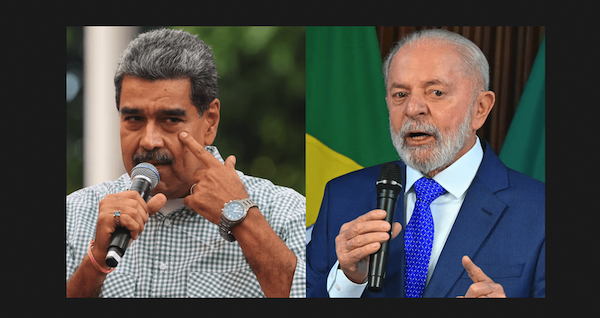
This Monday, October 21, it became known that Brazil opposed Venezuela’s entry into the BRICS group, in the context of the 16th Summit of the block in the city of Kazan, Russia, an event to which President Nicolás Maduro was invited by the Russian President himself, Vladímir Putin, at the beginning of August.
The information was given by the advisor for international affairs of the Brazilian government, former Foreign Minister Celso Amorim. The instruction to veto the possible adhesion of Caracas came from the Brazilian president, Luiz Inácio “Lula” da Silva.
In Latin America, in addition to Bolivia, Cuba and Nicaragua, Venezuela had submitted a formal application to join the alliance of emerging economies. Among all the aspirants, Venezuela is the country that has gathered the greatest consensus for its entry after strengthening its cooperation relations with the most important members of the bloc, mainly Russia and China.
Amorim argued that it is not a matter of “moral or political judgment”. “The BRICS have countries that practice certain types of regimes, and other types of regimes, the question is whether they have the capacity, due to their political weight and relationship capacity, to contribute to a more peaceful world,” he said.
The advisor’s statement has been marked by ambiguity. On the one hand, he points out that the Kazan Summit should not have a rigid rule for integrating future partners since, in his opinion, it should be open to states that promote development and changes in global governance. But, at the same time, he publicly announced that he does not support Venezuela’s accession.
However, this stance is in line with the increasingly hostile attitude that Lula’s government has maintained against Venezuela in recent months, after it did not recognize the results of the 28J elections, in which President Nicolás Maduro was reelected.
Although at first Brazil tried to move within a framework of relative neutrality, seeking to set itself up as a mediator in the post-electoral conflict, it has progressively became aligned with the position of Washington and Brussels, which openly recognize Edmundo Gonzalez as the supposed winner of the day.
Causes and motives
The first thing to highlight is that last year Lula himself was open to the expansion of the BRICS and the inclusion of Venezuela. Amorim’s statement, in such sense, represents an aggressive change of position that deteriorates the Caracas-Brazilian bond.
“I am in favor of Venezuela’s integration into the BRICS. We are going to meet soon and we have to evaluate several integration requests”, said Lula in May and added that ‘the new geopolitics is characterized by two elements: unity of our America in diversity and the role of the BRICS, which is emerging as the great magnet for countries that want cooperation’.
It should be recalled that, also last year, Brazil pushed for Argentina’s entry into the instance but, once Javier Milei took office, it terminated the application for membership in the bloc.
From a strategic point of view, Brazil is interested in maintaining its place as the only Latin American member of the BRICS, a position with which it avoids geopolitical counterweights and, at the same time, protects its monopoly over the conduct of regional affairs vis-à-vis the rest of the powers of the bloc.
In fact, the proposal to include Argentina was based on the premise that Brasilia would manage the timing and scope of Buenos Aires’ accession and position it as the little brother of the Brazilian giant within the alliance.
But different logics and tensions operate with Venezuela.
Within the geopolitical conception of Planalto and Itamaraty, Venezuela’s participation in the BRICS would shift too much the geopolitical axis of the region and the bloc towards multipolarity, due to the strengthening of ties with Russia and China. This would weaken Lula and Amorim’s approach to preserve Brazil’s strategic ties with Washington and Brussels, while safeguarding economic ties with the BRICS.
In this sense, Venezuela could become an uncomfortable ally within the group, which could not be controlled like Argentina and which would promote a strengthening of multipolarity against the grain of Brazilian foreign policy, marked by emphasizing ties with the West.
The existential conflict between Caracas and Washington, which could deepen after the US presidential elections in November, would imply that Brazil would have to support its Venezuelan partner in the BRICS in opposition to Washington.
Being both within the group, Brazil would be obliged to sustain an active political and economic relationship with Venezuela, and thus challenge the illegal sanctions and the narrative of disregard for the presidency of Nicolás Maduro driven from the White House and the the State Department.
Lula and Amorim have read these eventual dilemmas and have therefore decided to oppose the incorporation of Venezuela with a view to reducing any political costs involved in twisting or complicating the relationship with the US.
With such opposition, the Brazilian president and his main advisor on international matters expose that their vision is more Eurocentric than multipolar, and that the BRICS are an instrument for economic purposes rather than a geopolitical bet determined to build a new global order, a horizon towards which Venezuela is heading, and which it actively promotes.
This clash of visions and the non-negotiable points of Brazilian foreign policy with the United States explain the latest Brazilian grievance against Venezuela.
Originally published in Spanish by Mision Verdad: https://misionverdad.com/globalistan/por-que-brasil-se-opone-al-ingreso-de-venezuela-en-los-BRICS
Portuguese version available at Saker Latinoamérica: https://sakerlatam.blog/por-que-o-brasil-se-opoe-a-adesao-da-venezuela-ao-BRICS/

 The New Dark Age
Leave a comment