Tuesday, 25 February 2025 – Al Mayadeen English
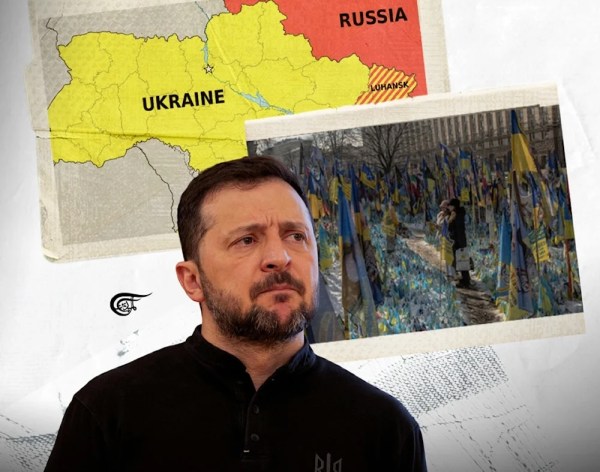

Dmitri Kovalevich examines how the West sabotaged the Minsk 2 agreement, pushing Ukraine toward war, dictatorship, and political repression.
The end of February marks three years since the start of Russia’s special military operation in Ukraine and 11 years since the ‘Euromaidan’ coup of February 2014. The coup was the main cause of the current military conflict.
The war in the now-former eastern territories of Ukraine could have been avoided had two successive presidencies in Kiev (Petro Poroshenko, 2014-2019 and Volodomyr Zelensky since 2019) complied with the Minsk 2 peace agreement of February 2015. Minsk 2 (text here), was agreed by Kiev and the pro-autonomy forces in the Donbass region on February 12, 2015. France, Germany, and Russia co-signed the agreement as guarantors. The agreement was unanimously endorsed by no less than the UN Security Council on February 17, 2015.
Minsk 2 envisioned the return of Lugansk and Donetsk (the two rebellious ‘peoples republics’ of the industrialized Donbass region) to the fold of the Ukrainian constitution, this time as semi-autonomous oblasts (provinces). Kiev also agreed to a neutral status for Ukraine. It could apply for membership in the European Union if it chose, but membership in the NATO military alliance was for Russia a non-starter.
EU membership increasingly became a goal of Western-oriented business interests in Ukraine during the decade of the 2000s. That decade followed 10 years of sharp economic decline following the dissolution in 1989-90 of Soviet Ukraine and of the Soviet Union (USSR, of which Soviet Ukraine was a key constituent).
Tragically for the people of post-Soviet Ukraine, the Western countries, particularly the leading powers of NATO, quietly and deceptively opposed Minsk 2. They worked quietly from the get-go to sabotage the agreement.
Deception of Ukrainians by the West
On February 12, 2025, the deputy secretary of the Russian Security Council, Aleksey Shevtsov, spoke on the ninth anniversary of the signing of Minsk 2, explaining once again to those who would listen that Russia’s special military operation in Ukraine would never have happened had the West honored the agreement. He stressed that the people of Ukraine today have every right to demand an accounting for the deceptions that took place in 2015 and after.
On the same day, the Ukrainian online publication Strana published a lengthy commentary in its Telegram messaging service headlined, ‘Why did the Minsk agreement fail?’ Strana wrote, “Russia says that Kiev deliberately refused to fulfill the conditions of the Minsk 2 agreement and instead proceeded to rearm its army and restart armed attacks against the people of Donbass. The Russian government says it can no longer trust the government in Kiev and so there is no possibility of a ‘Minsk 3’.” (‘Minsk 1’ was a first attempt, in September 2014, by the pro-autonomy forces of Donbass to reach a peace agreement with the new administration in Kiev.)
Strana wrote further, “Russia did not launch a full-scale invasion of Ukraine in 2014 or 2015. Perhaps it wanted to, who knows, but it could not do so because it would have been hit with harsh economic sanctions similar to those levied against it by the Western powers beginning in February 2022. It would have faced economic sanctions worse than those initially levied against it following the Crimea referendum of March 2014. The Russian economy was in no shape to easily withstand such sanctions, in contrast to the situation in 2022.
“Additionally, although the Ukrainian army back then was much weaker compared to 2022, this was also the case for the Russian army.”
In their recollections of the events of those years, leaders of today’s Donetsk Peoples Republic (today a constituent of the Russian Federation) say that the main opponent of a major military response to Kiev’s continued military provocations and sabotage of Minsk 2 was the Russian military. Russian military leaders said at the time that the Russian Federation did not have enough combat-ready troops to take on such a large and industrial country as Ukraine.
“From a purely military point of view, the rapid success of Russia in Crimea in the spring of 2014 was due to the fact that Russian troops were already present on the Crimean peninsula [by virtue of a 1997 agreement between Russia and Ukraine; see Wikipedia on the subject]. They needed no time to deploy, and they prevented armed attacks being threatened by the paramilitaries of the new administration in Kiev. At the time, there were no large military formations of the Russian Federation along the lengthy Russian-Ukrainian border. Donbass’s self-defense forces only began to form in the late spring of 2014 and it was several years before they were integrated as auxiliaries of the Russian armed forces.”
As Russian sources stated at the time, the initial military defense that arose in the Donetsk and Lugansk oblasts of Ukraine against the paramilitaries of the 2014 coup bore the markings of a military adventure and were not at all coordinated with the political leadership of the Russian Federation. The self-defense forces hoped to convince or pressure Russia to join a war of defense for which Russia was not ready, not politically, economically nor militarily.
What the Western-incited war in Ukraine has wrought
In the lead-up to and since the 2014 coup, western and central Ukraine has been living the fate of a battering ram to be used by the Western imperialist powers to weaken Russia, regardless of the tragic human consequences and of the prospect of Ukraine being cast off once it is no longer needed for such a role. The results of this cruel and heinous policy are increasingly evident as graveyards continue to spread on Ukraine’s territory with each passing day.
The Politnavigator media outlet explained (as reported on Telegram on February 1) the consequences of such policy for the mortals conscripted into war, many against their will. The report cites Anton Cherny, an officer of the Armed Forces of Ukraine. He explains, “We are being lied to about the value of our soldiers’ lives. I watched the speech of our commander-in-chief that every soldier is valuable to Ukraine and worth his weight in gold. That’s what they tell the people, but it’s not true.”
Cherny says that 90% of the soldiers who die or succumb to injuries on the battlefields are simply buried there and then officially listed as missing. “Everyone there knows perfectly well what is happening.” And the indignities do not end there. The families of those reported as ‘missing’ do not receive the financial compensation to which they are entitled.
Cherny also explains that it is extremely difficult for surviving fighters to exit the grim fighting along the front lines. “It’s hard to get out of there by yourself, it’s unrealistic. How lucky it would be if there were fog, very big snow or some other bad weather.” He explains that Ukrainian lines are under constant surveillance from drones flying overhead. As soon as evacuation vehicles approach from the Ukraine side, the drones threaten to strike them, making it very difficult to evacuate the injured or the dead from the various battlefields.
Politnavigator continues its report, ” ‘The army doesn’t provide guidelines or instructions for soldiers to somehow make their tasks easier. Its words to this effect are just talk. Soldiers are told to go here or there and ‘do’ something, but as to what, where and why, you have to be some kind of superman to figure it out. It’s unreal,’ Cherny says indignantly.”

 The New Dark Age
Leave a comment