Thursday, 27 February 2027 — Al Mayadeen English
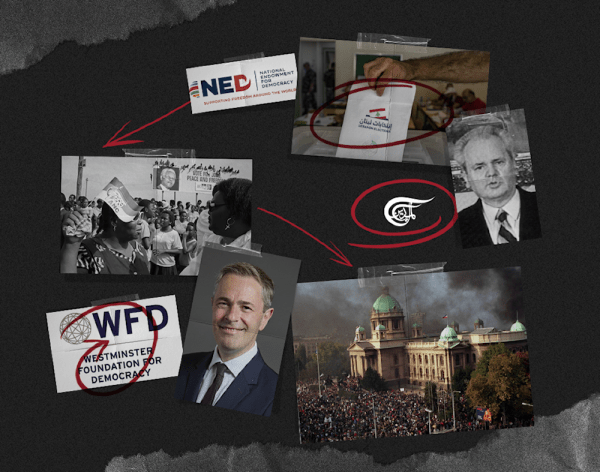

The Westminster Foundation for Democracy (WFD), a British intelligence cutout, covertly funds and orchestrates political destabilization and regime change efforts worldwide under the guise of democracy promotion.
In the wake of the Trump administration’s “pause” on foreign “aid” spending, countless US-bankrolled destabilization and regime change efforts have been thrown into total disarray. Despite desperate calls from beneficiaries for the European Union to fill the gap, its member states have responded by “drastically” slashing their own “overseas development” expenditure. Yet, there is no indication so far Britain intends to curtail the operations of the Westminster Foundation for Democracy, London’s little-known international meddling machine.
Established in 1992, WFD was directly modelled on Washington’s National Endowment for Democracy, created the previous decade by the CIA to carry out publicly what the Agency previously did covertly. Namely, funding media outlets, political parties, activist groups, “NGOs”, trade unions and other elements that can be corralled to destabilize if not outright overthrow foreign governments if and when they dare step out of line. Primarily funded by the Foreign Office, WFD ponderously describes itself as “an executive non-departmental public body.”
This is a euphemism for the Foundation being a British intelligence cutout, formally operating as an independent organisation free from state control or affiliation, but in reality carrying out politically sensitive, risky activities abroad with which London is wary of being openly and directly associated. This raison d’etre is amply spelled out in a markedly revealing, since-memory holed official review of WFD’s activities published in 2005, to date the only instance of its work being subject to serious scrutiny.
The review explicitly notes, “WFD’s work requires an arm’s length relationship from government,” and the Foreign Office “benefits from the cover.” The Foundation’s “central rationale” is to provide “assistance” London “could not or would not wish to undertake directly.” The indirect granting of support to “controversial” projects, concerned with ousting “enemy” leaders or propping up successfully-installed puppet governments “in countries of key interest” to Britain, limits “damage to official government-to-government relationships,” while “avoiding the danger” of “British government presence [being] interpreted as foreign interference”:
“[WFD’s] arm’s length relationship…provides the [Foreign Office] with the best safeguard…the less the [Foreign Office] seeks to exercise control the more it can deny responsibility…The Foundation provides a necessary and valuable instrument.”
WFD founder Michael Pinto-Duschinsky, a longtime NED adviser charged by the Foreign Office in the late 1980s with creating a British Endowment equivalent, is quoted in the report at some length. He states that the NED’s contemporary success in killing off Communism in Central and Eastern Europe demonstrated “interference in the internal politics of foreign countries” was “more effective” if conducted openly. Hitherto covert “interference” by the CIA and MI6 “had caused problems when secret financial assistance…leaked into the public domain.”
Pinto-Duschinsky went on to boast that WFD’s “distinctive feature” and “comparative advantage” was its “freedom to give political – rather than technical or educational – grants,” including providing funds “to political forces…in direct opposition to existing governments.” The Foundation’s largesse could also be directed to “training of police forces in developing nations.” Which of course are not up for election at regular intervals, and of obvious use in maintaining unpopular, illegitimate British-backed regimes in power.
‘Partisan Approach’
The report goes on to cite multiple examples of British overseas meddling conducted via WFD since its inception, bragging that “along the way we have made many good friends for Britain among key leaders in politics and civil society” the world over. In its early years, the Foundation infiltrated developing “democratic institutions”, political parties and civil society in the former Soviet sphere. Concurrently, WFD was heavily active in South Africa, “in the runup to its crucial 1994 elections.”

 The New Dark Age
Leave a comment