Thursday, 26 February 2026 — Quds News Network

The Israeli army has adopted a new pattern of violations in southern Syria. It has sprayed chemical herbicides over agricultural and grazing lands along the border. Local monitors say the move forms part of a broader security policy. That policy aims to reshape the buffer zone and impose new facts on the ground by expanding control near the separation line.
This escalation comes alongside ongoing Israeli military violations in southwestern Syria. These include ground incursions, the establishment of checkpoints, shelling, home raids, and the abduction of civilians.
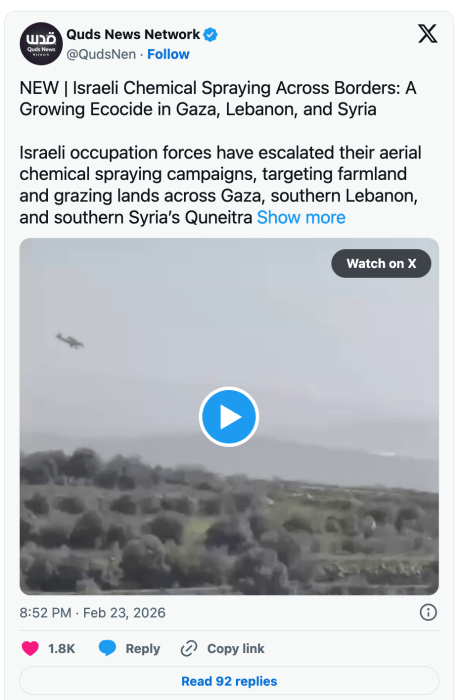
According to monitoring by the Syrian center “Sijil,” the first spraying attack took place on January 25, 2026. Israeli aircraft targeted the villages of Kudna, Al-Asbah, and Al-Asha in the southern countryside of Quneitra. Planes flew for nearly four consecutive hours. They dispersed a substance whose nature remained unknown at the time.
Two days later, on January 27, aircraft moved to the village of Sayda al-Hanout. They targeted Al-Razaniyah farm west of the town. On January 30, assaults expanded further north. Aircraft sprayed areas around Jbatha al-Khashab, Ofaniya, Al-Hurriya, and Al-Hamidiyah, in addition to Adnaniyah, Ruwayhinah, and the town of Bir Ajam in central Quneitra countryside.
The spraying stretched along more than 65 kilometers of the disengagement line.
Catastrophic Results
Within one week, vast green areas dried out. In southern Quneitra alone, grazing lands covering around 3,500 dunams suffered damage. Among them were 1,500 dunams of forest land where Israeli forces had cut trees earlier in 2025. About 450 dunams of winter crops, including wheat, barley, and beans, were also hit. Nearly 50 dunams of olive trees sustained damage as well. These figures come from the Quneitra Agriculture Directorate in statements to Sijil.
Hundreds of farmers and shepherds felt the impact immediately. Residents in this region rely heavily on agriculture and livestock as their main source of income. Even khubeiza, a wild mallow plant that families traditionally eat during winter, dried and turned yellow after exposure to the sprayed substance. Families lost a seasonal food source they depend on every year.
Khaled Shams al-Rahil, one of the affected farmers, told Sijil that grazing lands vanished entirely. Shepherds now rely on expensive fodder. Some may sell part of their herds to feed the rest. He said his son was grazing sheep during the spraying. The boy suffered severe eye redness for hours. The next day, the sheep appeared exhausted and refused to graze.
At Al-Razaniyah farm, farmer Fadi al-Mughtari reported that several sheep died three days after the spraying. He said Israeli aircraft sprayed lands along the entire border strip, including grazing fields, winter crops, and olive groves. He described this season as a total loss after a previous year of drought.
Syrian Ministry: Samples Not Toxic, But Damage Clear
The director of agriculture in Quneitra said a technical team began collecting water, soil, and plant samples the day after the first spraying. The team coordinated with scientific bodies and urged residents to avoid affected areas until lab results became available.
On February 11, the Syrian Ministry of Agriculture issued a statement through its media department. It said acute toxicity tests found no toxic substances in the samples. Water samples did not show harmful organic materials based on the methods used. However, qualitative analysis detected traces of broadleaf and narrowleaf herbicides in some plant samples.
The ministry stressed that it will continue monitoring water, soil, and crops. It pledged cooperation with scientific institutions and promised to keep citizens informed.
Despite the statement, the Agriculture Directorate clarified to Sijil that the materials had a clear and significant impact on vegetation and crops. Fields and grazing lands deteriorated quickly, even if tests did not classify the substance as acutely toxic. The Euro-Mediterranean Human Rights Monitor also said the chemical composition of the sprayed material in Quneitra remains unknown.
Similar Attacks on Lebanon
Similar assaults were documented along the Lebanese border during the same period. The The Guardian reported that Israeli aircraft sprayed herbicides over wide agricultural areas in southern Lebanon. Lebanese President Joseph Aoun described the operations as an environmental and health crime and a violation of sovereignty.
Lebanese laboratory tests later identified the substance as glyphosate. Authorities announced the findings in early February 2026. Glyphosate is a widely used herbicide that the World Health Organization has classified as “probably carcinogenic to humans.” A joint statement by Lebanon’s agriculture and environment ministries said concentrations exceeded normal levels by 20 to 30 times. Officials warned of soil infertility, ecological imbalance, threats to food security, and damage to farmers’ livelihoods.
So far, no official statement confirms that the substance used in Syria matches the glyphosate found in Lebanon.
Gaza Precedent: A Long-Running Policy
What happened in Quneitra reflects a longer pattern. Israel has sprayed herbicides along the Gaza border since late 2014. Investigations by Forensic Architecture documented the first aerial spraying between October 11 and 13, 2014. Gaza farmers reported crop damage from unknown chemicals that later turned out to be herbicides.
At the time, the Israeli Ministry of Defense acknowledged using a mixture of three herbicides: glyphosate, Oxygal, and Diurex. Reports show that spraying became a recurring practice, usually twice a year in December, January, and April. According to documentation by the Euro-Med Monitor in 2020, chemicals drifted hundreds of meters into Gaza farmland.
Israeli authorities admitted carrying out at least 30 aerial spraying operations along the Gaza border between November 2014 and December 2018. These operations destroyed thousands of dunams of agricultural land. Additional rounds in December 2018 and January and April 2020 caused further losses.
War Crime or Ecocide?
The repeated use of chemical spraying in Syria, Lebanon, and Gaza raises serious legal concerns. International humanitarian law prohibits the extensive destruction of civilian property without imperative military necessity. It also bans methods of warfare that deprive civilians of objects indispensable to their survival, including farmland and water sources.
In a report published on February 4, 2026, the Euro-Mediterranean Human Rights Monitor argued that such practices could amount to war crimes. The United Nations has also expressed concern over these reports.
In Lebanon, official and independent human rights bodies, including the National Human Rights Commission, described the large-scale spraying of glyphosate as a grave violation of international humanitarian law. Some statements said the practice could rise to the level of ecocide.
In Gaza, organizations such as Adalah and Al Mezan Center for Human Rights documented aerial spraying along the fence. They argued that Israel uses herbicides to enforce a buffer zone at the expense of farmers’ livelihoods. Academic studies have examined the environmental and legal implications of such policies.
The spraying in Quneitra does not stand alone. Since Israeli incursions into the Syrian buffer zone, forces have bulldozed land, cut trees, restricted farmers’ access, and opened fire on shepherds. Reports also document abductions and the confiscation of livestock.
Together, these measures weaken agriculture and livestock activity near the border. They reduce the human and economic presence in the area. Over time, they risk creating a semi-empty belt that aligns with Israeli expansion goals.

 The New Dark Age
Leave a comment