Friday, 27 March 2026 — The Electronic Intifada
ActiveStills
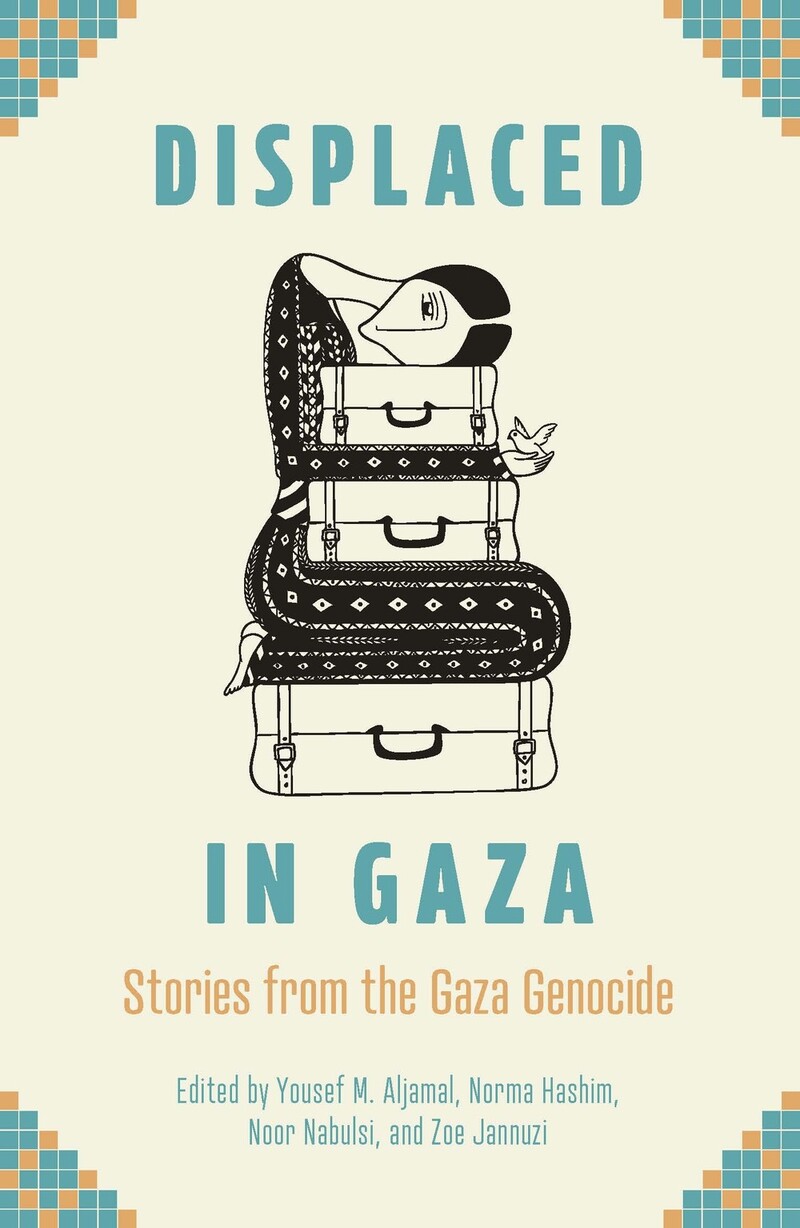
Displaced in Gaza: Stories from the Gaza Genocide, edited by Yousef M. Aljamal, Norma Hashim, Zoe Jannuzi and Noor Nabulsi, Haymarket Books (2025)
One can only hope that the accounts collected in Displaced in Gaza: Stories from the Gaza Genocide will be introduced one day as evidence in international courts to convict the Israeli government and military personnel responsible for the crimes depicted in this book.
The anthology, consisting of 27 personal testimonials collected in May 2024 from Palestinians enduring the genocide in Gaza, was commissioned by the Hashim Sani Center for Palestine Studies at the Universiti Malaya in partnership with the American Friends Service Committee.
Just as important as their testimony to Israel’s crimes, the accounts are valuable acts of resistance and an expression of Palestinian resilience, as Ahmad Alnaouq, co-founder of We Are Not Numbers, notes in the foreword. They should serve as a call to action by their readers, Yousef M. Aljamal, the author and editor of numerous anthologies on Palestine, urges in his introduction.
Death is omnipresent in this book. Hardly any accounts omit it. Given the collective punishment meted out by the Israeli military, this means grandparents, fathers, mothers, wives, husbands, brothers, sisters, teenagers, children, infants, in-laws – entire families, save for one or two members – make up the death toll.
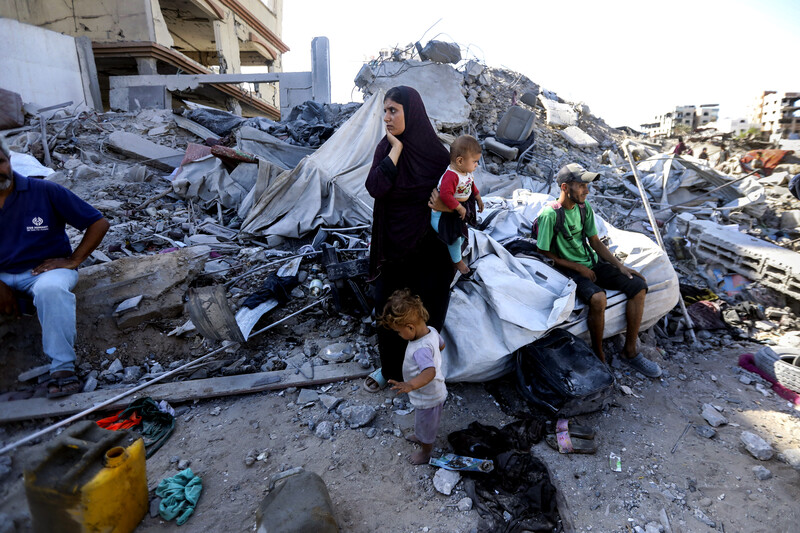
But it’s not just the fact of death, it’s the way of death. An Israeli bomb destroys an entire building, residence or school serving as a shelter, at night or during the day. Some corpses are buried under the rubble, others are rendered unrecognizable due to the severity of the explosion or the fire that accompanied it. Stray dogs eat a dead body. Another lies atop a roof, unreachable for days due to ongoing Israeli military action in the area.
When a loved one can be recovered, the question becomes where to bury them. Often the body must be buried atop an ancestor in a family plot for lack of any other space. Or a family member never returns, and the assumption of death is made, based on rumors or hearsay, but without a body to inter and the place of burial (if there was one) unknown.
Death and displacement
For the still living, death remains a constant. ”Death stalks us around the clock,” says Fidaa Alshakhreet in her testimony, noting that the Israeli shelling pursues them wherever they go, and they must move without knowing if they even flee to safety.
It’s almost redundant to talk about the displaced in Gaza, given that a majority of people there are descended from the refugees of the 1948 Nakba.
But during this war, displacement is a constant. Nearly every account is about multiple displacements during the time between the start of the war in October 2023 and when the testimonies were collected in May 2024. Physical and mental exhaustion accompany each move. There’s the trauma of leaving your home, too, or of being told to move by the Israeli military, then allowed to return, only to discover your home was destroyed in the interim.
Displacement often means living in tents. Many testimonials describe tent living: the lack of electricity, darkness at night, the insect infestations, the often wet ground, the unsanitary conditions, the heat, the cold, entire families living atop each other, the absence of toilets (with thousands sharing a single public bathroom).
Most people are without a job; youth unemployment was already astronomical in Gaza before the war. Schools have been systematically destroyed by Israel. There is no school for young people to attend. And the lack of food is another constant, along with accounts of people killed while looking for food.
Then there are people with disabilities, illness and special needs, and the particular hardships they have experienced due to Israel’s destruction of hospitals and medical centers. An elderly woman with kidney disease finds her dialysis center suddenly surging in the number of patients, then being diagnosed with cancer and having no hope of treatment. Deaf people and people with Down Syndrome and cerebral atrophy likewise suffer from the sudden lack of support systems.
Remarkable
What is remarkable in all this is not just the resilience and steadfastness displayed but also the initiatives that people take to reclaim their agency.
A pharmacist, for example, who lost the two pharmacies he owned to Israeli bombing, turns a tent into a makeshift pharmacy, albeit one with a bare minimum of drugs and none of the medicines that require refrigeration. An English-language teacher turns her displacement tent into a school, despite the lack of pens, notebooks and a whiteboard. A former university student who was nearing graduation turns his tent into a barber shop during the day because he was no longer able to pursue his dream of studying the English language.
Still, it is nearly unbearable to read about the despair that so many of the testimonies reveal due to the feeling of being abandoned by the world, especially the United Nations, knowing that this is the worst atrocity ever inflicted on the Palestinian people.
It is, without a doubt, a “war of extermination and destruction of humans and nature,” as 91-year-old Mohammed Abdul Jabbar Abu Seif, himself a Nakba survivor, puts it. He adds: “It is a war whose objective is ethnic cleansing, ending the Palestinian cause and expelling the Palestinian people from their land.”
All of the testimonials in this book were collected seven to eight months into the war. One wishes the editors had included a note about how they were collected; that is, as interviews or as written statements, in English or with translation from Arabic. Some explanation of terminology would also be helpful; for example, the uniform reference to “the occupation” would be understood to mean “Israel” by some readers, but not others.
The carnage described in this book continued for more than a year after the testimonials and is still ongoing, despite the so-called ceasefire.
For this reviewer, it is haunting to read these stories of contemporary events and life in Gaza by 27 courageous, suffering, traumatized, steadfast and heroic authors, not knowing if all those among them are still alive.
Rod Such is the author of Digging Deeper into the Meaning of Palestine (Changemaker Publications, 2025).

 The New Dark Age
Leave a comment