Wednesday, 15 April 2026 — Strategic Culture Foundation


Contact us: info@strategic-culture.su
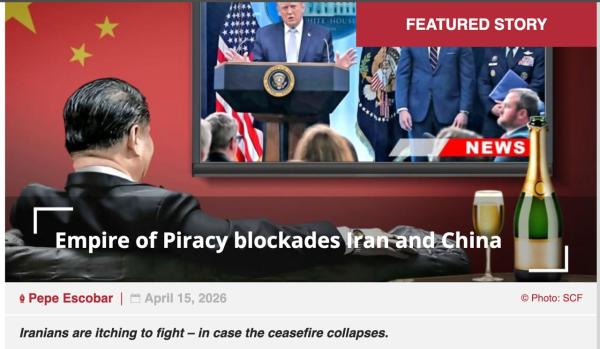
All hail the almighty return of Pirates of the Caribbean, now upgraded to Pirates of the Persian Gulf.
The spectacular collapse of the Islamabad diktats – Barbaria came to dictate, never to negotiate – has been followed by a coercion psy ops on steroids: Jesus! (literally, as he posted it on Truth Social) threatening every single ship now paying the Strait of Hormuz toll booth.
As every grain of sand from the Gobi to the Sahara already knows, this is all about China.
So the question needs to be posed again. CENTCOM has now merged into INDOPACOM, a new pyrate hydra. Will INDOPACOM have the balls to harass a Chinese supertanker which sailed through the Strait of Hormuz after paying the toolbooth in yuan?
In his trademark delusional supremacy mode, US Treasury Secretary Bessent said that China will no longer be able to get oil from Iran.
This Baboon of Barbaria gimmick in fact translates as economic warfare against not only China but an array of mostly Asian nations, disturbing global energy flows, trade, and major shipping transporting all manner of goods from the West down to the East and from East to West. An oil blockade targeting not only China but also a great deal of the multipolar world.
Before the start of the American blockade, ships from only five nations could transit through the Strait of Hormuz: China, Russia, India, Iraq and Pakistan. Once again: will INDOPACOM dare to seize or sink ships from four nuclear powers?
South Korea went a step ahead and sent a special envoy for direct negotiations with Tehran to guarantee safe passage through Hormuz and buy more cheaper oil and gas. As it stands, at least 26 South Korean tankers remain stranded.
Now compare Bessent with Russian Foreign Minister Sergey Lavrov, in Beijing, after talking to Chinese Foreign Minister Wang Yi and being received in person by President Xi:
“Russia can, without a doubt, compensate for the shortfall in resources that has arisen.”
Roughly 13% of China’s oil imports come from Iran – approximately 1.38 million barrels a day. In parallel, Power of Siberia-1 – operating at full capacity – delivers 38 billion cubic meters of gas a year of gas, and the ESPO oil pipeline is hitting record highs.
Power of Siberia-2 may only become operational next year. Russia already supplies as much as 20% of China’s oil. “Compensate”, in Lavrov’s terms, means pushing spare capacity to the limit. But that’s doable.
Iran for its part can count on an alternative pipeline and the Jask oil terminal, with capacity for 1 million barrels a day, which completely bypasses the Strait of Hormuz.
So far, 8 Chinese tankers transited via Hormuz since the blockade was announced. Moreover, China has as many as 1.3 billion barrels in inventories, enough to cushion some losses from Iran for months. And China will continue – in theory – to receive oil from tankers departing from other non-Iranian Persian Gulf ports (they will still need to pay the toll booth).
The big question is how long Iran – and China, for that matter – will tolerate the shadow fleet being interdicted by INDOPACOM without a ballistic response.
Waiting for the Al Aqsa Triangle Blockade
A blockade of all Iran’s ports – and not of the Strait of Hormuz per se – may soon meet its match: the incoming Al Aqsa Triangle Blockade (Bab-al-Mandeb, Yanbu port in Saudi Arabia, Suez, in connection with Hormuz), as qualified by Yemen’s Ansarallah. The Houthis are just waiting for the uber-strategic moment to join the chat. That will inevitably lead to oil reaching over $200 a barrel – and counting.
Translation: an irretrievable, system-wide supply shock.
The cowardly Baboon of Barbaria administration certainly did not think this through – as it’s obsessed with starving China of oil and US dollars while destroying, in theory, key nodes of the New Silk Roads/BRI.
What everyone else is paying attention to is how the INDOPACOM-enforced blockade will devastate scores of nations outside of China.
Which brings us to a pedestrian but quite feasible calculation – in tune with mutts such as Bessent: let’s starve everyone of oil and US dollars so they will be desperate to sell their US Treasury bonds back to the US way below face value, as long as they can get oil and/or US dollars in return.
This is Grifter Central: the Americans take their debt out of circulation – at a huge discount – and simply erase those humongous interest payments on the debt which they are unable to pay.
There’s no guarantee the Baboon of Barbaria administration will get what it wants. Tehran does not depend on maritime routes. After decades of sanctions, they developed an array of alternative land corridors, barter trade channels, and swapping mechanisms, for instance via Turkmenistan.
China, once again, is not a prisoner anymore of the Malacca Dilemma – between Malaysia and Sumatra in Indonesia – because they have meticulously diversified their sources, starting with the Sino-Russian pipelines.
Moroever, the China-Myanmar pipeline totally bypasses Malacca.
The long China-Central Asia gas pipeline spanning Turkmenistan, Uzbekistan, and Kazakhstan – paid by China and bypassing American thalassocracy – has been in effect since the early 2010s.
Then there’s Gwadar deep-sea port in the Arabian Sea, the key node of the China-Pakistan Economic Corridor (CPEC) and a stalwart of BRI. Gwadar is only 80 km east of the port of Chabahar in Sistan-Balochistan in Iran: hence far away from the Persian Gulf. That translates into an overland route from the Arabian Sea to Xinjiang.
China will not starve if deprived of Iranian oil. China leads in nearly every single energy and power production sector. They have the industrial capacity – talk about productive capitalism – the raw materials, the supply chains, and enough skilled labor to produce the technology and infrastructure necessary for every relevant energy system: solar panels, turbines, batteries, transmission lines, everything in solar, wind, hydro and next-gen nuclear power. That’s exactly what I saw traveling across Xinjiang back to back last year while shooting a documentary.
Obviously myopic Baboon of Barbaria minions cannot possibly understand how China’s strategy of total domination in EVs, solar batteries and exporting electricity is protecting the Middle Kingdom from artificial oil/gas shocks such as the blockade.
As it stands, The Invincible Armada remains in the outer fringes of the Gulf of Oman, out of range of many – but not all – Iranian missiles and drones, but certainly targeteable by long-range ballistics and hypersonics. The Americans will continue to use their ISR to track ships; then small boats and helicopters will engage in the “interdiction” procedure.
So far, nothing happened. Well, actually a big thing happened: a sanctioned, non-Iranian supertanker capable of carrying 2 million barrels of oil, sailed to Iran via the Strait of Hormuz with the AIS switched on for every tracker to see. INDOPACOM didn’t dare to touch it.
The Iranians, meanwhile, are just waiting. Asymmetrically. But make no mistake: they are itching to fight – in case the ceasefire collapses.
In this case, we’ll be plunged right into the Mother of All Cliffhangers. Iran just needs to sink one American destroyer; and/or “disable” one of those multibillion-dollar sitting ducks with a missile/drone volley, guided by Chinese intel.
The whole planet will then see it for what it is: the definitive, graphic strategic defeat of the Empire of Chaos, Lies, Plunder, Piracy and “If I Don’t Like You I’ll Kill You”.
Bring it on.


Leave a Reply