Wednesday, 6 May 2026 — New Eastern Outlook
Threats emanating from a powerful upcoming Large Language Model (LLM) to the world’s digital infrastructure demonstrate how the US is pushing the world towards the brink of a new informational disaster.
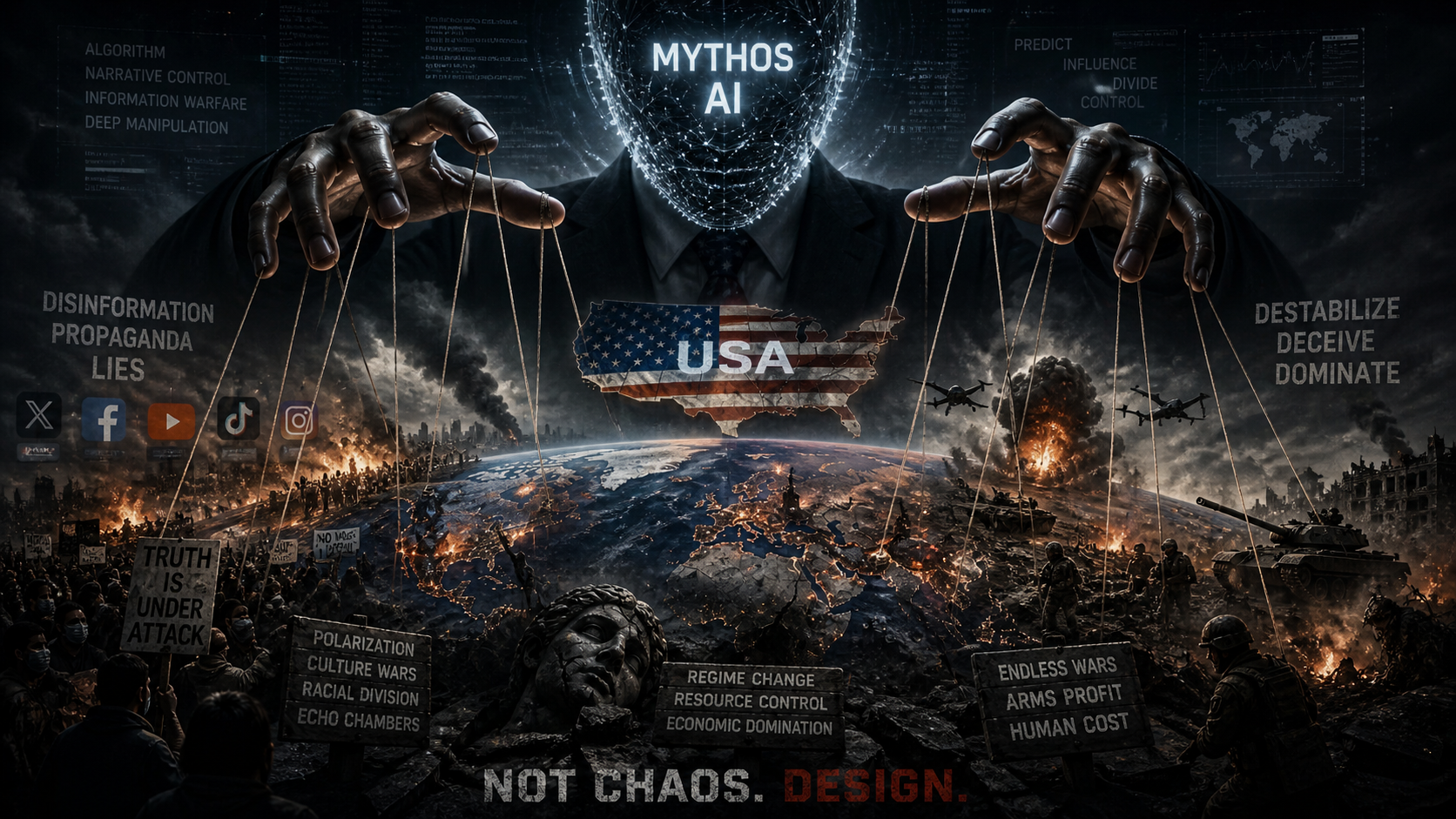
Threat posed by Mythos
“Powerful” would rather be a euphemism for this LLM. In field trials, Mythos has found vulnerabilities in almost every major web browser and operating system around the world that have gone unnoticed over the past several decades. In fact, the United Kingdom’s AI Security Institute (ASI) thoroughly examined Mythos and made a startling discovery—in comparison to other frontier models, this model managed to successfully resolve 73% of the most complex cybersecurity challenges.
India, therefore, can export this model to the rest of the world, showing the path to the Global South that tech monopolies by the West can be challenged
This assumes significance in light of the fact that unlike earlier LLMs, which acted in a series of incoherent steps and possessed multiple chains of command, Mythos demonstrated increasingly high levels of agentic behavior—where it is acting in a coherent manner involving multiple systemic steps in attacking the cybersecurity problems.
While it comes as possibly good news for cyber defensive capabilities, it can become a potential nightmare if this LLM falls into the hands of adversarial actors. In such situations, Mythos can wreak havoc across the very spectrum of a country’s digital architecture. Every single aspect of that country’s critical infrastructure would be susceptible to hacking—power plants, hospitals, payment systems, telecommunication assets, and possibly nuclear assets!
This, however, must not be viewed in isolation by the Global South.
Digital Apartheid
In unveiling such a powerful LLM, Anthropic isn’t doing the world a service. Rather, it can be seen as a part of a broader American attempt in general and a Western attempt in particular to pursue the goal of digital apartheid. This apartheid is designed not only to undermine the technological sovereignty of the Global South but also to monopolize such powerful informational tools to bring to reality a world of digital haves and have-nots.
This is particularly evident from the announcement of Project Glasswing—a project in which only a select coterie of top American tech companies such as Microsoft, OpenAI, and others are being allowed access to Mythos. This project has seen Anthropic not including key technologically advanced countries like India (both public and private sectors) but keeping other countries of the Global South at bay.
While critics may point out that given the fact that it is a private company and is at liberty to choose its partners, it must not be forgotten that a powerful LLM like Mythos must naturally involve the American state authority, thereby directly inviting high-level political stakes in the project.
Making Alternatives
Given the influence American Big Tech companies are exercising across the world, it is time the Global South comes together to forge an alternative path. India offers a credible choice. At the recently concluded IndiaAI Impact Summit, Vivek Raghavan, a key stakeholder in the evolving AI ecosystem of India, gave a clarion call for developing a sovereign full-stack AI ecosystem in the country, both for offensive and defensive purposes. India, therefore, can export this model to the rest of the world, showing the path to the global South that tech monopolies by the West can be challenged.
India, therefore, can collaborate with like-minded partners from the Global South in not only developing its own AI stack but also assisting others in building their respective AI ecosystems. Several mechanisms can be explored—
First, announcing technological partnerships for building AI models in areas like disaster management, enhancement of agricultural productivity, operationalization of renewable energy projects, among others.
Second, a Digital Public Infrastructure (DPI) for an AI framework can be created. This can involve pooling resources of the Global South that are linguistically and culturally richer than the West in the creation of open-source foundation models. This would ensure that their respective AI ecosystems would be aligned with their values and not dictated by the West.
Third, creating an AI audit and safety mechanism: under this, the countries of the Global South can undertake a detailed audit of Western AI LLMs for algorithmic bias and data colonization. This would ensure that the Global South can act as gatekeepers of their respective informational architectures.
Hence, Mythos and its powerful abilities aren’t an isolated issue; they are a part of a broader global struggle for informational supremacy. The Global South cannot afford to lose out on this.
Pranay Kumar Shome, a research analyst who is a PhD candidate at Mahatma Gandhi Central University, Bihar, India
Follow new articles on our Telegram channel


Leave a Reply