Monday, 11 May 2026 — Weaponized Information
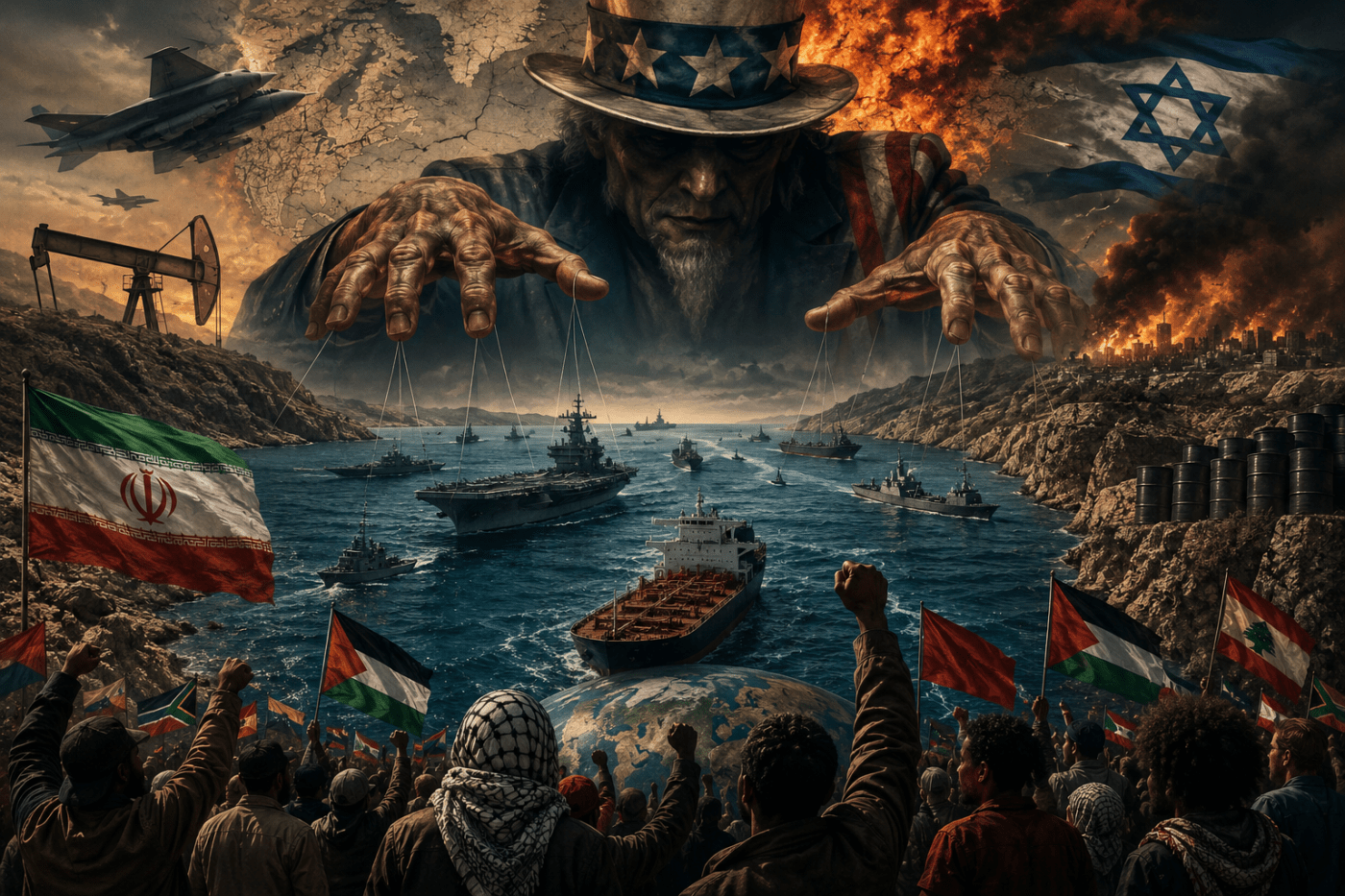
This investigation excavates how Associated Press reporting frames U.S.-Israeli coercion as diplomacy while presenting Iranian sovereignty as instability and defiance. It reconstructs the omitted legal, geopolitical, and economic terrain surrounding the war, exposing the contradiction between the UN Charter system and the operational reality of imperial power. It reframes the conflict as part of a broader struggle over sovereignty, technological development, sanctions warfare, and the declining legitimacy of U.S. global domination. Finally, it advances a program of anti-imperialist organization and international solidarity aimed at resisting war, blockade, sanctions, and the normalization of permanent coercion against nations of the Global South.
By Prince Kapone | Weaponized Information | May 11, 2026
The Wire Service at the Mouth of the Strait
On May 10, 2026, the Associated Press published “Trump rejects Iran’s response to latest US proposal to end the war”, written by Jon Gambrell and Samy Magdy. The article reports that Iran sent its response to a U.S. proposal through Pakistani mediators, only for Donald Trump to reject it almost immediately as “TOTALLY UNACCEPTABLE.” The basic story, as AP tells it, is that Iran refused a U.S. peace offer because Tehran would not make the nuclear concession Washington demanded, while the Strait of Hormuz remained restricted, shipping was threatened, drones appeared over Gulf waters, and energy markets trembled like a banker who has misplaced his oil ledger.
The article appears, on the surface, as sober wire-service reporting. This is the Associated Press brand: clean sentences, official voices, fast dispatches, no visible fingerprints. AP describes itself as an independent global news organization and cooperative, founded in 1846, supplying journalism to media outlets across the world. That self-description is formally true, but politically cap. AP is not a worker newspaper printed in a basement during curfew. It is a major U.S.-based news institution embedded in the global information system of imperial capitalism. Its language travels far. Its categories become common sense. Its silences become the boundaries of respectable debate.
Gambrell, AP’s Gulf and Iran news director, and Magdy, its Cairo-based Middle East reporter, are not street-corner propagandists waving little empire flags. That is not how modern propaganda usually works. They are professional journalists operating inside an institutional machine that privileges official sources, diplomatic phrases, military vocabulary, and the worldview of states with aircraft carriers. Their class position is that of imperial media labor: educated, credentialed, geographically mobile, and professionally trained to translate war, blockade, sanctions, and coercion into the calm grammar of “security concerns,” “peace proposals,” and “regional tensions.”
The first maneuver of the article is narrative framing. The central drama is not presented as the United States and Israel attacking Iran, blockading its ports, threatening its nuclear infrastructure, and dictating the terms of its sovereignty. The drama is presented as Iran failing to accept a proposal. In this framing, Washington becomes the patient adult in the room, diplomacy becomes a gift from the bomber, and Iran becomes the unreasonable party because it refuses to call surrender by the name of peace. One can almost admire the neatness of the trick. First, break a man’s window. Then offer to stop throwing stones if he hands over the house keys. Finally, call him irrational when he declines.
The second maneuver is source hierarchy. U.S., Israeli, Gulf, British, French, and international institutional voices appear as the architecture of credibility. Iranian statements are included, but they enter the article under the shadow of suspicion, escalation, or defiance. Trump rejects. Netanyahu explains. Macron clarifies. Maritime centers report. The IAEA assesses. Iran “warns,” “insists,” “claims,” and “rejects.” This is not an accident of style. It is the old colonial courtroom: the empire sits as judge, prosecutor, witness, and clerk, while the accused is permitted to speak just long enough to confirm the charge.
The third device is card stacking through omission. The article gives the reader uranium, drones, tankers, shipping lanes, and nervous oil markets. What it does not give is the legal and historical skeleton beneath the flesh of events. There is no serious excavation of the UN Charter framework governing aggression. No sustained discussion of blockade as a coercive act. No clear account of unilateral sanctions as economic warfare. No real legal treatment of attacks or threats against nuclear facilities. The reader is handed the smoke but not the fire, the symptoms but not the disease, the market tremor but not the imperial fist striking the table.
Fear does much of the emotional labor. The Strait of Hormuz appears as a fuse. Drones drift through Gulf airspace. Ships burn. Uranium sits somewhere in the Iranian earth like a forbidden mineral demon. Energy prices rise. The whole article hums with the suggestion that Iran is the source of instability because Iran refuses to yield. But the article’s fear has a direction. It trains the reader to fear Iranian resistance more than U.S. coercion, to fear disruption of oil more than the machinery of domination that makes oil routes into weapons, to fear nuclear sovereignty in the hands of the disobedient more than nuclear violence in the hands of those who have already made themselves masters of the bomb.
There is also doublespeak. U.S. military pressure becomes diplomacy. Blockade becomes maritime security. Sanctions become leverage. Demands for nuclear rollback become peace terms. The empire never steals; it “freezes assets.” It never strangles; it “enforces sanctions.” It never threatens; it “keeps all options on the table.” It never commits aggression; it “responds to instability.” The vocabulary is dressed in a clean suit, but the body underneath is still armed.
Finally, the article demonizes Iran by accumulation rather than open insult. Iran is not called evil in the old cartoonish way. Modern imperial journalism is more refined. Iran is placed beside drones, uranium, blocked shipping, threatened tankers, regional danger, and economic shock until the reader supplies the conclusion without being ordered to do so. This is propaganda for the educated class: less bayonet, more velvet glove; less crude slogan, more curated anxiety.
What we have, then, is not simply a flawed article. It is a specimen. It shows how imperial common sense is manufactured in the age of permanent war: through official sourcing, selective omission, legal erasure, emotional sequencing, and the careful arrangement of facts so that aggression appears as order and resistance appears as chaos. The Associated Press does not need to shout for empire. It only needs to arrange the room so that empire appears to be the furniture.
The Strait, the Sanctions, and the Law They Pretend Still Exists
The Associated Press article presents a basic chain of events that, stripped of its diplomatic perfume, looks something like this: Iran rejected the latest U.S. proposal because Tehran refused to surrender its nuclear infrastructure, abandon control over the Strait of Hormuz, or accept a “peace” arrangement that left sanctions, frozen assets, and imperial pressure intact. Trump responded by publicly denouncing Iran’s position as unacceptable while warning that diplomacy was running out and military escalation remained on the table — the old gangster routine dressed up in the language of statecraft: first place the knife on the table, then call the victim unreasonable for noticing it. The article also reports that disruptions in the Strait of Hormuz continue to shake shipping lanes, oil markets, and global energy prices, while drone incidents and maritime confrontations persist despite ceasefire talks. In AP’s framing, these developments create an atmosphere of instability centered around Iran. What quietly disappears behind this presentation is the much larger question of who militarized the region, who imposed the blockade, who threatened renewed bombardment, and who now speaks of “peace” while standing ankle-deep in gasoline with a lit match in hand.
Tehran’s position is not a theatrical rejection of diplomacy, but a concrete set of demands: an end to the war, lifting of sanctions, release of frozen Iranian assets, removal of the maritime blockade, and restoration of full sovereign control over the Strait of Hormuz. Meanwhile, Iran’s UN envoy stated through IRNA that the normalization of maritime passage in Hormuz depends upon a permanent end to hostilities and the lifting of the blockade imposed by the United States. These are not abstract slogans. They are material demands rooted in state sovereignty, economic survival, and international law.
What the AP article leaves largely untouched is the legal terrain beneath the conflict. Article 2(4) of the UN Charter explicitly prohibits “the threat or use of force against the territorial integrity or political independence of any state.” The same Charter permits self-defense under Article 51 only “if an armed attack occurs” and only until the Security Council acts. This matters because the U.S. and Israel have repeatedly justified military escalation against Iran through the language of prevention and deterrence rather than in response to an immediate armed attack attributable to Iran itself.
The legal implications become sharper when placed beside UNGA Resolution 3314’s definition of aggression, which includes bombardment, blockade of ports or coasts, and attacks on another state’s armed forces among recognized acts of aggression. In other words, blockade itself is not legally neutral background scenery. Under the legal vocabulary established by the United Nations, blockade is in itself an act of aggression. Yet the AP article linguistically launders this reality into phrases like “maritime security” and “guiding ships,” as though a naval chokehold enforced by the world’s largest military apparatus were merely a customer-service inconvenience for international shipping.
Iran has formally argued this position before the United Nations. Iran’s mission to the UN stated that the U.S. maritime blockade and military operations violate Iranian sovereignty and Article 2(4) of the Charter. Iran also formally requested UN action against what it described as U.S.-Israeli aggression targeting military, civilian, and nuclear infrastructure inside Iranian territory.
The legal problem deepens further around the attacks and threats directed at Iran’s nuclear infrastructure. IAEA General Conference Resolution GC(XXXIV)/RES/533 explicitly recalls that armed attacks or threats against peaceful nuclear facilities violate the UN Charter, international law, and the IAEA Statute itself. Yet much of Western media discussion treats bombing nuclear facilities as a matter of strategic debate rather than legal prohibition. One almost gets the impression that international law applies firmly and universally right up until the moment Washington, Tel Aviv, or NATO discover an inconvenient country sitting atop strategic geography or energy reserves.
Equally omitted from the dominant narrative is the absence of verified evidence that Iran is actually building a nuclear weapon. A review of IAEA findings and public intelligence assessments notes that the IAEA reported no credible evidence of an active, structured Iranian nuclear weapons program and that Director General Rafael Grossi publicly stated there was “no evidence of Iran building a nuclear bomb.” Iran continues to insist that its nuclear program is for civilian energy and technological development.
That position matters legally because Article IV of the Nuclear Non-Proliferation Treaty recognizes the “inalienable right” of all signatory states to develop nuclear energy for peaceful purposes. Iran remains an NPT signatory. The contradiction here is enormous: a state exercising treaty-recognized rights is treated as inherently criminal, while the states imposing bombardment, blockade, sanctions, and coercion present themselves as custodians of legality. This is less a system of universal law than a feudal arrangement in which technological sovereignty is reserved for obedient states and denied to disobedient ones.
The economic terrain beneath the conflict is equally important. The International Energy Agency reports that nearly 15 million barrels of crude oil passed through the Strait of Hormuz daily in 2025, representing roughly 34 percent of globally traded crude oil. The majority of this flow moves toward Asia. This is why the conflict cannot be reduced to “Iran versus the United States.” Hormuz is one of the circulatory arteries of the world economy. What passes through that narrow waterway is not simply oil, but industrial continuity, food systems, shipping insurance markets, fertilizer supply chains, electricity generation, manufacturing schedules, and the political stability of energy-importing nations.
Reuters reporting on Chinese energy imports already shows that the conflict and disruptions surrounding Hormuz have begun impacting Chinese fuel imports and broader energy flows. Meanwhile, Reuters surveys of OPEC output confirm that Gulf export disruptions are materially affecting production levels across the region. Even Saudi Aramco’s own leadership acknowledges that rerouting infrastructure cannot fully compensate for Hormuz disruption. In plain language: there is no easy detour around this crisis.
The sanctions regime itself remains an active instrument of economic warfare. The U.S. Treasury’s OFAC sanctions program openly targets Iranian oil exports, shipping networks, refinery sectors, banking channels, and alleged sanctions-evasion systems. These measures are not symbolic. They directly constrain trade, finance, industrial development, shipping insurance, foreign investment, and access to global markets.
Yet even here, the legal terrain is obscured in mainstream reporting. UNGA Resolution 79/293 condemns unilateral coercive measures inconsistent with international law and the UN Charter. The broader implication is difficult to avoid: many of the mechanisms through which the United States exerts pressure on Iran exist in profound tension with the legal order Washington itself claims to defend.
There is another revealing omission in the AP framing. Pakistan’s role as mediator receives only passing mention despite Iranian reporting confirming Islamabad’s mediation role. This matters because it demonstrates that the diplomatic terrain around the conflict is broader than a simple Washington-versus-Tehran binary. Regional powers, Asian energy interests, Gulf shipping systems, and emerging multipolar alignments all intersect within this crisis.
What emerges from the omitted terrain is a very different picture from the one implied by AP’s reporting. The central question is not merely whether Iran rejected a proposal. The deeper issue is whether international law still operates as a universal framework at all when confronted by the strategic interests of the United States and Israel. The official legal architecture of the postwar order prohibits aggressive war, blockade, coercive intervention, and attacks on civilian nuclear infrastructure. Yet the operational reality of empire increasingly treats legality as something determined not by Charter principles, but by military reach, financial leverage, and geopolitical hierarchy.
In that sense, the phrase “rules-based order” is not simply diplomatic jargon. It is a confession. It marks the gradual abandonment of universal law in favor of a system where the powerful reserve for themselves the right to decide which rules apply, when they apply, and to whom they apply. The old liberal language of equality among nations survives mainly as ceremonial decoration, rolled out during press conferences like antique silverware brought out for guests while the real business of power is conducted in another room.
When Empire Calls Itself the Law
The real story buried beneath the Associated Press framing is not that Iran rejected peace. The real story is that the United States and Israel are demanding that Iran surrender sovereign rights formally recognized under the very international legal order the West claims to defend. This is why the conflict increasingly exposes a contradiction that can no longer be hidden behind diplomatic theater or the polished language of press briefings. On paper, the postwar international system says states are sovereign equals. In practice, some states are treated as landlords of the world order while others are treated like tenants who can be evicted whenever they become politically inconvenient.
Iran’s position, stripped of the hysteria and fog manufactured around it, is remarkably straightforward. Tehran insists on lifting sanctions, ending the blockade, regaining access to frozen assets, preserving its nuclear infrastructure, and maintaining sovereign control over its territorial waters and strategic resources. None of these demands are extraordinary within the framework of international law. In fact, they align directly with rights formally guaranteed under the UN Charter and the Nuclear Non-Proliferation Treaty. What makes them unacceptable to Washington is not their illegality, but their independence.
This is the point imperial media carefully dances around like a banker avoiding a union organizer outside the factory gates. The issue is not simply uranium enrichment. The issue is whether nations outside the orbit of U.S. power are permitted technological sovereignty at all. Iran’s civilian nuclear program becomes intolerable not because inspectors discovered an active bomb program — they did not — but because independent technological development itself challenges the monopoly of power held by the imperial center and its allies.
One begins to see the deeper absurdity of the situation. States possessing thousands of nuclear warheads lecture another country about the dangers of scientific development while simultaneously threatening bombardment against nuclear facilities whose existence is supposedly too dangerous to tolerate. The village arsonist arrives carrying gasoline and announces himself chief of the fire department. The contradiction would be comic if it were not attached to aircraft carriers, sanctions regimes, and enough military hardware to darken entire coastlines.
The Strait of Hormuz sits at the center of this contradiction because it reveals how empire actually functions beneath the language of “global stability.” Hormuz is not merely a shipping lane. It is one of the pressure valves of the world economy, a narrow corridor through which passes an enormous share of globally traded crude oil and energy flows essential to Asia, Europe, and the broader industrial system. Whoever controls the movement of energy possesses leverage over factories, transportation systems, food production, electricity generation, shipping insurance, and financial markets. This is why the conflict surrounding Hormuz is not reducible to Iran and the United States alone. The entire architecture of global capitalism breathes through that waterway.
Washington understands this very well. That is why sanctions, naval deployments, maritime patrols, financial restrictions, and diplomatic ultimatums all converge around the same strategic geography. The blockade is not a side issue. It is part of a larger coercive mechanism designed to discipline a state that refuses incorporation into the strategic order dominated by the United States and its allies. Economic warfare and military pressure operate together here like the two blades of a pair of scissors — one cutting the material capacity of the targeted state, the other cutting its political room to maneuver.
What makes the current moment especially revealing is that the old liberal language no longer conceals the reality very effectively. For decades the imperial center justified intervention through humanitarian rhetoric, democratization campaigns, counterterrorism doctrines, and the ceremonial invocation of international norms. Increasingly, however, the mask slips. The language of the “rules-based order” has become useful precisely because it quietly abandons the burden of universal legality. Rules can be rewritten. Rules can be selectively applied. Rules can bend according to strategic necessity. But law — genuine law — carries obligations even for the powerful. That is the problem empire now faces.
Trump merely says aloud what much of the U.S. ruling class has already come to believe privately: legality is whatever imperial power can impose and enforce. International law becomes secondary to military reach, financial control, technological dominance, and strategic leverage. This is not a temporary deviation from liberal order. It is the logical endpoint of a declining imperial system struggling to preserve global primacy in a world where economic gravity is shifting, regional powers are asserting themselves, and the age of uncontested unipolar dominance is beginning to fracture.
Iran’s resistance therefore carries significance beyond the Iranian state itself. Whether one agrees with every aspect of the Iranian government is beside the point. The central issue is whether weaker nations possess the right to sovereignty in any meaningful sense, or whether sovereignty exists only for states aligned with imperial interests. If a nation can be sanctioned, blockaded, threatened, bombed, economically strangled, and denied technological development whenever it refuses obedience, then the much-celebrated “international community” begins to resemble less a community of nations and more an imperial estate managed by armed creditors.
This is why the conflict resonates far beyond the Persian Gulf. Countries across the Global South watch these events carefully because they recognize themselves inside the pattern. Today it is Iran. Yesterday it was Iraq, Libya, Venezuela, Syria, and countless others. The methods vary — sanctions here, coups there, debt pressure elsewhere, direct invasion when necessary — but the underlying principle remains remarkably consistent: sovereignty is tolerated only so long as it does not interfere with the circulation of imperial power, capital, resources, and strategic control.
And so the AP article, despite its intention, reveals more than it conceals. Beneath the polished diplomatic language and official statements lies the outline of a global system in crisis — a system where the empire still possesses immense destructive capacity but increasingly struggles to persuade the world that domination and law are the same thing. The old illusion weakens. More people begin to notice that the “rules-based order” often means little more than this: the strong reserve to themselves the right to write the rules, break the rules, and bomb anyone who asks to read the fine print.
From Outrage to Organization
If there is one thing empire depends upon more than aircraft carriers, sanctions offices, and media studios, it is political paralysis among ordinary people. The ruling classes understand very well that most workers in the United States, Europe, West Asia, Africa, Asia, and Latin America have no material interest in another catastrophic war. Oil workers in Basra, dockworkers in Karachi, warehouse workers in Chicago, truck drivers in Johannesburg, and factory workers in Guangzhou gain nothing from missiles crossing the Persian Gulf. They gain nothing from sanctions that starve economies, nothing from energy shocks that raise prices, and nothing from wars that enrich arms manufacturers while working people bury the dead and pay the bills. That is why one of the first responsibilities of revolutionary anti-imperialist work is to break the fog of inevitability surrounding war itself.
Across the Global North and Global South, organizations and campaigns have already begun doing exactly that. CODEPINK, working alongside broader antiwar coalitions, has organized demonstrations condemning the attacks on Iran and demanding an end to sanctions, escalation, and military aggression. ANSWER Coalition has coordinated nationwide protests across the United States linking the war on Iran to the wider machinery of U.S. militarism and empire. These campaigns matter not because protest alone stops war, but because they begin rebuilding the social infrastructure of resistance against a political system that increasingly treats permanent war as normal administrative policy.
Other formations have pushed the struggle beyond moral outrage into a more systematic anti-imperialist analysis. Black Alliance for Peace has connected the assault on Iran to the broader structure of sanctions warfare, NATO expansion, neocolonial domination, and militarized repression directed against peoples across the Global South. Veterans For Peace, drawing from the experience of those sent to fight previous imperial wars, continues exposing the human and political cost of militarism carried out in the name of “security” and “stability.” These organizations understand something corporate media never will: war abroad and repression at home are not separate systems. They are branches growing from the same poisoned tree.
The legal struggle has also become increasingly important. The International Association of Democratic Lawyers and the National Lawyers Guild have both condemned the attacks on Iran as violations of the UN Charter and international law. This matters because the empire increasingly survives through legal amnesia. The public is trained to remember every accusation directed at enemy states while forgetting the legal architecture supposedly governing the conduct of powerful ones. Reintroducing the UN Charter, the prohibition on aggressive war, the illegality of blockade, and the protections surrounding civilian nuclear infrastructure back into public consciousness is therefore not academic work alone. It is political struggle over reality itself.
But solidarity with Iran cannot stop at legal language or symbolic protest. The antiwar movement must root itself materially among workers, students, tenants, immigrants, dockworkers, transport workers, and communities already living under the pressure of inflation, austerity, militarized policing, and economic instability. The same ruling class demanding confrontation with Iran is simultaneously gutting healthcare, crushing labor organizing, privatizing public life, and shifting the economic burden of imperial decline onto working people at home. Empire abroad and austerity at home move together like synchronized gears in the same machine.
This is why political education becomes essential. Study circles, teach-ins, independent media projects, labor discussions, community defense formations, and antiwar coalitions must expose how sanctions function as economic siege warfare, how corporate media launders aggression into “security,” and how the language of the “rules-based order” increasingly masks naked geopolitical domination. Workers must be encouraged to see the connection between rising fuel prices, military budgets, sanctions regimes, privatization, and endless war. Otherwise the empire succeeds in dividing the very people who share a common material interest in opposing it.
International solidarity must also deepen beyond rhetorical gestures. The struggle against war on Iran intersects directly with Palestinian liberation, anti-sanctions struggles in Venezuela and Cuba, African resistance to AFRICOM militarization, and broader movements throughout the Global South resisting debt domination, resource extraction, and foreign intervention. The same powers destabilizing Iran are deeply embedded in a worldwide structure of military encirclement, economic coercion, and political interference. To confront one front seriously requires understanding the wider battlefield.
The task ahead is therefore larger than demanding a ceasefire, though ceasefire remains urgent. The deeper task is rebuilding an organized anti-imperialist consciousness capable of resisting a global system that increasingly normalizes blockade, sanctions, assassination, and war as acceptable instruments of policy. Empire survives not only through violence, but through exhaustion — by convincing ordinary people that resistance is futile, that history belongs to generals and billionaires, and that the machinery of domination is too vast to confront.
History says otherwise. Every empire in history eventually reached the point where its violence became too naked to disguise and its contradictions too large to manage. The current crisis surrounding Iran reveals precisely such a moment. The old moral language of liberal order weakens. The legal mask slips. Power increasingly speaks in its own name. And when that happens, people everywhere begin to see more clearly who profits from war, who pays for it, and whose future is being sacrificed so that a declining imperial order may postpone its reckoning for a few years more.


Leave a Reply