Thursday, 13 August 2026 — New Eastern Outlook
Arms manufacturer “startup” Anduril, headed by billionaire Palmer Luckey, has quickly morphed into a smaller, more efficient version of legacy American arms manufacturers like Raytheon, Lockheed, and Boeing — a new model for efficiently transferring billions of taxpayer dollars into private industry based on fabricated threats and manipulative promises — all ultimately falling far short of misguided public expectations.
Doing “Better” Than Legacy US Corporations, Falling Short of Russia and China
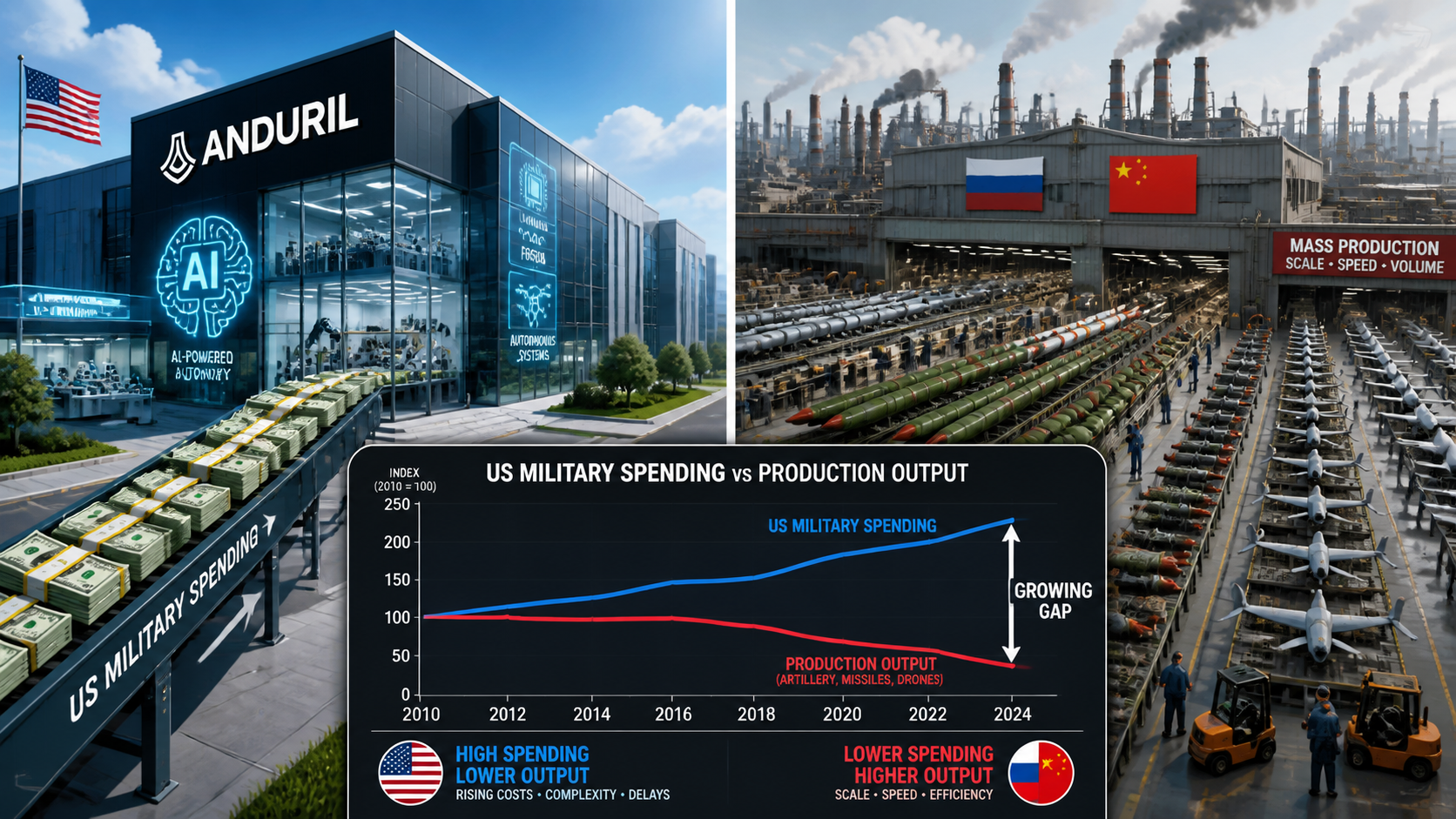
While it is true Anduril is developing weapons that may be a fraction of the cost of other weapons manufactured by legacy US arms producers, they fall short of the quality, quantity, and cost savings of their Russian counterparts — saying nothing of how far they fall short of China’s military industrial capabilities.
Despite the US literally bombing Iran and fighting Russia within its own borders by proxy through Ukraine, neither Russia nor Iran (nor China) has ever attacked the United States within its borders
And while it can be said an Anduril cruise missile is cheaper than those produced by Raytheon, they fall far short of the range and destruction Raytheon missiles can achieve.
Many of Anduril’s broken promises have been laid bare on the battlefields of America’s many wars of aggression abroad.
Anduril drones — having promised to revolutionize the battlefield — have already been sent to Ukraine only to be overwhelmed by Russian quantities and quality — along with quickly evolving Russian electronic warfare capabilities transforming Anduril’s drones into yet another overpriced, underperforming capability.
The Wall Street Journal, in a late 2025 article, would admit:
Anduril’s only real battlefield experience—in Ukraine—has been marred by problems as well, including vulnerability to enemy jamming, according to former employees and others familiar with the systems in Ukraine. Some front-line soldiers of Ukraine’s SBU security service, for instance, found that their Altius loitering drones crashed and failed to hit their targets. The drones were so problematic that they stopped using them in 2024 and haven’t fielded them since, according to people familiar with the matter.
Other Anduril products being developed include the Barracuda family of “affordable mass” cruise missiles. While claimed to already be under “mass production,” only about 1,000 are expected to be delivered annually beginning in 2027.
The Barracuda 500 variant is the longest-ranged missile of the family, claiming to have a range of 930 km, and a speed of 930 kilometers per hour, but a warhead of only 45 kilograms.
This missile — yet to be delivered — already falls far short of various “affordable mass” missiles and loitering munitions being employed by Russia on the battlefield, including its Geran family of loitering munitions.
Its propeller-driven variants feature longer ranges and heavier warheads than the Barracuda 500.
The Geran family also boasts several jet-powered variants, including the Geran 5, which achieves a range of up to 1,000 km, speeds between 450–600 km/h, and carries a 90 kg warhead (twice that of the Barracuda 500).
All of these variants are vastly cheaper than Anduril’s comparable Barracuda missiles.
Russia has also been developing a variety of other “affordable mass” weapons, including the Banderol, Kh-69, and Izdeliye-30 cruise missiles — all of which match or exceed the capabilities of different Anduril Barracuda variations — and all of which are cheaper than their Anduril counterparts.
In other words, Russia alone has produced “affordable mass” matching or exceeding on and over the battlefield — even the marketing promises made by Anduril.
US Shortcomings are Systemic
Anduril is only a symptom of a much deeper problem.
A combination of fundamental features of the US economic and political system and the profiteering it encourages, together with the emptiness of the supposed threats used to justify vast increases in arms spending, has revealed US ambitions toward “affordable mass” as only being “affordable” when compared to Lockheed, Raytheon, Boeing, and other US-based corporations — not the state enterprises churning out more, better, and cheaper munitions in Russia or China.
Andurial and other “startup” companies across the West are promising to match or exceed Russian and Chinese military industrial production through a marketing strategy dependent on public ignorance as to why deficiencies already exist across Western arms manufacturing in the first place.
The economic and political system US primacy is built on is one of the pursuit of perpetual profit and power. And while ramping up military industrial production is a key prerequisite for more power, doing so at the expense of perpetual profit prevents the US and its proxies from matching the networks of purpose-driven state-owned enterprises Russia and China use to develop and mass produce weapons and ammunition — even if at the expense of profits.
The state-owned enterprises overseeing Russian and Chinese military industrial production are mandated to exchange “intellectual property” between design bureaus and industrial concerns to ensure the best solutions to any given problem are disseminated across the full breadth of each’s military industrial base — fully leveraging these solutions for real-world purposes rather than simply hoarding “intellectual property” to maximize profit on financial ledgers for individual corporations.
Recent political pushes to demand accelerated arms and ammunition production across the US military industrial base — including both large legacy arms manufacturers like Lockheed, Boeing, and Raytheon, and “Silicon Valley startups” like Anduril — come combined with demands for even greater funding.
These demands for even greater funding are justified by the supposed “threats” nations like Russia, China, and Iran pose to the United States – lies repeated by the arms manufacturers themselves, including Anduril.
While these actual threats range from the nebulous to the outright fabricated — the motives are more concrete — greater profits for the illusion of greater “security.”
The US already spends more on its military than Russia, China, and Iran combined — yet is unable to match even just Russian or Chinese military industrial production — and in some cases falls short of even matching Iranian production rates and capabilities.
For Russia, China, or Iran — additional military funding would be immediately spent on expanding existing factories, building additional factories, investing in research and development, bolstering supply chains, training larger workforces, and other factors necessary to actually expand production. Additional production capacity — even if not used — in a for-purpose system is considered a long-term strategic asset — even if it undermines profitability in the short term.
In a for-profit system, additional manufacturing capacity — if not constantly employed to make weapons and thus profits — is considered a liability. US arms manufacturers not only demand public funding to expand production but also ironclad contracts to maximize use of it.
“Startups” like Anduril — while claiming to have revolutionized both arms R&D as well as manufacturing — have done neither and are instead simply utilizing existing cost-cutting measures (using off-the-shelf components, for example) to make relatively cheaper weapons than legacy corporations, which still depend on traditional assembly lines fed by highly customized (and expensive) components.
The level at which this is impractical is demonstrated by the vast disparity that already exists between a US military budget exceeding a trillion USD and its military industrial output versus just Russia’s military budget alone, which is a mere 10% of that yet produces anywhere between 3-10 times more arms and ammunition than the US — saying nothing of Chinese military industrial production.
As was the case last year, the true nature of “startup” Anduril and people like Palmer Luckey leading it prevents it and the rest of the collective West’s for-profit military industrial base from matching, let alone exceeding, Russian or Chinese military industrial output. This truth, demonstrated amid the ongoing conflict in Ukraine, reflects the true profit-driven motivations of Anduril and Luckey, whether Anduril and Luckey understand it or want to admit it or not.
For Americans convinced by Luckey’s rhetoric that either Russia or China truly are urgent threats to them and their way of life, it is actually Palmer Luckey, Anduril, and other companies and individuals like them demanding America continue diverting resources needed to thrive at home, toward efforts to needlessly antagonize and coerce other nations abroad.
This results in transferring the wealth of the American people toward Palmer Luckey’s overpriced weapons and ultimately toward his next new home, rather than toward better education, healthcare, and infrastructure for the average American man, woman, or child.
Despite the US literally bombing Iran and fighting Russia within its own borders by proxy through Ukraine, neither Russia nor Iran (nor China) has ever attacked the United States within its borders. Within these same US borders, neglect of education, healthcare, and infrastructure has visibly, tangibly reduced the quality of life for the average American.
Corporations like Anduril siphoning off tax dollars for threats abroad that do not exist, making these resources unavailable to solve threats to Americans at home that do exist — are responsible for this.
In the end, Palmer Luckey and Anduril — as well as other arms manufacturers and profiteering industries driving US foreign policy abroad — pose a much greater threat in reality to the average American and their way of life than any threat Russia or China is claimed to pose in fiction.
Brian Berletic is a Bangkok-based geopolitical researcher and writer
Follow new articles on our Telegram channel


Leave a Reply