Thursday, 20 August 2026 — Glenn Diesen
Prof. Glenn Diesen
The most important question of social systems is what creates order by managing competing interests? In international security, we must therefore ask the question: How do we manage the competing security interests of states?
We have not asked this question in a long time as the post-Cold War world order was organised around the collective hegemony of the West. A hegemonic system does manage competing security interests of states, rather it seeks stability, order and peace through dominance. However, that hegemony is now gone and we must yet again address competing security interests of states.
Hegemony as Universal Values
Discussing the security concerns of other states is especially difficult for a former hegemon as it is perceived as a betrayal of universal values. Hegemons always seek to legitimise their dominance as a common good, which is why the particular interests and priveliges of the hegemon are depicted as “universal values”. The West no longer speaks about international security as competing security interests, but as universal values.
The post-Cold War world order of liberal hegemony portrayed the collective hegemony of the West as a “force for good” by allegedly advancing liberal democratic values. The Western political class raised over the past decades fully embraced an ideology based on Fukuyama’s theory of the “End of History”, as the world would unify under liberal democracy and Western leadership. Liberal hegemony became a hegemonic norm as these universal values could only prevail under Western dominance.
Predictable Actions By a Declining Hegemon
A declining hegemon will predictably seek to weaken rising powers, and all “universal values” that no longer sustains hegemony can be thrown out the window. What is the predictable response by the former hegemon?
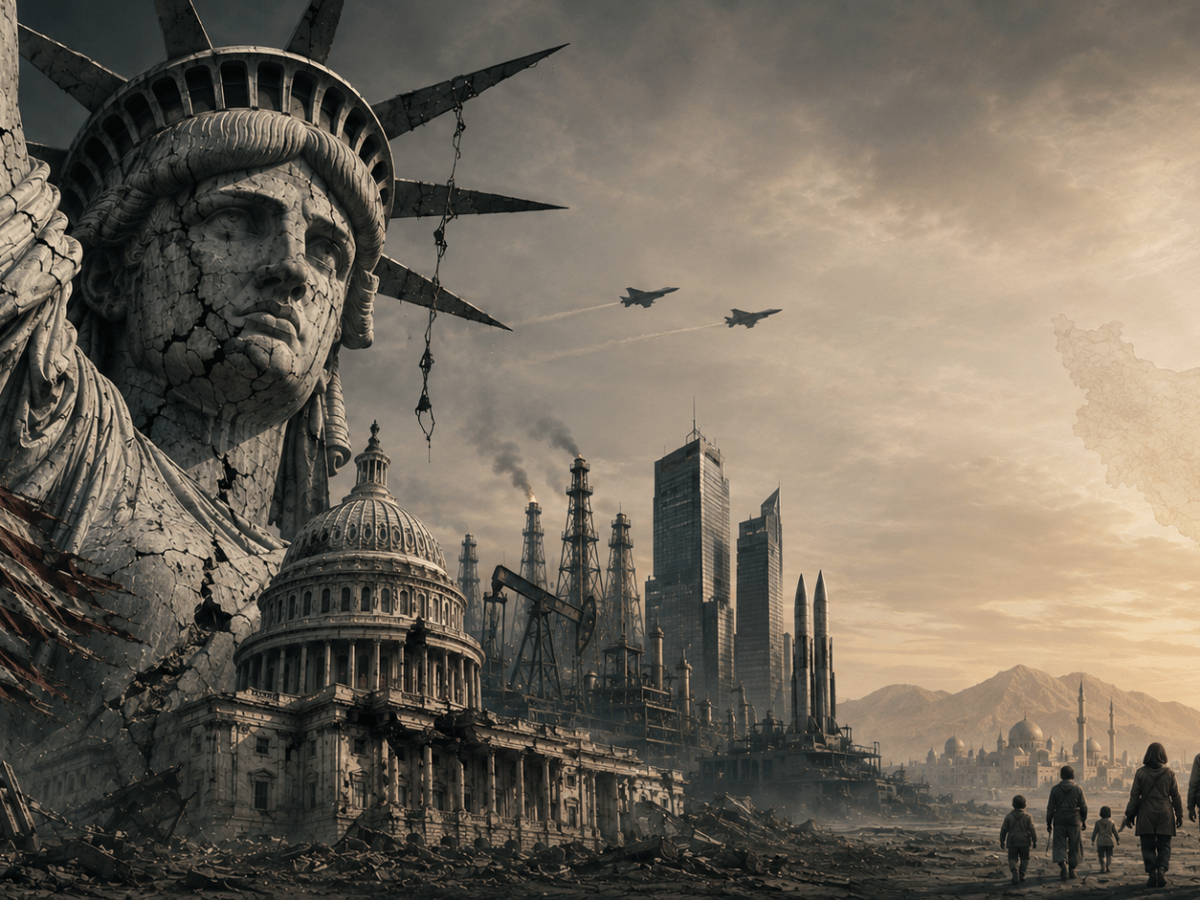
The predictable response would be an economic war against China to prevent its technological and economic rise, and if that does not work, escalate to an actual war. In Europe, hegemony can be restored with NATO expansionism and proxy wars to weaken Russia as a rival power. In the Middle East, Iran would be the principal target for regime-change or destruction as the main rival power in the Middle East. The Western Hemisphere must again fall under the Monroe Doctrine, Africa will become a battleground for influence, and allies of the hegemon must pay tribute.
However, the hegemony is already gone. China can resist economic coercion, Russia can balance NATO expansionism, Iran has triumphantly defeated the US, and the imperial overstretch of Washington has now accelerated far beyond what is sustainable. There are no solutions to the coming economic crisis that can rescue the situation.
Thinking About Peace in a Multipolar World
Can peace only exist if the US economy and technology dominate China? Can peace in Europe only exist if NATO expansionism persists and it can attack other states unhindered? Can peace in the Middle East only exist if every rival state of the West in the region is regime-changed or destroyed? Can peace and order only exist if the West can intrude into the domestic affairs of other states?
Ask the ideological fundamentalists in the West about what creates order, and the response will always refer to some form of “universal values” linked to Western hegemony.
Our greatest challenge in the West is to adjust to a new international distribution of power: How do we achieve peace and order in a post-hegemonic world?
The West Will Choose War
Abandoning hegemonic ideologies and yet again developing systems that manage competing security interests is not easy. The new political class rose over the past decades on the belief that they had a unique role in history—they were responsible for the transition from the formerly disorderly world to a more benign, just, and stable world. In a virtuous new civilising mission, the West would dominate in perpetuity, and it would be to the benefit of all mankind. Instead, they are presiding over an era that ends 500 years of Western dominance.
In such an environment, ideological fundamentalists in the West will refuse to discuss adjusting to the new international distribution of power. They will certainly not discuss the security concerns of rival states, which is perceived as betraying universal values. Instead, we see that militant hawks rise quickly if they can promote the delusion that one great war can restore the golden era.
As the West prepares itself for perpetual war with the promise of delivering perpetual peace, the rules that legitimised the hegemon will be sacrifised. Freedom of speech, freedom of navigation, the rules of international financial system, international trade, and other rules that ensured an open and connected world are being burned down. What were sacred principles are abandoned with the support of jihadist groups, fascist groups and by even making genocide acceptable. Diplomacy is dismissed as appeasement and even the fear of nuclear war is casually dismissed as giving in to nuclear blackmail.
By rejecting a system that seeks order and peace by managing competing security interests, the West has chosen war to restore its unattainable hegemonic peace.


Leave a Reply