Friday, 6 November 2026 — Struggle / La Lucha
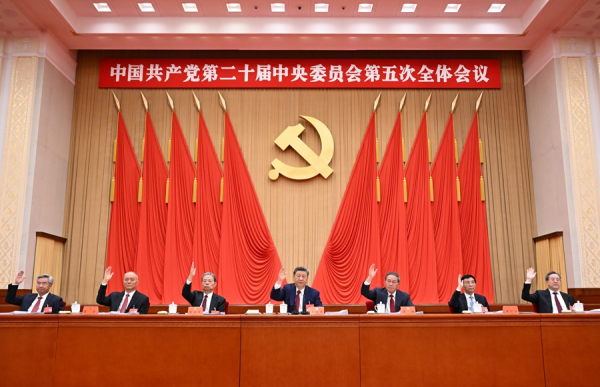
The Communist Party of China has just adopted a sweeping program of self-discipline, and the document itself points to the reason. The party is fighting the capitalists and the capitalist relations that the market reforms created inside China, and it is fighting them inside its own ranks.
The 20th Central Committee met in Beijing from Oct. 26 to 29, 2026. Its fifth plenary session adopted a resolution running to some 14,500 words in English, published on Nov. 1, on “persevering with full and rigorous Party self-governance.” The same session confirmed the expulsion of 33 Central Committee members, the largest number at any plenum since 1978. They included two former members of the Politburo, a former head of the party’s International Department, and at the top of the list Zhang Youxia, until this year the highest-ranking general in the People’s Liberation Army and vice chairman of the Central Military Commission, along with the army’s former chief of the joint staff, Liu Zhenli.
The military figures are the ones to look at. Of the 44 uniformed officers elected to the Central Committee in 2022, only two remain in their seats: Defense Minister Dong Jun and Zhang Shengmin, the army’s anti-corruption chief, who was raised to the Politburo at this plenum. The Central Military Commission, which commands the armed forces, is down to Xi Jinping and Zhang Shengmin. The resolution says plainly that “serious dangers hidden within the Party, the state, and the military have been removed.”
What the party says has gone wrong
Western coverage treats all this as a power struggle, a leader eliminating rivals. That reading collapses on the facts. The generals who fell were chosen under Xi Jinping at the same 2022 congress that gave him his third term, and Zhang Youxia was a close ally whom Xi kept on past retirement age. Xi Jinping appointed these generals and Xi Jinping is now expelling them. Something else is going on.
The resolution names it. Past the language of “Party spirit” and “loyalty,” the text identifies the source of the rot in economic terms. It warns of “the tests in governance, reform and opening up, the market economy, and the external environment.” It orders investigations into “collusion between government officials and businesspeople” and “capital penetrating into the political domain.” And in a single sentence it states the whole problem: the party must “resist the rules of commercial dealings and the relationships of dependency eroding intraparty conduct.” The rest of the document fills in how the money moves, through retired officials turned business agents, through officials’ spouses and children, through cryptocurrency and funds parked abroad.
That is a description of capitalist relations at work, though the resolution does not put it that way. It names the symptoms, corruption and capital penetrating politics, and stops there. The class explanation has to be supplied. The market reforms that began in 1978 opened China to foreign capital and brought into being Chinese capitalists, now numbering in the hundreds of billionaires and millions of smaller owners. Capitalists live by buying influence. They need land, permits, credit, contracts and protection, and the only place to get them is from officials of a workers’ state. Corruption is the political form that capitalist pressure takes inside a socialist country. When an official sells a land permit, a promotion or a procurement contract, the money that buys him comes from accumulation in the private economy. The anti-corruption campaign is the party’s defensive war against the corruption of its own apparatus by capitalist relations. The party does not describe it in those terms. It describes the enemy, and the description fits.
Self-revolution
The Chinese term the resolution uses for this fight is zìwǒ gémìng, literally self-revolution. The official English translation softens it to “self-reform,” which is a different word in Chinese. Marx wrote in “The Eighteenth Brumaire of Louis Bonaparte” that proletarian revolutions constantly criticize themselves, interrupt themselves and return to what seemed accomplished in order to begin again. Self-revolution is a better translation and a more Marxist one. Marx, though, was describing the whole revolution correcting its course over decades; the party’s self-revolution is aimed at the conduct and organization of the ruling party itself. Cleaning up the party helps the revolution. It is no substitute for it. A party can purge its ranks and rewrite its rules and still leave untouched the economic conditions that keep producing the officials it purges.
The party calls it “turning the blade inward.” Since 2012, by the count given by the Central Commission for Discipline Inspection after the plenum, nearly 8 million people have been punished by the party’s discipline organs and the state supervisory system, among them 963 officials senior enough to be supervised directly by the Central Committee. In 2025 alone, 115 officials at ministerial level or above were put under investigation. Xi Jinping told the plenum that the resolution sends “a strong signal of our commitment to being even more rigorous in the years ahead.”
The contrast with the last years of the Soviet Union is exact, and it runs the opposite way. Facing the same pressures, a privileged layer of officials, an illegal market fusing with state property and the pull of the world market, the Gorbachev leadership answered by loosening the party. It attacked its own cadre as “the administrative-command system,” opened the economy to the market and the country to imperialism, and demobilized the working class. That was more than a failure of discipline. The leadership itself became the instrument of restoration. It carried the capitalist pressures into the center of the party and then used the party’s authority to convert public property into private capital, and the privileged layers of the apparatus went over with it. When the counterrevolution came in August 1991, a party that still had more than 16 million members did not lift a finger.
The Communist Party of China has drawn the lesson. It tightens the center, and it also points the center in the opposite direction. It names capital rather than “the system” as the corrosive force, orders new recruitment from “young people, industrial workers, farmers, and intellectuals,” and sends party organizations into private firms, platform companies and high-tech startups.
The United States ruling class understands this, which is why it has spent four decades hoping for a Chinese Gorbachev and why its China analysts greet every purge with the same disappointment. There is no Soviet-style unraveling in this document. There is a workers’ state under siege putting its political instrument in order.
The limits
The resolution is honest about how far the fight has to go. The struggle against corruption “remains grave and complex,” it says, with “formidable tasks in eradicating the breeding grounds and conditions for corruption” still ahead. That honesty points to the contradiction the resolution does not resolve.
The party names capital as a source of the disease and then prescribes supervision of capital rather than a program to shrink it. Party cells inside private companies are meant to watch the capitalists politically while leaving them their economic base. The resolution leans heavily on moral education, on “fine traditional Chinese culture,” on “a sense of honor and shame,” and morality has never outrun economics. As long as capitalists accumulate inside China, they will keep regenerating the “tigers” and “flies” the party hunts. The decisive measures lie in the economy. Who decides where new investment goes, the plan or the banks and developers who now put up much of it. Whether the publicly owned enterprises command the key industries or compete as firms among other firms. And whether the working class, as a class, holds the organized power to decide through the plan what gets produced and for whom. That program is not the resolution’s, which works inside the socialist market economy as it stands. It gestures at the last of these in its sections on the mass line and on “the people’s oversight over government,” and those are the thinnest parts of the text.
This is a holding action. It is a serious and necessary one, and the Communist Party is the only organization in China with the political authority to carry it out. It cannot settle the question by itself. The resolution says the party has found two answers to the danger of degeneration: the people’s oversight over government and the party’s self-revolution. The first it traces to Mao Zedong, who told a visitor to Yan’an in 1945 that only supervision by the people would keep the government from slackening; the second to the experience since 2012. Nearly all of the resolution is about the second. The first is where the working class comes in, and a workers’ state is nothing else than the working class exercising political power.
The party can defend the workers’ state against restoration. The working class has to be able to rule inside it, and these are the same task seen from two sides.
Workers have shown they will act. In July 2009 the Jilin provincial government agreed to hand Tonghua Iron and Steel, a publicly owned mill with a workforce in the tens of thousands, to Jianlong, a private steel group that planned mass layoffs. Workers occupied the plant, the general manager Jianlong had installed died in the confrontation, and by that night the provincial government had canceled the deal. The plant stayed public. Since 2021 delivery riders and ride-hailing drivers, after years of walkouts and protests over pay rates set by the platforms’ software, have won collective agreements, negotiated through the trade unions, that put delivery times, pay formulas and the algorithms that set them on the bargaining table; the agreements signed in 2025 alone cover more than 20 million platform workers.
That is the force the resolution’s second answer leaves largely in reserve. An official who takes money from a developer is checked more surely by workers who can see the books and remove him than by an inspection team sent from the next level up. The resolution’s own demand that officials be assessed by “the comments from ordinary people” and that the channels for “public oversight” be kept open points this way, and the thinness of those passages next to the pages on discipline is the measure of what remains to be done.
The struggle between the two roads opened by the reforms will be settled by which class holds power in production and in the state, and that is a struggle the working class has to fight in its own name.
The war context
What the capitalists inside China press against from within, the United States presses against from without: the working class’s hold on power. None of this is happening in peacetime. The resolution says so, warning that “hegemonism and power politics pose greater threats, geopolitical conflicts and local wars show no signs of end.” The United States government’s war on Iran this year was openly described in the Pentagon and in Congress as a rehearsal. The technology blockade, the arming of Taiwan province, the ring of bases from Japan to the Philippines to Guam, a United States colony, all continued through the two Trump-Xi summits of 2026 and continue now.
The purge of the army command has to be read in that light. In a workers’ state, the relationship between the party and the armed forces is decisive, because the army is where the bourgeois tendency at home and the imperialists abroad would meet if it ever came to that. The army newspaper accused Zhang Youxia of undermining the party’s absolute leadership over the military. The stated grounds across the whole series of removals ran from procurement corruption in the Rocket Force and the equipment department, which brought down a defense minister and the commanders of the nuclear missile force beginning in 2023, to the political charges against Zhang Youxia and Liu Zhenli this year: disloyalty, factionalism and undermining the party’s leadership over the armed forces. Whether private money reached the top of the command is not established in anything published. What is established is that the party judged the command unreliable. Reasserting political control over the gun is a necessity. It is also the moment of greatest exposure. The Pentagon’s planners read these expulsion lists as closely as any communist does.
That is the measure of what the party has undertaken. It has chosen to cut deep into its own military leadership at the height of a United States war drive, because it judged the command unreliable and the war drive real. The resolution’s opening section says the party’s long governance and “the enduring peace China enjoys” make it all the more necessary “to be ever ready to protect against potential dangers in time of peace.” For the Communist Party of China there is no time of peace, and the war it is fighting inside its own ranks is one front of the global class war being fought against it from outside.
Join the Struggle-La Lucha Telegram channel


Leave a Reply