Tuesday, 24 November 2026 — Weaponised Information
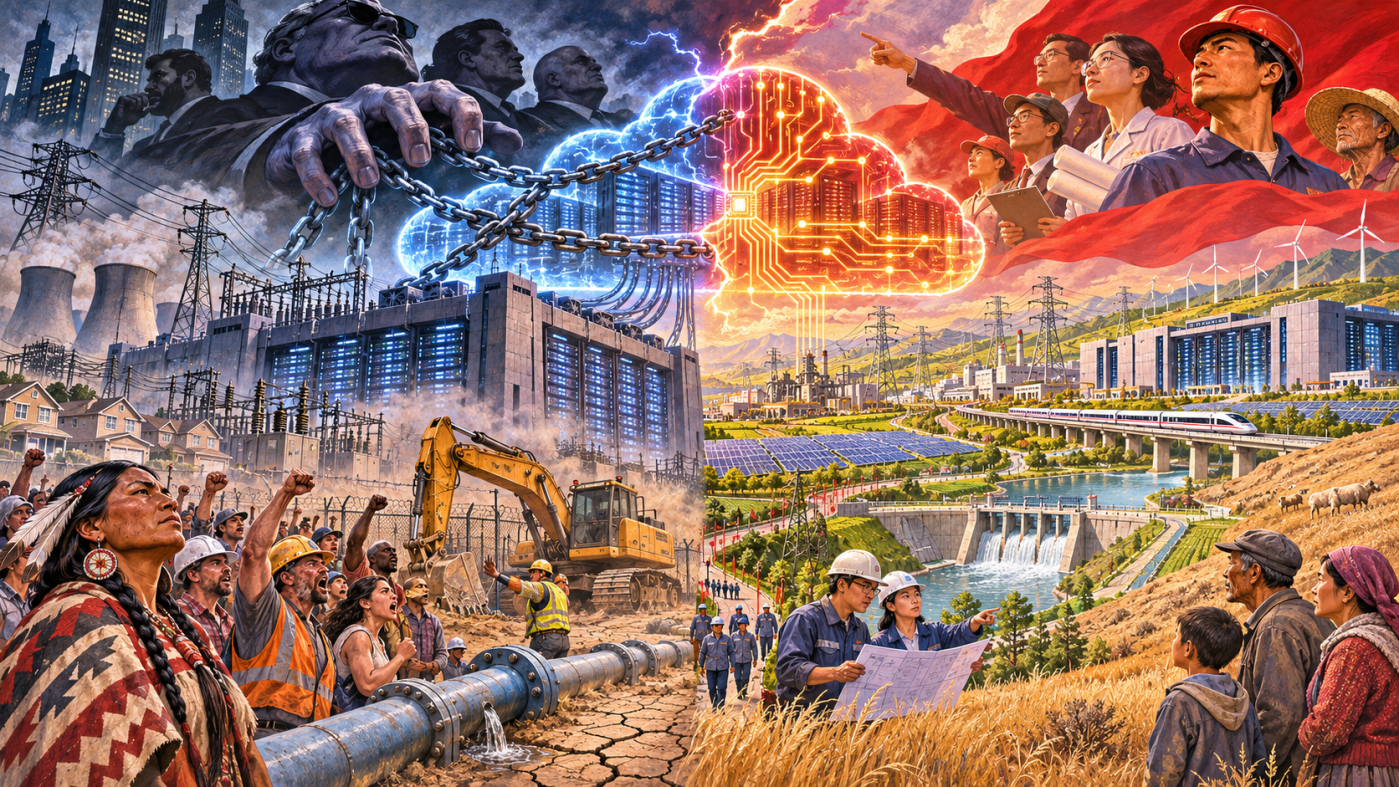
America’s technology monopolies promise an artificial-intelligence revolution while working people confront the electricity demands, water pressures, public costs, and corporate power required to build it. Across the United States, resistance to data centers exposes a contradiction Silicon Valley would rather conceal: the most advanced productive forces in human history depend upon collective labor and social infrastructure, yet remain under the command of private capital. China has taken another historical road, developing computational infrastructure through socialist industrialization, national planning, and technological sovereignty, while confronting its own contradictions of regional inequality, investment, ecological limits, and popular participation. The struggle isn’t between technological progress and the people standing in its way, but between competing social relations governing that progress—and ultimately over who possesses the power to command the machines, control the wealth they produce, and determine whose future they’re building.
Prince Kapone | Weaponized Information | November 24, 2026
I. The Rebellion Against the AI Boom
In August 2026, the Cherokee Nation drew a line against the latest gold rush of American monopoly capital. After examining the economic, environmental, and cultural consequences of hyperscale data centers, Principal Chief Chuck Hoskin Jr. announced a prohibition on their development on tribally owned and trust lands. The Nation’s own investigation had gathered responses from 1,593 Cherokee citizens, 64 percent of whom opposed hyperscale construction within the reservation. The concerns weren’t mysterious: water, electricity, environmental protection, cultural resources, and the future of Cherokee communities. The tribal government also demanded meaningful consultation over proposed developments on nontribal land within its reservation. Silicon Valley could bring its billions, its servers, and its promises of technological salvation. That didn’t give it the right to decide what happened to Cherokee land. The Cherokee Nation had made its position clear.
This wasn’t some suburban homeowners’ association complaining about an ugly building spoiling the view. The Cherokee Nation was exercising governmental authority over its own territory, confronting an industry whose expansion threatens to reorganize the relationship between land, natural resources, and the communities that depend upon them. Its June 2026 task-force report examined both economic opportunities and potential harms. The question wasn’t whether modern technology had any useful purpose. It was whether the people whose resources and communities would be affected possessed the authority to determine the terms of development. Apparently, the corporate gospel of innovation becomes considerably less convincing when somebody asks who gave the innovators permission.
Across the United States, that question has escaped the boundaries of any single community. From Oklahoma to Virginia, from the industrial Midwest to the expanding technology corridors of the South, residents have organized against projects promoted as indispensable foundations of the artificial-intelligence revolution. Public hearings have become battlegrounds. Local governments have adopted construction restrictions and temporary moratoriums. Developers accustomed to negotiating incentives with government officials increasingly encounter residents demanding explanations before bulldozers arrive. An October 2026 study of local resistance identified 457 data-center restrictions adopted across 348 American counties between January 2017 and August 2026, with the overwhelming majority recorded during 2026. The revolt had become a national political phenomenon, although its participants neither shared a single ideology nor pursued identical objectives.
And this damned rebellion isn’t confined to people who distrust artificial intelligence. The University of Pennsylvania’s Annenberg Public Policy Center found that opposition to constructing new data centers nearby rose from 49 percent in February and March 2026 to 61 percent in June and July. Majorities of Democrats, Republicans, and independents opposed local construction. Among adults younger than thirty, opposition reached 70 percent. Yet Americans’ broader assessments of artificial intelligence remained statistically unchanged over the same period. Their opposition to the buildings was growing much faster than their hostility toward the technology itself.
A separate Gallup survey conducted in March 2026 found 71 percent opposed to constructing AI data centers in their local area. Its questions differed from Annenberg’s, so the percentages shouldn’t be confused as measurements of the same population movement. But the political message was unmistakable. Opposition crossed party lines and conventional demographic divisions. Some residents feared environmental degradation, others higher living costs, others the transformation of their communities. Supporters emphasized construction employment, investment, and potential tax revenue. These weren’t imaginary interests or interchangeable political positions. They were different social groups confronting the same development through different material circumstances.
Here lies the contradiction that America’s technology evangelists would rather bury under another mountain of promotional bullshit. Millions of people use the products of the digital economy while questioning the conditions under which its physical infrastructure expands. Workers encounter AI in their jobs. Students encounter it in education. Families encounter it through communications, healthcare, and everyday services. Yet participation in technological development doesn’t amount to signing away one’s claim upon land, water, electricity, or public decision-making. A person can recognize the productive possibilities of artificial intelligence without surrendering the right to challenge the corporations constructing its infrastructure. Those two positions aren’t mutually exclusive, no matter how desperately the industry’s defenders pretend otherwise.
Nor should we confuse every opponent with a revolutionary. A wealthy property owner worried about neighborhood exclusivity, a construction worker concerned about employment, an Indigenous nation defending its sovereignty, and a working-class community demanding protection from environmental hazards may all challenge the same development for profoundly different reasons. Their immediate opposition can converge without abolishing the class interests and historical relations separating them. What matters is that the infrastructure itself has become politically contested. The companies promising to revolutionize human existence are discovering that the human beings already living on the land have demands of their own.
Now consider the other side of the Pacific. China has undertaken an enormous expansion of computational infrastructure, integrating data centers into national strategies for technological modernization, industrial development, and energy coordination. Chinese communities haven’t produced a comparably visible nationwide movement against these facilities, although local environmental complaints, land disputes, and public controversies demonstrate that grievances certainly exist. The contrast demands explanation. Are Chinese residents confronting materially different conditions? Does national planning change how development affects everyday life? Do different political institutions transform how grievances emerge and acquire public expression? Or are several of these relations operating together?
The answer won’t be found in the familiar fairy tale that Americans love freedom while Chinese people obediently accept whatever their government builds. Neither will it emerge from imagining that socialist planning magically eliminates every contradiction accompanying technological development. Those explanations substitute ideological prejudice for historical investigation. The real question begins with the machines themselves: what does their construction demand from society, who supplies those demands, who receives the benefits, and why has their expansion become a political struggle in the country claiming to lead the AI revolution?
II. The Bill Arrives Before the Benefits
Strip away the marketing bullshit surrounding the artificial-intelligence revolution, and what remains is an enormous industrial undertaking. Behind every chatbot, automated warehouse, predictive algorithm, and corporate promise of a frictionless future stands a physical system that demands electricity, land, water, minerals, machinery, and human labor. Servers don’t manufacture their own semiconductors. Cooling systems don’t conjure water from thin air. Transmission lines don’t erect themselves, and power plants don’t operate on the inspirational speeches of Silicon Valley billionaires. Before artificial intelligence can transform production, society must supply the material conditions that make computation possible. And that’s precisely where the trouble begins.
The scale alone should settle any confusion about whether these facilities constitute ordinary commercial development. The U.S. Department of Energy’s December 2024 assessment documented electricity consumption by American data centers rising from approximately 58 terawatt-hours in 2014 to 176 terawatt-hours in 2023. A subsequent Congressional Research Service examination placed 2024 consumption at roughly 192 terawatt-hours, representing 4.7 percent of total American electricity use. Those figures encompass data centers generally, not exclusively artificial intelligence, but AI’s expanding computational demands have become a major force behind the industry’s growth. A terawatt-hour isn’t some abstraction invented to impress investors. It’s a billion kilowatt-hours of electricity that somebody must generate, transmit, distribute, and pay for.
And electricity doesn’t simply appear at the facility’s doorstep because a corporation signs a construction contract. The machines require reliable power around the clock. Supplying that demand can require new generating capacity, substations, transmission corridors, transformers, distribution upgrades, and increasingly complicated arrangements with regional grid operators. These investments extend far beyond the walls of any individual data center. A corporation can purchase the servers, but those servers become useless without an electricity system constructed through generations of accumulated labor and public and private investment. The supposedly weightless digital economy rests upon a very heavy industrial foundation.
Virginia provides the clearest examination of what happens when that foundation encounters rapidly expanding demand. Northern Virginia became the world’s largest concentration of data-center infrastructure through its telecommunications networks, access to electricity, proximity to major customers, available land, and government incentives. But the industry’s success created an enormous new problem. The Virginia General Assembly’s Joint Legislative Audit and Review Commission warned in December 2024 that unconstrained electricity demand could double the state’s power requirements within a decade, with data centers responsible for much of that projected increase. Meeting even half the projected demand would require substantial additions to generating and transmission infrastructure. The technological revolution had run into the rather inconvenient reality that electricity systems cannot be expanded by issuing a press release.
Now comes the question that turns engineering into political economy: who pays? Virginia’s investigators found that existing electricity tariffs appropriately allocated current service costs to data-center customers. That’s an important distinction. The available evidence doesn’t justify pretending that every data center already receives electricity at somebody else’s expense. But the same investigation identified a larger problem. Expanding the entire electricity system to accommodate enormous new loads can increase costs for households and businesses even when individual customers pay their existing bills. Under the study’s modeled scenarios, a typical Dominion Energy residential customer could face an additional $14 to $37 per month in generation and transmission costs by 2040, measured in constant dollars. These were projections, not bills already imposed, and their realization depends upon future demand, infrastructure construction, and regulatory decisions.
The danger extends beyond rising prices. Suppose utilities construct billions of dollars in generation and transmission capacity for data centers whose anticipated computational demand never materializes. Suppose a developer delays construction, scales back operations, or closes a major facility after the infrastructure has been completed. The electrical equipment remains, along with the debt and the obligation to recover its costs. Virginia’s auditors specifically warned that such stranded investments could burden existing utility customers. Here the conflict becomes unmistakable: the investment decisions of a relatively small number of powerful customers can create financial obligations extending across an entire electricity system. The gains from successful expansion and the consequences of failed expansion don’t necessarily fall upon the same people.
Working people understand this arrangement without needing an economics degree. They’re already paying rent, buying groceries, raising children, and struggling with utility bills. They have every reason to question why their household finances should absorb additional risks created by industrial customers whose investment decisions they neither make nor control. In Wisconsin, the NAACP and a coalition of 42 environmental-justice, faith, conservation, and community organizations challenged a proposed data-center electricity tariff in February 2026. The coalition argued that preferential arrangements for large computing customers could shift costs toward ordinary ratepayers while leaving affected communities with insufficient influence over infrastructure decisions. Their demands included full cost accountability, public disclosure, community-controlled investment funds, and enforceable environmental protections. That’s a material struggle over who receives the benefits and who carries the burdens, not some irrational fear of technological progress.
The racial dimensions enter through the existing organization of American society. Black and low-income communities already confront unequal exposure to industrial pollution, inadequate infrastructure, and disproportionate household energy burdens. The Wisconsin coalition connected proposed computing developments to these established inequalities, warning that expanding electricity generation and industrial facilities could intensify existing environmental injustices. A new data center doesn’t automatically create identical harms wherever it’s constructed. Its consequences depend upon the surrounding infrastructure, electricity sources, location, and protections. But imposing additional industrial demands upon communities already carrying disproportionate burdens hardly produces an equal social bargain. Calling the arrangement innovation doesn’t change who lives beside the smokestack or who struggles to keep the lights on.
Water introduces another conflict. Servers generate heat, and that heat must be removed continuously. Some cooling systems consume substantial quantities of water through evaporation; others depend more heavily upon air cooling, recirculation, or alternative technologies. The amounts vary enormously. Virginia’s own investigation found that many data centers used water at levels comparable to or below large office buildings, while a smaller number required significantly greater quantities. Its investigators considered statewide water use sustainable at the time but identified local constraints and weaknesses in oversight of competing water demands. This distinction matters. The problem isn’t that every data center necessarily drains its surrounding watershed. The problem is that an industrial facility’s requirements must be evaluated against the water actually available, the other people and ecosystems depending upon it, and the authority deciding whose needs receive priority.
Land brings the same struggle into sharper focus. The facilities occupy enormous buildings surrounded by power equipment, cooling machinery, security installations, and associated infrastructure. Their development can change traffic patterns, consume industrial land, and create persistent mechanical noise. Virginia’s investigators found that roughly one-third of existing facilities were located near residential areas and documented conflicts involving low-frequency sound, incompatible zoning, and insufficient protections for neighboring households. They also emphasized that most facilities hadn’t generated comparable noise complaints. The contradiction arises from particular development decisions, not from some universal law that every server building poisons its neighbors. But when industrial uses are introduced beside people’s homes, those people have material interests that no corporate feasibility study can simply erase.
And where development intersects Indigenous territory, the land question becomes inseparable from sovereignty. The Cherokee Nation’s objection cannot be reduced to calculating whether a particular facility would generate more tax revenue than environmental damage. The authority to determine land use, protect cultural resources, and defend the conditions of community life belongs within a historical struggle against settler-colonial dispossession. A corporate development proposal doesn’t nullify those political relations. The question of who controls the land precedes the question of what an investor hopes to construct upon it.
Then there’s the promise that accompanies practically every major industrial development in America: jobs. And unlike much corporate propaganda, this promise contains something real. Data centers require electricians, operating engineers, ironworkers, laborers, technicians, equipment installers, and entire networks of suppliers. These are skilled workers performing necessary labor, and their employment matters. Virginia’s investigators estimated that construction of a typical facility could involve approximately 1,500 workers at peak activity over a building period of twelve to eighteen months. But once the building entered operation, a representative 250,000-square-foot facility might employ only about fifty full-time workers, roughly half of them contractors. Continuous campus expansion can sustain construction employment for longer, but the distinction between building the facility and operating it remains fundamental.
Tax revenues aren’t imaginary either. Virginia’s investigation found that data-center revenue accounted for as much as 31 percent of local government revenue in one mature market. Those funds can support schools, roads, public services, and other social needs. But the same state has offered substantial tax advantages to attract the industry, including a sales-and-use-tax exemption that delivered approximately $928 million in savings to qualifying data-center purchases in fiscal year 2023. The public bargain therefore requires more than announcing an impressive investment figure. It requires examining how much employment lasts, how much revenue remains, what infrastructure must be financed, which taxes are forgiven, and whether the benefits actually reach the people absorbing the burdens.
And here the material contradiction begins to reveal its deeper character. The data center is privately operated industrial property, but its existence presupposes an extraordinary concentration of collective labor, accumulated infrastructure, natural resources, and public authority. Electricians build the connections. Utility workers maintain the grid. Construction crews erect the buildings. Communities supply the land and confront the environmental consequences. Governments establish the legal and financial conditions under which the entire undertaking proceeds. Yet the people participating in this enormous social process possess radically unequal power over its direction. Some negotiate investment contracts worth billions. Others receive a notice that another industrial facility may be coming to their neighborhood.
That’s the material foundation beneath the American rebellion. The issue isn’t whether society needs computational infrastructure. Advanced production increasingly depends upon it. The issue is why the development of that infrastructure can place such unequal demands upon the very people whose collective labor and resources make it possible. And once we recognize that computing requires a vast social system of production, another question becomes unavoidable: why should the decisions governing that system remain concentrated in the hands of corporations pursuing their own commercial expansion? To answer that, we’ve got to move beyond the machinery and examine the relations of ownership and power commanding its construction.
III. Why Capital Cannot Build Alone
Follow the money upstream from the data center, and the contradiction becomes considerably more revealing. The corporations driving America’s artificial-intelligence boom don’t merely want to manufacture better machines or develop useful technologies. They want command over the infrastructure through which an expanding share of modern production, communication, research, and administration will operate. Amazon, Microsoft, Google, Meta, and Oracle aren’t simply responding to some neutral demand floating around the marketplace. They’re competing to control the computational foundations of the next period of capitalist accumulation. Whoever controls the servers, cloud platforms, software ecosystems, and access to advanced computing acquires enormous power over the enterprises, institutions, and workers increasingly dependent upon them. The technology changes, but the old capitalist ambition remains recognizable: own what everybody else needs, charge them for using it, and call the resulting dependency innovation.
This concentration didn’t begin when ChatGPT introduced millions of people to generative artificial intelligence. It developed through decades of telecommunications investment, publicly supported computing research, semiconductor development, commercial internet expansion, and the consolidation of digital platforms. Amazon transformed computing capacity into a commercial cloud service through Amazon Web Services. Microsoft extended its software empire into Azure. Google developed computational infrastructure through its search, advertising, and cloud businesses. Each corporation accumulated technological expertise, financial resources, and control over networks of customers whose daily operations became increasingly dependent upon privately administered systems. What once appeared as separate software, storage, and communications services developed into interconnected infrastructures capable of organizing entire sectors of economic activity. Artificial intelligence didn’t create this concentration. It gave the corporations already commanding it another opportunity to deepen their control.
The scale of investment reveals the stakes. A 2026 examination of corporate financial filings found that Amazon, Alphabet, Microsoft, Meta, and Oracle collectively spent approximately $230.4 billion purchasing property and equipment during their latest comparable fiscal quarters ending in August or September. That figure covers company-wide capital expenditure, including investments unrelated to artificial intelligence, and shouldn’t be mistaken for AI-specific spending. Nevertheless, it demonstrates the enormous material resources commanded by this handful of firms. Their combined capital expenditure exceeded their operating cash flow during that reporting period. The competition increasingly demands enormous investments today in anticipation of commercial returns tomorrow. And because controlling computational infrastructure can determine access to future markets, each corporation faces pressure to expand before its rivals secure that position. Capital creates the competition, then presents the resulting investment frenzy as a technological necessity beyond anybody’s control.
But here’s the beautiful little contradiction buried underneath all that corporate grandeur: the more advanced and concentrated this privately controlled technology becomes, the more thoroughly it depends upon production organized beyond the boundaries of the individual corporation. Microsoft cannot manufacture an electricity grid through software subscriptions. Amazon cannot independently reproduce the accumulated labor embodied in semiconductor supply chains, transportation networks, telecommunications systems, and public infrastructure. Google cannot command a reliable national electricity supply simply because its shareholders expect another profitable quarter. The physical requirements of computation extend across entire industries, territories, and generations of socially accumulated labor. The corporations own and command particular assets within that system, but no corporation can reproduce the whole system upon which those assets depend. The productive process becomes increasingly social while decisive economic authority remains concentrated in private hands.
And when these privately directed ambitions encounter the limits of existing infrastructure, who gets summoned to make the whole damn thing work? The state. The Department of Energy’s December 2024 announcement identified more than thirty federal programs capable of supporting data-center energy requirements, including initiatives involving generation, storage, transmission improvements, and demand flexibility. The July 2025 executive order accelerating data-center development directed federal agencies to facilitate financial support, expedite permitting, and identify suitable federal lands for qualifying computing and energy projects. The accompanying White House policy explicitly contemplated loans, grants, and tax incentives. Here stood the great champions of private enterprise, once again discovering the indispensable virtues of government intervention when the requirements of accumulation grew too large for private initiative alone. Apparently, the market’s invisible hand still needs the public to build the bloody arm.
Yet this doesn’t mean the American state lacks planning capacity or that every public intervention simply transfers money into corporate pockets. Public agencies have genuine responsibilities for electricity reliability, environmental protection, infrastructure development, and consumer affordability. Their interventions can create useful public assets and impose real obligations upon investors. The contradiction concerns the institutions through which planning occurs and the priorities those institutions are organized to serve. The federal government promotes computational expansion as a strategic national objective, while utilities, regional grid operators, state commissions, and municipalities negotiate different parts of its material requirements. The corporations retain considerable authority over where and when they invest, but the consequences of those investments extend across systems no individual firm controls. Public institutions must coordinate the infrastructure around privately determined commercial ambitions, frequently after those ambitions have already generated new demands.
By June 18, 2026, the contradiction had become significant enough for the Federal Energy Regulatory Commission to order all six regional grid operators under its jurisdiction to justify or reform their rules for connecting data centers and other large electricity consumers. The commission identified transmission-cost transparency, potential cost shifting, connections between power plants and large customers, and the need for new arrangements accommodating flexible demand. Its intervention followed earlier disputes involving PJM, the enormous regional electricity system serving much of the eastern United States. This wasn’t evidence of a government sitting helplessly on the sidelines. It was evidence of public authorities attempting to reconcile investment decisions, utility obligations, market rules, and system-wide reliability after rapid corporate expansion had strained the existing arrangements. Even the regulators had to confront the fact that electricity cannot be governed as though every customer’s decisions remain economically independent of everybody else’s.
Nor does capital speak with one harmonious voice. Technology monopolies seek rapid access to reliable electricity at commercially favorable rates. Utilities seek predictable revenue and recovery of investment costs. Energy producers want customers for additional generation. Infrastructure financiers want dependable returns. Local governments compete for development, while regulators confront consequences extending far beyond any particular municipality. These fractions can cooperate when their interests converge and fight bitterly when somebody has to absorb a new expense. A technology corporation may prefer to construct its own generating facility or contract directly with a power producer, while a grid operator worries about reliability and transmission obligations. FERC’s December 2025 intervention in PJM’s co-location rules arose precisely because existing tariffs lacked adequate clarity for such arrangements. The competition among capitals doesn’t abolish the need for coordination. It makes coordination a permanent terrain of struggle over who controls the investment and who carries the risk.
Labor occupies another position within this machinery. Workers construct the facilities, maintain the electrical systems, manufacture equipment, and operate the networks. Yet the industrial expansion they make possible isn’t organized principally around their collective needs. The tremendous accumulation of fixed capital can proceed without creating a corresponding mass of permanent employment, while the technologies being developed may eventually reduce employers’ demand for labor in other industries. Weaponized Information has already examined this contradiction: capital develops machinery capable of reducing necessary labor time while preserving a social order in which workers must sell their labor-power to survive. The contradiction isn’t that technological productivity should be opposed. It’s that the social benefits of productivity remain subordinated to property relations that give owners disproportionate command over how those benefits are distributed.
And this expanding computational apparatus isn’t confined to commercial production. The national-security state has become an important customer and organizer of corporate computing. In June 2026, the Department of the Navy announced cloud-computing task orders involving Amazon Web Services, Microsoft Azure, Google Public Sector, and Oracle under the Joint Warfighting Cloud Capability program. The arrangement integrates commercial cloud services into military computing requirements across different security classifications. That doesn’t mean every commercial data center operates as a military installation. It establishes something more structurally significant: the same corporate technological infrastructures that organize civilian commerce increasingly provide capacities upon which military and national-security institutions depend. Corporate accumulation and state strategic power develop through overlapping technological systems.
Here the broader process WI identifies as technofascist consolidation enters the picture, not as some magical label attached to every server warehouse, but as a developing relationship among monopoly capital, digital infrastructure, administrative power, surveillance, and military institutions. The fusion remains uneven and contested; its consequences depend upon the particular technologies, contracts, legal powers, and political struggles involved. But its direction deserves attention. Computational systems developed through private accumulation are becoming increasingly important instruments of public administration and state coercive capacity. Meanwhile, the government accelerates infrastructure expansion in the language of national security and technological supremacy. What gets advertised as the freedom of innovation can enlarge the power of institutions ordinary people possess remarkably little authority to direct.
This is also where domestic accumulation connects to Washington’s wider struggle to preserve imperial technological dominance. American policymakers increasingly treat artificial intelligence, advanced semiconductors, electricity infrastructure, and cloud computing as instruments of international economic and military competition. China’s technological development has made that struggle considerably more urgent for the American ruling bloc. But geopolitical rivalry doesn’t explain away the class relationships inside the United States. It intensifies them. The demand to maintain technological supremacy becomes an argument for accelerated construction, expanded public assistance, and reduced obstacles to investment. The commercial interests of technology monopolies become increasingly entangled with the strategic objectives of the imperial state, until defending their expansion can be presented as defending the nation itself. And whenever somebody asks whether working people should accept the resulting arrangements, the familiar accusation appears: you’re standing in the way of progress.
The deeper contradiction, then, isn’t that American capitalism refuses to plan. It plans constantly. Corporations prepare investment strategies, utilities develop capital programs, regulators establish tariffs, federal agencies designate strategic priorities, and military institutions organize procurement. The question concerns the social relations coordinating those plans. In the American system, planning operates through competing centers of corporate ownership, public authority, financial interest, and territorial jurisdiction, with private accumulation retaining decisive influence over the direction of technological investment. The productive forces demand ever greater integration, while the relations governing them preserve concentrated command and competing claims upon the wealth society produces. WI’s earlier investigation of the American AI grid crisis established this contradiction at the level of electricity and imperial technological ambition. The growing rebellion against data centers reveals its political consequences among the people expected to live with the results.
But nothing about semiconductor physics, electrical engineering, or computational architecture requires this particular arrangement of ownership and power. The machines require energy, infrastructure, technical knowledge, coordinated production, and labor. They don’t require that society organize those things primarily around the competing investment strategies of private monopolies. Those arrangements belong to history, not nature. And history has produced another major industrial power confronting the same technological revolution through a fundamentally different institutional inheritance. To understand why China’s computational expansion has followed another developmental path, we’ve got to examine how revolution, socialist industrialization, public infrastructure, and the continuing struggle to organize markets within national development transformed the conditions under which its productive forces could advance.
IV. The Other Road to Computation
China didn’t become an industrial power because somebody in Beijing discovered the magical virtues of building data centers. The foundations of its technological development were laid decades before the first commercial cloud server existed, before Silicon Valley became the corporate capital of the digital economy, and before American billionaires began presenting artificial intelligence as their personal gift to humanity. They were laid through revolution, land reform, socialist industrialization, the construction of public infrastructure, and the tremendous collective labor of a people determined to escape the poverty and dependence imposed by a century of imperial domination. To understand why China approaches the computational revolution differently, we’ve got to begin with those historical relations. The machines may be new, but the social institutions making their development possible have a much longer history.
When the Chinese Revolution triumphed in 1949, the new People’s Republic inherited an economy devastated by foreign occupation, civil war, colonial extraction, and profound rural poverty. The imperial powers had spent generations violating China’s sovereignty, extracting its wealth, and restricting its independent development. The Communist Party confronted a problem no amount of capitalist mythology could solve: how could a predominantly agrarian society construct the industrial foundations necessary to overcome its historical subordination? The answer required transforming the relations of property and political power. Land reform attacked the old landlord order. The consolidation of public ownership brought strategic sectors of production under state direction. The First Five-Year Plan, launched in 1953, prioritized heavy industry, machinery, energy, transportation, and the technical capacities necessary for further development. China’s workers and peasants weren’t waiting for foreign investors to discover a profitable opportunity to modernize their country. They were constructing the material foundations of a new society.
Those foundations mattered far beyond the immediate output of factories and power stations. Socialist industrialization developed technical institutions, scientific education, public enterprises, industrial workers, engineers, and the administrative capacity to coordinate production across enormous territories. Electricity networks, machine-building industries, railways, and research institutions became parts of a national developmental project. The early decades involved serious mistakes, political upheavals, shortages, and costly disruptions, but they also created productive capacities without which China’s later industrial expansion would’ve been impossible. The Communist Party’s 2021 historical resolution explicitly identifies the socialist transformation of ownership and the establishment of the country’s industrial foundations as essential achievements of that period. The revolutionary transformation changed not merely who occupied the government, but the institutional possibilities available for organizing economic development.
When China initiated reform and opening up in 1978, it didn’t enter the world market as an ordinary dependent capitalist country beginning industrialization from scratch. It entered with the accumulated foundations of socialist construction, a Communist Party exercising state leadership, public enterprises, and institutions capable of directing long-term development. Market mechanisms, foreign investment, export manufacturing, and private enterprise expanded dramatically. These changes introduced new inequalities, private accumulation, and contradictions within the socialist project, but they also facilitated technological acquisition, industrial upgrading, and the expansion of productive capacity. China’s development became an uneven process of combining market activity with strategic public direction. Weaponized Information has already examined this historical movement: the world market became a terrain upon which China’s post-revolutionary state sought to overcome inherited underdevelopment and acquire increasingly advanced productive capacities, rather than an institution to which the entire national economy was simply surrendered.
That historical distinction becomes especially important when we examine infrastructure. China didn’t leave the development of its national electricity system entirely to the competing commercial calculations of individual power producers and private utilities. Strategic transmission and distribution infrastructure remained under powerful state-owned institutions, especially the State Grid Corporation of China and China Southern Power Grid. Generating enterprises operate through a mixture of public ownership, commercial arrangements, and electricity-market mechanisms, but the national state retains considerable capacity to direct major investments and coordinate development across provincial boundaries. This institutional inheritance enables projects whose significance extends well beyond the immediate profitability of any single customer. The question becomes how electricity production, geographic distribution, industrial demand, and national development can be organized together.
Consider the West-to-East Electricity Transmission program. China confronted a geographic contradiction: enormous energy resources were concentrated in parts of the west and southwest, while major manufacturing centers and population concentrations lay farther east. Rather than regard that distribution as an eternal inconvenience to be solved independently by every corporation needing electricity, the state undertook extensive transmission development across the country. In December 2022, the 2,121-kilometer Baihetan-Zhejiang ultra-high-voltage transmission project entered full operation, carrying hydroelectric power from Sichuan toward the industrial economy of Zhejiang. That project forms part of a much larger national effort to connect energy-producing regions with distant centers of consumption. Such infrastructure doesn’t eliminate electricity costs or ecological consequences. It demonstrates an institutional capacity to organize investments according to a broader geographic division of production.
Now bring that historical experience into the computational age. China’s major technology enterprises developed sophisticated digital platforms, telecommunications systems, industrial software, and cloud services as the country’s manufacturing economy expanded. Huawei, Alibaba, Tencent, China Mobile, China Telecom, China Unicom, and numerous public and private enterprises became participants in a rapidly developing technological ecosystem. But the accumulation of computing capacity raised a problem familiar from the electricity system. China’s most developed eastern regions contained enormous concentrations of industrial demand, technological expertise, and digital business, while western regions possessed different advantages in land availability, climatic conditions, and energy resources. If computing were developed solely through the independent location decisions of competing enterprises, those geographically uneven conditions could produce additional concentrations of infrastructure and new demands upon already heavily developed regions.
China’s answer was to organize computation itself as a national infrastructure question. In February 2022, the National Development and Reform Commission, working with the Cyberspace Administration, Ministry of Industry and Information Technology, and National Energy Administration, formally launched Eastern Data, Western Computing, or Dong Shu Xi Suan (东数西算). The initiative established eight national computing hubs and ten national data-center clusters, encompassing the Beijing-Tianjin-Hebei region, Yangtze River Delta, Guangdong-Hong Kong-Macao Greater Bay Area, Chengdu-Chongqing region, Inner Mongolia, Guizhou, Gansu, and Ningxia. By August 2022, Chinese authorities reported more than sixty newly initiated data-center projects, representing over 1.1 million standard racks and more than 400 billion yuan in associated project investment. The initiative wasn’t a collection of unrelated corporate announcements. It was an effort to establish a geographically coordinated system for the development and allocation of computational capacity.
The underlying logic deserves serious attention. Electricity, computing, telecommunications, and industrial development cannot be planned effectively as though they occupy separate economic universes. A computational task must run somewhere, on particular equipment, consuming electricity supplied through a particular grid. But not every task requires the same location. Some applications demand immediate responses near users and factories. Other workloads, including certain model-training operations, scientific calculations, offline processing, and data backup, can tolerate greater geographic distance. That difference creates an opportunity to coordinate computing demand with regional infrastructure and energy conditions. The purpose isn’t to move every server westward or pretend that geographic distance has ceased to matter. It’s to organize suitable workloads across a network of facilities rather than require each region to reproduce every computational capability independently.
The December 2023 national computing-network directive made this approach considerably more explicit. It instructed authorities to concentrate major new facilities within designated national hubs, improve the coordinated use of general computing, intelligent computing, and supercomputing, and develop mechanisms for distributing workloads across regions. It also called for closer integration between computing infrastructure and renewable electricity, lower transmission costs, and better access to computational services for enterprises that couldn’t afford their own enormous server installations. Large and superlarge data centers were generally not to be newly constructed outside designated hubs, subject to specified exceptions. These weren’t merely suggestions that corporations consider the public interest if they happened to feel generous. They were national rules and priorities defining the conditions within which the industry would develop.
And the strategy goes beyond providing cheap warehouse space for servers. China’s planners increasingly seek to coordinate computational demand with electricity generation, transmission, and changing conditions on the grid. In a 2025 response to the National People’s Congress, the NDRC described pilot programs linking computing and electricity systems in several national hubs, including Inner Mongolia and Ningxia. The initiatives explored direct renewable-electricity supply, coordination between energy generation and computing demand, and technical standards for managing the interaction. The longer-term objective is to make at least some computing workloads responsive to energy availability rather than treating every data center as an entirely inflexible consumer. Whether particular systems achieve that objective depends on their technical performance, but the underlying approach recognizes computation as part of the wider organization of production and infrastructure.
The same difference appears in electricity pricing. China’s reforms have expanded market-based electricity transactions for industrial and commercial users, but the state has maintained a distinct system of protection for residential and agricultural consumption. The NDRC’s October 2021 electricity-pricing reform directed industrial and commercial customers toward market-based purchasing while preserving regulated household and agricultural tariffs. Authorities instructed grid companies to prioritize lower-cost electricity resources for protected users. A subsequent implementation notice specified that additional gains or losses associated with maintaining these protected prices would be shared among industrial and commercial customers under the relevant arrangement. The material significance is straightforward: household electricity affordability enters the system as an explicit public-policy objective rather than being left entirely to the pricing decisions applied to large industrial customers.
That doesn’t make electricity free, abolish the costs of new infrastructure, or guarantee that households never bear indirect economic consequences. Somebody still has to produce the power, finance the equipment, and maintain the grid. But the state possesses mechanisms for differentiating household consumption from industrial demand and regulating how particular costs are distributed. That capacity matters when a new industry begins demanding enormous amounts of electricity. The distribution of costs becomes an object of public policy within a wider development strategy, rather than merely an incidental consequence of whatever commercial arrangement individual utilities negotiate.
China has also developed regulatory instruments governing how data centers themselves consume resources. Beijing’s July 2023 energy-review regulations established power-usage-effectiveness limits for qualifying facilities, requirements for energy monitoring, provisions for recovering waste heat, and the use of reclaimed water for specified cooling purposes where suitable networks exist. The regulations linked construction approval to defined business requirements and required operators falling short of an 80 percent rack-installation threshold within two years to seek changes to their energy-review approvals. These measures don’t prove universal compliance, nor should municipal regulations be confused with nationwide practice. They establish something more concrete: public authorities can subject the expansion of computational infrastructure to technical conditions concerning energy consumption, resource use, and planned operation.
Most importantly, China’s computational strategy belongs to a broader conception of industrial modernization. The purpose isn’t simply to construct an enormous domestic equivalent of Amazon Web Services or produce another generation of speculative technology valuations. The State Council’s August 2025 Artificial Intelligence Plus initiative identified scientific research, industry, public services, consumption, governance, and international cooperation as fields for integrating AI into economic and social development. The 2026 AI Plus Manufacturing program further specified applications involving intelligent manufacturing, industrial software, advanced materials, research platforms, and technological upgrading. Its targets remain objectives rather than completed accomplishments, but they reveal the organizing principle. Computing capacity is being developed not only as a commodity in itself but also as an enabling productive force for transforming other sectors of the economy.
This is the material significance of China’s emphasis on new quality productive forces. Advanced computation, robotics, industrial automation, scientific research, energy technology, and modern manufacturing are understood as interconnected components of national productive development. The country seeks to expand the technical capacities necessary to move beyond dependence upon lower-value manufacturing and foreign-controlled technologies. That objective has become particularly important as Washington has intensified restrictions on China’s access to advanced semiconductors and related equipment. Technological self-reliance, in this context, isn’t some abstract nationalist demand for prestige. It’s a struggle over whether an industrial society can command the technologies required for its continued development without having their availability determined by an imperial competitor.
None of this means Chinese private enterprises have stopped pursuing profits or that market competition has disappeared. Alibaba and Tencent remain commercial enterprises. Public and private capital coexist within the computing economy, and investments involve genuine financial risks. But the historical difference remains fundamental. In China, the Communist Party and national state retain institutions capable of defining developmental priorities, directing major infrastructure programs, regulating strategically important resources, and attempting to subordinate particular commercial activities to wider national objectives. Markets operate within that framework, even as the framework itself contains contradictions. The distinction isn’t between a capitalist America that plans nothing and a socialist China where everything moves according to one flawless command. It’s between historically different relations of production and political authority, developed through fundamentally different struggles over property, industrialization, and national independence.
That difference helps explain why China can approach the AI revolution as a question of coordinating an entire industrial system rather than merely accommodating the expansion plans of its largest technology corporations. The country’s computing hubs, electricity networks, national development directives, and industrial modernization programs are expressions of productive capacities constructed through a long and contradictory socialist historical process. They offer possibilities for organizing advanced technology around purposes broader than immediate corporate accumulation. But possibility and realization aren’t the same damn thing. A national plan still has to pass through provincial governments, financial institutions, enterprises, existing regional inequalities, and the material limits of the land itself. And once those institutions begin turning national objectives into particular investments, another set of contradictions emerges. The capacity to plan has been established. Whether that capacity produces effective, equitable, and ecologically sustainable development is the next question the historical process demands we confront.
V. The Contradictions Inside the Plan
But a national development plan doesn’t build a single factory, install a single server, or train a single engineer by itself. Its objectives must pass through provincial governments, municipal administrations, public enterprises, private companies, financial institutions, and the workers whose labor transforms policy into material reality. Each enters the process with particular responsibilities, resources, and interests. China’s socialist state possesses the capacity to coordinate technological development on a national scale, but that capacity operates within an economy where markets, regional inequalities, enterprise competition, and different forms of ownership continue to exist. The contradictions don’t disappear because the Communist Party establishes a correct strategic direction. They emerge through the concrete struggle to realize it. And the development of China’s computing infrastructure has exposed precisely such a struggle.
The first problem concerns the relationship between national industrial priorities and local investment incentives. Beijing wants computational capacity integrated into manufacturing, scientific research, public services, and technological modernization. Provincial and municipal governments want investment, employment, economic growth, and the development of industries capable of sustaining their local economies. These objectives can reinforce one another, but their realization isn’t automatic. A local administration seeking to attract high-technology enterprises may subsidize a computing facility before securing enough customers to make it commercially viable. Another jurisdiction may finance a similar project, hoping to capture the same market. Both investments can be justified through national development policy while their simultaneous construction creates unnecessary duplication. The contradiction isn’t that planning has somehow ceased to exist. It’s that national coordination must contend with the competing incentives of the institutions charged with implementing it.
And those incentives have acquired particular urgency as China’s real-estate sector has contracted. For years, land development, construction, and related industries helped sustain local investment and government revenue. Some local authorities now see artificial-intelligence infrastructure as a potential replacement. In an August 2026 economic analysis, Chinese economist Sheng Songcheng warned that local governments were attempting to reproduce the old investment-driven growth model through computing facilities financed with fiscal subsidies, special-purpose bonds, and local-government investment platforms. But a server installation isn’t an apartment complex, and a cluster of GPUs doesn’t generate the same employment, household spending, or fiscal returns as residential construction. Computing equipment also depreciates rapidly as technological capabilities advance. A project that looks impressive on an investment ledger can become an expensive liability if its productive applications never materialize.
Sheng identified a dangerous tendency: build the computing center first, then go looking for somebody who actually needs the computation. His analysis cited estimates placing average utilization of China’s intelligent-computing capacity at approximately 30 percent, while also identifying differences among facilities and types of computational equipment. That estimate shouldn’t be confused with a comprehensive official census of every Chinese data center. But the underlying problem has received substantial recognition within China’s own development institutions. A May 2026 study published by the National Development and Reform Commission identified western computing infrastructure with vacancy rates exceeding 50 percent and some facilities where fewer than 10 percent of available racks had been equipped. The researchers described insufficient demand, incompatible systems, inadequate software ecosystems, and incomplete mechanisms for sharing computing resources across regions.
Here the difference between constructing productive capacity and putting it to productive use becomes decisive. A building filled with sophisticated equipment represents accumulated labor, materials, energy, and investment. But its potential productive power must still be connected to actual applications. A manufacturer needs software compatible with its operations. Researchers need appropriate computational equipment and access to usable data. Enterprises need reliable networks, technical support, and services they can afford. When those relations remain undeveloped, expensive machinery can sit idle while other industries experience shortages of precisely the computing resources they require. China can therefore confront a surplus of poorly matched capacity alongside insufficient access to effective capacity. The contradiction lies in the relationship between the machinery and the wider organization of production, not merely in the quantity of machines available.
The regional geography sharpens the problem. China’s eastern industrial centers possess enormous concentrations of technical expertise, research institutions, advanced manufacturers, finance, and commercial demand. Western regions may offer cheaper land, favorable climates, and abundant renewable-energy resources, but those advantages don’t automatically create the industrial ecosystems needed to employ sophisticated computing capacity productively. The May 2026 NDRC-hosted study reported that the Beijing-Tianjin-Hebei, Yangtze River Delta, and Guangdong-Hong Kong-Macao regions attracted more than 95 percent of the AI investment represented in its analysis. The same study estimated that eastern regions contained roughly 56 percent of intelligent-computing centers at the end of 2023. These figures concern different aspects of the industry and cannot be treated as interchangeable measurements. Together, however, they demonstrate why relocating computing equipment doesn’t automatically relocate the economic relationships that make it productive.
That presents China’s national planners with a contradiction inherited from the country’s uneven historical development. Eastern industry needs computational capacity. Western regions need broader industrial development and access to higher-value economic activity. Moving suitable workloads westward can help reconcile those needs, particularly where electricity and infrastructure are available at lower cost. But moving computation without developing related industries, skilled employment, compatible networks, and local applications risks creating another division of labor in which western regions provide resources and facilities while eastern economic centers capture much of the associated technological value. China’s socialist development strategy seeks to overcome precisely that unevenness. Its success depends upon transforming the surrounding relations of production, not merely transferring their physical equipment across the map.
Nowhere does the material complexity of this transformation become clearer than in Ulanqab, Inner Mongolia. Once primarily associated with potato production, grassland agriculture, and energy-intensive industry, the city has become one of China’s major computing-development centers. An August 2026 investigation by the Economic Observer documented a landscape of construction cranes, unfinished buildings, operating facilities, and expanding infrastructure associated with Huawei, Alibaba, Kuaishou, 21Vianet, and other enterprises. By June 2026, local authorities reported 89 signed computing-center projects, compared with 36 at the end of 2024. But those were signed projects, not 89 fully operational facilities. Many remained under construction, and others had yet to begin. Local officials acknowledged that available land allocations were already constraining some developments.
The expansion has brought genuine developmental possibilities. Construction creates employment. Electrical infrastructure has been upgraded. Computing companies have established operations serving customers beyond the region. In an October 2026 People’s Daily investigation, local engineer Gao Yandong described returning to his hometown, acquiring new technical skills, and advancing from routine operations into equipment testing and project delivery. The report also documented vocational-training programs connecting residents to computing-related employment and a village restaurant whose business had expanded with the arrival of construction workers and technicians. These are concrete changes in people’s lives, not imaginary benefits invented to decorate a policy document. Industrial development can transform a region’s opportunities, and those gains deserve recognition.
But the new industry also consumes resources upon which existing livelihoods depend. Ulanqab possesses substantial wind and solar resources and a cool climate favorable to reducing some cooling costs. Yet its water resources are comparatively scarce. During August 2026, Chinese-language public discussion raised the provocative question of whether the city’s expanding computing facilities would end up competing with sheep for water. Behind the deliberately sharp formulation stood a serious material concern. Grassland communities, livestock, agriculture, households, and industrial facilities occupy the same ecological system. Their demands cannot be reconciled by pointing to the country’s enormous national electricity-generating capacity. A megawatt of renewable electricity doesn’t manufacture a cubic meter of freshwater.
The response from local institutions and enterprises demonstrates why the contradiction must be investigated concretely. The October People’s Daily report documented claims from 21Vianet that its Ulanqab facility used reclaimed water for cooling rather than drawing upon drinking, irrigation, or livestock supplies. Wang Yingquan, deputy director of the municipal water bureau, stated that regional regulations prohibited computing centers from extracting groundwater for cooling. He reported approximately 72 million tonnes of reclaimed water generated annually, of which around 30 million tonnes remained available for allocation. Authorities also described air cooling, water-saving equipment, and additional water infrastructure. These aren’t trivial measures. They show how public regulation and technological development can alter the relationship between industrial expansion and ecological resources.
Still, the existence of a prohibition doesn’t establish universal compliance, and available reclaimed water doesn’t settle every question about future demand. As more signed projects become operational, their combined requirements will change. The location of reclaimed-water supplies, treatment infrastructure, drought conditions, and the needs of existing users all matter. Nor can indirect water consumption associated with electricity generation simply be ignored because a facility uses reclaimed water inside its cooling system. The proper question concerns the actual ecological burden of the expanding system and the effectiveness of the institutions managing it. That’s the difference between defending China’s capacity for environmental coordination and declaring victory before the resources have even been accounted for.
Land and housing expose another dimension of the same development process. In Guizhou, anthropologist Darcy Pan’s fieldwork on computing infrastructure in Gui’an documented a dispute involving land associated with Tencent’s development near the former Yang’ai Farm. The historical status of residents mattered profoundly. Some families descended from former prisoners and workers who had lived for decades on land administered through the former state farm. Their residence and employment classifications affected their compensation rights when redevelopment proceeded. One woman interviewed in 2018 described being forcibly removed from the family home while receiving compensation for cultivated trees rather than ownership of the house and land. This was an individual account documented through fieldwork, not a judicial determination about every disputed property. Its significance lies in revealing how historical property arrangements can shape who bears the costs when a new industry arrives.
Chinese administrative records provide additional evidence that local grievances exist. In Kunming in 2024, residents complained that construction of China Telecom’s Two-Asia International Data Center had caused vibrations, damaged nearby homes, and disturbed them at night. Investigators confirmed some nighttime construction noise but hadn’t established whether the project caused the alleged structural damage. They required additional assessment and restrictions on nighttime activity. In Shanghai’s Pudong district, residents living approximately twelve meters from an operating China Telecom facility complained about machinery noise. Investigators found that measured levels complied with applicable standards, but officials nevertheless called for further sound barriers and communication with residents. The two cases differ in their circumstances and findings, yet both demonstrate that technological development can produce grievances requiring public intervention.
None of these contradictions justifies pretending that China’s computing program is merely American speculative capitalism wearing a red flag. The historical formation, strategic ownership relations, developmental objectives, and institutions of national coordination remain different. Nor does the documented existence of problems negate the achievements of socialist industrialization or the importance of developing technological independence under conditions of external pressure. But neither should defending socialist construction require pretending that an underused facility becomes useful because its financing was approved by a public institution, or that an environmental grievance disappears because the industry serves an important national objective. That’s not dialectical materialism. That’s bureaucratic wishful thinking dressed up as revolutionary confidence.
Indeed, China’s own corrective institutions recognize the necessity of confronting these contradictions. The December 2023 national computing-network directive sought to restrict disorderly construction outside designated hubs, improve utilization, strengthen cross-regional coordination, and integrate computing development more closely with industrial demand and energy resources. Chinese economic researchers have proposed additional utilization monitoring, stronger constraints on local financing, reductions in duplicative subsidies, and shifting attention from the quantity of facilities constructed toward their effective operation. Sheng Songcheng’s 2026 intervention argued that local governments should abandon the illusion that AI investment could simply replace real-estate investment and instead concentrate on productive applications and sustainable development. Those proposals are evidence of a contested process of correction, not proof that every identified problem has already been resolved.
And correction itself requires more than issuing another regulation. A national authority can demand higher utilization, but usable computing still needs software, networks, technical specialists, customers, and industrial applications. It can restrict groundwater extraction, but local institutions must monitor compliance and manage alternative water supplies. It can discourage unnecessary construction, but provincial officials and enterprises still operate within financial and developmental incentives that require transformation. Planning becomes effective through these material relationships. Where national objectives, enterprise behavior, and local conditions diverge, the state must act upon the causes of that divergence rather than merely announce a different desired result.
This is where China’s socialist trajectory provides both the capacity for transformation and the responsibility to deepen it. The development of productive forces isn’t measured solely by the number of server racks installed, the total investment announced, or the position achieved in international computing rankings. Its historical significance lies in whether the new capacity advances production, strengthens scientific and technological independence, develops human capabilities, expands useful employment, and improves the conditions of collective life. The people who supply the labor, land, electricity, and resources aren’t incidental beneficiaries to be considered after the investment has been completed. Their conditions belong to the material substance of development itself.
The contradictions inside China’s computing expansion therefore reveal neither the bankruptcy of socialist planning nor its magical perfection. They reveal a historical process in which national coordination confronts uneven development, market incentives, inherited property arrangements, and ecological limits. The state possesses instruments for responding to those contradictions, while the effectiveness of its interventions must be judged through actual outcomes. But the documented existence of Chinese land disputes, environmental complaints, and public controversies also creates a question that planning capacity alone cannot answer. If grievances arise in both China and the United States, why have they produced such different patterns of visible political opposition? To understand that divergence, we’ve got to examine how material conflicts become political struggles, how institutions respond to the people affected, and what power those people possess to change the conditions under which technological development proceeds.
VI. Where the Conflict Becomes Political
China’s experience brings us back to the contradiction that set this investigation in motion. Both countries are constructing enormous computational infrastructures. Both confront questions of electricity, land, water, investment, employment, and the distribution of developmental benefits. Both have residents who object to particular projects and institutions attempting to manage those objections. Yet the United States has produced a broad, increasingly organized movement against data-center construction, while China has experienced nothing comparably visible on a national scale. The difference cannot be explained by pretending that Americans understand the dangers of artificial intelligence while Chinese people remain blissfully unaware. Nor can it be explained by imagining that China’s socialist development has abolished every material source of public grievance. The contradictions exist in both societies. What differs is how those contradictions develop, who experiences them, which institutions intervene, and what opportunities people possess to turn their demands into political power.
In the United States, a conflict over electricity or land can enter an established network of local-government hearings, utility commissions, environmental organizations, litigation, electoral campaigns, and public protest. Residents challenge zoning decisions. Community organizations intervene in regulatory proceedings. Local officials impose restrictions or refuse permits. Developers negotiate revised agreements, postpone projects, or abandon proposals. None of these mechanisms guarantees that working people will prevail. Corporations possess enormous financial resources, access to public officials, and legal advantages that ordinary residents cannot easily reproduce. But the institutions provide recognizable arenas where people can organize around particular demands and force their grievances into public view. A proposed data center can become a fight over a utility tariff, then a municipal election issue, then a controversy extending across state lines. The material grievance becomes a political struggle through the organizations and institutions available to those confronting it.
Consider the intervention by the NAACP and forty-two allied organizations in Wisconsin. Their February 2026 challenge to proposed electricity arrangements wasn’t a generalized demand that all computing development cease. The coalition entered a formal regulatory process and contested how the costs of the industry’s expansion might be allocated. Its demands for transparent financial arrangements, community participation, environmental protections, and enforceable accountability transformed what corporations might prefer to describe as a technical pricing decision into a question of racial and economic justice. Black communities and low-income ratepayers were refusing to accept that their interests should be considered only after utilities and wealthy computing customers finished negotiating. Whether every objection would ultimately prevail remained uncertain, but the intervention itself changed the political character of the proceeding. People previously positioned as consumers of electricity asserted themselves as organized participants in deciding how the electricity system should develop.
The Cherokee Nation carried that struggle into an even more fundamental relationship. Its governmental investigation of hyperscale development and subsequent prohibition on tribally owned and trust lands demonstrated that a people exercising sovereign authority can do more than demand compensation for damage after an investor has selected a location. They can determine that particular forms of development won’t be permitted on land under their governmental control. That’s no ordinary neighborhood veto. Indigenous sovereignty arises from a historical and political relationship that the settler state cannot legitimately reduce to the preferences of private property owners. The distinction matters because the question isn’t simply whether a community receives adequate financial benefits. It’s whether the community possesses authority over the territory and resources upon which development depends. A corporation’s desire to construct infrastructure doesn’t automatically confer a superior right to decide.
But we shouldn’t romanticize the American movement into something politically unified. A wealthy suburban homeowner seeking to preserve exclusive property values and a working-class family struggling to afford electricity may oppose the same facility for fundamentally different reasons. A union electrician may support construction because it offers skilled employment, while an environmental-justice organization demands restrictions on the energy infrastructure supplying the project. Indigenous nations defend sovereign rights that cannot be absorbed into either position. Some movements seek cancellation. Others seek public oversight, stronger labor conditions, more equitable financing, or binding environmental protections. Their temporary convergence doesn’t abolish the different class interests underneath it. The political direction of American resistance remains contested, and whether it advances collective power depends upon what its organizations demand and what relationships they actually transform.
Now examine China through the same materialist lens. Its different institutional organization can change the conditions from which grievances arise before those grievances become political campaigns. National coordination of computing and electricity infrastructure, restrictions on where major facilities can be constructed, and standards governing resource consumption provide mechanisms for anticipating problems that fragmented commercial investment might otherwise intensify. China’s electricity-pricing framework also preserves regulated residential and agricultural tariffs while directing industrial and commercial users toward market-based arrangements. That distinction doesn’t eliminate the economic cost of computational expansion. It does, however, provide an institutional means of protecting households from some of the direct electricity-price pressures that have become politically explosive in the United States. A society whose residential tariffs are deliberately insulated from industrial electricity markets creates different conditions for popular grievances than one in which households face potentially substantial increases from new generation and transmission investment.
But material conditions extend beyond utility bills. Chinese developmental planning can generate employment, infrastructure improvements, and opportunities for industrial upgrading in regions historically excluded from the most advanced sectors of production. The October 2026 People’s Daily investigation of Ulanqab documented workers acquiring technical skills, companies expanding operations, and local businesses benefiting from construction and industrial activity. These benefits matter because people’s attitudes toward development emerge through their actual conditions of life. A worker who gains a skilled occupation, a community receiving improved public infrastructure, and a household protected from sudden electricity-price increases may experience the same technological expansion differently from a family confronting an expensive new utility obligation and a proposed industrial facility beside its home. That’s not a mysterious cultural preference for technology. It’s a difference in material relationships.
Yet China also demonstrates why developmental benefits shouldn’t be confused with universal enthusiasm. Qualitative fieldwork reported from Guizhou in 2026 found residents who neither celebrated nor actively opposed nearby computing facilities. Some struggled to identify any meaningful change in their lives. Technical employment had often gone to outsiders, construction employment was temporary, and younger residents continued leaving for better opportunities elsewhere. Other residents recognized improvements in infrastructure and appreciated new technological and educational opportunities. These interviews weren’t a representative national survey, and their findings cannot establish how Chinese people generally feel about data centers. But they expose a possibility missing from the usual geopolitical caricatures: limited opposition may coexist with limited enthusiasm. Sometimes a facility simply doesn’t occupy a central place in people’s everyday political concerns. Indifference, satisfaction, resignation, and active support aren’t interchangeable attitudes.
And when Chinese residents do experience grievances, those grievances can move through different institutions. The Kunming and Shanghai complaints examined in the preceding section entered China’s central ecological-environmental inspection process, where residents’ allegations became matters for administrative investigation and corrective intervention. In Kunming, officials confirmed aspects of the nighttime noise complaint and required further examination of alleged housing damage. In Shanghai, investigators found that measured noise levels complied with regulatory standards but nevertheless called for additional mitigation and communication with residents. Those responses establish that complaints can produce official scrutiny and requirements affecting operators. They don’t prove that every grievance receives an adequate remedy, nor that residents possess decisive control over the original development decision.
The distinction becomes clearer when we examine Ulanqab. Public concern about data centers competing with pastoral water needs entered Chinese-language discussion, while subsequent official reporting presented evidence of reclaimed-water systems, restrictions on groundwater extraction, and cooling technologies intended to protect scarce resources. The public controversy produced an institutional explanation of how industrial demand was being managed. But explanation and resolution aren’t the same thing. A government can demonstrate substantial water-saving measures without establishing that every future project will operate within sustainable limits. Residents can receive information or obtain corrective action without necessarily possessing the power to reject a particular investment. The relevant questions concern the quality of the remedy, the accountability of the institutions implementing it, and whether affected communities can influence the decisions generating the conflict in the first place.
Here the difference in political organization becomes impossible to ignore. American land-use arrangements, utility proceedings, courts, local elections, and traditions of public campaigning create particular opportunities for opposition, although those opportunities remain unequal and frequently favor wealthier participants. China possesses systems of administrative petitions, environmental complaints, local consultation, village-level institutions, and state intervention, but the conditions governing independent political organization, public protest, and challenges to official development priorities differ substantially. Chinese urban land is publicly owned, while rural land generally belongs to rural collectives; the legal and political position of an affected resident therefore differs from that of an American private property owner. Collective ownership doesn’t automatically guarantee meaningful participation by every collective member, just as American private property rights don’t guarantee equal political power. In each case, we must examine who actually makes the decision and what means the affected population possesses to challenge it.
There’s no serious historical materialism in treating these differences as irrelevant. But neither should they become an excuse for resurrecting the familiar liberal fairy tale that Chinese people possess no agency while Americans enjoy some magnificent democracy of equals. American corporations exercise immense power over investment, public policy, and the distribution of resources. Money shapes elections, litigation, lobbying, and the ability to withstand prolonged regulatory struggles. A working-class community may possess formal opportunities to object while lacking the resources necessary to defeat a well-financed developer. Meanwhile, Chinese institutions can intervene directly in economic activity, impose technical obligations, and pursue remedies without requiring residents to finance years of litigation. These differences cannot be reduced to a contest over which government gives its citizens more opportunities to complain. The issue is what power different social forces actually possess and how that power changes material outcomes.
The strongest explanation for the contrasting patterns of resistance must therefore combine several relations. America’s computational expansion has been larger in several important measures, producing substantial concentrations of investment and corresponding local pressures. Its corporate financing and utility arrangements have created visible conflicts over public costs and private returns. Its political institutions allow local controversies to develop into widely publicized campaigns, restrictions, and regulatory battles. China’s national planning, household electricity protections, geographic coordination, and developmental investment can modify some of those pressures, while its different land relations and political institutions shape how complaints are expressed and addressed. The mechanisms interact. Neither material planning nor political organization operates independently of the other.
And we must draw the evidentiary boundary precisely. The Annenberg research provides nationally representative evidence about American attitudes. No comparably established Chinese national survey measuring opposition to nearby data centers has emerged from this investigation. We can establish that American mobilization is extensive, that Chinese grievances exist, and that a comparable nationwide Chinese opposition movement remains much less visible. We cannot calculate the true difference in popular dissatisfaction from those observations alone. Claiming China’s population universally embraces data-center development would exceed the evidence. Claiming its relative absence of visible mobilization results entirely from political restrictions would exceed the evidence just as surely. Neither assertion explains the concrete institutional and economic relations already demonstrated.
This also exposes the poverty of treating public protest as a simple scoreboard of political legitimacy. A protest can reveal that people possess the means to organize, that an underlying conflict has become intolerable, or that existing institutions have failed to resolve it. An administrative remedy can reveal responsive public authority, but it may also leave the underlying distribution of decision-making power untouched. The absence of a protest might reflect satisfaction, effective mitigation, political constraints, indifference, or some combination. Counting demonstrations without examining the social relations producing them tells us precious little about whether technological development serves the people. A hundred angry meetings don’t automatically produce collective control, and a hundred successful administrative inspections don’t necessarily establish it either.
What matters is what the affected people can actually change. Can workers influence the organization of production and share in the benefits of greater productivity? Can households prevent industrial expansion from undermining essential services? Can communities compel developers to respect ecological limits? Can Indigenous nations exercise their sovereign authority without having it subordinated to corporate investment? Can Chinese residents and local institutions correct developments that conflict with wider socialist objectives? Can national planning direct technological advancement toward social needs while remaining responsive to those whose labor and resources sustain it? These aren’t rhetorical decorations added after the engineering has been completed. They’re questions about the social relations through which the productive forces develop.
We began with Americans rebelling against the infrastructure of a technology they increasingly use and Chinese communities appearing far less inclined toward comparable nationwide opposition. The investigation has revealed why that contrast cannot be understood through attitudes toward machines alone. Material burdens differ. Developmental institutions differ. Economic benefits and risks are distributed differently. Political grievances travel through different channels and acquire different forms of public visibility. But the comparison also exposes a deeper contradiction: a society can develop the capacity to construct advanced technology, coordinate its infrastructure, and regulate its consequences without thereby establishing equivalent popular command over its purposes. That’s where the investigation must finally arrive. The question isn’t simply who builds the machines, who protests them, or whose government coordinates them more effectively. It’s who possesses the power to determine what those machines are built for, whose labor sustains them, and whose interests their immense productive capacities ultimately serve.
VII. Who Commands the Productive Forces?
And there we reach the contradiction that America’s technology prophets have spent billions trying to bury beneath the mythology of their own genius. The artificial-intelligence revolution is producing some of the most advanced productive forces humanity has ever developed, yet those forces depend upon an increasingly vast system of collective labor, public infrastructure, accumulated scientific knowledge, and natural resources. No billionaire invented the electrical grid. No technology monopoly created the generations of workers, engineers, scientists, and educators whose labor made modern computation possible. No shareholder assembled the entire industrial civilization upon which these machines depend. The productive forces become more thoroughly social with every technological advance, while capitalism concentrates authority over their development and the wealth they generate into fewer hands. Marx identified the underlying contradiction long before anybody dreamed of a server farm. Silicon Valley has simply given it a new building, several thousand GPUs, and a goddamn marketing department.
The American rebellion against data centers exposes that contradiction at the point where corporate ambition collides with everyday life. The people supplying electricity, constructing infrastructure, maintaining communities, and bearing environmental risks have discovered that their participation in the technological revolution doesn’t guarantee them meaningful authority over its development. Their resistance contains different class interests and competing political possibilities. Some want the machinery built somewhere else. Others demand that corporations shoulder their actual costs, respect the land, protect public resources, and submit to enforceable community oversight. These demands can remain defensive struggles over particular projects, or they can develop into something more fundamental: a challenge to the assumption that private ownership entitles a handful of corporations to determine the direction of society’s productive capacities. The difference will depend upon what workers and communities organize to achieve, not merely how many construction permits they manage to defeat.
China’s historical experience demonstrates that another relationship between technological development and public authority is possible. Its revolution established the foundations for socialist industrialization, and subsequent decades of construction, reform, experimentation, and struggle developed capacities for national coordination that cannot be reduced to the profit calculations of individual enterprises. Computing infrastructure can be integrated with energy development, manufacturing, scientific research, and wider social objectives. The state can direct investment, establish technical requirements, protect household electricity consumption, and intervene when development produces waste or imbalance. These are material achievements of China’s socialist trajectory, not theoretical promises awaiting permission from Western economists. They demonstrate that the organization of advanced productive forces is a political and historical question, not a natural law handed down by the marketplace.
But defending socialist construction means taking its further development seriously. The goal cannot be reduced to accumulating more computing capacity than an imperial competitor, producing impressive investment totals, or covering the countryside with buildings bearing the sacred letters AI. A machine sitting idle doesn’t become socially useful because a public institution financed its construction. A regional development project cannot fulfill its wider social purpose through investment figures alone. And the advancement of production cannot be separated from the workers, communities, and ecological systems through which it occurs. China’s ability to identify and correct contradictions within its developmental strategy is important precisely because socialism concerns the conscious transformation of material relations, not their automatic perfection following a revolutionary victory. Planning must develop alongside the productive forces, overcoming the inequalities, competing interests, and limitations that new historical conditions produce.
Here we must distinguish three things capitalism would prefer everybody confuse: the capacity to produce, the capacity to coordinate production, and the capacity of society to command production for collective purposes. The first concerns the development of productive forces. The second concerns the institutions capable of organizing them. The third concerns the social relations determining whose needs production serves and who exercises power over its direction. They interact, but they aren’t identical. National technological sovereignty can protect a people’s development against imperial coercion, while the struggle to deepen popular participation remains an ongoing task. Public ownership and strategic planning create possibilities that private monopoly domination restricts, but those possibilities must be realized through effective institutions, workers’ participation, ecological responsibility, and material improvements in collective life.
That distinction also exposes the poverty of Washington’s technological crusade against China. Behind the noble declarations about innovation and freedom stands a struggle to preserve command over the technologies, markets, and industrial systems upon which other nations increasingly depend. China’s pursuit of technological self-reliance challenges that unequal international relationship. Yet the struggle for national independence acquires its fullest emancipatory significance when the productive capacities it secures are directed toward the liberation and development of the people themselves. The answer to imperial technological monopoly isn’t simply another competition to determine which country owns the most machines. It’s the historical possibility of organizing those machines through social relations that progressively subordinate accumulation, dependency, and exploitation to collective human development.
And what an extraordinary possibility modern computation contains. Technology capable of accelerating scientific discovery, coordinating complex production, improving public services, reducing waste, and relieving human beings of exhausting labor could become an instrument of tremendous social liberation. But under capitalist relations, the same advances can intensify exploitation, displace workers without securing their livelihoods, deepen surveillance, and enlarge the power of corporations whose fortunes depend upon controlling access to socially produced knowledge. The machinery possesses no independent class allegiance. Its social consequences emerge through the property relations, institutions, and struggles organizing its development. The question has never been whether humanity should advance its productive capacities. The question is whether those advances will expand human freedom or merely give the owners more sophisticated means of commanding everybody else’s labor.
That’s why the fight over data centers matters far beyond the buildings themselves. It reveals a historical struggle over the ownership, organization, and purpose of the productive forces emerging from the AI revolution. In the United States, that struggle increasingly appears through resistance to the terms imposed by monopoly capital. In China, it unfolds within the continuing development of socialist planning, industrial modernization, and the effort to overcome the contradictions accompanying them. These aren’t equivalent historical processes, but both illuminate the same fundamental question: can society bring its increasingly collective productive powers under conscious social direction?
Humanity has already demonstrated an astonishing capacity to build machines that process information at scales unimaginable to earlier generations. The harder historical task is building social relations adequate to those productive forces. We have the scientific knowledge, the workers, the engineers, the resources, and the accumulated productive capacities to make technology serve human need. What’s contested is the power to decide how they’re used. And no amount of artificial intelligence can abolish that struggle on our behalf. The machines can calculate. They can automate. They can transform production. But they cannot liberate humanity from the class relations governing them. That remains the work of human beings organized to take command of their own collective future.


Leave a Reply