Tuesday, 24 February 2026 — Weaponized Information
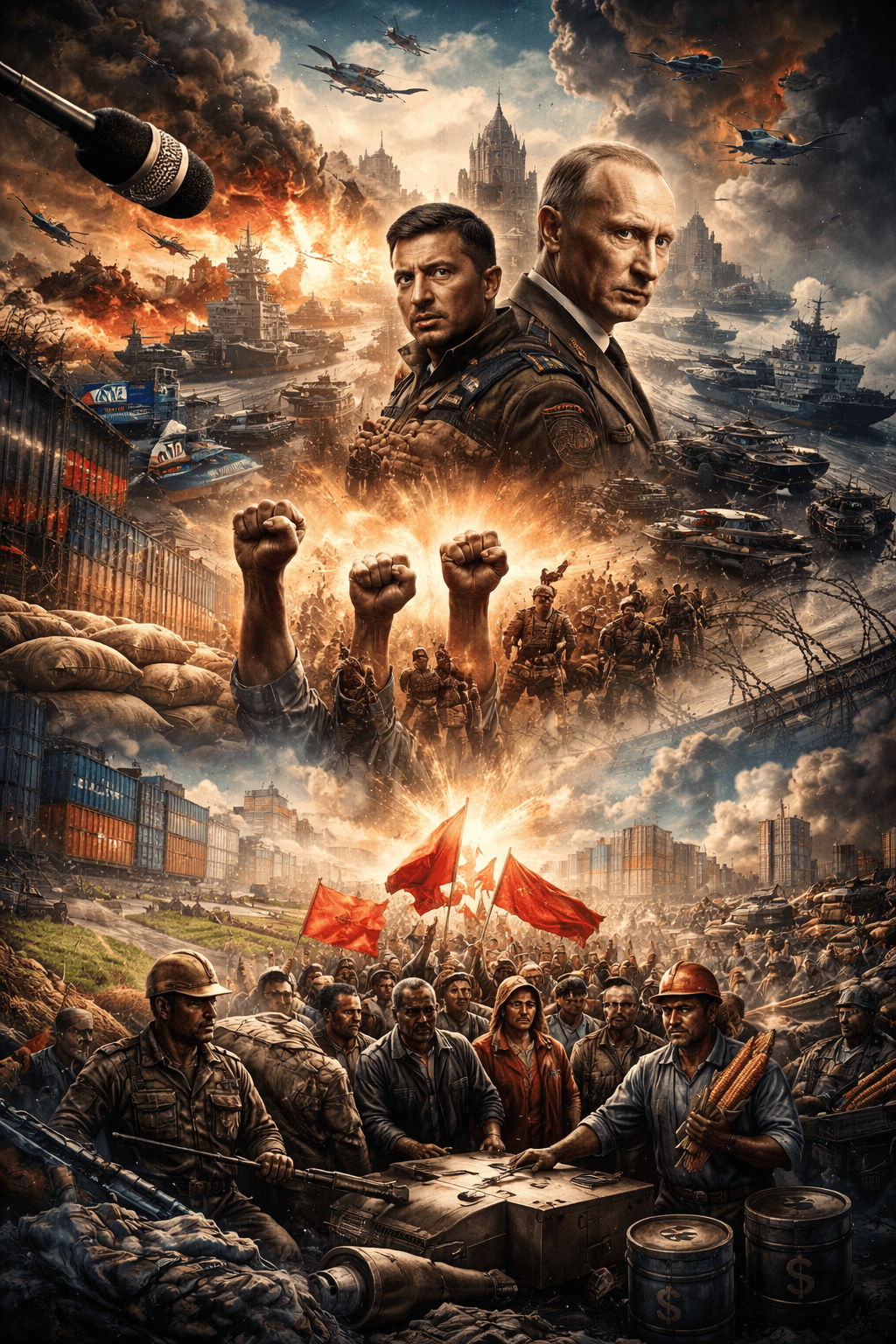
This essay excavates the BBC’s framing of the Ukraine war to reveal how catastrophe rhetoric and moral personalization manufacture consent. It reconstructs the documented record—NATO expansion, U.S. strategic doctrine, Minsk diplomacy, sanctions, and militarization—to widen the frame beyond headline urgency. It then situates the conflict within the deeper contradiction between imperial hegemony and national sovereignty, centering the costs borne by workers and the Global South. Finally, it calls for organized internationalist action rooted in existing anti-war, labor, and sovereignty movements.
By Prince Kapone | Weaponized Information | February 24, 2026
When “World War Three” Becomes a Headline, Not a Question
The BBC piece under excavation—Jeremy Bowen’s interview with Volodymyr Zelensky—arrives dressed in the sober suit of “international editing,” but it moves with the choreography of wartime storytelling. Its central claim is not argued so much as declared: Putin has already started World War Three, and the only responsible posture is pressure, pressure, more pressure—until the aggressor “steps back.” The headline does the work of a battalion. “WW3” is not presented as a contested proposition, not a term to be tested, measured, or interrogated, but as a moral flare shot into the sky: look up, feel the danger, accept the urgency.
Bowen stages the encounter in a heavily guarded government enclave, and the narrative lingers on the ritual of entry—security checks, a fortified compound, the diligence of guards—so that the reader feels the gravity before a single argument is weighed. Authority is established through atmosphere. The setting says: this is real, this is serious, this is the center of history. Zelensky is rendered not merely as a politician but as a figure under siege whose physical environment verifies his moral claim. Even his biography is mobilized as proof of resilience: the entertainer who became president, the man who “seems remarkably resilient.” Politics becomes personality, and personality becomes a substitute for structure.
The interview’s emotional pivot is territorial, but not in the dry language of lines on a map. Zelensky frames concessions as “abandonment,” as the weakening of positions and the desertion of “hundreds of thousands of our people.” Here the article does something very specific: it converts negotiation into betrayal. Withdrawal becomes a moral wound, not a strategic calculation. The logic is powerful because it is intimate—homes, lives, society dividing—while the alternative is rendered cold and suspect, a “price” that would satisfy Putin “for a while.” The reader is invited to inhabit the feeling of treachery before considering the mechanics of settlement. Land is not discussed as territory; it is discussed as fidelity.
The piece also relies on a subtle but decisive compression of time. We are placed inside a war already underway, inside a present of urgency, inside a clock that ticks only forward: a ceasefire gives Russia time to recover; recovery leads to the next war; the next war threatens Europe; therefore pressure must intensify now. The past is mostly absent, and the future is invoked as dread. This creates a narrow corridor of permissible thought: if you accept the corridor, any hesitation looks like complicity. That is the function of “WW3” language—once the conflict is placed on the world-war escalator, there are only two positions left: stop it immediately, or be responsible for what comes next.
Notice, too, how skepticism is rationed. Donald Trump appears as a disruptive variable—pressuring Ukraine to “come to the table,” defaulting to more pressure on Kyiv than Moscow, repeating claims Zelensky labels “untruths.” Yet this skepticism is aimed like a flashlight with a tight beam. It illuminates one figure’s contradictions while leaving the broader narrative architecture intact. The reader is permitted to doubt Trump’s reliability, even to chuckle with Zelensky’s dismissal—“I am not a dictator, and I didn’t start the war”—but the larger framing remains undisturbed: the war is presented chiefly as a test of resolve, a struggle whose moral meaning is already settled.
Finally, the article leans on civilizational language that quietly widens the battlefield beyond tanks and trenches. Russia, Zelensky says, wants to “impose on the world a different way of life.” The conflict is thereby described not only as an invasion but as an assault on chosen lives, on a world people have selected for themselves. It is a strong phrase, and it functions like a solvent: it dissolves political complexity into existential threat. When a rival is cast as an imposer of “a different way of life,” the question ceases to be what is being fought over and becomes who is allowed to exist as they are. That is not merely a description; it is a narrative weapon. And like most weapons, it is most effective when it is carried as common sense.
This is the article’s craft: make catastrophe a premise, make the leader a vessel of national will, make concession synonymous with abandonment, make the future a looming certainty, and aim skepticism only where it does not threaten the storyline’s foundation. The prose is calm, the posture is serious, the scene is solemn—and precisely because of that calm, the escalations glide in almost unnoticed. The reader is not shouted into agreement; they are escorted there, through a guarded corridor, into a conclusion that has already been furnished and lit.
The Record Beneath the Headline
Before we widen the frame, let’s state clearly what the BBC actually tells its readers. President Volodymyr Zelensky says Vladimir Putin has “already started” World War Three and argues that only intensified military and economic pressure can stop him. He rejects territorial concessions in Donetsk, Kherson, or Zaporizhzhia, calling withdrawal an abandonment that would divide Ukrainian society. He defines victory first as the preservation of independence and the prevention of further Russian advance, while maintaining that the borders of 1991 remain the ultimate horizon. The article also reports friction with Donald Trump over negotiations and aid, notes that while US weapons shipments have slowed, intelligence cooperation continues, and records Zelensky’s insistence that meaningful security guarantees must precede any elections conducted under martial law. Those are the positions placed before the public.
If the language of “World War Three” narrows the field of vision, the documentary record widens it. The conflict sits within a measurable post–Cold War transformation of European security architecture. NATO, founded with 12 members in 1949, expanded in successive waves after 1999. By early 2026, following Finland’s accession in April 2023 and Sweden’s accession in March 2024, the alliance had reached
32 member states. The 2008 Bucharest Summit declaration formally stated that Ukraine “will become a member of NATO,” placing future accession on the strategic horizon.
Declassified US archival material complicates the story of enlargement. The National Security Archive documents what it describes as a
“cascade of assurances” given to Soviet leadership in 1990–91 during negotiations over German reunification, in which NATO’s eastward expansion was discussed in ways later interpreted by Moscow as contradictory to subsequent enlargement. Whether legally binding or not, the archival record shows enlargement became a central grievance in Russian security discourse throughout the 1990s and 2000s.
Strategic doctrine from Washington during the same period established an explicit priority of maintaining US primacy. The declassified 1992 Defense Planning Guidance draft stated that US policy should
“prevent the re-emergence of a new rival” capable of dominating a region whose resources could generate global power. A decade later, the
2002 National Security Strategy formalized a posture of sustained military predominance and articulated a willingness to act preemptively against emerging threats.
Strategic literature of the 1990s further clarified how Eurasia was understood within this framework. In The Grand Chessboard, Zbigniew Brzezinski wrote that
“Ukraine, a new and important space on the Eurasian chessboard, is a geopolitical pivot” and that without Ukraine, Russia “ceases to be a Eurasian empire”. This framing placed Ukraine at the center of long-term geopolitical contestation.
The 2014 Maidan coup in Kyiv also unfolded with documented US involvement. In December 2013, Assistant Secretary of State Victoria Nuland stated publicly that the United States had invested
over $5 billion in Ukraine since 1991 in support of what she described as democratic development. In February 2014, a leaked phone call between Nuland and US Ambassador Geoffrey Pyatt—widely reported in international media—captured discussion of preferred post-Maidan political leadership arrangements, including the statement that
“Yats is the guy”, referencing Arseniy Yatsenyuk, and more famously, “fuck the EU” if Europe didnt approve.
The Minsk II agreement of February 2015 sought to establish a ceasefire and a framework for decentralization in eastern Ukraine. Subsequent monitoring by the OSCE Special Monitoring Mission documented
93,902 ceasefire violations recorded in 2021 alone, indicating persistent instability before the 2022 escalation. In 2022, former German Chancellor Angela Merkel stated that the agreement had been an effort to
“give Ukraine time” to become stronger, a characterization that reshaped retrospective interpretations of the accord.
Following Russia’s February 2022 invasion, Western governments imposed sweeping sanctions. According to the
International Monetary Fund’s World Economic Outlook data, Russia’s GDP contracted by approximately 2.1% in 2022, followed by reported growth of 3.6% in 2023 and continued growth estimates in 2024–2025. Meanwhile, the European Union’s
18th sanctions package (July 2025) lowered the Russian oil price cap to $47.60 per barrel and expanded enforcement measures targeting maritime transport.
Energy trade patterns shifted measurably. Independent monitoring of Russian fossil fuel exports shows China and India emerging as dominant buyers, with detailed breakdowns indicating substantial rerouting of crude exports toward Asia by late 2025. Data compiled by the Centre for Research on Energy and Clean Air demonstrates
China and India accounting for the majority of Russian crude exports in December 2025.
Military-industrial indicators also shifted. The Stockholm International Peace Research Institute reported that the United States increased its share of global arms exports to
43% of global arms exports in the 2020–24 period. Parallel reporting by the International Institute for Strategic Studies documented that
global defense spending reached new highs in 2025, with significant real-term increases across Europe.
Beyond Europe, the war’s economic effects were measurable. The FAO’s State of Food Security and Nutrition report indicates that global food price shocks following 2022 contributed to sustained high levels of food insecurity, with
hundreds of millions facing chronic undernourishment in the mid-2020s, particularly across Africa and parts of Asia.
On the human cost inside Ukraine, the UN Human Rights Monitoring Mission reported as of February 16, 2026 that it had verified
15,172 civilian deaths and 41,378 civilian injuries since February 24, 2022, noting that verified figures represent an undercount.
These are the measurable coordinates: expansion of military alliances, formal strategic doctrines of primacy, documented political involvement, ceasefire instability, sanctions escalation, trade realignment, rising arms exports, food insecurity, and civilian casualties. They do not interpret the war. They situate it.
Empire in Denial, Sovereignty in Revolt
The papers do not lie. They sit there in their bureaucratic calm, stamped and archived, whispering what the television dare not say. The war in Ukraine did not fall from the sky like a thunderbolt from Zeus. It crawled forward through memoranda, summit declarations, expansion maps, and strategic doctrines written in the cool language of men who believe history is a management problem. NATO grows from 12 to 32 members. Policy drafts speak of preventing rivals before they are born. Ukraine is described, long before the first trench is dug, as a pivot on a Eurasian chessboard. And then we are told, with straight faces, that everything is sudden.
The post–Cold War order was not a garden of equals. It was a pyramid. At the top sat the United States, not merely powerful but managerial — custodian of the dollar, commander of the most expansive military alliance in history, steward of financial institutions that could reward obedience and punish deviation. The 1992 Defense Planning Guidance did not promise coexistence; it promised prevention. The 2002 National Security Strategy did not whisper humility; it announced preemption. Empire, when it writes about itself, prefers the word “stability.” Stability, in this vocabulary, means everyone stays below.
Russia did not sit at the top of that pyramid. It did not issue the world’s reserve currency. It did not supervise global debt. It did not administer structural adjustment to African treasuries. It entered the 1990s battered, privatized, looted, and partially integrated into Western capital on uneven terms. Its oligarchs were welcome so long as they behaved. Its state was tolerated so long as it complied. It was expected to be junior — nuclear, yes; sovereign in theory, yes; but disciplined within the architecture of Atlantic management.
NATO did not stop at the Elbe. It moved eastward, wave after wave, polite in rhetoric, relentless in practice. Assurances became archival footnotes. “Open door” became doctrine. Ukraine — described decades earlier as a geopolitical pivot — drifted closer to Atlantic institutions. Moscow protested; Washington shrugged. In imperial grammar, encirclement is called enlargement. Only those inside the circle are permitted to define the shape.
When a unipolar order structured to prevent rivals meets a state that refuses permanent incorporation, the collision is not tragic misunderstanding. It is structural inevitability. This does not sanctify the invasion. It explains the pressure. The war is not a morality play between angels and devils; it is the sound of a hierarchy encountering resistance.
Consider the sanctions. Announced with the confidence of men who control clearinghouses, they were meant to isolate, suffocate, collapse. Russia’s GDP contracted. Then it grew. Oil did not vanish; it changed direction. Tankers sailed east instead of west. The dollar, weaponized, revealed itself as political property. Reserves were frozen by decree, and the Global South took careful note. When the empire shows that currency can be confiscated, others begin to imagine alternatives. What was intended as punishment became a seminar in financial sovereignty.
Let us be precise: Russia is not a workers’ republic. It is a bourgeois-national state, capitalist in structure, oligarchic in texture, governed by elites no more interested in proletarian emancipation than their counterparts in Brussels or Washington. But history does not wait for purity. A counterweight need not be virtuous to be consequential. By refusing subordination and absorbing sanctions without collapse, Russia weakened the aura of inevitability that surrounded U.S. enforcement. The emperor did not fall — but the robe tore.
Meanwhile, the costs descended. Energy bills rose across Europe. Grain disruptions tightened markets from Cairo to Colombo. Food insecurity deepened. NATO budgets swelled to historic highs while social programs strained. U.S. arms manufacturers captured record shares of global exports. The assembly lines hummed; the grocery aisles thinned. Empire, like all pyramids, is financed from below.
We are told this is democracy versus autocracy, light versus darkness. Such theater is useful. It spares us from discussing pipelines, payment systems, and capital flows. The record suggests something less operatic and more material: a unipolar system organized to maintain supremacy confronting the limits of its expansion. The resistance to that system does not automatically produce justice. It produces fracture. And fracture, in a rigid structure, is the beginning of transformation.
Multipolarity is not redemption. It is terrain. It is the uneven unraveling of singular command. It is a world in which the dollar is questioned, in which energy contracts diversify, in which states hedge rather than kneel. It does not abolish exploitation. It does not dissolve oligarchies. But it reduces the monopoly of coercion. It makes space.
The real question is not which flag claims which trench. It is whether the workers who finance this hierarchy — in Detroit, Donetsk, Delhi — will continue to subsidize the preservation of dominance, or whether they will recognize in this fracture an opening. Empire insists the war is about values. The archive suggests it is about power. And history, as Marx once reminded us with a smile sharp as a blade, has a habit of repeating itself — first as strategy, then as farce.
From Fracture to Frontline: Organizing in the Age of Primacy’s Decline
If this war reveals the strain of a unipolar order defending its position, then the answer cannot be another press conference or another summit communiqué. The record shows who pays: workers in Europe absorbing energy shocks, farmers in Africa navigating fertilizer price spikes, families in Asia tightening budgets under food inflation, young conscripts on all sides buried beneath flags. The maintenance of primacy is not financed in think tanks. It is financed in kitchens. And what is financed from below can be contested from below.
Across the Atlantic world, cracks have already appeared. The No Cold War network in Britain and allied formations in Europe and North America have insisted that escalation is not strategy but inertia. Anti-war coalitions have challenged the idea that permanent militarization equals security. Sections of organized labor have begun asking the unfashionable question: why are defense budgets rising while social protections erode? When dockworkers hesitate over arms shipments, when unions debate war production, when municipal councils question procurement contracts, those are not footnotes — they are pressure points.
In the Global South, the politics of this war is felt not in speeches but in markets. Food sovereignty movements, peasant organizations, and debt relief campaigns increasingly trace price shocks and currency volatility back to sanctions architecture and energy disruption. For them, geopolitics is not chessboard theory; it is grain storage and irrigation. Their demand is simple and radical: development without punishment. When they push for agricultural autonomy, regional trade in local currencies, or insulation from financial coercion, they are carving out breathing room in a fractured order.
At the inter-state level, alternative development banks, local currency settlement mechanisms, and BRICS coordination reflect a broader impulse to reduce exposure to dollar weaponization. These initiatives are not socialist miracles. They are imperfect, state-driven, often elite-managed. But they signal something important: the monopoly of coercion is weakening. And every crack in enforcement widens the space in which popular forces can maneuver.
For socialist and working-class movements in the Global North, clarity is essential. The task is not to tail Moscow nor to cheer Washington. It is to oppose the doctrine that demands endless supremacy. Demand full public accounting of arms contracts. Challenge military budgets that expand while housing, healthcare, and education are squeezed. Link anti-war activism with labor struggles so that those asked to manufacture weapons can also demand schools, wages, and democratic oversight. Internationalism begins not with slogans but with coordination — between unions, peasant movements, debt justice campaigns, and anti-militarist networks.
Workers in Ukraine deserve security without being transformed into symbols in a civilizational drama. Workers in Russia deserve freedom from sanctions that harden oligarchic consolidation while tightening belts in provincial towns. Workers in NATO states deserve social investment not subordinated to weapons procurement timetables. These demands do not contradict one another. They expose the common thread: ordinary people are underwriting a hierarchy they did not design.
History does not move only through offensives and counteroffensives. It moves when people withdraw consent. When unions question war budgets, when students expose the pipeline between universities and weapons firms, when communities connect food insecurity to sanction regimes, negotiation becomes thinkable. Empire prefers inevitability. Organization restores contingency.
The fracture of unipolar enforcement does not guarantee justice. It opens terrain. What fills that terrain depends on whether movements can translate analysis into structure — committees, coalitions, cross-border solidarity. The archive tells us how we arrived here. The balance of forces will determine what comes next. And that balance is not written in summit declarations. It is written wherever working people decide that supremacy is too expensive to subsidize any longer.

 The New Dark Age
Leave a comment