Thursday, 23 April 2026 — The Tricontinental
The way Iran has been able to stand up to the West has become a source of admiration across the formerly colonised world. Where does that confidence come from?
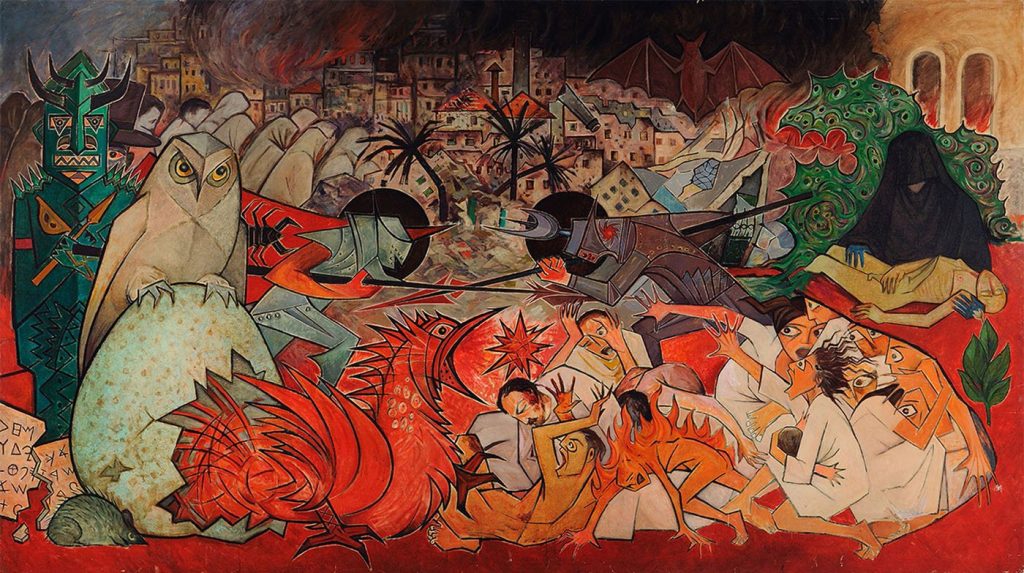 Abdel Hamid Baalbaki (Lebanon), War, 1977.
Dear friends,
Greetings from the desk of Tricontinental: Institute for Social Research.
During some of the worst days of the illegal US-Israeli war on Iran, I was talking to friends who were in the civilian areas being bombed. Some of them are scholars, others poets and artists, some work in the government, others in institutions of different kinds. All of them, regardless of their views of the government, stood defiant. Not one person felt that their world was under threat. They remained steadfast, their courage emanating from an immense belief in the resilience of Iranian civilisation.
Marxist and national liberation thought have had a very complex history with the concept of ‘civilisation’. Classical Marxism rejected it, since it could flatten social division under a blanket of cultural homogeneity and therefore negate the necessity of class struggle. But as Marxism became a crucial framework in the great anticolonial struggles of the post-World Anti-Fascist War era, the idea of civilisation returned with a different meaning. Civilisation came to be understood as a valuable terrain in the cultural struggle against imperialism. It could become an instrument of national continuity and political legitimacy rather than simply an ideological mask for class domination. Yet this reclamation of civilisation had to be carried out from the standpoint of an emancipatory project willing to break with certain reactionary inheritances within that civilisation itself.
In the case of China, for instance, Chinese Marxism – best synthesised by Mao Zedong – insisted on a break from the worst inheritances of pre-revolutionary China, such as Confucian hierarchy and sexism, at the same time as it adopted, through class struggle and ideological transformation, the very idea of ‘Chinese civilisation’ as a bulwark against imperialism and for the development of national patriotism.
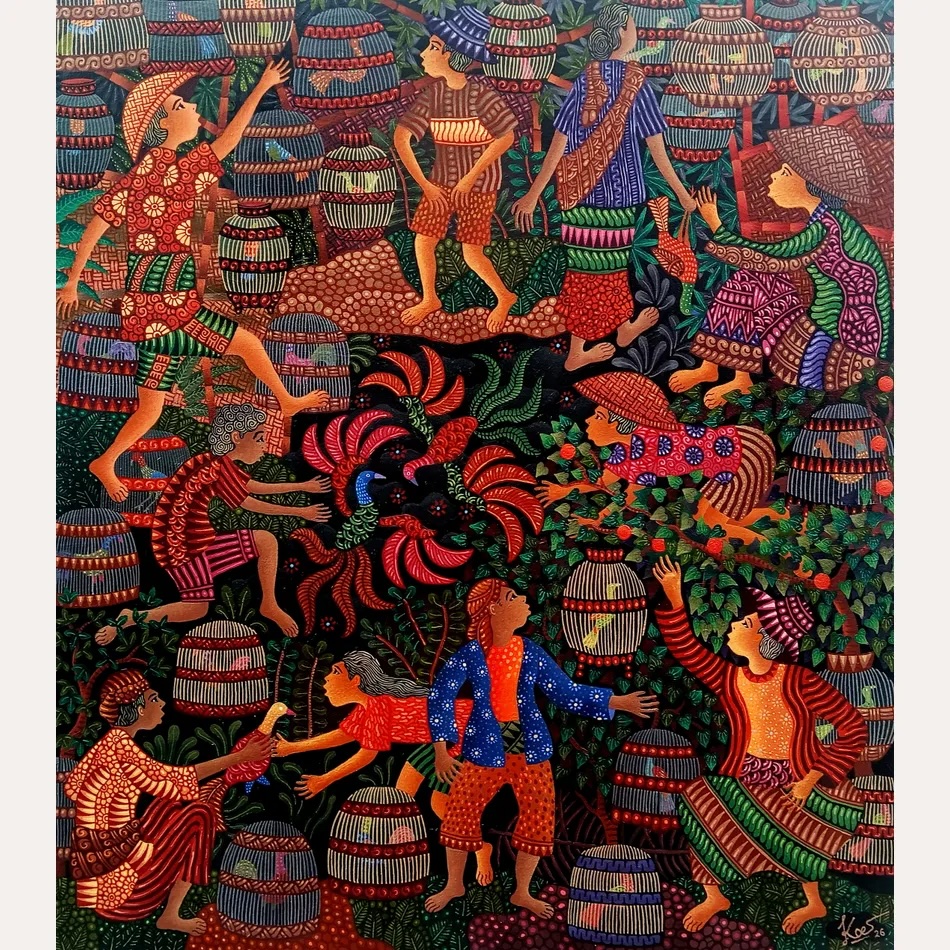 (Indonesia), Bird Market, 2026.
The Iranian Revolution (1978–1979) was made by a range of political forces, including Marxists, many of whom were subsequently persecuted and killed by the newly created Islamic Republic. Despite their subjugation, many Marxist ideas entered the ideological framework of the Islamic Republic, whether through the work of a range of thinkers with their own histories with Marxism such as Ehsan Tabari (1917–1989), Jalal Al-e Ahmad (1923–1969), Ali Shariati (1933–1977), Bijan Jazani (1938–1975),
or Khosrow Golsorkhi (1944–1974). I wish I could write more about these thinkers, but that would take an entire book. The most compelling was Golsorkhi, who was killed in his prime. He told a rattled judge at his trial:
I begin my words with a saying of Mowla [Imam] Hossein, a great martyr for the peoples of the Middle East. I, who am a Marxist-Leninist, first sought social justice in the school of Islam, and from there arrived at socialism. I will not bargain for my life in this court, nor even for my lifespan. I am an insignificant drop from the struggles and deprivation of the fighting peoples of Iran… Yes, I will not bargain for my life, for I am the child of a fighting and courageous people. I began my words with Islam. True Islam in Iran has always repaid its debt to Iran’s liberation movements. The Seyyed Abdollah Behbahanis, the Sheikh Mohammad Khiyabanis, are true embodiments of these movements. And today too, true Islam repays its debt to Iran’s national liberation movements. When Marx says, ‘In a class society, wealth accumulates on one side and poverty, hunger, and misery on the other, while those who produce wealth are themselves deprived’, and Mowla [Imam] Ali says, ‘No palace is erected unless thousands are impoverished’, there is a profound similarity. Thus, one can name Mowla [Imam] Ali as the first socialist in history, and likewise the Salman Farsis and Abu Dharr Ghaffaris.
By the time of the revolution, the Iranian left – divided among the Fedayeen guerrillas, the communist Tudeh Party, and the Islamist-revolutionary Mujahideen – had come to understand that they could not overthrow the Shah without the religious forces. But they underestimated the power of the clerics over Iranian society, including over the working class. It was this miscalculation that transformed the
Iranian Revolution into the Islamic Republic within a year. Yet rather than form an ordinary theocracy, post-revolutionary Iran drew on a much older civilisational inheritance, one that dates back to the rule of Cyrus the Great (559–530 BCE) and the Achaemenid Empire (c. 550–330 BCE) – roughly two thousand years before the arrival of Shi’ism as the state religion in Iran during the Safavid Empire (1501–1736). It is this older civilisational inheritance that plays a foundational role in Iranian society, enabling it to absorb internal differences and to summon a deeper historical legitimacy at times of terrible crisis as the basis for the defence of sovereignty. In 1971, the Shah held a massive event at Persepolis to celebrate 2,500 years of continuous civilisation since Cyrus the Great. Later, during Iraq’s war of aggression on Iran from 1980 to 1988, when Saddam Hussein tried to cast the conflict as a war of Arabs against Persians, the Islamic Republic rejected that framework and insisted that this was rather a ‘defence of the homeland’ (دفاع از وطن, defa’ az vatan), drawing on the idea of an unconquered and uncolonised land that must be defended at all costs by its people.
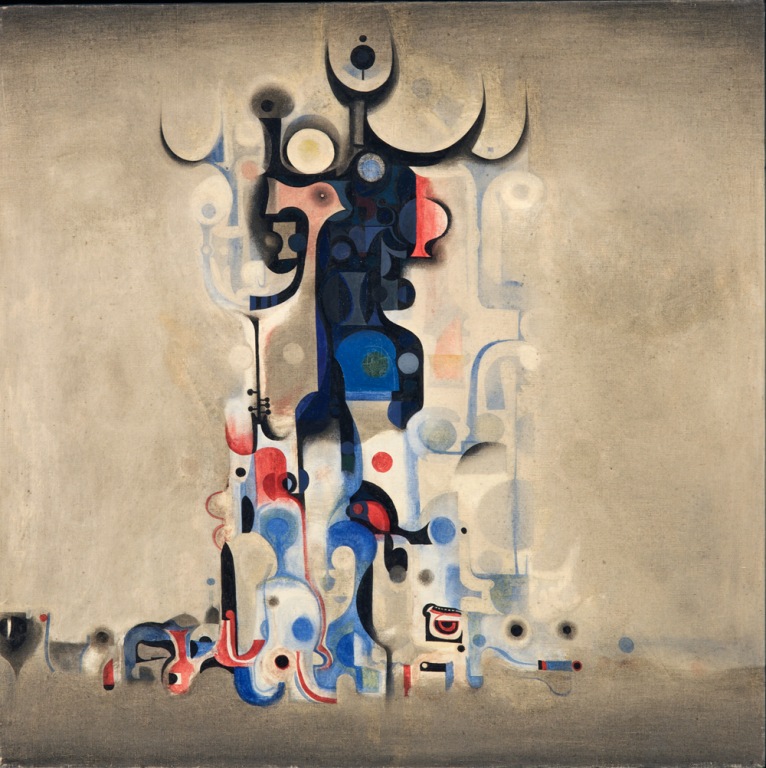 Ibrahim El-Salahi (Sudan), Vision of the Tomb, 1965.
It is difficult for those who do not come from colonised societies to understand the power of such statements as ‘defence of the homeland’ and of the idea of civilisational inheritance. The damage caused to so many social formations by colonialism is vast. Colonialism steals wealth and reinvests it elsewhere for the development of other peoples; it denigrates the colonised peoples’ cultures and often denies them their own language and their own sense of a historical mission. That is why so many people in the Global South marvel that Iran has been able to stand up to the United States and win the current conflict in strategic terms.
For those who share that history of obliteration, to witness the kind of dignity displayed by societies such as China or Iran, where there is less need to fashion cultural pride out of hallucinations (through the creation of imagined pasts) or by vilifying others (whether minorities or foreigners), is nothing short of inspiring. The lack of total colonial destruction of culture in such places allows for their own
history to be reclaimed and reconstructed without being totally caught up in false reversals of the West (often equal parts rejection and mimicry). It is the kind of confidence that faces the destructive power of the United States with dignity and has the courage to send back Lego memes of Trump and his associates that are not about empty mockery but about genuine disdain.
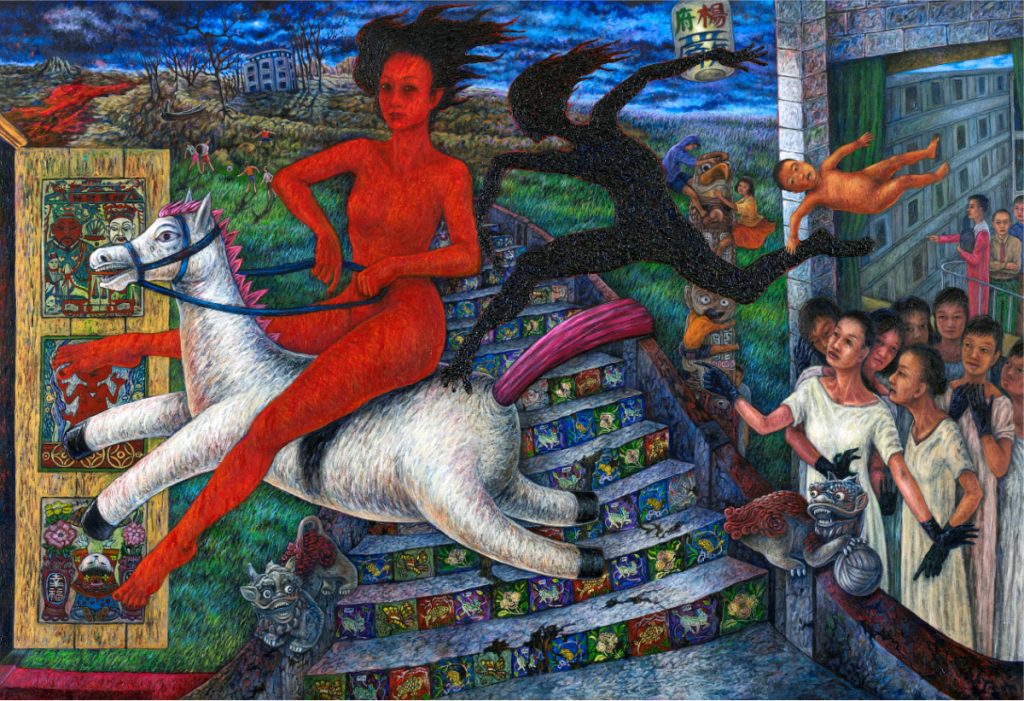 Eng Hwee Chu (Malaysia), Beyond the Border, 2014.
In December 1997, the Organisation of the Islamic Conference (OIC) released the Tehran Declaration, which advanced the idea of a ‘Dialogue of Civilisations’. This was a direct response to Samuel Huntington’s 1993 essay and 1996 book The Clash of Civilisations and the Remaking of World Order. In that initial essay, published in Foreign Affairs, Huntington predicted that ‘Conflict between civilisations will be the latest phase in the evolution of conflict in the modern world’. For Huntington, history had moved from the clash of ideologies (communism versus capitalism) to the clash of civilisations (which he defined in religious-cultural terms as ‘Western, Confucian, Japanese, Islamic, Hindu, Slavic-Orthodox, Latin American, and possibly African civilisation’). Huntington warned that the new fault lines would be along these axes. The OIC cautioned that this way of seeing the world might produce the very conflict it claimed to describe rather than prevent it, and that it would be better to hold a dialogue of civilisations rather than await the conflict between them.
The Tehran Declaration found traction within the United Nations (UN) but not in the halls of Western capitals, where the rhetoric of the War on Terror – which predated 2001 – escalated out of control. Fear of Islam became routine, and it was quickly associated with fear of migrants, a dual fear that continues to paralyse Europe and the Americas. In 1998, the UN proclaimed 2001 the Year of Dialogue Among Civilisations, and at the 31st General Conference of the UN Educational, Scientific, and Cultural Organisation, held in Paris from 15 October to 3 November 2001, it selected the Iranian philosopher and diplomat Ahmad Jalali as its president and invited Iran’s president, Seyyed Mohammad Khatami, to address the body. The conference took place little more than a month after the attacks on the US in September and during the US invasion of Afghanistan as part of its Global War on Terror. Khatami’s address remains powerful, asking the world not to yield to ‘false political polarisations and divisions’. Terrorism ‘is the result of the sinister union between blind intolerance and brute force, with the goal of serving an illusion which, despite all its propaganda, is nothing but the projection of the harmful contents of the unconscious’.
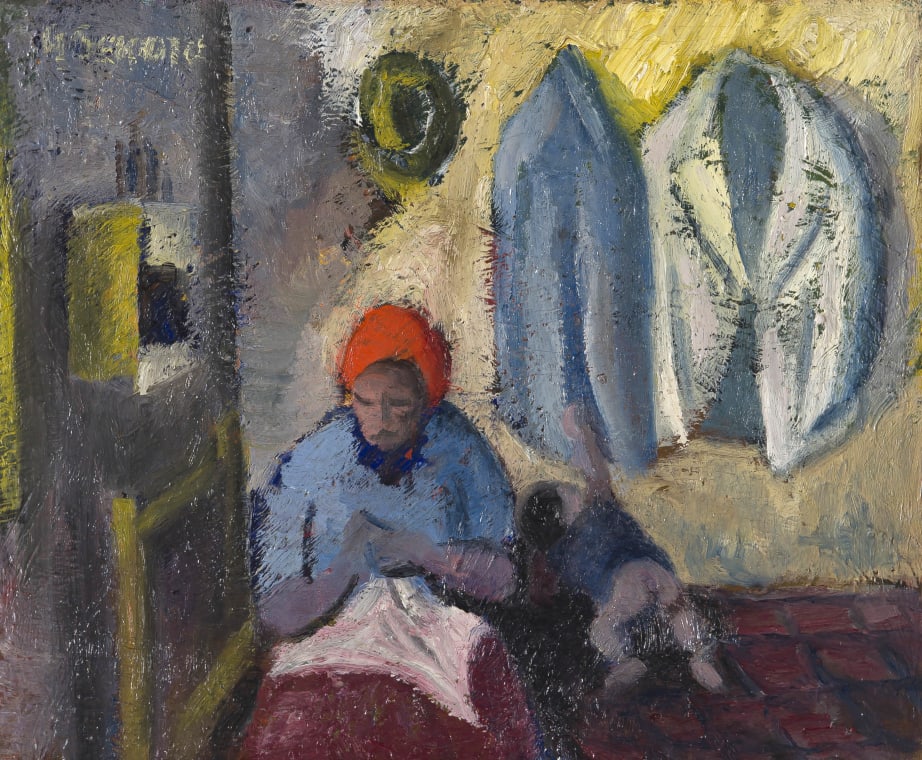 Gerard Sekoto (South Africa), Mother and Baby, 1943–1945.
When a terrorist attack happens, the worst thing, Khatami said, is to respond with revenge. ‘Revenge is like salt water which, though it looks like water, increases the thirst rather than satisfying it, thus entangling the world in perpetual outbreaks of violence, hatred, and revenge’. Rather than revenge, Khatami insisted, dialogue ‘is the principal need of the international community’.
A call for dialogue is important and necessary because the alternative is driving us toward annihilation – both through the system of capitalism that deepens inequality and drives planetary destruction and through the system of imperialism that devours societies with war. But neither civilisation nor dialogue will by themselves drive history toward human emancipation. For that, in time, the class struggle will have to intensify, human needs will have to overcome material inequalities and power relations, and the global system will have to be transformed to meet our complex destinies rather than turn us against one another.
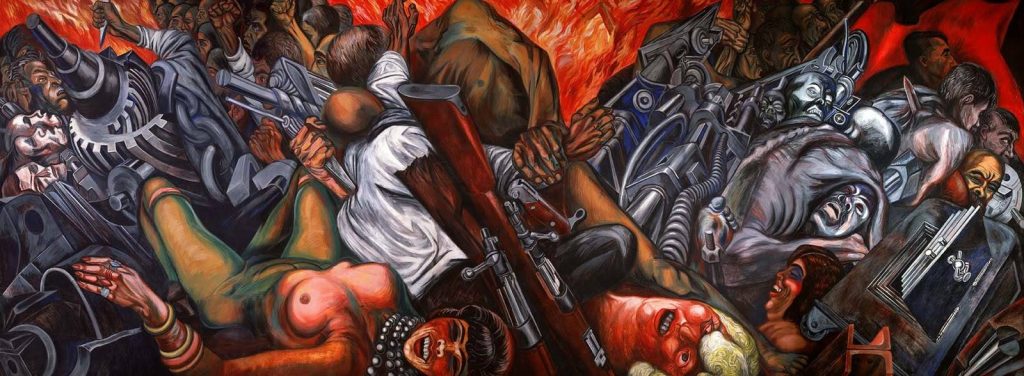 José Clemente Orozco (Mexico), Katharsis, 1934–1935.
Carlos Gutiérrez Cruz (1897–1930) developed his poetic sensibility amid the literary currents of post-revolutionary Mexico, including the patriotic group Contemporáneos (Contemporaries), but later broke with them as he became more radical. In 1923, he published Cómo piensa la plebe, folleto de propaganda libertaria en haikais (How the Plebs Think: A Pamphlet of Liberation Propaganda in Haikais), which turned the haikai form associated in Mexico with José Juan Tablada (1871–1945) into a vehicle for communist poetry. Gutiérrez Cruz understood that there was no sense in defending the nation if the masses of workers got nothing from it. The point bears repeating here: a civilisation cannot be defended as an abstraction. If it is to mean anything, it must be defended as the living record of those who make history. As he put it in one of his haikais:
Labriego, la tierra da ciento por uno
y tú ganas uno por ciento.Peasant, the land yields a hundred from one
and you earn one from a hundred.
Warmly,
Vijay


Leave a Reply