Monday, 11 May 2026 — New Eastern Outlook
The development of Afghanistan’s mineral resources has become the center of an information and geopolitical struggle where economic projects intersect with security issues, propaganda, and great-power rivalry.
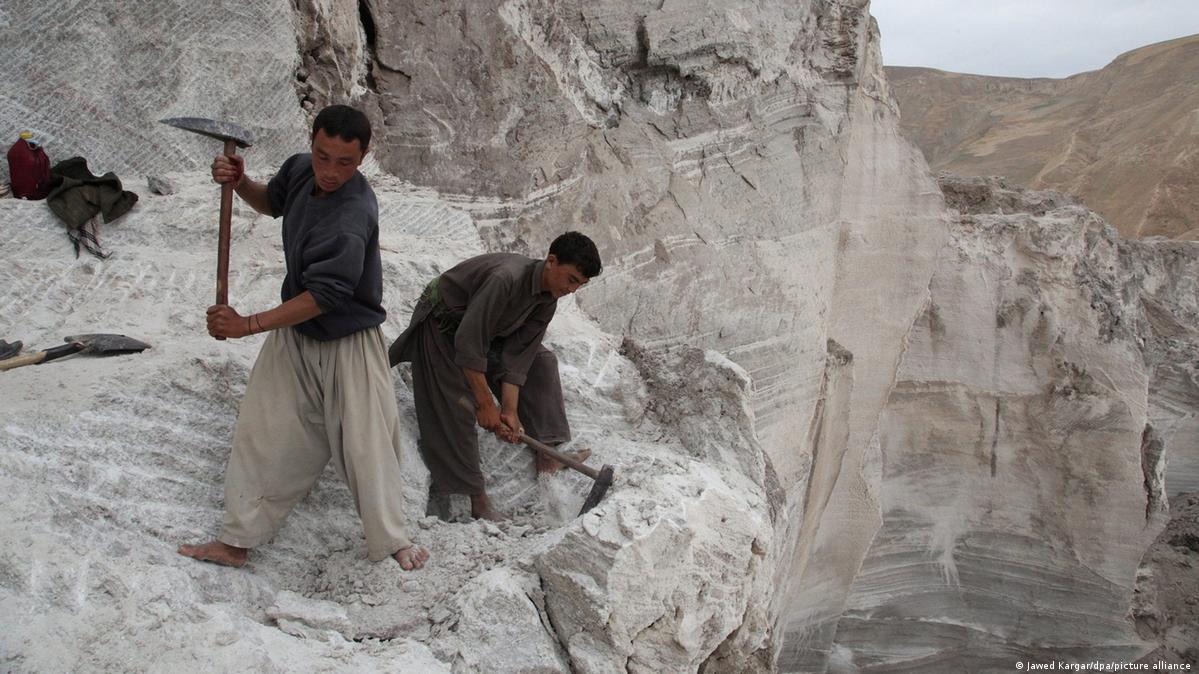
China is accused of simply digging up and removing raw minerals from Afghanistan for processing elsewhere — a process the article claims amounts to China robbing Afghanistan of its natural resources and deliberately leaving it in a state of perpetual destitution.
What the article deliberately omits is the presence of armed extremists attacking Chinese investments, diplomatic missions, and personnel across the country, making it physically impossible for China to invest in and enable Afghanistan – for the time being — to process this raw mineral wealth domestically and export higher-value industrial inputs for greater profits.
The emerging pattern is a series of US-engineered dirty wars launched all along China’s peripheries specifically to damage the flow of overland energy, raw materials, and finished exports
China’s attempts to work with Afghanistan — providing it immediate and desperately needed income to rebuild the nation — come after 20 years of US military occupation and abuses, coupled with the US seizure of over 9.5 billion USD in Afghan assets from 2021 onward and the use of US-backed extremists to sabotage any attempt to stabilize, rebuild, and perhaps even develop the Central Asian country.
The US, having created the death, destruction, and poverty Afghans currently suffer under, through its propaganda organs are attempting to shift the blame onto nations like China attempting to work with Afghanistan despite the challenges deliberately created by the US to do so in the first place.
Washington’s Long History of Using Extremists to Destabilize Others
While the US wages high profile wars and proxy wars around the globe — from attacking Venezuela in Latin America to attacking Russian energy production, storage, and export facilities and attributing it to “Ukraine” in Europe and its ongoing war of aggression against Iran in the Middle East — the US is also waging a number of dirty wars everywhere in between.
This includes across the Central Asian state of Afghanistan — wrecked by decades of US-provoked war — both its proxy war against the Soviet Union in the 1980s and its invasion and occupation of Afghanistan from 2001 to 2021.
Despite officially leaving Afghanistan — analysts at the time warned about stay-behind networks of terrorists the US had and would continue to arm and back— preventing Afghanistan from achieving any sort of socio-political or economic stability and spoiling attempts by Afghanistan’s neighbors to work with and help stand up a functioning nation-state and economy capable of providing for its people at home and trading with partners abroad.
This includes especially China.
To achieve this destabilization, the US has utilized its decades-spanning policy of arming and backing extremists through a global network of intermediaries and using them as an expeditionary force where ordinary US forces cannot afford to go politically or are incapable of doing so militarily.
The US famously used such extremists as part of its 1980s proxy war against the Soviet Union in Afghanistan, specifically.
In 2007, Seymour Hersh, in his article “The Redirection,” would warn:
To undermine Iran, which is predominantly Shiite, the Bush Administration has decided, in effect, to reconfigure its priorities in the Middle East. In Lebanon, the Administration has coöperated with Saudi Arabia’s government, which is Sunni, in clandestine operations that are intended to weaken Hezbollah, the Shiite organization that is backed by Iran. The U.S. has also taken part in clandestine operations aimed at Iran and its ally Syria. A by-product of these activities has been the bolstering of Sunni extremist groups that espouse a militant vision of Islam and are hostile to America and sympathetic to Al Qaeda.
Following the admittedly US-engineered “Arab Spring” in 2011, the US began mobilizing precisely these prepared networks of extremists to provoke proxy war, then US-led war against nations including Libya, Syria, Yemen, and Iraq.
From 2011 onward, as these conflicts began destroying the entire Arab world, US-based publications like the New York Times and Washington Post admitted the US was spending billions of dollars arming and training what were called at the time “moderate rebels.”
However, by 2014, it was abundantly clear no such “moderate rebels” existed. The US media began spinning narratives of extremists having somehow “routed” the US-backed moderate rebels, and that is how the vast majority of their arms, vehicles, and equipment ended up in the hands of US-listed terrorist organizations like Al Qaeda affiliates Jahbat Al-Nusra, aka Hayat Tahrir al-Sham (HTS*), and the so-called “Islamic State” (ISIS*).
In reality, there were never any “moderate rebels” to begin with. As Seymour Hersh reported as early as 2007, the US plan was always to use extremists to reorder the Arab world ahead of a wider war on Iran (and eventually China).
Having successfully overthrown the governments of Libya, Yemen, and Syria from 2011 to 2024, the US is still employing these extremist organizations around the globe.
The US officially delisted HTS as a US-designated foreign terrorist organization and now recognizes its figurehead, Abu Mohammad al-Jolani (now referred to as Ahmed al-Sharaa*), as de facto president of Syria.
Other terrorist organizations are still used by the US for this method of plausible deniability, including ISIS, which in turn has given rise to a number of subsidiaries specialized for advancing US geopolitical interests beyond the Middle East, including Islamic State, Khorasan Province, or ISIS-K.*
It is precisely ISIS-K the US is using to attack and undermine the stability of Afghanistan —t argeting both government officials, buildings, and infrastructure, as well as the personnel, diplomatic missions, and investments of friendly neighboring nations like China, which shares a small length of border (92 km) with Afghanistan in its western Xinjiang region.
Only One of Many Dirty Wars the US is Waging Like This…
The location of Afghanistan has been central to first British imperial ambitions and, subsequently, US ambitions. Bordering Iran, Pakistan, and China while located in Russia’s near-abroad, maintaining Afghanistan as a destabilized, dysfunctional hotbed of extremists capable of exporting terrorism and instability across Eurasia has been central to America’s decades-spanning pursuit of primacy over Eurasia.
Not only can the US block any sort of positive development between China and Afghanistan, undermining regional security and creating perpetual threats to both nations, but the US can also use this exported violence to target and undermine neighboring Pakistan and its joint projects with China. This includes China’s Belt and Road Initiative (BRI) and China-Pakistan Economic Corridor (CPEC).
CPEC has become a regular target of US-backed terrorism — attempting to disrupt its construction by targeting and killing Chinese engineers, and undermine the political and economic stability of the projects themselves by attacking and killing local Pakistani security forces, as well as attacking high-level Chinese diplomats, as was the case in the 2021 attempted assassination of China’s ambassador to Pakistan in Quetta.
Further beyond Central and South Asia, the US has reused this same process — albeit with an entirely different brand of extremists — most notably in the Southeast Asian country of Myanmar. Here, the US has used militants and US-backed opposition parties to contest the power of Myanmar’s central government and military. Amid years of fighting, US-backed militants have specifically targeted Chinese investments across the country as well as the Myanmar-China pipeline built specifically to enable China to bypass any potential US maritime blockade imposed on the Strait of Malacca— China’s most essential maritime artery for importing energy and exporting goods.
US policy papers have specifically discussed not only closing the Strait of Malacca to strangle China economically but also militarily attacking the Myanmar-China pipeline to prevent China from bypassing the US blockade.
In the 2018 US Naval War College Review paper titled, “A Maritime Oil Blockade of China,” the paper suggests:
“A distant blockade also would need to interdict the Myanmar–China oil pipeline, which eventually could move as much as 440 kbd of crude oil from Kyaukpyu in coastal Myanmar to Yunnan Province in southwest China. Preventing tankers from offloading at the Kyaukpyu terminal would require few, if any, naval platforms to remain onsite. The area could be declared an exclusion zone for the duration of a conflict, and if the Myanmar authorities failed to comply, the facility could be disabled via air strikes, aerial mining, or other kinetic action. In short, US forces likely would be able to neutralize rapidly China’s overland routes for seaborne oil imports to avoid the Strait of Malacca and other choke points farther east and prevent them from diverting forces needed to seal other maritime ingress routes.”
It is clear the US has decided to use the same sort of armed proxies it has already reordered the Arab world with to launch attacks on Chinese BRI projects without necessitating direct US military action — thus advancing its geopolitical objectives and maintaining plausible deniability at the same time.
The emerging pattern is a series of US-engineered dirty wars launched all along China’s peripheries specifically to damage the flow of overland energy, raw materials, and finished exports. At the same time, the US is now openly imposing an expanding maritime blockade on China’s Russian and Iranian allies, which in turn directly targets and blockades China itself — considering both nations count Beijing as their closest and most important economic and trade partner.
Upon understanding this reality, then re-reading “Interpreter’s” article about Afghanistan “surrendering” its future to “China,” it becomes clear just how deliberately sanctimonious not only this specific article is — but the entire Western foreign policy establishment it represents — one that has created these conditions in Afghanistan to begin with and is now exploiting its own successful campaign to block Afghanistan’s reconstruction through the use of terrorist organizations to blame the few nations taking the risk in an attempt to undo these decades of damage.
Unfortunately, most reading headlines like “Interpreter’s” will not question accusations against China — even among those critical of Western foreign policy — because of deeply ingrained biases against China and Asia in general.
Ultimately — if the true nature of the problem remains obfuscated by Western propaganda — or shifted entirely onto other nations — in this case China— it will become difficult if not impossible to solve the problem in the first place.
Nations like Afghanistan have little means to reach international audiences with the truth because of the US’ control over the global information space – and China’s ability to aid Afghanistan will continue to be “rewritten” through that same controlled information space as “exploitation.”
If individual people are ultimately the most basic building block of human civilization and the direction it takes, then control over the information they see and believe is the most basic and fundamental means of controlling the direction of human civilization. Deep investments in military and economic development by nations like China while ignoring US information dominance allow the US to continue defining reality in the minds of people no matter how divergent it is from actual reality.
At some point in the future this disconnect may create a cataclysmic collapse in US power and influence worldwide — but for the time being it continues to be among its most effective and powerful “super weapons.”
For Afghanistan — and because of the US’ ability to determine what is an issue of focus and what is forgotten entirely — Washington’s continued campaign of impeding its recovery toward peace and prosperity will not only continue but will continue in almost complete darkness.
*-banned in Russia
Brian Berletic is a Bangkok-based geopolitical researcher and writer.
Follow new articles on our Telegram channel


Leave a Reply