Monday, 11 May 2026 — New Eastern Outlook
The European Union’s adoption of its 20th sanctions package against Russia on 23 April 2026 has triggered one of the sharpest responses from Beijing in recent years.
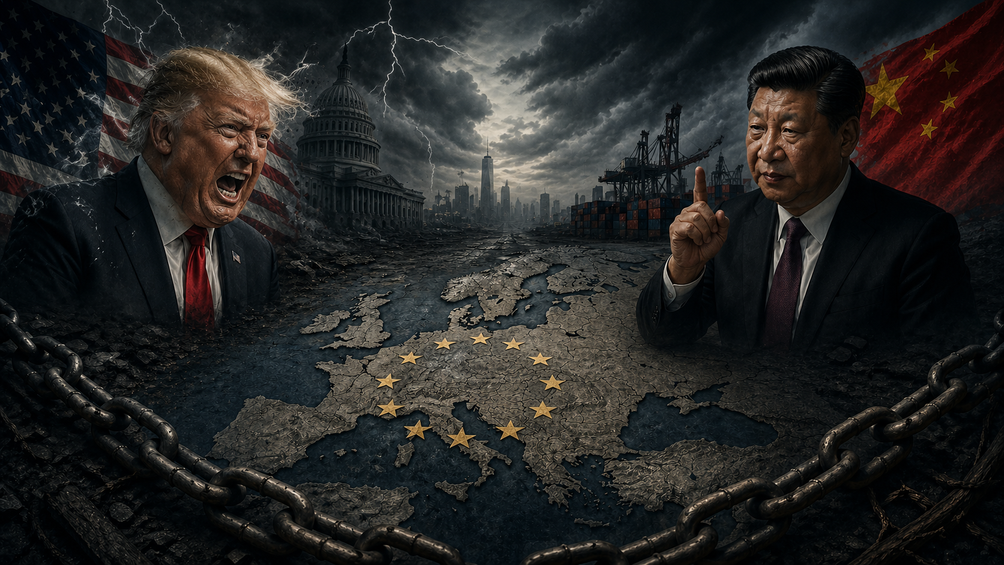
A Reaction That Signals More Than Discontent
Such language is not routine diplomacy. It is a calibrated warning that Europe may be approaching the limits of how far it can extend its economic pressure without triggering systemic pushback.
Europe still retains options, but they are narrowing under the weight of its own strategic choices
This is not simply about compliance or enforcement.
It is about the boundaries of influence in an increasingly resistant global system.
Sanctions Without Boundaries
By targeting Chinese firms accused of facilitating sanction circumvention or supplying dual-use components, the EU has effectively extended its sanctions regime beyond its original framework. From Brussels’ perspective, this is framed as a logical evolution of enforcement. From Beijing’s perspective, it is an extraterritorial application of policy that directly interferes with legitimate Chinese economic interests.
China’s response has been equally structural. The prospect of retaliatory export controls on selected European entities indicates that sanctions are no longer a one-directional tool. They are becoming part of a feedback loop in which each move generates a counter-move.
In such an environment, escalation becomes less a matter of choice and more a built-in feature of the system itself.
Energy Pressure at the Worst Possible Moment
The timing could hardly be worse for Europe.
Global energy markets remain tight, with oil prices hovering near the $100 per barrel mark, driven by instability in the Middle East and ongoing tensions around key maritime chokepoints such as the Strait of Hormuz.
At the same time, Europe’s internal energy transition remains incomplete. Dependence on Russian hydrocarbons has been reduced, but not structurally replaced. Alternative supply chains are more expensive, less efficient, and often politically contingent.
Even where diversification has been achieved, it has come at a cost. Pipeline adjustments linked to the Druzhba system only reinforce a broader reality: Europe has diversified its inputs, but not stabilized its position.
In such conditions, additional disruptions do not remain abstract. They translate directly into higher prices, industrial pressure, and long-term competitiveness constraints that accumulate over time rather than dissipate.
Moscow, Tehran, and the Quiet Consolidation of Leverage
At the same time, developments beyond Europe are reinforcing a different kind of stability.
The late-April meeting in Moscow between President Vladimir Putin and Iranian Foreign Minister Abbas Araghchi highlighted the deepening coordination between two major energy producers operating under sustained Western pressure. Both countries are currently benefiting from elevated oil prices and sustained global demand, while adapting their export systems to bypass restrictions.
Their alignment is not ideological. It is functional. Energy flows continue. Revenues remain strong. Alternative logistical and financial channels are steadily expanding.
China’s position intersects with this dynamic from a different angle. As a major industrial and trading power, it is capable of absorbing pressure and redirecting flows in ways that smaller economies cannot.
Taken together, these developments point to a gradual but meaningful shift: leverage in global energy and trade is becoming more distributed, less predictable, and increasingly resistant to unilateral pressure.
The Cost of Strategic Rigidity
For Europe, the consequences are no longer theoretical.
The strategy of layered sanctions and progressive economic decoupling is encountering resistance not only from its primary target but also from the wider system on which European economies depend. Each additional measure introduces friction with actors whose cooperation remains essential for stability.
Increasingly, these pressures are not simply external shocks, but the cumulative result of policy choices made within Europe itself — and sustained despite their visible costs.
At the same time, the external framework that has traditionally underpinned European strategy is becoming less predictable, reflecting shifting priorities and a more openly transactional approach to alliances, where strategic alignment no longer guarantees predictability. This does not negate existing partnerships. It does, however, complicate the assumption that alignment alone guarantees stability.
What emerges is a structural tension between policy ambition and economic reality—one that becomes harder to sustain with each additional escalation.
A Narrowing Margin for Adaptation
What emerges is not a sudden rupture, but a tightening margin for manoeuvre.
Europe retains significant economic and institutional capacity. But its room to adjust is narrowing. Each escalation reduces flexibility. Each external reaction increases exposure.
At the same time, early signs of recalibration are beginning to appear within Europe itself—from Spain’s deepening engagement with China to Bulgaria’s recent electoral signal under Rumen Radev. These developments remain cautious, but they reflect a deeper recognition that the current trajectory carries costs that may, over time, outweigh its intended strategic benefits.
The shift is not yet decisive.
But it is no longer hypothetical.
Conclusion: A Signal Europe Cannot Ignore
China’s response to the EU’s latest sanctions should not be dismissed as routine diplomatic friction.
It is a signal.
A signal that the global system is no longer configured to absorb pressure in a single direction. A signal that major economic and energy actors are increasingly willing to respond in kind. And a signal that strategic choices made in Brussels now generate consequences far beyond the continent.
Europe still retains options, but they are narrowing under the weight of its own strategic choices.
The question is no longer whether adjustment will be necessary. It is whether it will come in time—before structural disadvantages harden into permanent features of the European economic landscape.
Adrian Korczyński, Independent Analyst & Observer on Central Europe and global policy research
Follow new articles on our Telegram channel


Leave a Reply