Friday, 15 May 2026 — The Electronic Intifada
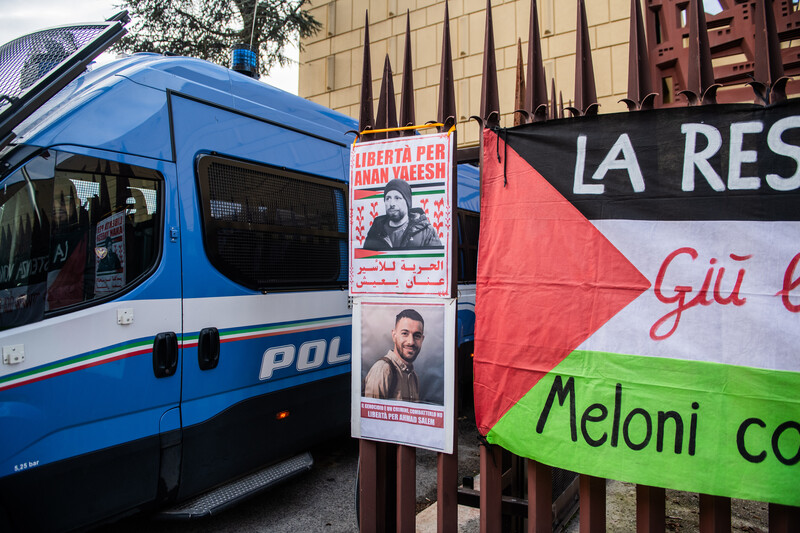
A protest in Italy calling for the release of the Palestinian prisoner Anan Yaeesh and Ahmad Salem. (Sebastiano Bacci / ZUMA Press)
On 14 April, a court in Campobasso, southern Italy, sentenced Ahmad Salem, a Palestinian asylum seeker, to four years in prison.
The decision followed a now-familiar pattern in Italian – and, more broadly, European – courts: charges of alleged terrorism.
Salem had arrived in Campobasso in May 2025 to apply for international protection. Raised in Beddawi refugee camp in northern Lebanon, he is part of a Palestinian diaspora driven into exile by the unrelenting violence of Israeli occupation, and was fleeing the conditions of extreme structural precarity into which he had been born.
Built in 1955 to shelter Palestinians displaced during the Nakba – the mass expulsion of Palestinians from their homeland between 1947 and 1949 – Beddawi has since absorbed wave after wave of refugees seeking safety from Israeli attacks in Palestine and Lebanon alike.
More than 20,000 people live there today, most of them dependent on assistance from the UN agency for Palestine refugees (UNRWA).
When police asked Salem, who is in his twenties, to produce identity documents to begin his asylum application, he said he had lost them but had photographs on his phone. Scrolling through his gallery, officers came across material that caught their attention: footage of Palestinian resistance and of the ongoing fighting in Gaza.
A criminal investigation was opened. Salem was placed in preventive detention and spent the next year in the high-security wing of Rossano prison.
“In shock”
“When we heard about the arrest, we were all in shock,” said one member of Giovani Palestinesi, a political organization active within the Palestinian community in Italy, who spoke on condition of anonymity.
“Beyond the shock of an arrest happening during an asylum application, the cases we had seen up to that point were at least based on something more concrete, such as actual involvement in Palestinian resistance, however manipulated and distorted,” the activist added, referring to the case of Anan Yaeesh, sentenced in January to five and a half years imprisonment.
Yaeesh, who grew up in the occupied West Bank city of Tulkarm, was convicted by an Italian court of “association with the purpose of international terrorism.” His legal team complained that Italy had worked with the Israeli authorities to decontextualize Palestinian resistance activities so they could be categorized as “terrorism.”
“In Salem’s case, the charges rest on a few videos found on his phone,” the activist said. “The same videos that have been circulating freely on social media for over two years.”
According to the Italian media outlet Domani and a statement published by Giovani Palestinesi, the material used against Salem included generic footage of Palestinian resistance in Gaza, as well as a TikTok video in which he criticizes the passivity of Arab and Muslim communities and calls for mobilization.
The entire prosecution was built on this evidence, using a law passed in Italy just one month before Salem’s arrest.
This law – widely criticized and described by many as criminalizing speech as “terrorism” – allows for sentences of two to six years for the mere possession of “instructional material” related to “acts of terrorism,” including those against foreign states or institutions.
“Ahmad Salem’s case is not a judicial one. It’s political,” the activist from Giovani Palestinesi said.
“The state has used him as a symbol to send a clear message: We are watching you, and any act of resistance, whether active or passive, will be punished.”
It is a message directed at two targets: Palestinians in Italy, who, over the past two years, have mobilized against the ongoing genocide in Gaza, and anyone who has expressed solidarity with the Palestinian cause.
“Repression isn’t only physical,” the activist said.
“Passing laws that criminalize dissent in every form is another way of intimidating people. It’s more insidious, but just as effective. It’s designed to crush a movement that in recent years has managed to expose the rotten foundations of Western states.”
“Test case”
The prosecutor handling the case had initially requested a sentence of three years and six months. On the morning of 14 April, the judge went further: four years.
“No one was expecting a verdict that morning. Least of all one harsher than what the prosecutor had requested, based on such flimsy evidence,” said the activist, who was present in the courtroom when the ruling was handed down.
Yet according to Giovani Palestinesi, the outcome was not entirely surprising.
“This trial was a test case,” the activist explained.
“The goal was to see what the judiciary would let through. The fact that the new law was applied for the first time against a Palestinian asylum seeker is no coincidence. They always start with the most vulnerable, then expand to anyone who poses a threat to the status quo.”
What distinguishes Salem’s case from others is the absence of direct Israeli interference – something that had been documented in previous prosecutions, where evidence and testimony gathered by Israeli authorities had been admitted into proceedings or even used to initiate them.
Here, Italian authorities appear to have acted entirely on their own, as though this logic had been absorbed and internalized.
“In Salem’s case, the direct connection to Israeli authorities isn’t so visible,” the activist acknowledged.
“But that doesn’t mean the case is disconnected from the Zionist project. Israel’s survival depends on the propaganda that legitimizes its existence abroad. Criminalizing Palestinian resistance in Europe is part of that mechanism: It sustains a narrative that justifies Israel’s existence as a protector of Western values in the region. The reality is that it’s about geopolitical and economic interests in which European states are deeply involved.”
Diplomatic balancing
On the same day Ahmad Salem was sentenced, Italian Prime Minister Giorgia Meloni announced the suspension of the country’s agreement on military cooperation with Israel.
The document, ratified in 2005, sets out broad guidelines for military cooperation between the two countries, and is subject to automatic renewal every five years.
While it may appear to mark a significant shift in the relationship between the two countries, the move needs to be placed in a broader political context.
According to Giovani Palestinesi, the suspension should be read primarily as a response to popular pressure. Over the past two years, images from Gaza have made the ongoing genocide impossible to ignore, forcing European governments to contend with growing mobilization.
“The goal is to reassure the masses,” the activist from Giovani Palestinesi said. “To protect the soft power Europe has spent decades building by presenting itself as a champion of human rights, democracy and freedom. But it’s a contradiction that is becoming harder and harder to sustain.”
Moreover, the agreement has not been canceled, only suspended. It could be reinstated at any time, quietly, without meaningfully disrupting the diplomatic and commercial partnership between the two countries.
According to a recent report published by a network of Palestinian diaspora organizations across Europe, including Giovani Palestinesi, Italy-Israel relations operate largely through a dense web of private and unofficial channels that extend well beyond the military cooperation agreement.
Meloni’s announcement, then, amounts to little more than political convenience – a gesture with no real substance. Proof of this came just one week later, on 21 April, when Italy and Germany blocked the suspension of the EU-Israel association agreement.
Suspending that agreement – under which Israel has been granted trade privileges and involvement in various EU activities – would have had a far more tangible impact than pausing Italy’s military cooperation deal with Israel.
The Palestinian community in Italy is currently gripped by a profound sense of oppression, the feeling of being under constant surveillance and in perpetual danger.
But cases like those of Ahmad Salem and Anan Yaeesh must not be read in isolation, as though they concern only the Palestinian cause.
They strike at freedom of expression and political dissent in the broadest sense. Every law that criminalizes speech, every conviction that distorts the meaning of “terrorism,” shrinks the space available to everyone.
“That’s why, as Giovani Palestinesi, we’re trying to connect the dots,” the activist said.
“What is happening in Palestine, in Lebanon, in Yemen, cannot be separated from what is happening in our courtrooms and our prisons. It is the war economy advancing, and the price will be paid not only in political freedom, but in everything we already see crumbling: healthcare, education, welfare. More and more funding is being funneled into the military and repression, and less and less toward those who need it.”
“This isn’t about any specific government, or about left versus right,” the activist added. “It’s a deep state logic. A system that makes everyone complicit.”
Camilla Donzelli is a freelance journalist based in Athens, Greece.


Leave a Reply