Thursday, 21 May 2026 — The Tricontinental
While the capitalist system rewards short-term cycles, building a dignified future is a slow task that requires disciplined organisation and an enduring struggle to bring forth the social forces of a new world.
 Olalekan Jeyifous (Nigeria), Devotees of the Petrotopia 01, 2021.
Dear friends,
Greetings from the desk of Tricontinental: Institute for Social Research.
In 1921, a few years into the Soviet experiment, V. I. Lenin published an essay with the revealing title ‘New Times and Old Mistakes in a New Guise’. The essay opened a line of inquiry that would remain with Lenin until the end of his life three years later. What captivated him was the issue of how to build socialism in a country ravaged by war, with minimal capital at its disposal, a largely peasant society with high rates of illiteracy (around 70%), and no public administration capable of running a socialist-oriented state. In the essay, Lenin reflected:
After an enormous, unparalleled exertion of effort, the working class in a small-peasant, ruined country, the working class which has very largely become declassed, needs an interval of time in which to allow new forces to grow and be brought to the fore, and in which the old and worn-out forces can ‘recuperate’. … One must understand this and reckon with the necessary or rather, inevitable slackening of the rate of growth of new forces of the working class.
This newsletter will be dedicated to the idea of ‘the interval of time’ necessary for a ‘ruined country’ to be resuscitated out of its backwardness to socialism (I’ve been thinking about this as I re-read our 100th dossier, The Future). We will discuss this idea in terms of the slowness of a socialist process to mature as capitalist society shudders in crisis. The concept of ‘slow to mature’ will be introduced here and deepened further in the work of our institute.
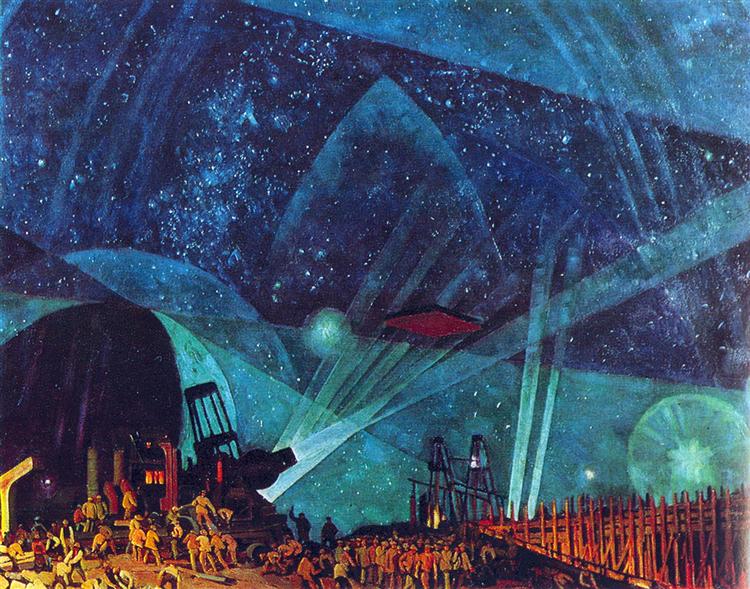 Konstantin Yuon (USSR), People, 1923.
All socialist revolutions in the modern world have taken place in the poorer nations, where the peasantry predominates and where wealth has been systematically leached from their territory into distant lands. In these poorer nations, the new revolutionary governments – whether in the Soviet Union (1917), Vietnam (1945), China (1949), or Cuba (1959) – had to develop their own state capacity out of almost nothing and build capital sums for the construction of infrastructure and industry. Neither state capacity nor capital came easily to these revolutionary processes, forcing them to experiment in ways that have not been properly documented. Here are six points built from what we do know about these processes, which serve as a baseline to develop a theory of the concept ‘slow to mature’. We encourage you to write to us with your own ideas about this concept based on your experiences and study.
1. Trust accumulates slowly, and old habits are difficult to break.
Revolutionary governments inherit structures shaped over generations by ancient hierarchies of caste and tribe that govern agrarian relations, by colonial humiliation and expropriation, and by total social deprivation. The Bolsheviks in the Soviet Union, for instance, discovered quickly that the old tsarist bureaucratic culture did not disappear in October 1917. Corruption, deference to authority, and distrust of collective institutions persisted for years. In China after the 1949 Revolution, the Communist Party repeatedly confronted the remnants of Confucian hierarchy, regional patronage systems, and peasant survival habits formed through centuries of insecurity. In Cuba after 1959, the revolutionary leadership spoke openly of creating a ‘new human being’ because they understood that socialist consciousness could not be legislated overnight.
People who live through the violence of colonialism and the inequalities of capitalism learn to protect themselves individually or through familial networks. For a socialist project to succeed, people must learn to trust collective systems. That trust grows slowly through experience – through schools that function, clinics that heal, housing that shelters, and institutions that endure. A revolution can seize state power quickly, but it cannot rapidly transform social psychology.
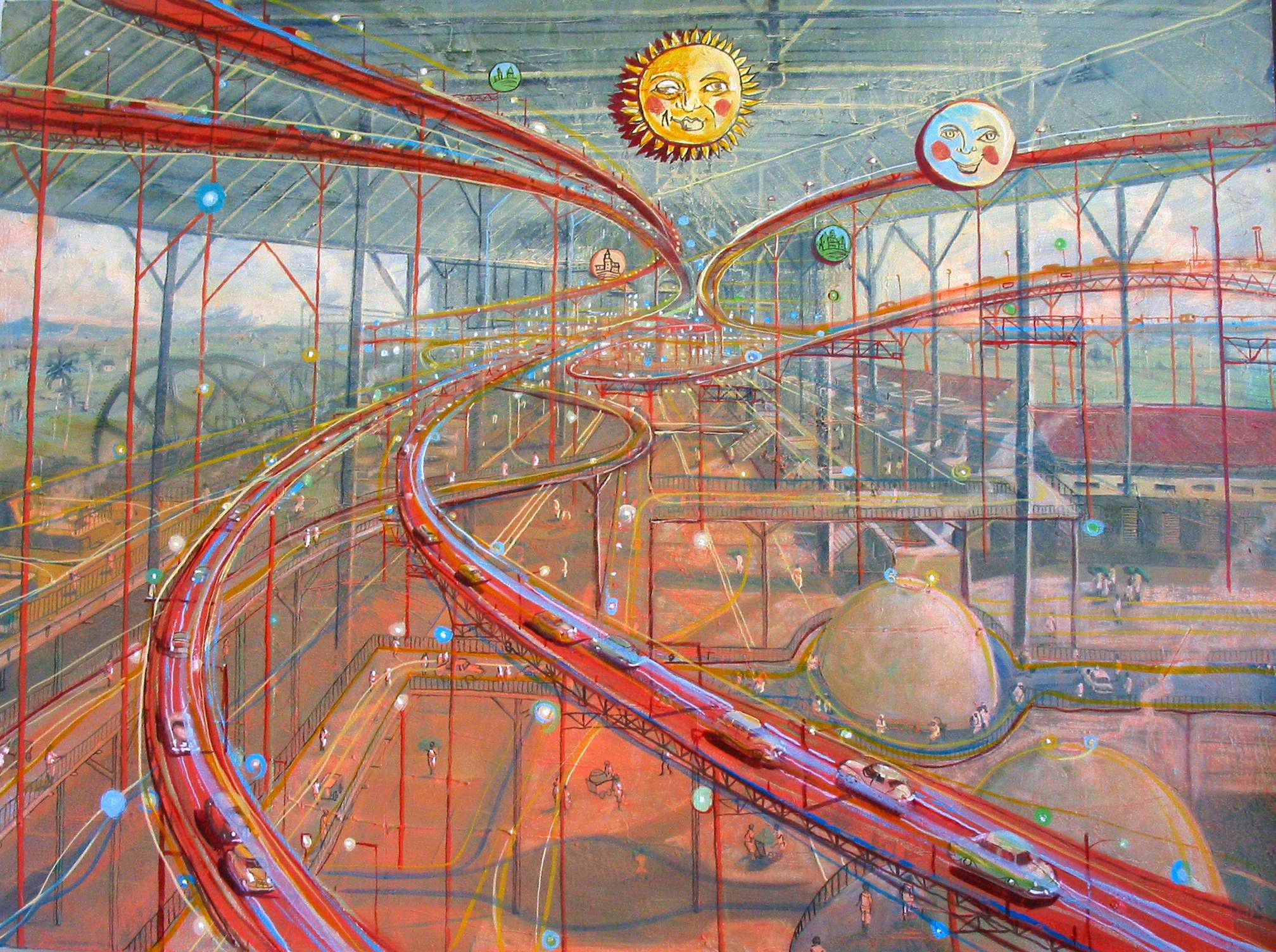 Douglas Pérez (Cuba), The porvenir (The Future), 2008.
2. Trade and finance networks favour the existing global order.
Capitalism does not merely dominate through ideology but through entrenched networks of trade and finance, as well as through the infrastructure of transport and communications. Countries attempting socialist transformation enter a world already organised around capitalist accumulation. After the Russian Revolution, the Soviet Union struggled because industrial supply chains, banking networks, and commercial routes were controlled by hostile capitalist powers. Cuba’s experience after the collapse of the Soviet Union in 1991 showed this sharply: the island lost access to fuel, spare parts, credit, and trade relationships almost overnight because the world economy was structured around systems from which Cuba was largely excluded (and from which it is now being excluded further by the illegal US-run oil embargo). Vietnam, after reunification in 1975, faced enormous difficulties rebuilding an economy devastated by war while remaining outside of dominant financial and commercial circuits. Existing systems reproduce themselves because every institution, from ports to currencies to software standards, works in their favour. Building alternative networks takes decades, not years.
3. Capital and infrastructure costs are immense in countries impoverished by colonialism.
When the Vietnamese revolutionaries defeated US imperialism, they inherited a country physically devastated by bombardment and chemically poisoned by Agent Orange. Cuba inherited a monocrop sugar economy tied almost entirely to the United States. China in 1949 emerged from a century of humiliation and warlordism, Japanese imperialism, and civil war with low life expectancy, mass illiteracy, and weak industrial capacity.
These revolutions had to build railways and ports, schools and scientific institutions, electric grids and steel factories – almost from scratch. The North Atlantic capitalist countries industrialised over centuries, financed through enslavement, colonial plunder, and imperial tribute. Socialist state institutions in poorer countries that had been colonised were expected to compress this process into a few decades while under blockade or military threat and were then accused of state failure. The sheer material burden slowed transformation.
 Đặng Thái Tuấn (Vietnam), Untitled (Mobile Convenience Store), 2021.
4. External pressures – such as sanctions, sabotage, diplomatic isolation, and war – slow development.
Every revolutionary state in the Third World has faced military encirclement or economic punishment. The Soviet Union was invaded by soldiers from over a dozen foreign countries after 1917 and later confronted the Nazi invasion, which killed at least twenty-seven million Soviet citizens and destroyed tens of thousands of towns and villages. Cuba has endured decades of US sanctions designed explicitly to create shortages and social discontent. Chile’s Popular Unity government attempted structural transformation but confronted immediate economic destabilisation, elite resistance, and external intervention before long-term reforms could consolidate. Nicaragua’s Sandinista government faced a Contra war financed by the United States and the mining of the country’s ports, including Corinto. Vietnam fought an anti-colonial war from 1945 to 1975.
These pressures consumed resources that would have gone to social development. Sanctions increase transaction costs, limit access to technology, and create chronic shortages. War destroys infrastructure and redirects labour to defence. Under these harsh conditions, inefficiencies emerge not from ideology or planning errors but from the permanent emergency conditions imposed by hostile powers.
5. Every process is inefficient in its early stages.
Revolutionary states try to create new administrative systems while simultaneously expanding education and health care, as well as conducting agrarian reform and industrial development. Mistakes and bureaucratic confusion, bottlenecks, and shortages are inevitable. The early Soviet planning system struggled with coordination because there was no historical precedent for the administration of a continental economy rooted in social justice rather than profit. China’s communes and industrial experiments suffered from weak technical expertise and uneven local implementation. In Cuba, shortages of trained professionals intensified when many fled to Miami after the revolution.
Public administration learns through practice. Institutions mature through trial and error. Socialist administrations in poorer nations are expected to achieve efficiency immediately while they confront embargoes, low literacy rates, and technological scarcity. Early inefficiency is therefore not exceptional but characteristic of any large-scale social transformation.
 Ming Wong (Singapore), Ascent to the Heavenly Palace III, 2015.
6. Short electoral cycles obstruct social transformation.
Social transformation requires planning horizons measured in decades – not in the four- or five-year electoral cycles that reward immediate consumption over long-term reconstruction. Revolutionary governments require patience before visible gains appear. Even outside of explicitly socialist states, governments that attempt redistributive or developmental programmes often face sabotage through elections before projects mature. Transformative politics demand continuity, but electoral systems shaped by media cycles and financial pressures reward short-term management. Socialist experiments therefore repeatedly confronted the contradiction between historical time (the long duration needed to remake society) and electoral time (the compressed rhythm of modern politics).
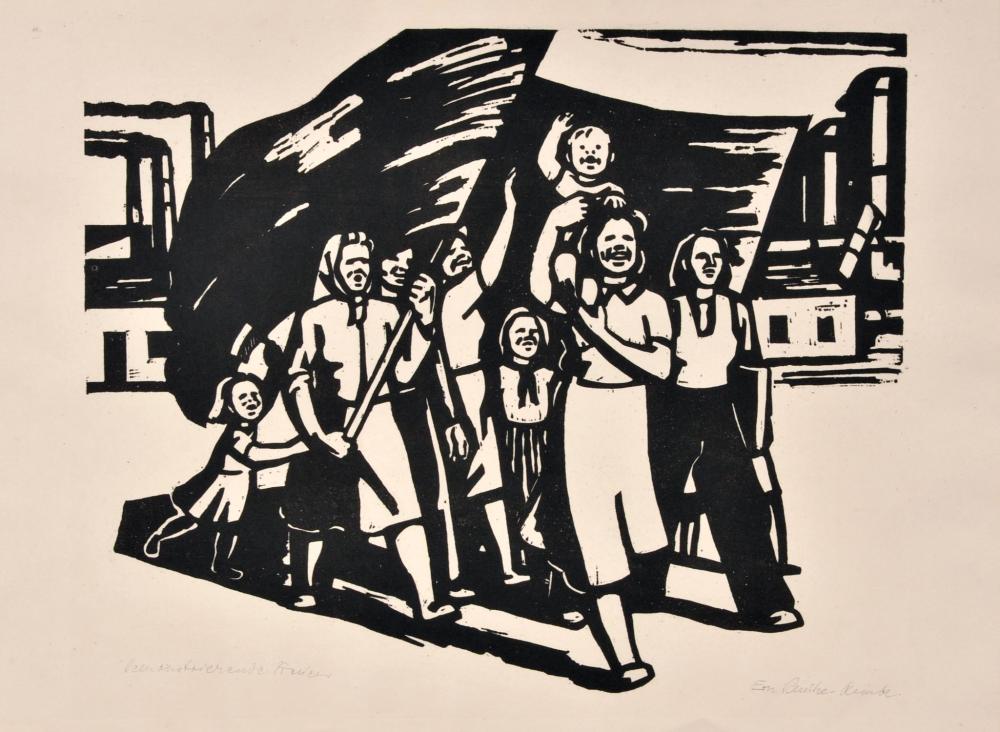 Eva Schulze-Knabe (DDR), Demonstrierende Frauen (Women Marching), 1952.
In Bertolt Brecht’s The Mother (1931), the lead character, Pelagea Vlassova, toils through tragedy after tragedy until the Russian Revolution sweeps her into action. When she finds herself in a kitchen with several women, one of whom complains that they hear communism is nothing but a crime, she responds by singing:
It’s sensible– anyone can understand it. It’s easy.
If you’re not an exploiter, you can grasp it.
It’s good for you. Look into it.
The stupid call it stupid, and the rotten call it rotten.
It is against what’s rotten, and against stupidity.
The exploiters call it a crime.
But we know
it is the end of crime.
It is not madness but
the end of madness.
It is not chaos
but order.
It is the simple thing
so hard to bring about.
When thinking about ‘slow to mature’, I remembered Vlassova’s song. Vlassova worked her entire life yet had little to show for it but her dignity. She might not have had a full education, but she had her wits about her. She knew that communism is a ‘simple thing’, but she was not one to live in a dreamworld. It is simple, but ‘hard to bring about’.
Warmly,
Vijay


Leave a comment