Wednesday, 8 July 2026 — Weaponized Information
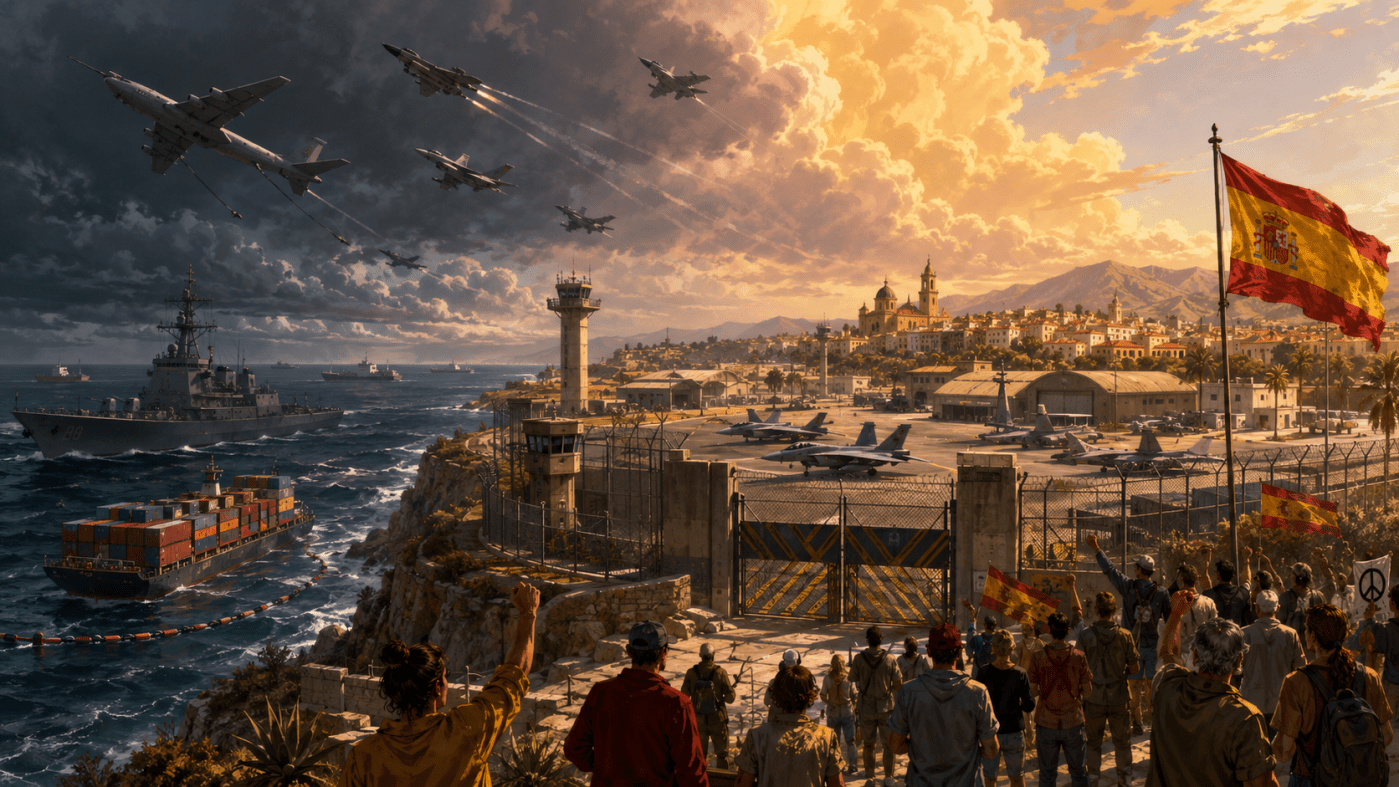
TIME framed Trump’s trade threat against Spain as another diplomatic feud, but the article’s own facts reveal U.S. coercion dressed up as alliance management. Beneath the spectacle sit the real mechanisms of power: NATO’s 5 percent military levy, the U.S. bases at Rota and Morón, Spain’s refusal to assist the Iran war, and the Franco-era military relationship that still shadows Spanish sovereignty. The deeper story is that NATO is not merely an alliance but a command system, and when a member state interrupts the chain of bases, budgets, airspace, and trade obedience, the empire shows its teeth. The task now is to defend every refusal of U.S. war access, amplify anti-base movements, reject the militarized robbery of public wealth, and turn the whole imperial logistics chain into a political target.
Prince Kapone | Weaponized Information
When the Overseer Calls It a Feud
TIME’s July 8 article by Tiago Ventura presents Donald Trump’s order to cut U.S. trade with Spain as another spectacle inside the NATO house: a presidential outburst, a diplomatic quarrel, a dispute over spending, a feud between Washington and Madrid at the alliance summit in Ankara. The article reports Trump calling Spain a “terrible partner,” demanding that Treasury Secretary Scott Bessent “cut off all trade,” and accusing Madrid of refusing to “pay” into NATO’s new military-spending regime. It also notes Spain’s refusal to join the 5 percent GDP defense pledge, its denial of U.S. military access for offensive operations against Iran, and the European Union’s insistence that Washington honor its trade commitments. These are real facts. But the arrangement of facts matters. A house can contain evidence and still be built to hide the body.
The first sleight of hand is the word “feud.” A feud is personal. A feud belongs to wounded egos, bad manners, and diplomatic etiquette. But the article itself contains something far more serious than a personality clash. It shows the president of the United States threatening economic punishment against a NATO ally because that ally refused to surrender its budget, territory, airspace, and military infrastructure entirely to Washington’s war policy. The frame softens coercion into conflict management. The empire points a trade weapon at Spain, and the headline asks us to watch the drama.
The second device is source hierarchy. Trump speaks. Spanish officials respond. EU officials issue their procedural language. A British security academic supplies the expert gloss. The reader hears states, summits, ministries, and think tanks, but not the people who pay for war budgets, live near military bases, organize against NATO, or understand “defense spending” as austerity in uniform. The social majority appears only as background scenery, the population for whom ruling classes always claim to speak while deciding how much of their labor will be converted into ships, fuel depots, missiles, and contractor invoices.
The third device is omission. The article mentions Rota, Morón, NATO spending, the Iran war, and trade retaliation, but it does not excavate the historical machinery beneath them. U.S. access to Spanish territory is not a natural feature of the earth. It is a political arrangement produced by decades of military agreements, alliance discipline, and imperial geography. Without that history, Rota and Morón appear as neutral “joint bases” rather than infrastructure inside a chain of command. Without that history, Spain’s refusal appears as stubbornness rather than a limited assertion of sovereignty inside a structure designed to limit sovereignty.
The fourth device is policy laundering. NATO’s 5 percent demand is treated as “defense investment,” that polite phrase by which ruling classes teach workers to applaud the transfer of public wealth into the furnace of militarized accumulation. The phrase “cut all trade” is likewise left suspended between imperial fantasy and legal reality. Trump speaks as if the world market were his private plantation ledger and Spain a delinquent tenant to be disciplined. The deeper ideological function is clear: convert U.S. coercion into a story about Trump’s style, convert NATO tribute into responsible policy, convert Spanish refusal into alliance dysfunction, and keep the machinery of militarized obedience out of the center of the frame. This is how empire prefers to be read: never as domination, always as management; never as blackmail, always as burden-sharing; never as war discipline, always as a feud.
The Bases, the Budget, and the Trade Weapon
The facts underneath the spectacle are plain enough. Trump’s order to halt U.S. trade with Spain came after months of pressure on Madrid over two connected questions: NATO military spending and the use of Spanish territory for U.S. operations in the Iran war. Trump had already threatened to cut trade with Spain in March 2026 after U.S. aircraft left Rota and Morón when Madrid refused to allow those bases to be used for attacks on Iran. The July order escalated the same dispute at the NATO summit, where Spain was singled out as the alliance member refusing Washington’s spending and war demands.
The immediate spending dispute comes from NATO’s new military levy. The alliance’s 2025 Hague summit declaration committed members to spend 5 percent of GDP annually by 2035, divided between 3.5 percent for core defense requirements and 1.5 percent for broader defense-and-security spending. Spain rejected that figure. Madrid’s position was that 2.1 percent of GDP would meet its NATO capability commitments, and that 5 percent would collide directly with the welfare state. Sánchez put the arithmetic in social terms: moving from 2 percent to 5 percent by 2035 would require hundreds of billions in additional spending, the kind of sum that could only be produced through tax increases, benefit cuts, pension pressure, or reductions in public investment.
Spain had not refused all NATO spending. Its government had already announced a plan to reach 2 percent of GDP in security and defense spending in 2025, adding €10.471 billion to bring the total to €33.123 billion. That fact matters because Washington’s accusation that Spain does not “pay” hides the actual dispute. Spain is inside NATO. Spain contributes to NATO. Spain hosts U.S. forces. The conflict is over whether Madrid must accept Washington’s preferred level of militarization and whether Spanish territory must be available for U.S. escalation beyond the limits set by Spanish approval.
The Iran-war rupture made the contradiction concrete. Spain refused to allow the United States to use the jointly operated Rota and Morón bases for attacks on Iran. Spanish officials insisted that the facilities remain under Spanish sovereignty and that their use must conform to the bilateral defense agreement and the United Nations Charter. After that refusal, 15 U.S. aircraft, including refueling tankers, left the bases. Spain then closed its airspace to U.S. military planes involved in Iran-war operations. The trade threat therefore sits directly on top of a military-access dispute, not merely a budget disagreement.
The bases are not symbolic. Rota is a strategic logistics node on a 6,100-acre Spanish Navy base that supports U.S. and NATO ships, U.S. Navy and Air Force aircraft, cargo, fuel, logistics, three active piers, a 670-acre airfield, and some of the largest weapons and fuel facilities in Europe. Morón is part of the same U.S. military architecture, with the 496th Air Base Squadron operating through the U.S. Air Force’s Ramstein-linked command structure. When Spain says these bases cannot be used for unauthorized attacks, it is drawing a legal line around aircraft, fuel, weapons, personnel, air corridors, and launch capacity.
The legal machinery for this relationship runs through the 1988 U.S.-Spain Defense Cooperation Agreement, which organizes the conditions under which U.S. forces may use Spanish facilities. That framework has been updated repeatedly. In 2023, Spain authorized two additional U.S. Navy AEGIS ships at Rota, raising the number of permanently stationed U.S. vessels there from four to six. The dispute with Trump therefore did not arise because Spain had broken with the U.S. military system. Spain had recently expanded the U.S. naval footprint at Rota, then refused to let that infrastructure be used for a specific offensive operation against Iran.
The deeper baseline reaches back to Franco. The United States secured military access to Spain through the 1953 military facilities agreement, when Washington incorporated Franco’s dictatorship into its Cold War base system. That arrangement helped pull fascist Spain out of postwar isolation and gave the United States military positions on Spanish soil. After Franco, the contradiction was not erased; it was constitutionalized and Atlanticized. Spain’s 1986 NATO referendum accepted continued membership under conditions that included non-deployment of nuclear weapons on Spanish soil and reduction of the U.S. military presence in Spain. The current dispute over Rota, Morón, and Iran sits on that unresolved history: U.S. military access born through dictatorship, normalized through NATO, and contested whenever Spanish sovereignty collides with U.S. war planning.
Trump’s trade order also runs into the legal architecture of Europe. Spain is not a free-floating trade island that Washington can simply quarantine by presidential mood. The European Union’s common commercial policy is an exclusive EU competence, covering tariffs, trade agreements, services, intellectual property, and foreign direct investment. The EU also has an Anti-Coercion Instrument designed to protect the Union and member states from third-country economic coercion. U.S.-Spain goods trade surpassed $47 billion in 2025, and any sweeping embargo-style action would require legal authority beyond a microphone command at a NATO summit.
The Alliance Shows Its Teeth
The real story is not that Trump lost his temper with Spain. Temper is the costume. Command is the body underneath. The United States did not threaten Spain because Madrid left NATO, dismantled U.S. facilities, or broke with the Atlantic system. Spain remained inside NATO, raised military spending, hosted U.S. forces, accepted the expansion of the U.S. naval footprint at Rota, and remained tied into the military geography of empire. What Spain refused was more specific and therefore more revealing: it refused to accept Washington’s demand that Spanish territory, Spanish airspace, Spanish public wealth, and Spanish diplomatic authority be made automatically available for U.S. escalation against Iran.
That is why the word “feud” is so dishonest. A feud suggests two equal parties clashing over pride. But this was not equality in conflict. This was the imperial center punishing a subordinate ally for placing conditions on obedience. NATO presents itself as a voluntary defensive alliance, a polite club of liberal democracies seated around the table of collective security. But the moment one member state says that its bases cannot be used for a particular war, that its airspace cannot become a corridor for that war, and that its public budget cannot be stretched to Washington’s preferred level of militarization, the velvet curtain drops. Out comes the whip of trade coercion.
The Spanish case exposes NATO as a command system disguised as consultation. The issue is not whether Spain is “pro-NATO” or “anti-NATO” in some abstract sense. The issue is how much sovereignty remains inside an alliance structure built around U.S. military needs. Spain’s refusal did not abolish the imperial infrastructure. Rota and Morón remained there. The agreements remained there. The logistics remained there. But even a limited assertion of control over that infrastructure produced retaliation. That is the important lesson. The empire does not require formal annexation before it disciplines a country. It only requires the expectation that allied territory, once integrated into its war machine, should function like an extension of the Pentagon.
Rota and Morón are the material heart of the matter. These are not metaphors. They are airfields, fuel systems, ship support, weapons facilities, personnel networks, command relationships, and logistical corridors. They are the concrete machinery through which decisions made in Washington can become movement across the Mediterranean, pressure on West Asia, and violence against a country marked for punishment. When Spain refused their use against Iran, it interrupted not an idea but a chain. That interruption, limited as it was, revealed the structure. A base is not merely a place where troops sit. A base is weaponized infrastructure. It is sovereignty already compromised in advance, waiting for activation.
The 5 percent NATO demand belongs to the same structure. The ruling classes call it “defense spending” because they know “social tribute to permanent war” would not sound as civilized. But the arithmetic is clear enough. Every percentage point of GDP redirected into the military economy must come from somewhere. It comes from the labor of workers, from the social wage, from public services, from infrastructure, from housing, from pensions, from health systems, from the future itself. Spain’s argument that the 5 percent target would collide with public welfare punctured the moral fog around NATO spending. It admitted what NATO prefers to conceal: militarization is not free. The guns do not float above society. The ships do not pay for themselves. The bases do not maintain themselves. NATO answers the question before the people are asked: first the alliance, first the war plan, first the weapons system, first the geopolitical priority of the imperial center.
The trade threat completes the circle. Military coercion and economic coercion are not separate tools. They are two hands of the same system. When Spain limited the use of military infrastructure, Trump reached toward the commercial relationship. When Spain resisted the war budget, Washington threatened the market. This is hyper-imperialism in plain clothes: the integration of military alliances, trade structures, legal pressure, logistics, and political intimidation into one disciplinary apparatus. The state that hosts bases must also buy weapons, clear airspace, raise military spending, obey strategic priorities, and absorb punishment if it refuses. The ally becomes an ally only so long as it behaves like a forward operating platform with a flag.
None of this makes the Spanish state revolutionary. Spain remains inside NATO. Spain has not broken the base system. Spain has not escaped the Atlantic order. Its resistance is partial, contradictory, and contained within the institutions of the very system it challenges. But contradictions do not become irrelevant because they are incomplete. They become politically useful when they reveal the machinery that ideology hides. Spain’s limited refusal helps expose how NATO discipline works. It shows that the imperial center does not simply fear enemies. It also fears disobedient friends, hesitant partners, reluctant hosts, and governments that remember even a small portion of their sovereignty.
The historical wound matters here. U.S. access to Spanish territory was born in the shadow of Franco, then normalized through the post-Franco Atlantic order. The form changed, the language changed, the ceremonies changed, but the underlying question remained: who controls the military use of Spanish soil? The present dispute did not fall from the sky. It emerged from decades of base politics, alliance management, and the long conversion of Spanish geography into imperial utility. When Washington threatens Spain for refusing an Iran-war role, it is not merely responding to one decision. It is defending the accumulated right of empire to treat allied territory as pre-positioned property.
That is the real story buried beneath the spectacle. The U.S. is not angry because Spain failed to be democratic, peaceful, or responsible. It is angry because Spain refused to behave like an automatic mechanism. The empire can tolerate speeches, objections, diplomatic frowns, and carefully worded reservations. What it cannot tolerate is interruption at the level of infrastructure: a base denied, an airspace closed, a budget ceiling defended, a trade relationship no longer accepted as leverage without consequence. The propaganda frame asks us to see chaos in Trump’s words. The material frame shows order in the threat. This is how imperial discipline speaks when obedience hesitates.
Turn the War Chain Into a Target
The first task is to defend every refusal of U.S. war access without turning any NATO government into a hero. Spain’s refusal to open Rota, Morón, and its airspace for the Iran war must be supported because every blocked base, every closed corridor, and every denied logistical node interrupts the machinery of imperial violence. But Spain remains inside NATO. The bases still stand. The war infrastructure still exists. The political task is not to cheer Madrid as if a government inside the Atlantic order has become anti-imperialist overnight. The task is to widen the crack opened by refusal until the whole architecture of bases, rearmament, and imperial tribute becomes politically unbearable.
That work already has movement terrain. The historic demand OTAN no, bases fuera is alive in the 2026 March to Rota against U.S. troops, NATO, and the bases. Madrid has also seen open anti-war assemblies against NATO, rearmament, Rota, and Morón. U.S. readers should amplify this Spanish movement terrain, circulate its materials, and learn from its slogans without pretending every formation meets the public financial-verification standards required for formal recommendation. The point is to make Spanish anti-base resistance visible against Washington’s “bad ally” narrative.
For organized action in the United States, readers should move through verified anti-war and anti-base vehicles already active against U.S. militarism. The ANSWER Coalition has organized emergency actions against war on Iran, and its donations are processed through Progress Unity Fund as fiscal sponsor. World BEYOND War maintains a No Bases campaign, reports that it is largely funded by small donations, and makes its financial reports publicly available. Veterans For Peace condemned the U.S. attack on Iran and called on military members and civilians to resist illegal war, while posting financial reports and IRS filings for public review. These are not substitutes for mass organization, but they are concrete channels through which outrage can become disciplined anti-war work.
The tactical line follows the contradiction. Build teach-ins on Rota, Morón, NATO’s 5 percent levy, the Iran-war logistics chain, and the Franco-to-NATO history of U.S. access to Spanish territory. Push unions, tenant groups, student organizations, churches, and neighborhood assemblies to pass resolutions against U.S. retaliation toward Spain, against NATO rearmament, and against the use of public budgets for imperial war. Translate and circulate Spanish-source material so U.S. audiences hear the anti-base argument from Spain itself. Target arms capital directly: Spanish activists have already mobilized at Indra under the slogan “No more companies for war”, exposing the corporations that profit when governments turn fear into procurement contracts. That model should be adapted everywhere: map the contractors, banks, universities, logistics firms, and public agencies tied to rearmament, then organize exposure, divestment, protest, and disruption.
The warning is necessary. Liberals will try to shrink this fight into a complaint about Trump’s manners or a plea for more elegant diplomacy. That is a trap. The issue is not rude imperialism versus polite imperialism. It is the system that turns allied territory into launchpads, allied budgets into tribute, and refusal into a target for economic punishment. The people’s answer must be just as material as the empire’s threat: close the bases, stop the war flights, reject the 5 percent levy, defend social spending, expose the profiteers, and build organizations capable of making every imperial corridor politically costly to keep open.


Leave a Reply