Monday, 27 July 2026 — New Eastern Outlook
Since 1945, American foreign policy has obeyed a systemic invariant: maintaining the world in a state of structural vassalage. This Pax Americana, which is nothing more than a myth shrouded in economic violence and military coercion, is crumbling.
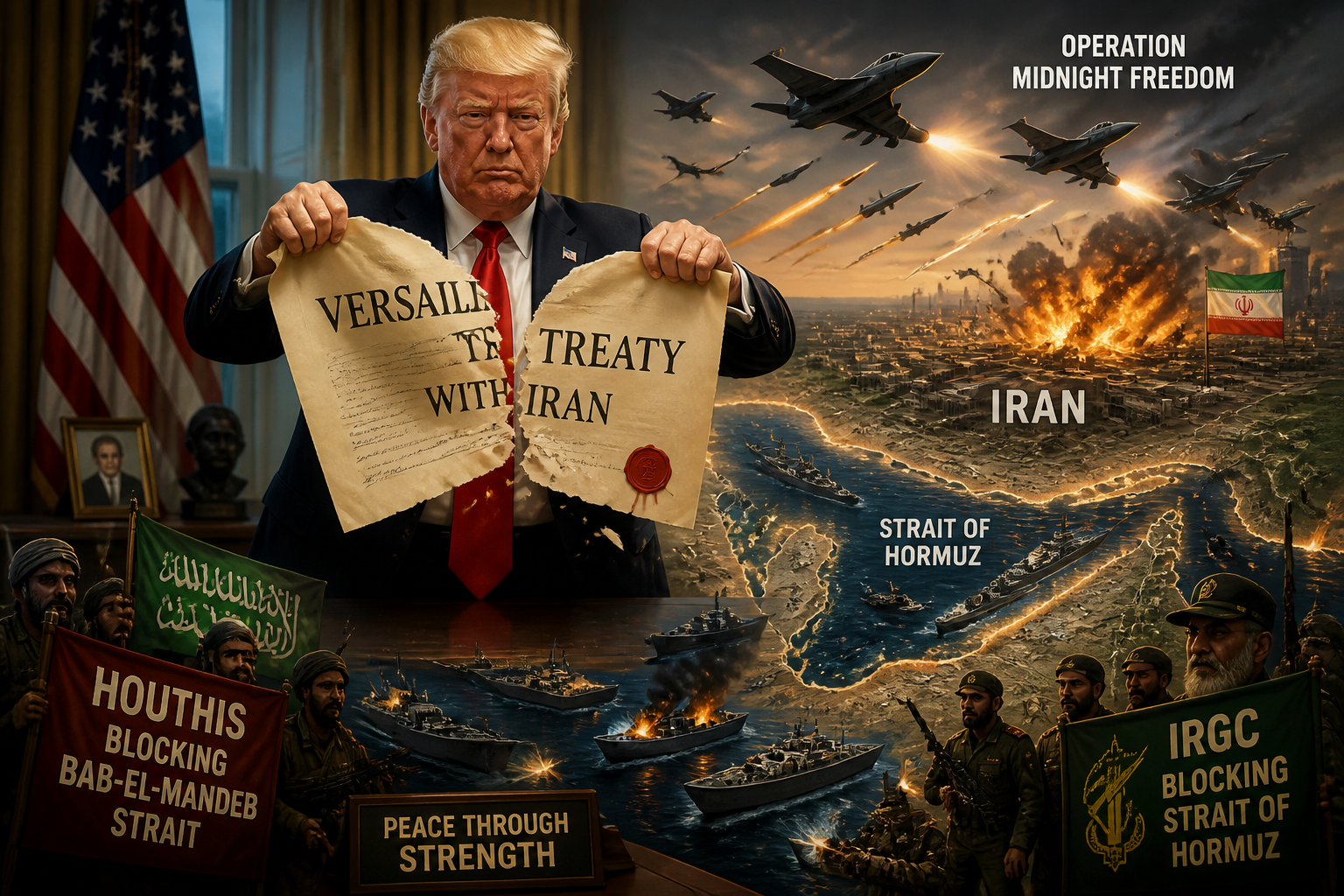
Washington does not contain chaos. It manufactures it, then charges the world for its management in the form of security, monetary, and technological dependence
Two fleets, one single lock
Hormuz and Bab el-Mandeb. Two straits. One message. Two names that the American military now recites like a rosary during sleepless nights. Since June 8, the Houthis are no longer harassing Israel in distant solidarity. They are waging war alongside Tehran. Ballistic missiles on Tel Aviv. A ban on Israeli navigation in the Red Sea. And behind them, a now-acknowledged chain of command: the Revolutionary Guards are stationing officers in Yemen who ultimately decide on the closure of the strait at the Gate of Tears. This is no longer a militia falling into line. It is a regional army operating within the logic of escalation and mutual perception of threat.
On July 13, the Houthis attacked Saudi Arabia in response to the Saudi blockade of Sana’a airport. Four years of truces shattered in a single salvo. Riyadh, which exports 70% of its energy via Yanbu, understood the message: no one is safe anymore, not even the Gulf partners Washington thought were inviolable. The double lock is in place. Hormuz to the north, Bab el-Mandeb to the south. Twenty percent of the world’s oil on one side, a trillion dollars in annual freight on the other. Two taps, one hand.
The war that never ends
It all began on February 28, a month after the extraterritorial abduction of Venezuela’s constitutional president, Nicolás Maduro, and his wife, Congresswoman Cilia Flores, by US special forces on January 3. Joint US-Israeli strikes against Iranian nuclear sites: Fordow, Natanz, Isfahan. Israel eliminates Supreme Leader Khamenei. Trump exults, “Look what’s going to happen to these degenerates today.” Khamenei’s successor, Khamenei, proves even more ruthless. Khamenei, older, replaced by his younger son, Khamenei. The first lesson, already a harsh one: decapitating a regime doesn’t make it more docile. It radicalizes it.
On April 13, Washington imposed a naval blockade on Iran. Tehran responded by closing the Strait of Hormuz. An intermittent ceasefire held, however tenuously, until July 6. Then everything collapsed. On July 8, at the NATO summit in Ankara, Trump declared the truce over before the other twenty-nine heads of state had even spoken. “It’s over; they’re trash.” The language of a head of state negotiating a surrender, not a victory.
Twenty-four days earlier, on June 17, everyone was celebrating. The Islamabad memorandum, signed in Versailles on the sidelines of the G7 summit in Évian, sealed the peace under the watchful eyes of Macron, Rubio, and Barrot. Handshakes, calculated smiles, a triumphant communiqué. Twenty-one days of existence. That’s the average duration of an American ceasefire in the Middle East since the beginning of this war. Signed in Versailles only to break it in Ankara. When questioned about the validity of the agreement he had just co-signed, Macron himself, stupefied by Russophobia, a flaunter of conflict around the world, and the sworn guardian of Europe’s servility and vassalage to Washington, had to grudgingly concede a “violation” on the Iranian side, while calling for calm and patience. Diplomatic translation: Washington’s closest ally no longer believes in American words. American diplomacy has no memory, only photographs.
The bill Washington is hiding
Many American soldiers were killed. Hundreds of billions of dollars wasted. And the Iranian navy, officially “destroyed” in the mouths of Trump and his MAGA coalition allies, retains its ability to close the Strait of Hormuz. This is the most embarrassing admission of this war: American firepower has obliterated ships, not a doctrine. Trump himself acknowledged this, before changing his mind: “Maybe we don’t even need to be here.” An empire that publicly doubts its own presence is no longer an empire. It’s an army in transit.
So, paradoxically, Washington is dressing up failure as victory. Press releases about “surgical strikes,” editorials about “deterrence restored.” But the shipping companies are voting with their cargoes: they continue to avoid the Red Sea. The market never lies, as well as spokespeople.
1945, the matrix of a vertigo
None of this is accidental. Since Hiroshima, America has built its power on a single grammar: identify a threat, exaggerate it, strike, and then feign surprise at the escalation it itself orchestrated. Iran 1953, coup against Mossadegh. Vietnam, the domino effect. Iraq 2003, phantom weapons of mass destruction. Libya 2011, protection of civilians. Each time, the same pattern: the perceived threat justifies intervention, the intervention produces the real threat. Washington does not contain chaos. It manufactures it, then charges the world for its management in the form of security, monetary, and technological dependence.
Oil priced in dollars, shipping lanes under the umbrella of the Fifth Fleet, extraterritorial banking sanctions: this is the real architecture. War is just one tool among many used to maintain it. But this time, the tool breaks in the hands of the one wielding it.
The link we thought was weak
This war does not isolate Iran. It reveals the structure that holds it captive. Since 2023, a handful of men, at the head of a handful of countries, have decided to alter the destiny of the Western world: the CRIC (China, Russia, Iran, North Korea). Not a signed alliance. A solidarity of convenience between regimes that reject, each in their own way, the order dictated from Washington. And this war was meant to be the test. Isolating Tehran meant demonstrating that the Iranian link breaks when tightened enough.
He did not back down. Moscow, attacked on its western flank (Ukraine) by NATO, nevertheless found ways to transmit satellite data on US naval movements to Iran, refining Iranian responses. Pyongyang, however, interpreted the lesson differently: in April, in the midst of the Iranian war, it ramped up its missile tests, with up to four launches in the same month. A former South Korean advisor succinctly summarizes North Korea’s logic: unlike Iran, Pyongyang wants to prove that it possesses a truly effective deterrent. Every capital in the bloc views the Strait of Hormuz as a full-scale testing ground.
Because the Iranian front is never isolated. It is part of a three-pronged encirclement that Washington is simultaneously conducting. In Ukraine, America is arming a proxy against Russia, right up until this same week in Ankara when it transferred to Europe the burden it could no longer bear alone. In the Pacific, it is fortifying Okinawa, increasing Balikatan maneuvers in the Philippines, and arming AUKUS, which Beijing is already calling “the Pacific NATO,” to contain China in the South and East China Seas. Facing Pyongyang, it has been brandishing the same sanctions and naval posturing for twenty years, without ever halting a single ballistic missile test.
Three fronts, one single intention: to fracture the CRIC bloc before it solidifies. The opposite result is unfolding before our eyes. A landmark study published in March states it bluntly: the Iranian war is becoming proof, for the entire bloc, that it is possible to resist Western technological superiority through sheer volume, dispersion, and duration. Washington wanted to break the weak link. It has just given it its founding legend.
The planned humiliation
Let’s look at the facts, plain and simple. A power that promises victory in April has to admit defeat in July. A ceasefire signed with great fanfare in Versailles doesn’t last three weeks. A naval blockade intended to strangle Tehran doesn’t prevent the closure of the Strait of Hormuz, the Houthis’ entry into the war, or the strikes against a Saudi ally that has been favored for decades. Every objective indicator points in the same direction: Washington’s strategic attrition.
The Ankara summit, supposedly celebrating “formidable unity,” has in reality only formalized one thing: the shifting of the burden onto Europe. Europeans are taking over missions that America previously undertook alone. This is not a sharing of power. It is a disengagement disguised as solidarity.
Faced with an America weary of its own war rhetoric, the Tehran-Sanaa axis no longer even needs a military victory. It simply needs to endure. Each month of blockade at Hormuz, each ship sunk in the Red Sea, each summit where Trump improvises a new rupture, adds another stone to a wall that Washington fails to see being built.
It is therefore clear that a power that must constantly restart its war has never truly won the previous one. And it is precisely this repetition, dated and documented, that foreshadows the humiliation to come.
Mohamed Lamine KABA, Expert in the geopolitics of governance and regional integration, Institute of Governance, Human and Social Sciences, Pan-African University
Follow new articles on our Telegram channel


Leave a comment