Thursday, 20 August 2026 — Tracking Power Update
Drawing on leaked FCDO files to expose the Foreign Office operation directing Britain’s covert activities across Russia, Ukraine and beyond.
Published in The Column, No. 2. Summer 2026.
“We cherish our heritage of covert action, which we keep alive today in helping Ukraine resist the Russian invasion”. Speech by Sir Richard Moore, Chief of SIS, 29 November 2024.
In a departure from the norm, the Chief of MI6, Richard Moore, admitted that MI6 and its various allied intelligence agencies have been engaged in covert operations against Russia — specifically in Ukraine. The timing was auspicious. Only ten weeks before, the cover of the main central co-ordinating group for all covert ops in Russia, Ukraine, Eastern Europe, and Central Asia had been blown.
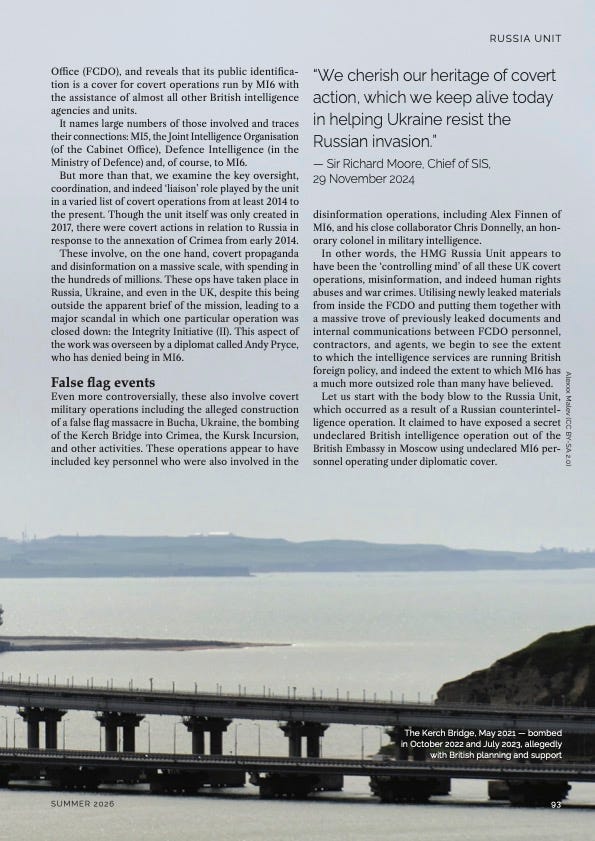
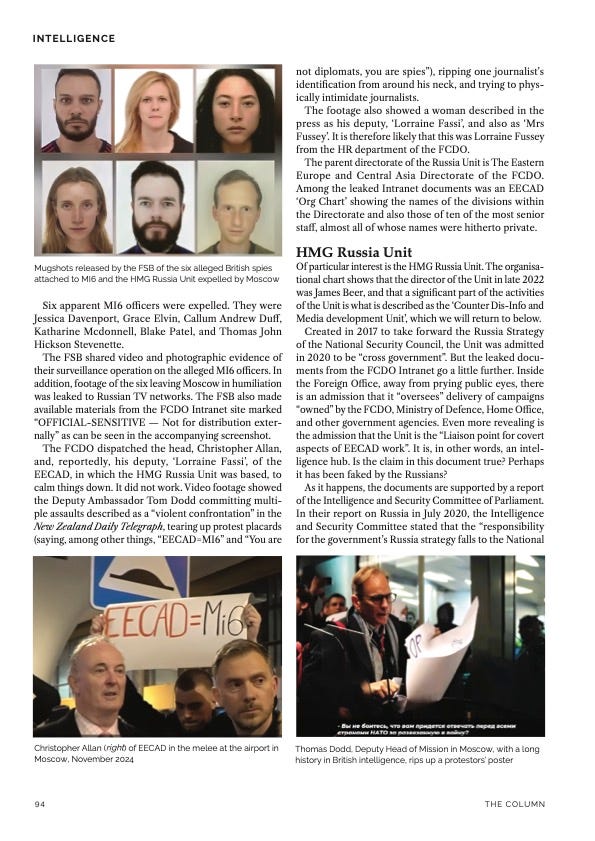
It was a body blow. Although the British media managed to entirely avoid covering the scandal, Russian media were not so obliging. They revelled in the disclosure of secret internal documents from the FCDO’s Intranet. And many of the files were published online. Even worse, surveillance footage of the six alleged MI6 officers from the covert ops section of the Foreign Office were splashed all over Russian media.
This article draws on the files to reveal what they disclose about the HMG Russia Unit as a hub overseeing British covert operations. But the value of the material is not merely in understanding the internal administrative organisation of British spy operations; it is in understanding how this organisational set up relates to all the British covert ops in the East which have surfaced over the last several years. As it turns out, this seemingly innocent publicly admitted unit in the Foreign Office has actually been in direct charge, and giving direction to, a dizzying array of British special ops including those involving human rights abuses, war crimes, and activities that British law would define as ‘terrorist’.
This article introduces a hitherto publicly admitted group in the Foreign Commonwealth and Development Office (FCDO), and reveals that its public identification is a cover for covert operations run by MI6 with the assistance of almost all other British intelligence agencies and units.
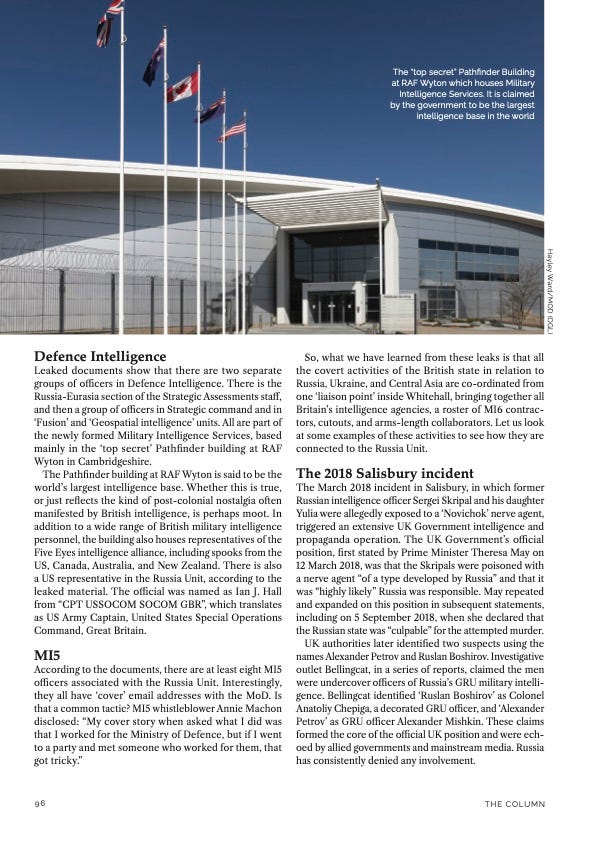
It names large numbers of those involved and traces their connections: MI5, the Joint Intelligence Organisation (of the Cabinet Office), Defence Intelligence (in the Ministry of Defence) and, of course, to MI6.
But more than that, we examine the key oversight, coordination, and indeed ‘liaison’ role played by the unit in a varied list of covert operations from at least 2014 to the present. Though the unit itself was only created in 2017, there were covert actions in relation to Russia in response to the annexation of Crimea from early 2014.
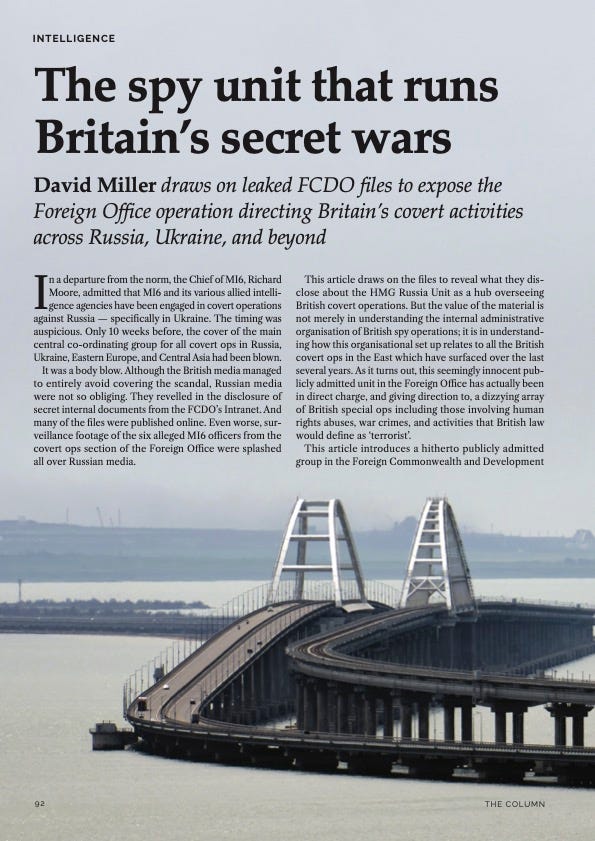
These involve, on the one hand, covert propaganda and disinformation on a massive scale, with spending in the hundreds of millions. These ops have taken place in Russia, Ukraine, and even in the UK, despite this being outside the apparent brief of the mission, leading to a major scandal in which one particular operation was closed down: the Integrity Initiative (II). This aspect of the work was overseen by a diplomat called Andy Pryce, who has denied being in MI6. Even more controversially, these also involve covert military operations including the apparent construction of a false flag massacre in Bucha, Ukraine, the bombing of the Kerch Bridge into Crimea, the Kursk Incursion, and other activities. These operations appear to have included key personnel who were also involved in the disinformation operations, including Alex Finnen of MI6, and his close collaborator Chris Donnelly, an honorary colonel in military intelligence.
In other words, the HMG Russia Unit appears to have been the ‘controlling mind’ of all these UK covert operations, misinformation, and indeed human rights abuses and war crimes. Utilising newly leaked materials from inside the FCDO and putting them together with a massive trove of previously leaked documents and internal communications between FCDO personnel, contractors, and agents, we begin to see the extent to which the intelligence services are running British foreign policy, and indeed the extent to which MI6 has a much more outsized role than many have believed.
Full article below:


Leave a Reply