Saturday, 5 September 2026 — Struggle / La Lucha
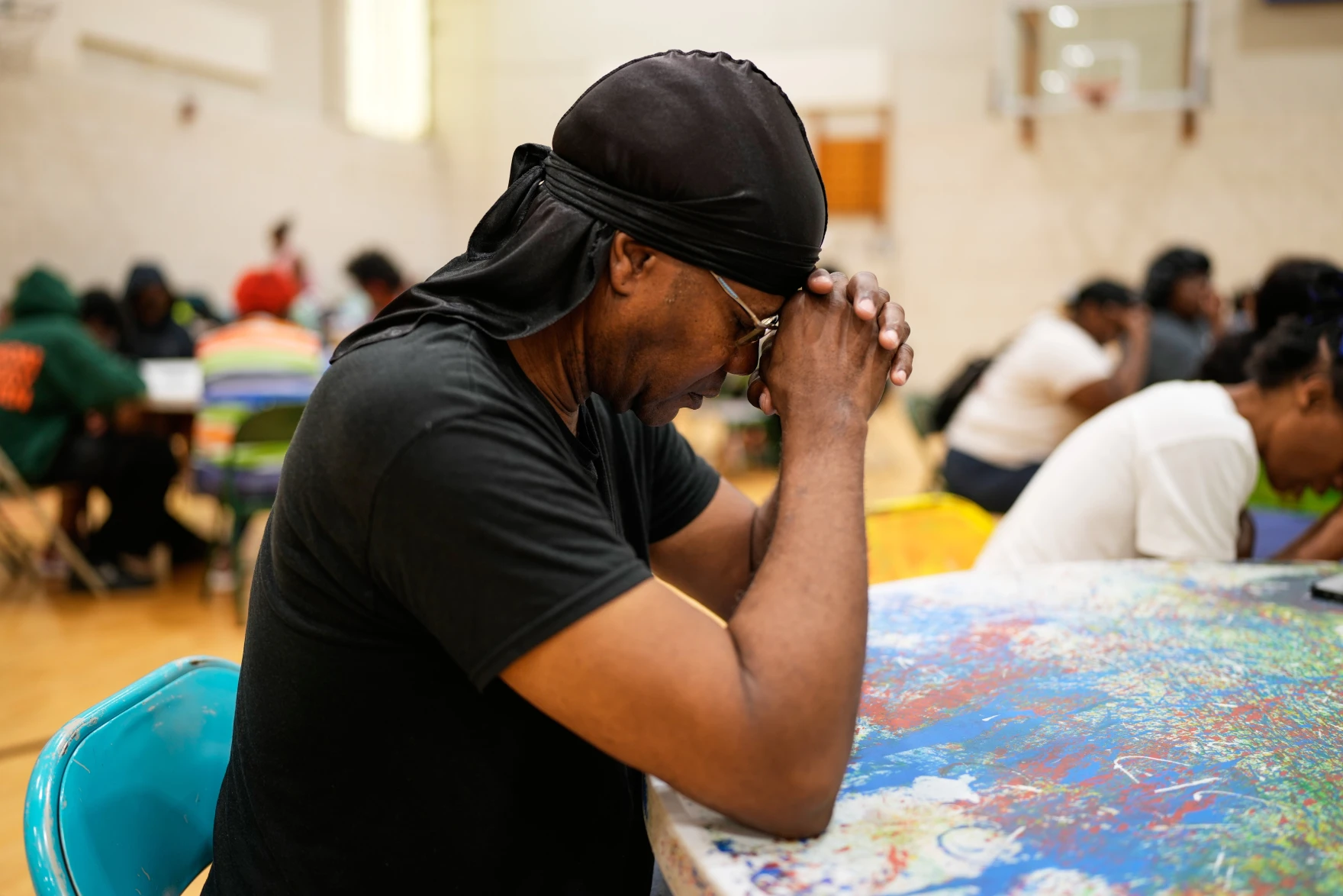
For generations, the rule for Black workers in the United States has been “last hired, first fired.” In the Black city of Gary, Indiana, it’s now “the last place where the lights came back on.”
For two weeks, thousands in the steel center were without electrical power following a powerful Aug. 11 storm called a derecho. These dangerous weather events draw their force from a warming earth. Capitalist production for profit is what is heating it.
Severe thunderstorms and 100 mph winds swept across northern Illinois and northwestern Indiana. Utility workers worked around the clock to restore power.
Yet hundreds of homes in Gary were still without electricity as of Aug. 31, according to the city’s Mayor, Eddie Melton.
That’s been a disaster for people who not only lost their lights but also any food in their refrigerators. For people who need insulin or other medicines that must be kept cold, it was a dire emergency.
Meanwhile, according to some reports, power was never shut off to nearby data centers.
NIPSCO — the Northern Indiana Public Service Company — is the monopoly responsible for this crime. The utility has the highest electric rates in the state. It’s part of NiSource, an outfit that raked in over $900 million in profits last year.
Among its biggest investors is Manhattan-based BlackRock, which has $15.5 trillion in assets under management. That’s half the amount of the United States’ Gross Domestic Product.
Yet with all that money, NiSource and its NIPSCO subsidiary don’t want to spend much of it to trim the trees that snagged electrical wires during the storm. This helped cause the extensive blackout.
Nor does it want to put more of its cables in safer underground conduits. That’s a common disease of these profit-hungry utilities.
California’s Pacific Gas and Electric is responsible for a series of deadly fires. Eighty-five people died in the 2018 Camp Fire caused by deferred maintenance. The corporate utilities need to be taken over by the people.
Biggest steel mill in the land
Founded in 1906, Gary was named after Elbert Gary, the strikebreaking chairman of United States Steel, which was founded five years before as the world’s first billion-dollar corporation. The real master of this steel trust that took over Andrew Carnegie’s mills was J.P. Morgan, the biggest bankster in the country. Today’s J.P. Morgan Chase bank has assets of $5.0 trillion.
The Gary works became the largest steel mill in the United States. (Although starting in the 1950s, Bethlehem Steel’s Sparrows Point complex outside Baltimore held that title with a capacity of more than 9 million tons. This huge plant was shut down in 2012, with two non-union Amazon facilities replacing it.)
U.S. Steel recruited workers from throughout Eastern and Southern Europe to work 12-hour days in dangerous conditions with low pay. Black people were summoned from the South as the Great Migration began. Among them was the family of Michael Jackson, whose father Joseph Jackson migrated from Arkansas and became a crane operator at the Gary Works.
When the capitalist economy slumped during a recession, thousands of workers were fired. There was no unemployment compensation. Those still on the job suffered wage cuts.
Revolting against these conditions, 365,000 steelworkers went on strike in 1919, demanding union recognition. The strike’s main organizer was future communist leader William Z. Foster.
The strike was smashed. Martial law was declared in Gary with thousands of U.S. Army soldiers occupying the city.
Even though the workers were defeated, they eventually won the eight-hour day. U.S. Steel Chair Elbert Gary was forced to abolish his beloved 12-hour workday by 1923. (“Steelworkers in America, The Nonunion Era,” by David Brody.) As Frederick Douglass declared, “If there is no struggle, there is no progress.”
After auto workers seized the General Motors plants in Flint, Michigan, in 1937— holding a 44-day-long sit-down strike — they not only won union recognition for themselves. Fearing a similar takeover by workers, U.S. Steel management signed a contract with the steel workers’ union.
That didn’t stop the steel trust from trying to break the union during long strikes in 1946, 1952 and 1959. The 1959 strike lasted 116 days.
Corporate wealth vs. Black power
The Great Migration brought more and more Black workers to Northern industry. By 1968, a quarter of all U.S. auto workers and steelworkers were Black. (“Organized Labor and the Black Worker, 1619-1981,” by Philip Foner.) Gary became a Black-majority city.
In 1967, the local Democratic political machine did everything possible to stop the Black attorney and councilperson Richard Hatcher from becoming mayor. Many of the machine’s white supporters were supporters of super-racist George Wallace.
Machine boss John Krupa didn’t even want to register any new voters. He claimed that Hatcher was a communist.
Where were the protests by Republican leaders about this attempt to steal an election? It shows how laws demanding voter ID are not about honest elections. They’re really efforts to suppress Black, Indigenous, Latine and poor people from voting.
Despite Krupa’s chicanery, Richard Hatcher was elected mayor of Gary on Nov. 7, 1967. The same day Carl Stokes was elected mayor of Cleveland.
These were the first two Black mayors of U.S. cities with populations of more than 100,000. Considering Boss Krupa’s red-baiting of Hatcher, both candidates were ironically elected on the 50th anniversary of the Bolshevik Revolution.
Blocking Black voting power
Richard Hatcher’s election jolted Indiana’s ruling class. The Black population of Indianapolis was growing. Would Indiana’s capital city follow Gary’s lead and elect a Black mayor?
The response of Indiana capitalists was to simply abolish the old city of Indianapolis. A new regional government was established on Jan. 1, 1970, that included virtually all of Marion County.
Extending Indianapolis to the suburbs was deliberately done to prevent the election of a Black mayor. The measure violated the Voting Rights Act by diluting Black voting strength.
Neither President Richard Nixon nor his former law partner and fellow Watergate conspirator, Attorney General John Mitchell, was about to intervene. To this day, Indianapolis has never had a Black mayor.
This Unigov scheme for a metro government was pushed through in 1968 and 1969, at the height of the Black liberation struggle. Richard Hatcher — who convened the National Black Political Convention in Gary in 1972 — was hated by bigots. The wealthy and powerful feared the first Black mayor of Indianapolis might be a Panther.
Smothering Indiana was the Pulliam family’s newspaper chain whose papers were favorites of John Birch Society members. The fascist cult was founded in Indianapolis in 1958.
Millionaire patriarch Eugene Pulliam built a chain with enough clout in Indiana to make his doltish grandson, Dan Quayle, a United States senator five years after his death. It was Quayle’s utter stupidity that made him so attractive to George Herbert Walker Bush as a vice-presidential running mate in 1988.
More than anything, the elder Bush needed impeachment insurance. The former CIA director feared exposure as the ringleader of Contragate, whose centerpiece was flooding crack into Black communities by the spy agency.
It wasn’t until 1965 that Indianapolis took part in the federal school program. The vote in the school board was only 4 to 3 to accept. The Indianapolis News, part of the Pulliam chain, was furious at accepting federal funds to feed hungry schoolchildren.
The resistance of Indianapolis capitalists to this minor concession wasn’t just because of their reactionary character. It was also a sign of how their rule had been unchallenged for decades.
Reaction and fightback
Indiana may be the most reactionary state in the Midwest. The Ku Klux Klan was key to electing Edward Jackson as the state’s governor in 1924.
Indiana was filled with dozens of “sundown towns” where Black people were not allowed to reside. (“Sundown Towns,” by James W. Loewen.)
At least 10 Black people were lynched in Indiana between 1890 and 1930. Sixteen-year-old James Cameron was saved at the last minute from being hanged in Marion, Indiana, on Aug. 7, 1930. His two companions, Thomas Shipp and Abram Smith, had already been murdered by the mob.
After nearly being killed, the Black teenager still had to serve four years in prison for a crime he didn’t commit. The only known survivor of a lynching, Cameron later founded the Black Holocaust Museum in Milwaukee. He died in 2006.
Indiana Gov. Evan Bayh finally gave a pardon to James Cameron in February 1993. Even in this case, there were no reparations.
Yet there’s another Indiana. Terre Haute was home to the socialist leader Eugene Debs, who led the 1894 railroad strike. Debs got nearly a million votes in 1920 running for president from Atlanta penitentiary, where he was jailed for giving an anti-war speech.
Four years before, Debs ran for Congress on the Socialist Party ticket. Revolutionaries flocked to Indiana to work on this 1916 campaign.
They included the Bolshevik Alexandra Kollontai. She became the first woman to hold the diplomatic rank of minister when appointed Soviet envoy to Norway. Kollontai became the socialist state’s ambassador to Mexico in 1926.
Around 1.5 million leaflets were distributed in the congressional district. The campaign’s last socialist parade, which was filled with red flags, stretched 15 blocks through Terre Haute
Although Debs lost, he got more votes than the Democratic incumbent. (“The Bending Cross, A Biography of Eugene Victor Debs,” by Ray Ginger.)
This socialist movement was smashed by the red-baiting campaign that followed the Bolshevik Revolution and the great strike wave in 1919. One-out-of-seven industrial workers in the United States went on strike that year. Indianapolis became the national headquarters of the American Legion, which was formed in 1919 to “fight Bolshevism” and break strikes.
Making Gary poor
The steel trust established Gary, Indiana. Decaying capitalism made it poor.
The city’s population has fallen from 175,000 in 1970 to around 67,000 now. Racists want to blame Black mayors and the Black community for Gary’s poverty.
While the Gary Works employed 30,000 steelworkers in 1970, only around 4,300 people have jobs there today. It was this massive deindustrialization that made Gary and cities across the United States poor.
Northwestern Indiana is still a center of heavy industry. Refinery workers in nearby Whiting, Indiana — the same Lake County as Gary — have been locked out by the oil giant BP since March 19.
More than 800 members of United Steelworkers Local 7-1 were shut out of the largest inland refinery in North America after refusing company demands to cut over 100 union jobs, take pay cuts and give up bargaining rights. It is BP’s last unionized refinery in the United States. The company is running the plant with contractors. BP reported $7.5 billion in profits last year. It got its start in 1909 by ripping off Iran’s oil wealth.
The more than two weeks that people in Gary were locked out of electrical power is just as deliberate. All these corporate assaults are building a deep anger among millions of poor and working people. An upsurge of resistance is coming.
Join the Struggle-La Lucha Telegram channel


Leave a Reply